2026年TOEFL口說Band 6的意義
2026年TOEFL將口說部分的成績以1到6分的單一分段呈現。這個總體分段反映了你在Listen and Repeat與Take an Interview這兩種口說題型上的綜合表現。每種題型皆依各自的標準單獨評分。
Listen and Repeat
依複述準確度與可理解度評分。Band 6的表現代表你能精準重現句子,發音清楚且自然流暢。
Take an Interview
依切題性、論述展開、流暢度、詞彙、文法及發音評分。Band 6的表現代表回答完全切題、論述充分,並以自然的口語方式表達。
Important: the official ETS TOEFL Speaking page and the ETS scoring documentation describe the dimensions evaluated for each task but do not publish the exact formula that converts task-level scores to the 1–6 section reporting band. What is clear is that consistent high performance across both task types — accuracy in Listen and Repeat, and communicative effectiveness in the Interview — is required for the highest section score.
For the full explanation of how TOEFL 2026 scores are calculated, see the 完整的2026年評分指南.
Listen and Repeat:邁向Band 6之路
The Listen and Repeat task plays a spoken sentence. Your task is to repeat it back as accurately and clearly as possible. The two core scoring dimensions are repetition accuracy and intelligibility — see the Listen and Repeat strategies guide for drill techniques.
複述準確度
準確覆述句子的用字、語序與含義。替換、遺漏或調換詞語——即使聽起來自然——都會降低你的分數。原句中的每一個字都很重要。Band 6答案幾乎能完美保留原句。
可理解度
你的發音必須夠清楚,讓所說的內容能立即被理解。非母語口音不會被扣分,但造成詞語難以辨識的發音錯誤會降低你的分數。全程維持一致的清晰度,才能拿到最高分段。
連貫的表達
Band 6答案以連貫、自然的語句呈現——而非逐字停頓。表達斷斷續續、每個字都被打斷,代表難以在記憶中保留整句話,也意味著口說流暢度較低。
關鍵練習習慣
錄下你的Listen and Repeat答案,直接與原始音檔比對。訓練耳朵去捕捉替換、遺漏詞語和發音上的落差。跟讀(shadowing)母語者音檔,是針對這項題型最有效的單一練習方式。
Take an Interview:邁向Band 6之路
The Interview task asks you to respond spontaneously to a question. Band 6 performance requires strong marks across six dimensions evaluated simultaneously. For an adaptable response framework, see the Speaking Interview Template.
直接切題
你的回答必須精準回應所提出的問題。無論表達多麼流暢,含糊或偏題的回答都會被扣分。表明清楚的立場並堅持下去。
連貫的展開
用至少一個具體理由、例子或細節來支持你的立場。Band 6答案不會止步於一句表態——而是以易於理解的方式展開這個想法。
自然的流暢度
表達應連續流暢,停頓極少。偶爾為了思考而出現的自然停頓是正常的,但頻繁使用填詞、長時間沉默或重新開始的句子,都顯示口說表達上的困難。
自然的發音與語調
Band 6答案使用自然的重音模式與語調——不只是可理解的發音,更是聽起來具有溝通效果的表達。即使每個音都發得清楚,單調平板的表達仍可能拉低這項分數。
精準的詞彙
使用多元且切合主題的詞彙。依賴少量基礎詞彙或過於籠統的表達,會顯示詞彙量有限。Band 6答案展現出用恰當詞語表達細膩想法的能力。
文法掌控
在Band 6程度,出現小的文法錯誤是正常且可接受的。不可接受的是反覆出現的結構性錯誤,這類錯誤會影響意思表達,或顯示對句子結構掌握不足。
Band 6評分標準詳解
下表整理了兩種口說題型在Band 6程度上的表現特徵。
| 評分面向 | Listen and Repeat | Take an Interview |
|---|---|---|
| 準確度 / 切題性 | 用字幾乎完全一致,所有字詞均保留 | 回答直接針對問題 |
| 可理解度 / 發音 | 全程清楚易懂 | 始終保持清晰,語調自然 |
| 表達方式 | 流暢、連貫的語句表達 | 自然流暢,停頓極少 |
| 論述展開 | 不適用(此題型僅為覆述) | 具體理由或例子獲得清楚展開 |
| 詞彙 / 文法 | 不適用(此題型僅為覆述) | 詞彙多元,文法掌控得當 |
Band 6答案長什麼樣子
了解Band 6答案的特徵,有助於校準你自己的表現。以下是每種題型中優異表現的樣貌。
- ✓以完全或幾乎完全一致的用字覆述句子
- ✓將句子當作一個連貫整體表達出來,而非逐字停頓
- ✓全程保持清晰——每個字都容易辨識
- ✓控制語速與音量以便於理解
- ✓沒有替換、遺漏或調換順序的字詞
- ✓以清楚、直接的回答開場,準確回應所提出的具體問題
- ✓接著至少提出一個具體且邏輯連貫的理由或例子
- ✓以自然流暢的句子表達,沒有長時間停頓或重新開始
- ✓使用切合主題的詞彙,重音與語調自然
- ✓全程文法錯誤輕微,且不影響意思表達
考生為何無法拿到最高分段
了解考生未能達到Band 6的最常見原因,有助於你發現並改善自己回答中的不足之處。
替換或遺漏詞語(Listen and Repeat)
最常見的準確度錯誤。哪怕只替換或遺漏一個字,也會降低該題的分數。訓練自己在開口前,先將整句話記在工作記憶中。
逐字停頓式表達(Listen and Repeat)
把句子當成一串互不相連的字詞來覆述,代表記憶分塊能力較弱、口說流暢度有限。練習把完整句子一氣呵成地表達出來。
含糊或偏題的回答(Interview)
回答一個相關但不同的問題,或給出一個沒有直接回應題目的籠統陳述,是Interview中代價最高的錯誤之一。
缺乏佐證的觀點(Interview)
僅表明喜好或觀點卻就此打住,不足以拿到Band 6。每個Interview答案都需要至少一個清楚、具體的佐證細節。
影響理解的發音錯誤
持續唸錯高頻詞會降低兩種題型的可理解度。口音不會被扣分——但清晰度不足會。
單調的表達(Interview)
即使每個字都發音正確,平板、機械般的語調仍會削弱語調這項評分標準。自然的英語口說在音高、重音與節奏上都富有變化。
Band 6備考策略
有效的Band 6備考應分別針對每種題型的特性。以下是持續練習應包含的內容。
每日跟讀練習
跟讀母語者音檔,在聽完後立即覆述句子。從8–10個單字的句子開始,逐步增加長度。這能同時訓練記憶容量與口說流暢度。
比對與落差分析
錄下自己的覆述並與原始音檔比對,找出替換、遺漏詞語和發音差異,每週持續追蹤自己的落差。
針對常見問題音專項練習
找出自己經常唸錯的英語音素,單獨練習,之後再重新融入完整句子的練習中。
使用結構化的回答架構
練習一套可靠的三段式格式:直接回答 → 具體理由 → 簡短展開。這能讓你的回答在時間壓力下仍保持條理,而不必依賴背誦的講稿。
限時回答練習
設定計時器,在目標時間內回答TOEFL Interview風格的問題。穩定的節奏有助於減少正式考試時的猶豫。
依主題分類累積詞彙
依TOEFL Interview常見主題——教育、科技、環境、個人經驗、偏好——分類學習詞彙,並練習在口說句子中自然運用每一類詞彙。
錄音並自我評估
用Band 6標準回聽自己的答案:是否切題?是否展開充分?表達是否自然?文法是否得當?每次練習找出一個不足之處,並於隔天有針對性地改進。
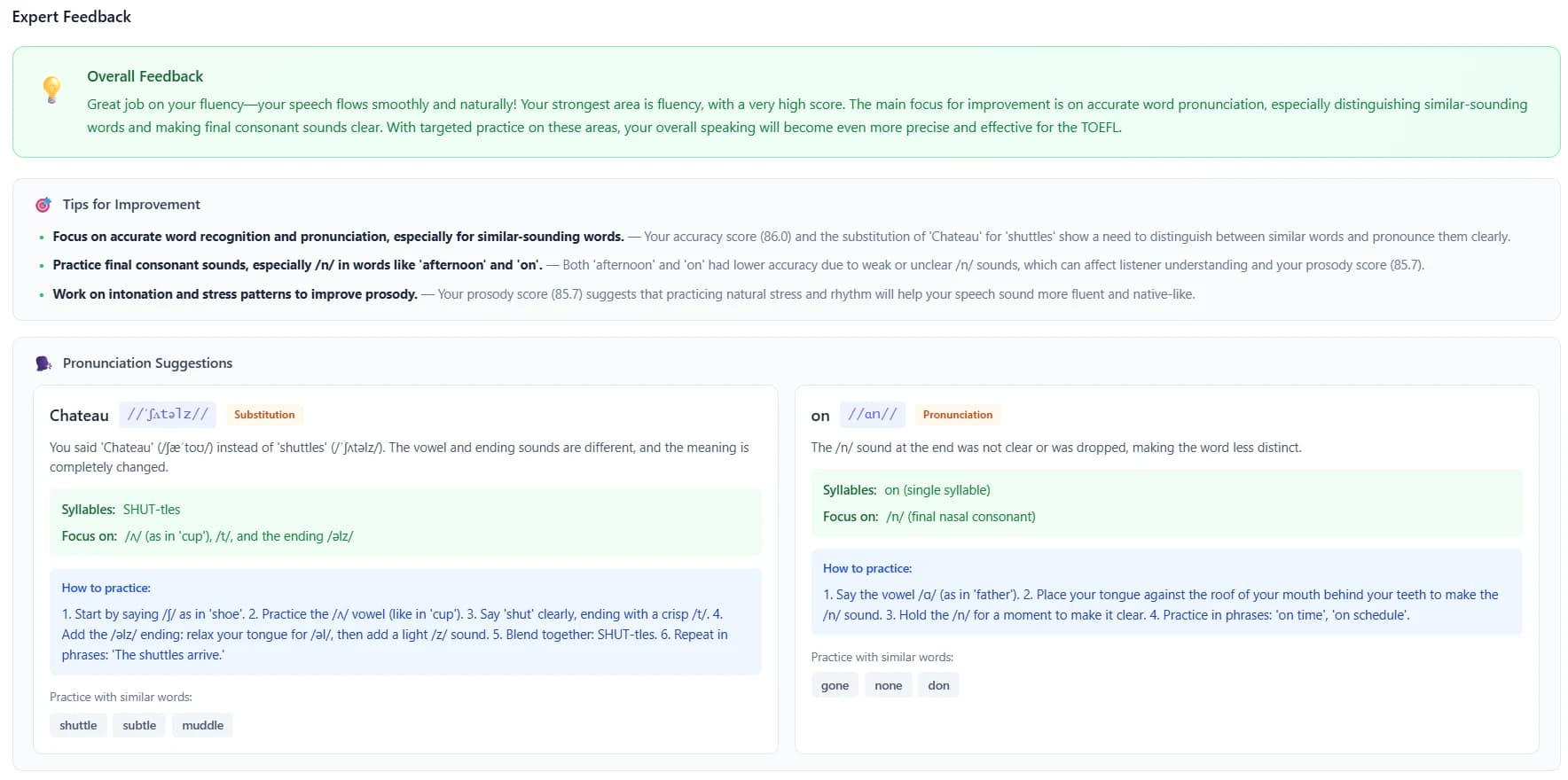
LingoLeap's TOEFL Speaking practice environment covers both Listen and Repeat and Interview tasks. Your responses are evaluated using scoring criteria that reflect what the rubric rewards, giving you actionable feedback on each session.
常見問題
2026年TOEFL口說的最高分是多少?⌄
The highest Speaking section score is Band 6 on the TOEFL 2026 1–6 scale. This corresponds to approximately a 27–30 score on the old 0–30 per-section scale and reflects consistently strong performance across both Listen and Repeat and Take an Interview tasks. For mappings between bands and the legacy 0–120 / IELTS / CEFR scales, see the TOEFL Score Converter.
對於口說高分而言,Listen and Repeat和Interview哪個比較重要?⌄
Both task types contribute to your Speaking section score, and consistently strong performance in both is needed to reach Band 6. The Take an Interview task is evaluated on more dimensions (relevance, elaboration, vocabulary, grammar, fluency, pronunciation), which makes it a higher-stakes area for most test-takers. However, accuracy errors in Listen and Repeat are easy to avoid with targeted practice and should not be a weak point — see the Listen and Repeat strategies guide.
如果我的口音較重,還能拿到Band 6嗎?⌄
Yes. TOEFL Speaking scoring does not penalize for a non-native accent. What matters is intelligibility — whether what you say can be clearly understood — and naturalness of intonation. You do not need to sound like a native speaker; you need to speak clearly and naturally. Many test-takers with strong accents achieve Band 6 by prioritizing clarity and correct stress patterns. See the official ETS TOEFL Speaking criteria for the full description.
我的Interview回答應該多長?⌄
TOEFL Interview responses are not measured by length alone, but Band 6 responses generally include a clear answer and sufficient elaboration. In practice, this typically means 3–5 sentences delivered naturally within the available response time. A response that is too short suggests a lack of elaboration; a response that rushes through content without development is also insufficient. For a structured response framework you can practice with, see the Speaking Interview Template.
為了拿到Band 6,我應該背誦口說範本嗎?⌄
No. Memorized templates are detectable and can actually lower your score if they make your response sound formulaic or if the template does not fit the specific question. What helps is having a reliable response structure (answer → reason → detail) that you internalize, not memorize. The content of every response should be original and specific to the prompt — see the Speaking Templates collection for adaptable frameworks rather than fixed scripts.
相關指南
About this guide
Written by Erin (LingoLeap Content & SEO Specialist) and reviewed by the LingoLeap TOEFL Content Team — preparation specialists who analyse ETS official scoring rubrics, test-taker performance data, and examiner feedback reports to produce accurate, rubric-aligned TOEFL 2026 content. All scoring criteria referenced in this guide are derived from ETS published materials. Last reviewed April 30, 2026.