TOEFL Reading · 2026 Guide
TOEFL Complete the Words: Format, Examples, and Strategies
The updated TOEFL iBT Reading section introduces a task many test takers find unfamiliar: Complete the Words. This guide explains how the task works, what makes it different from standard cloze exercises, and how to prepare effectively.
By Helen · TOEFL prep lead, LingoLeap··9-minute read
Fact-checked against the ETS TOEFL iBT Technical Manual (January 2026) and the Official Guide (Pocket Edition).
What is TOEFL Complete the Words?
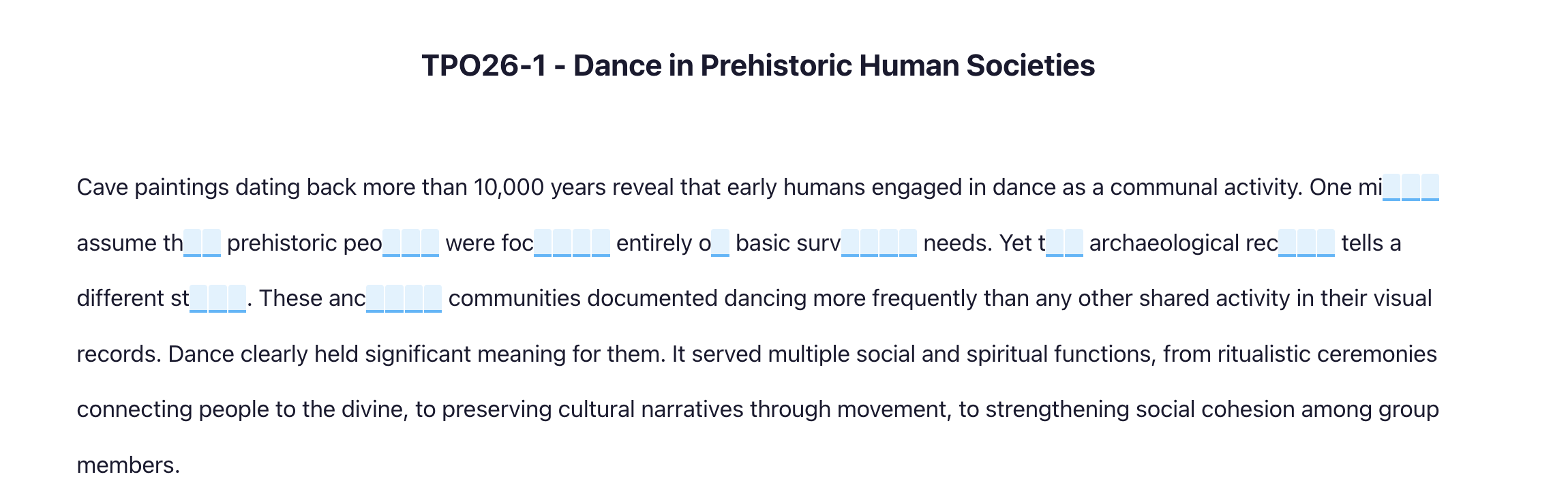
TOEFL Complete the Words is a reading task based on the C-test format. Test takers read a short paragraph (70–100 words) where 10 words have their second half removed. The first sentence stays intact, and students restore the missing letters using grammar and context clues. The deletion pattern follows a fixed rule rather than manual blank selection.
What Is TOEFL Complete the Words?
According to official ETS TOEFL materials, the TOEFL Reading section includes a task called Complete the Words. Students read a short academic-style paragraph where several words appear partially truncated. The goal is to restore the missing letters and reconstruct the original words.
This task is designed for all TOEFL test takers, regardless of proficiency level. It appears alongside other new TOEFL reading question types in the 2026 exam format. For a broader overview of all Reading tasks, see the TOEFL Reading overview or the Reading question types guide.
Skills tested
- Vocabulary knowledge and word recognition
- Grammar awareness (tense, agreement, word forms)
- Word formation and morphology
- Contextual understanding across sentences
TOEFL Complete the Words Format
According to the ETS TOEFL iBT Technical Manual, each Complete the Words item follows a standardized format. Here is a summary of the key parameters:
| Parameter | Detail |
|---|---|
| Section | TOEFL iBT Reading |
| Task type | C-test (Complete the Words) |
| Passage length | 70–100 words |
| Number of truncated words | 10 |
| Skills tested | Vocabulary, grammar, word formation, context |
| Best solving approach | Read for overall meaning, then use grammar and context clues to restore each word |
How the Task Works
Many students assume blanks are chosen by test writers. However, the TOEFL Complete the Words task uses a C-test deletion algorithm to generate the truncated words. Understanding this pattern helps you predict where blanks appear and solve them faster.
Rule 1: The first sentence is intact
The paragraph begins with a complete sentence that provides context before any truncated words appear.
“"A calendar is a system for organizing time into units such as days and months."”
Rule 2: Every second word is partially deleted
Starting from the second sentence, the passage follows an alternating pattern. Only the second half of each targeted word is removed.
| Word position | Action |
|---|---|
| 1st word | Kept intact |
| 2nd word | Second half removed |
| 3rd word | Kept intact |
| 4th word | Second half removed |
The deletion rule is mechanical and position-based. Even very short words can be truncated if they fall in the target position. See the full example below.
Illustrative Example: How Complete the Words Looks
The passage below is an illustrative example constructed to demonstrate the official C-test rule — it is not a released ETS item. It shows the original text, the truncated test version, and why each answer is correct.
1. Original passage
A calendar is a system for organizing time into units such as days and months. Early calendars often used observations of the Moon because its phases repeat in a regular cycle.
2. Test version (truncated)
A calendar is a system for organizing time into units such as days and months.
Early calen_____ often used obser_____ of the Moon because its pha_____ repeat in a regu_____ cycle.
3. Correct answers with explanation
calen_____
calendars
Plural noun matching 'Early ___ often used...'
obser_____
observations
Noun form required after 'used'; context = Moon
pha_____
phases
Plural noun; 'phases repeat' fits grammatically
regu_____
regular
Adjective modifying 'cycle'; context = repeating
Why Some Practice Questions Look Different
Students sometimes notice that practice materials found online do not follow the same pattern as the real TOEFL. There are several reasons — and recognizing them helps you choose better study resources.
Manual blank selection
Some materials insert blanks manually rather than using the C-test deletion rule. This turns the exercise into a traditional cloze test, which does not reflect the TOEFL design.
Blanks concentrated in one sentence
Official C-tests distribute truncated words across the paragraph. If most blanks appear in a single sentence, the item likely does not follow the authentic pattern.
No short-word truncations
The ETS documentation does not specify a minimum word length. Authentic materials may include very short truncated forms (e.g., "i_" → "is") because the rule is mechanical and position-based.
When choosing TOEFL practice tests, look for materials that follow the C-test structure: intact first sentence, alternating deletions, and 10 truncated words across the passage. TOEFL practice tests, look for materials that follow the C-test structure: intact first sentence, alternating deletions, and 10 truncated words across the passage.
Strategies to Solve Complete the Words Faster
These TOEFL reading strategies will help you approach Complete the Words questions with more speed and confidence.
Read the entire paragraph first
Understand the overall topic before attempting any blanks. The first intact sentence provides critical context that narrows down possible answers.
Use grammar clues
Look for signals such as plural markers (-s), verb tenses (-ed, -ing), and adjective forms (-al, -ful). Example: 'season_____ tasks' → 'seasonal' (adjective form).
Confirm meaning in context
Always check that your restored word fits both the grammar and the meaning of the sentence. A word that is grammatically correct but semantically wrong will cost you points.
Work through the passage in order
Earlier answers often provide context clues for later ones. Solving blanks sequentially builds a clearer picture of the passage's meaning.
Watch for word families
If you recognize the word root, think about common derivations: observe → observation, observations; regulate → regular, regulation. This speeds up restoration significantly.
Skip and return
If a word is difficult, move on. Completing easier blanks often reveals enough context to solve the harder ones when you come back.
Practice Complete the Words Questions
Build speed and accuracy with realistic C-test exercises. LingoLeap follows the officially described deletion rule so every practice passage matches real TOEFL design.
Practice Complete the WordsCommon Mistakes in TOEFL Complete the Words
Even well-prepared students fall into these traps. Knowing them in advance gives you an edge on test day.
Ignoring the first sentence
The intact first sentence sets the topic. Skipping it means you lose your strongest context clue.
Guessing without checking grammar
A word might seem right by meaning but be the wrong form. Always verify tense, number, and part of speech — "observe" vs. "observations."
Assuming blanks are random
The deletion pattern is systematic. Once you recognize the alternating rule, you can anticipate which words are affected.
Spending too long on one blank
Move forward and return. Later context often reveals earlier answers, and time management matters in the TOEFL Reading section.
Practicing with non-authentic materials
If your practice tests use random blank placement or full-word deletions, they are training a different skill. Use materials that follow the C-test format.
How to Practice TOEFL Complete the Words Effectively
Building a consistent practice routine is the fastest way to improve. Here is a practical approach:
Timed practice
Set a timer when solving Complete the Words passages. Aim to finish each 10-blank paragraph within 3–4 minutes, simulating real test pacing.
Context clue analysis
After each practice passage, review which context clues helped you — and which you missed. Train yourself to spot grammatical signals and semantic patterns faster.
Vocabulary building
Expand your academic vocabulary by reading articles on science, history, and social topics. Pay attention to word families and common suffixes like -tion, -ment, -ous, -ive.
Grammar review
Brush up on verb tenses, subject-verb agreement, and word formation rules. These are the grammar patterns that appear most often in Complete the Words tasks.
Use authentic materials
Choose practice resources that follow the C-test deletion rule — intact first sentence, alternating word deletions, and 10 truncated words per passage.
LingoLeap offers Complete the Words exercises that follow the officially described task design, with instant AI-powered feedback to help you identify patterns and improve faster.
Ready for the Full TOEFL Experience?
Take a complete TOEFL 2026 mock test with AI-powered scoring, detailed explanations, and coverage of every new question type — including Complete the Words.
Try a Full TOEFL Mock TestFrequently Asked Questions
Is TOEFL Complete the Words a cloze test?
How many blanks appear in a Complete the Words passage?
How long is the Complete the Words paragraph?
Why does TOEFL use the C-test format?
Can very short words be truncated in Complete the Words?
How should I practice for Complete the Words?
Related TOEFL Reading Guides
Continue preparing for the new TOEFL with these resources:
Related guides
TOEFL Reading Overview
Everything you need to know about the updated TOEFL Reading section, including timing, scoring, and question types.
Read guide → →TOEFL Reading: Academic Passage
Learn how to approach academic-style passages in the TOEFL Reading section with strategies and examples.
Read guide → →TOEFL Reading: Daily Life Passage
Understand the new daily-life passage type and how it differs from traditional TOEFL academic texts.
Read guide → →Next practice steps
Complete the Words Practice
Drill the C-test format with realistic passages and instant feedback.
Start practicing →TOEFL Reading Practice
Practice all new reading question types in one place.
Start practicing →TOEFL Full Mock Test
Simulate the full 2026 TOEFL exam with AI-powered scoring.
Take mock test →Explore Other TOEFL Sections
TOEFL Mock Test
Simulate the real test with timed, section-by-section practice.
Speaking Interview Topics
Explore 6 topic categories with 32+ practice questions.
Writing Email Topics
Practice the 5 most common email scenarios on the TOEFL.
Writing Discussion Topics
Master the 5 core discussion themes for TOEFL Writing.
Sources
Facts on this page are verified against official ETS documentation:
- TOEFL iBT Technical Manual (January 2026)
- The Official Guide to the TOEFL iBT Test, Pocket Edition
- ETS TOEFL iBT test format and scoring
- Klein-Braley, C. & Raatz, U. (1984). A survey of research on the C-Test. Language Testing, 1(2), 134–146.