Overview of Major Changes
TOEFL 2026 is not just a minor update. ETS redesigned the test structure, introduced new task types in every section, changed the scoring system, and added adaptive testing to two sections. Here are the headline changes:
Shorter test
~1 hr 23–29 min of section time instead of ~2 hours
New scoring scale
1-6 per section replaces 0-30
Adaptive sections
Reading and Listening now use a two-stage adaptive structure (router + lower/upper module), per the April 2026 ETS Blueprint
New task types
6 new task types introduced across all 4 sections
Redesigned Speaking
Listen and Repeat replaces integrated speaking tasks
New Writing tasks
Build a Sentence and Write an Email added
These changes reflect ETS's first major redesign of the TOEFL iBT since 2019, confirmed in the official ETS TOEFL iBT test information. Every section was rebuilt around shorter, more functional tasks.
Side-by-Side Comparison
The table below compares the old TOEFL format with TOEFL 2026 across every major dimension.
| Feature | Old TOEFL | TOEFL 2026 |
|---|---|---|
| Section time | ~2 hours | ~1 hr 23–29 min |
| Section scores | 0–30 each | 1–6 each |
| Adaptive testing | None | Reading & Listening |
| Reading tasks | Academic passages only | Complete the Words, Daily Life, Academic Passage |
| Listening tasks | Conversations & lectures | + Choose a Response, Announcement |
| Writing tasks | Integrated + Academic Discussion | Build a Sentence, Write an Email, Academic Discussion |
| Speaking tasks | 4 tasks (independent + integrated) | Listen & Repeat (7) + Interview (4) |
| Reading time | 35 min | ~27–30 min |
| Speaking time | 16 min | ~8 min |
Reading: What Changed
In the format used until 21 January 2026, TOEFL Reading consisted only of academic passages: 20 questions in 35 minutes, delivered in a linear (non-adaptive) format.
TOEFL 2026 Reading is now adaptive and runs about 27–30 minutes: a router module of about 18–21 minutes, then a lower or upper module of about 9 minutes. It adds two new task types alongside the retained Academic Passage format:
- Complete the Words — vocabulary-in-context fill-in tasks
- Read in Daily Life — short practical texts
- Read an Academic Passage — retained academic reading, in passages of about 200 words
The shift to adaptive testing means the second-stage module (lower or upper) is selected based on router-module performance. The April 2026 ETS blueprint confirms this structure but has not publicly disclosed the routing thresholds or the exact scoring algorithm. Practically: maintain consistent accuracy across the section — the strategic emphasis shifts compared with the flat-difficulty old format.
Listening: What Changed
In the format used until 21 January 2026, TOEFL Listening included conversations and academic lectures with 5–6 questions each: 28 questions in 36 minutes. TOEFL 2026 Listening runs about 25–29 minutes and adds two new task types:
- Choose a Response — new functional listening task
- Announcement — new short-monologue format
Conversations and Academic Talk (lecture) tasks are retained. Like Reading, Listening is now adaptive.
To understand what actually changed, look at the old Listening section concretely. It presented conversations of about 3 minutes each — a student speaking with a professor, adviser, or service representative — followed by 5 questions per conversation. Then came academic lectures of 3–5 minutes, some with brief student interaction, others pure monologue, each followed by 6 questions. Question types spanned gist-content, gist-purpose, detail, function, attitude, organization, and connecting-content. The audio never repeated, so note-taking discipline was decisive. In the format used until 21 January 2026, the section had 28 questions in 36 minutes.
TOEFL 2026 Listening cuts the section to about 25–29 minutes (router ~18 min + lower module 7 min or upper module 11 min) and introduces two new task types with distinct rhythms. Choose a Response presents a brief dialogue — typically two to four exchanges — and asks you to pick the most natural next reply from four options; it is a pragmatic listening check that rewards everyday conversational intuition over academic vocabulary. Announcement delivers a short monologue such as a campus bulletin, library closure notice, or museum tour intro, then asks targeted comprehension questions about stated facts and implied constraints. Conversations and Academic Talk are retained but trimmed. The section is now adaptive: a router module followed by either a lower or upper module. The blueprint confirms the structure but does not disclose how router and module responses combine into the final band, so the most defensible focus is consistent accuracy throughout — especially in the router.
Writing: What Changed
In the format used until 21 January 2026, TOEFL Writing had two tasks: an integrated task (read-listen-write) and Writing for an Academic Discussion, which replaced the independent opinion essay in mid-2023. The section ran about 29 minutes.
TOEFL 2026 Writing runs about 23 minutes and replaces the old tasks with three distinct formats:
- Build a Sentence — new sentence-construction task
- Write an Email — new functional writing task
- Academic Discussion — retained and updated
Writing remains linear. The old integrated task, which required synthesizing a reading passage and a lecture, has been removed.
To see what actually changed, consider the old Writing section in detail. The old Integrated Writing task gave you a 3-minute reading passage of roughly 230–300 words, followed by a 2-minute academic lecture that contradicted, extended, or cast doubt on the passage. You then had 20 minutes to produce a 150–225 word response synthesizing both sources — almost always opposing them — with a predictable structure. The second task, Writing for an Academic Discussion (updated from the older Independent essay in mid-2023), asked you to contribute to a classroom discussion thread with at least 100 words in 10 minutes. Well-prepared test-takers leaned heavily on memorized transition phrases and paragraph scaffolds.
TOEFL 2026 reorganises Writing around three smaller functional tasks that leave less room for templated output. Build a Sentence gives you target sentence material and asks you to form a single grammatically correct, context-appropriate sentence — a focused grammar and collocation check, machine-scored against predefined answers (10 items). Write an Email presents a practical scenario (returning an item, requesting an extension, confirming an appointment) with key details you must incorporate. Writing for an Academic Discussion is retained. The April 2026 ETS blueprint explicitly labels both Write an Email and Write for an Academic Discussion as AI-scored, with the model evaluating qualities such as fluency, coherence, grammar, and communication effectiveness. The total section runs about 23 minutes, down from about 29. Short-form precision and clear communication now matter more than essay-length development.
Speaking: What Changed
The Speaking section changed the most dramatically of any section. The format used until 21 January 2026 had 4 tasks — one independent task and integrated tasks requiring reading or listening first — running 16 minutes.
TOEFL 2026 Speaking runs approximately 8 minutes and has two task types:
- Listen and Repeat — entirely new; 7 items requiring sentence repetition
- Take an Interview — 4 open-ended conversational questions
Both task types follow the specifications laid out in the ETS TOEFL iBT Speaking section overview.
There are no integrated speaking tasks in TOEFL 2026. The independent interview format replaces the old independent task, and Listen and Repeat is a completely new skill assessment. Preparation strategies from the old TOEFL Speaking section do not transfer directly.
To understand what changed, it helps to look at the old tasks concretely. The old Speaking section followed a fixed four-task template. Task 1 was the Independent — 15 seconds of prep, 45 seconds of response to a personal-opinion prompt. Task 2 was a campus situation integrated task: read a 75–100 word announcement, listen to a student reaction, then summarize in 60 seconds. Tasks 3 and 4 were integrated responses built on academic material — a short reading, a professor's lecture, or both — again requiring a 60-second response. Template-based preparation dominated because prompt structures repeated across test dates.
TOEFL 2026 Speaking removes all four of those tasks and replaces them with a different skill profile. Listen and Repeat presents 7 short audio items — typically a single sentence or brief exchange, such as a museum guide announcing exhibit hours or a student confirming a meeting — and asks you to repeat the utterance verbatim. Per the April 2026 ETS blueprint, Listen and Repeat is machine-scored against predefined answers, focusing on pronunciation accuracy and listening precision. Take an Interview then asks 4 open-ended questions about familiar topics (study habits, travel, research interests) with roughly 10 seconds of prep and about 45 seconds of response each. The blueprint identifies Take an Interview as AI-scored, with the model evaluating fluency, coherence, grammar, vocabulary, and communication effectiveness. Pre-memorised templates offer little advantage; the test now measures spontaneous production and listening precision.
What the new TOEFL 2026 tasks actually look like
Below is how each new 2026 task appears in LingoLeap's practice environment. These screens mirror the official ETS interface so you can see exactly what to expect on test day. Each task also includes a real ETS sample question so you can see the format up close.
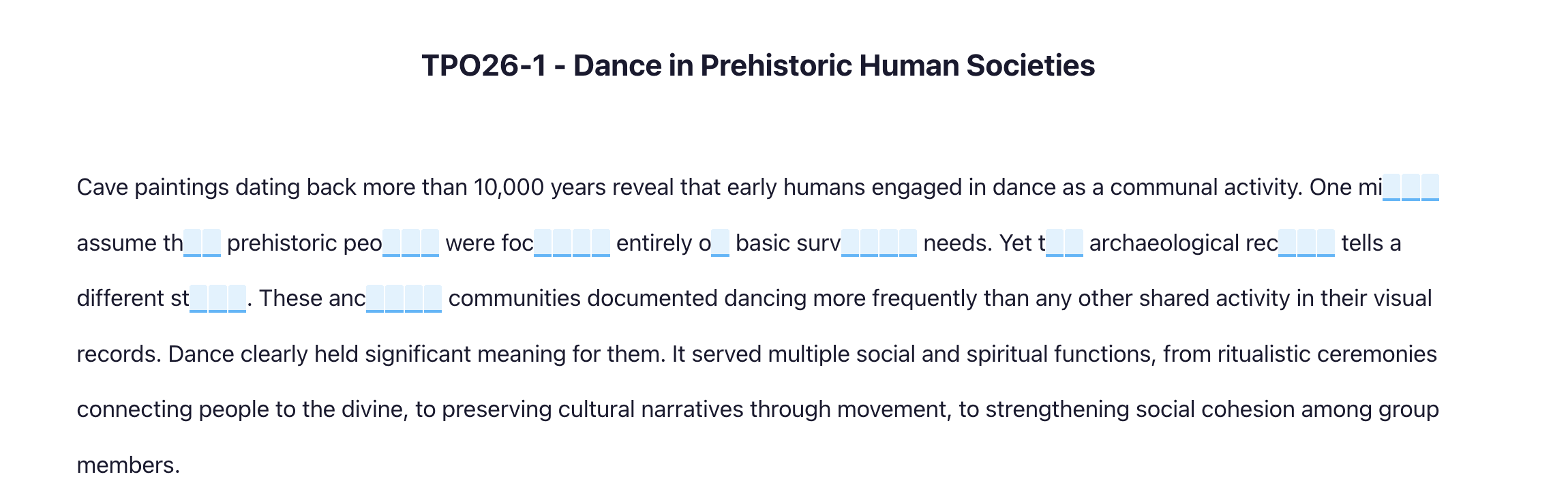
Complete the Words · Reading
A short factual passage (about 70–100 words) in which the second half of 10 words has been removed — you type the missing letters to restore each word, with no bank of options to choose from. This replaces part of the old long-passage comprehension workload with focused lexical accuracy.
Real ETS sample question
Fill in the missing letters in the paragraph.
Maps are tools that help us understand the world around us. They sh___ the loca______ of pla____ like cit____, rivers, a__ mountains. Th____ visual gu____ can al__ display different ty___ of infor______, such as climate or population. There are many kinds of maps, including physical, political, and thematic versions. The study of maps and cartography, the process by which they are made, can teach us about the geography of our planet and how people live in different regions.
Target words: show · locations · places · cities · and · These · guides · also · types · information
Source: The Official Guide to the TOEFL iBT® Test, Pocket Edition (ETS, 2025) and TOEFL iBT® Technical Manual (ETS Research Report RR-25-12, 2025).
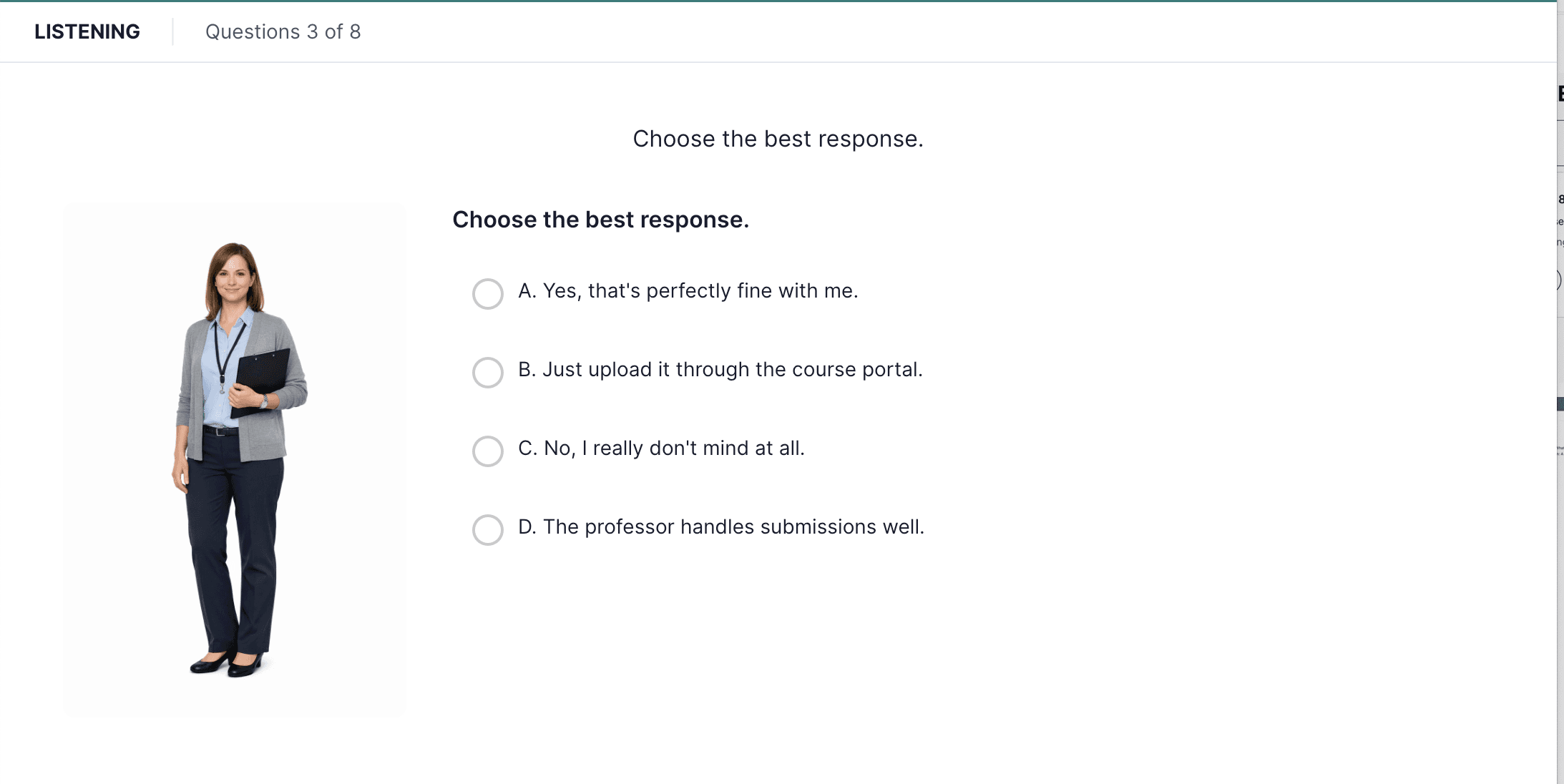
Choose a Response · Listening
Listen to a short dialogue, then pick the most appropriate next reply from four options. This is a functional listening check that did not exist in the old TOEFL.
Real ETS sample question
You hear: “Didn't I just see you in the library an hour ago?”
Choose the best response:
- The lighter one is over there.
- There's a switch on the back wall.
- The side door is open.
- I prefer to work at home.
Source: The Official Guide to the TOEFL iBT® Test, Pocket Edition (ETS, 2025) and TOEFL iBT® Technical Manual (ETS Research Report RR-25-12, 2025).
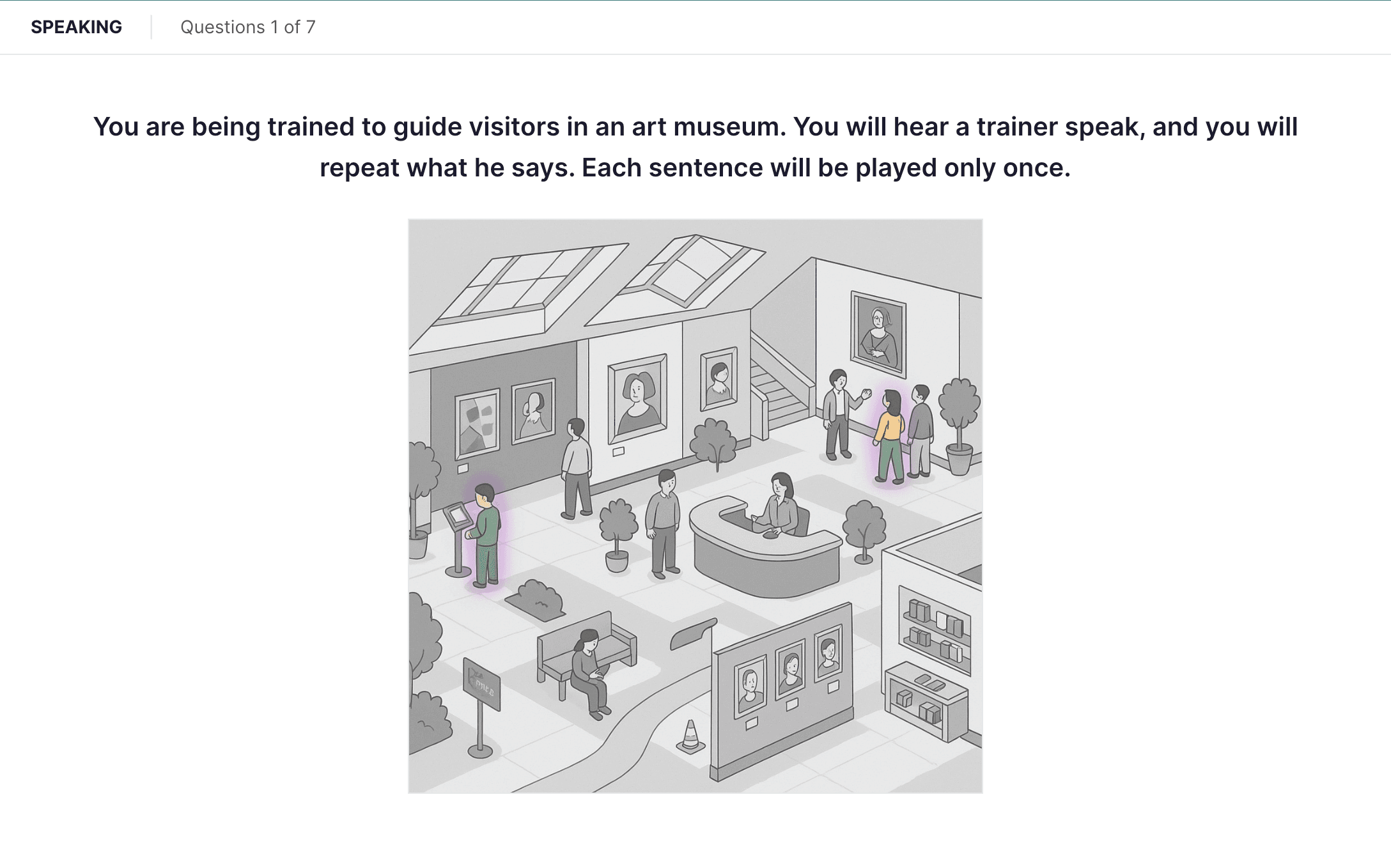
Listen and Repeat · Speaking
Hear a short sentence and repeat it verbatim. Scoring targets pronunciation and phonological accuracy — a completely new task category with no old-TOEFL equivalent.
Real ETS sample question
Scenario: Campus gym orientation. After each sentence, repeat exactly what you heard. Sentences get longer and more complex as you progress.
- “Welcome to our campus gym.”
- “Cardio machines are near the entrance.”
- “Free weights are in the back.”
- “All of our locker rooms are equipped with showers and towels.”
- “Our fitness instructors hold exercise classes over here.”
- “You can check the schedule for available classes and timings.”
- “If you have any questions, please seek assistance from the attendants at the help desk.”
Source: The Official Guide to the TOEFL iBT® Test, Pocket Edition (ETS, 2025) and TOEFL iBT® Technical Manual (ETS Research Report RR-25-12, 2025).
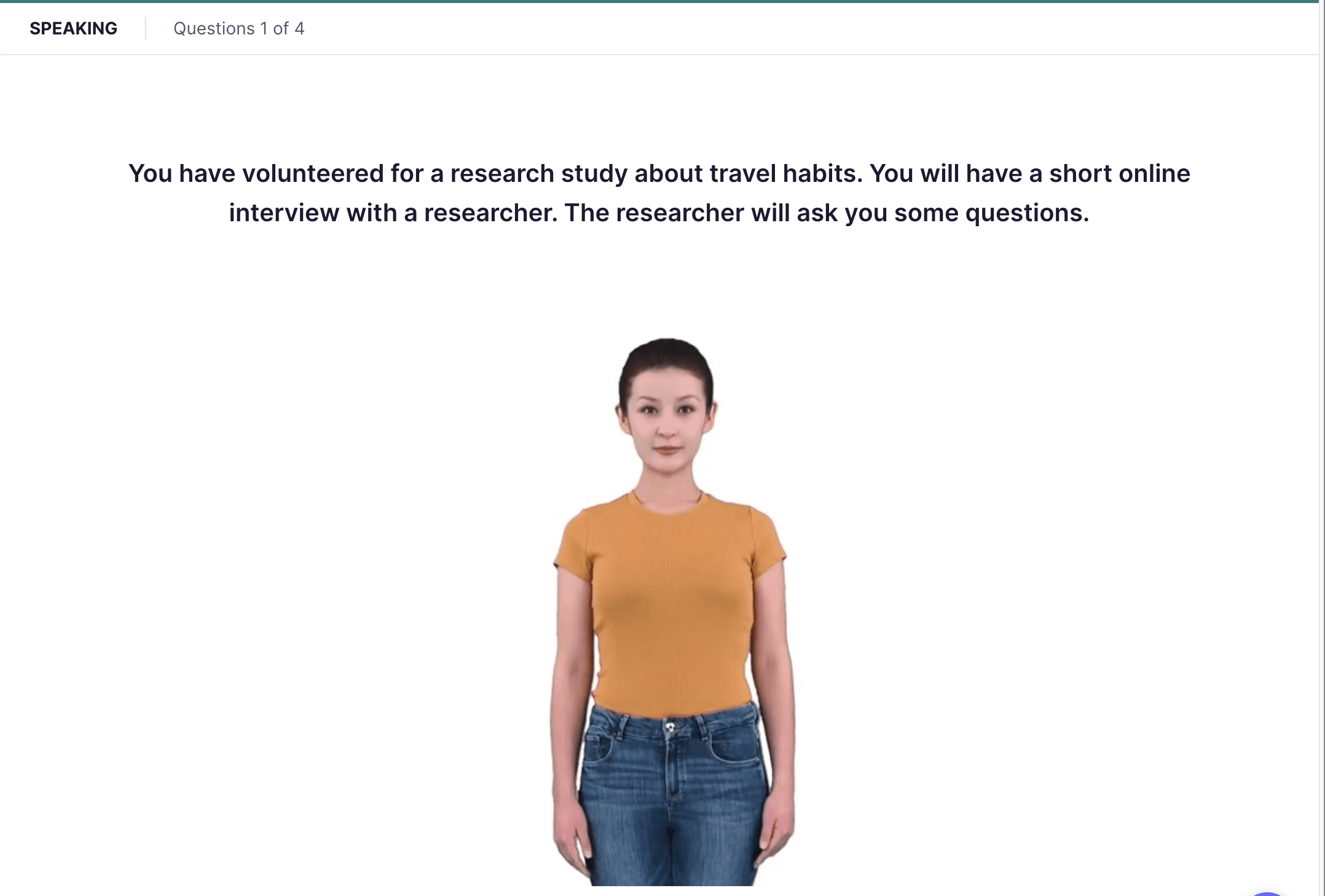
Take an Interview · Speaking
Four open-ended conversational questions about familiar topics — no reading or lecture input. Replaces the old integrated speaking tasks entirely.
Real ETS sample question
Scenario: Research-study interview about lifelong learning. You answer 4 questions, with about 45 seconds per response.
- “Do you currently engage in any activities aimed at obtaining new skills or knowledge? How often do you do this?”
- “Can you describe one or two ways you like to study new things? For example, do you take online courses, read books, or attend workshops?”
- “If money and time were not issues, what skill would you like to learn or what new knowledge would you like to develop? And why?”
- “Some people believe that, as adults, continuing education and gaining new knowledge are essential for personal development. Do you agree or disagree with this viewpoint? Why?”
Source: The Official Guide to the TOEFL iBT® Test, Pocket Edition (ETS, 2025) and TOEFL iBT® Technical Manual (ETS Research Report RR-25-12, 2025).
First sentence
I need to buy a new laptop. Now arrange the tiles into a grammatically correct follow-up question.
Build a Sentence · Writing
Arrange or complete a target sentence using the given fragments. A focused grammar and collocation check, new in 2026.
Real ETS sample question
Correct answer: “Which store has the best deals?”
Source: The Official Guide to the TOEFL iBT® Test, Pocket Edition (ETS, 2025) and TOEFL iBT® Technical Manual (ETS Research Report RR-25-12, 2025).
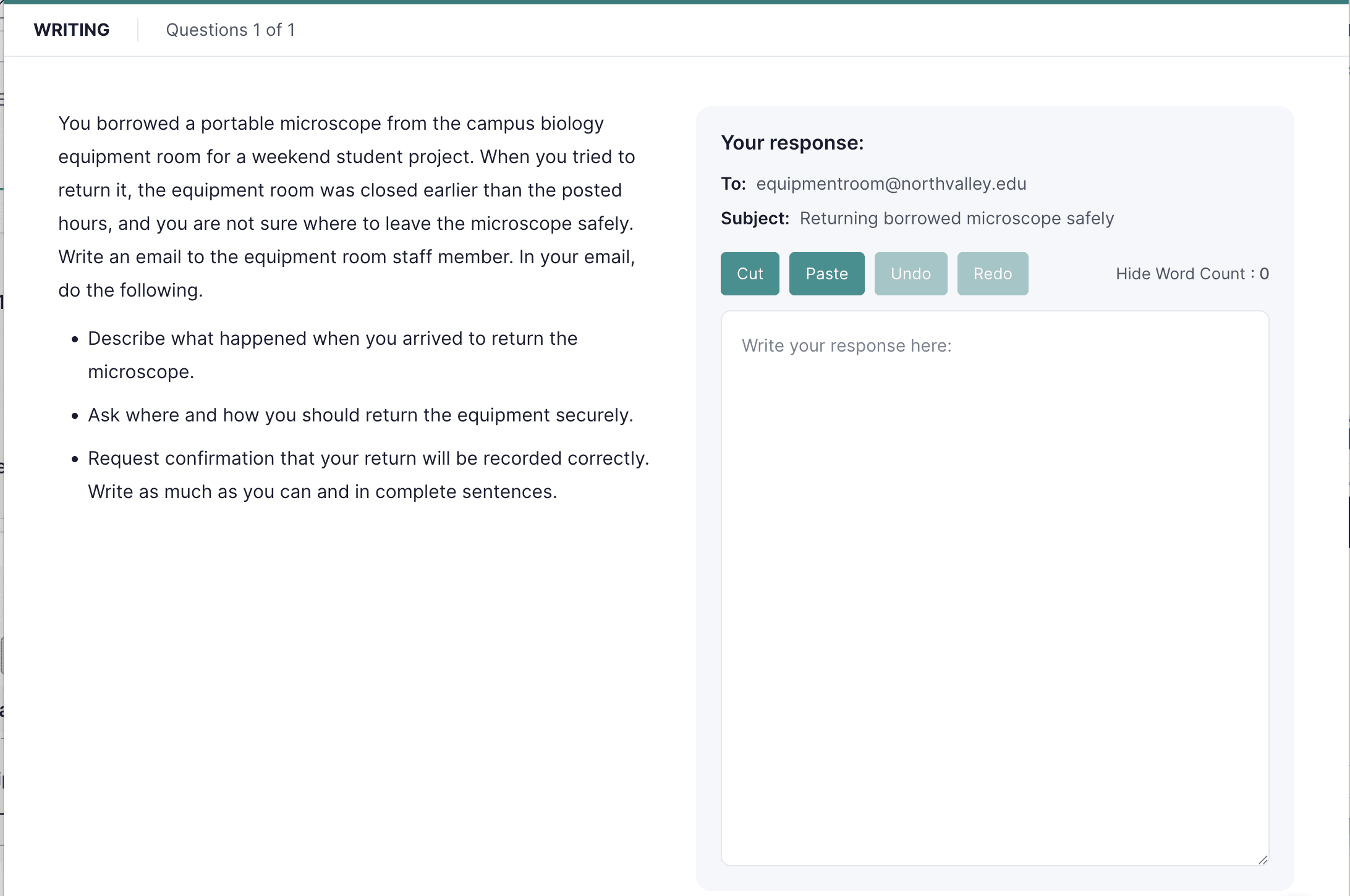
Write an Email · Writing
Respond to a practical scenario such as returning an item or confirming an appointment. A short functional writing task that replaces the old synthesis essay.
Real ETS sample question
Scenario: You have been working on a group project with several classmates for a course. One of your group members, Alex, has not been participating actively and has missed several assignments. You want to address this issue and find a solution.
Write an email to Alex. In your email, do the following:
- Describe the current progress of the group project.
- Explain how his lack of participation is affecting the group.
- Suggest ways he can contribute to the project moving forward.
Source: The Official Guide to the TOEFL iBT® Test, Pocket Edition (ETS, 2025) and TOEFL iBT® Technical Manual (ETS Research Report RR-25-12, 2025).
Scoring: Old System vs New 1-6 Scale
The scoring change is one of the most visible differences between old and new TOEFL. The 1–6 band structure follows the proficiency levels ETS describes on the official TOEFL iBT scoring page.
| Aspect | Old System | TOEFL 2026 |
|---|---|---|
| Per-section range | 0–30 | 1–6 |
| Score labels | Numeric only | Numeric + proficiency level |
| University benchmarks | e.g., 22+ per section | e.g., 4+ per section |
| Score validity | 2 years | 2 years |
Old scores cannot be directly converted to the new 1-6 scale for comparison. Universities set their own admission benchmarks for the new scale. See our TOEFL 2026 scoring guide for full details.
Should You Study Differently?
If you have been preparing for an older version of the TOEFL, you need to update your preparation in these specific areas:
Practice the new task types
Complete the Words, Choose a Response, Build a Sentence, Write an Email, and Listen and Repeat are all new. These will feel unfamiliar without specific practice. Start here if you have old-TOEFL study habits.
Rethink your Speaking preparation
Old integrated speaking templates and the old four-task structure are no longer relevant. Focus on Listen and Repeat accuracy and conversational fluency for the Interview task.
Understand adaptive scoring
In adaptive sections, performance in the router module appears to influence which module follows (lower or upper). ETS has not publicly disclosed the routing thresholds or the exact scoring algorithm, so the safest preparation strategy is consistent accuracy across the section rather than time-saving shortcuts that sacrifice router accuracy.
Keep what still works
Academic reading comprehension, note-taking for lectures, vocabulary development, and clear spoken expression remain valuable. Core English skills transfer across both versions.
Master TOEFL 2026 — Including All New Task Types
LingoLeap provides targeted practice for every new TOEFL 2026 task type, with AI scoring and feedback tailored to the 2026 format.
Start Free PracticeFrequently Asked Questions
What is the biggest difference between TOEFL 2026 and old TOEFL?⌄
The biggest differences are the new task types introduced in every section, the switch from a 0–30 per-section scale to a 1–6 scale, and the addition of two-stage adaptive testing in Reading and Listening (router + lower/upper module, per the April 2026 ETS Blueprint). Section time also fell, from about 2 hours in the format used until January 2026 to about 1 hr 23–29 min (about 2 hours including directions), and three tasks — Write an Email, Write for an Academic Discussion, and Take an Interview — are now officially AI-scored. Build a Sentence and Listen and Repeat are machine-scored against predefined answers.
Is TOEFL 2026 harder than the old TOEFL?⌄
Difficulty depends on your strengths. Some test-takers find the new task types (like Listen and Repeat or Build a Sentence) easier because they are shorter and more focused. Others find the adaptive sections more demanding: stronger router performance generally routes test-takers to a more challenging upper module. Overall, the redesigned test is more communication-focused and rewards different preparation than the old format.
Do old TOEFL scores still count?⌄
Scores from previous TOEFL administrations are valid for two years from your test date. If your scores are within this window, most universities will accept them. However, check whether your target institution requires the 2026 format specifically.
Did the Speaking section change a lot?⌄
Yes. In the format used until 21 January 2026, TOEFL Speaking had 4 tasks: one independent task and integrated tasks. TOEFL 2026 replaced these with Listen and Repeat (7 items) and Take an Interview (4 questions). The April 2026 ETS Blueprint identifies Take an Interview as the AI-scored task — the model evaluates fluency, coherence, grammar, intelligibility, and communication effectiveness. Listen and Repeat is machine-scored against predefined answers. Task structure, preparation strategies, and timing are significantly different from the old format.
Should I re-study from scratch for TOEFL 2026?⌄
Not necessarily. Core skills like academic reading comprehension, listening to lectures, and forming well-organised spoken responses remain relevant. You should, however, specifically practise the new task types, understand how the two-stage adaptive structure works in Reading and Listening (router followed by lower or upper module), and prepare for the three AI-scored tasks now confirmed in the April 2026 ETS Blueprint: Write an Email, Write for an Academic Discussion, and Take an Interview.