













The AI-Powered Prep Platform for TOEFL 2026

One AI platform to practice, get feedback, and track your progress — built specifically for the new exam.

Start Free TOEFL Mock Test

Updated for the 2026 TOEFL format

Built for the 2026 TOEFL format100+ full-length TOEFL 2026 mock testsSentence-level Speaking & Writing feedback
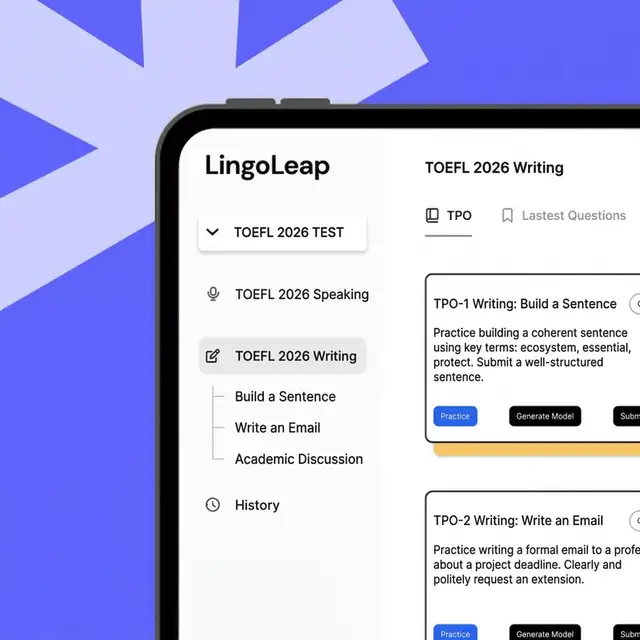
LingoLeap App Screenshot

Our students come from schools including:

Boston College
Cornell University
Chinese University of Hong Kong
Johns Hopkins University
Northwestern University
Nanyang Technology University
New York University
Ohio State University
Stanford University
Tsinghua University
UC Berkeley
UC Davis
University of Chicago
University of Michigan
Boston College
Cornell University
Chinese University of Hong Kong
Johns Hopkins University
Northwestern University
Nanyang Technology University
New York University
Ohio State University
Stanford University
Tsinghua University
UC Berkeley
UC Davis
University of Chicago
University of Michigan

For reference only — LingoLeap is not affiliated with or endorsed by these institutions.

Practice Smarter for the 2026 TOEFL

Take free test
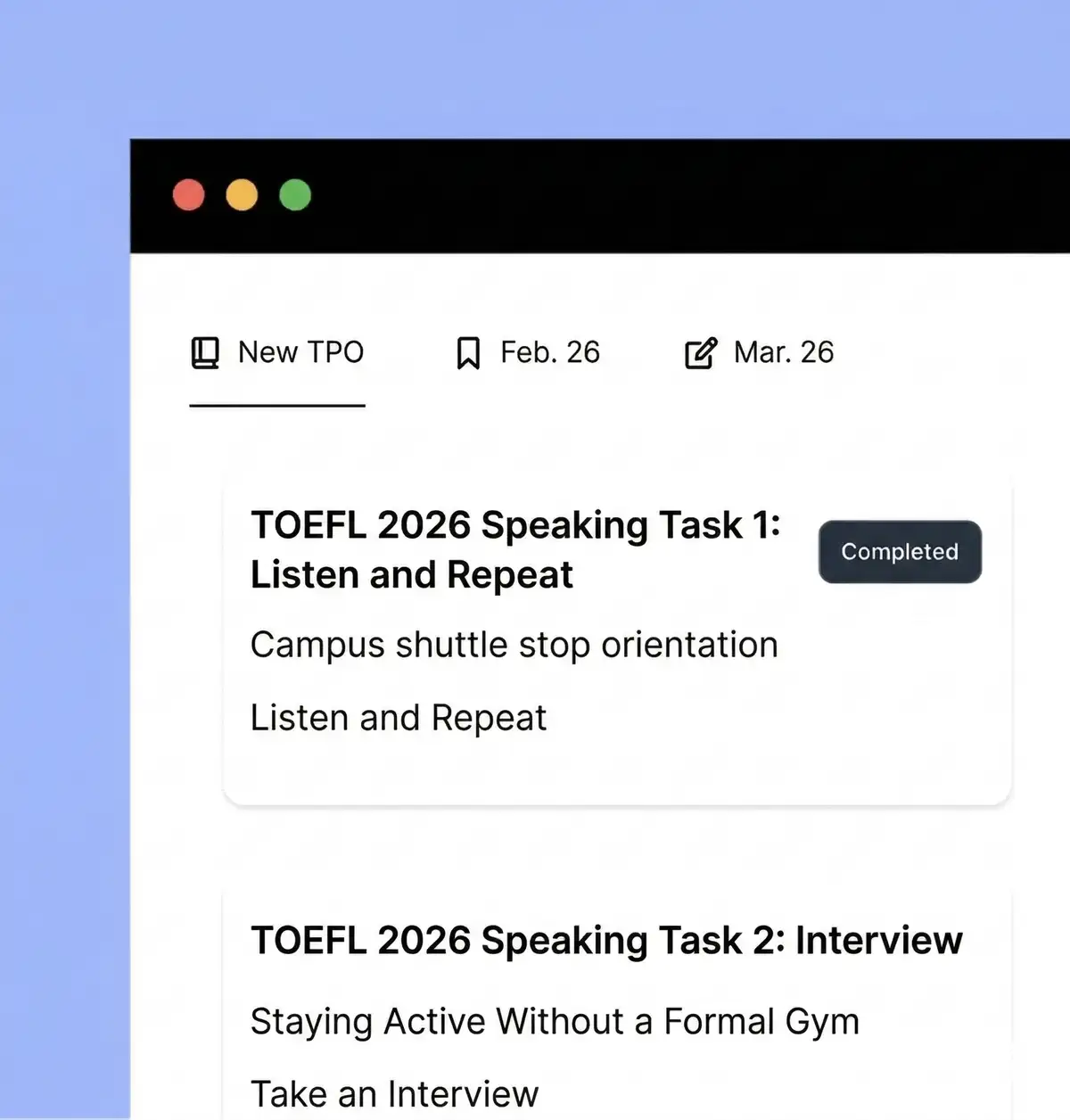
2026 TOEFL practice with adaptive Reading, Listening, and new question types

Built for the 2026 TOEFL

Practice the new TOEFL format, including adaptive Reading & Listening and the latest task types.

100+ full-length TOEFL 2026 mock tests with fast practice score estimates

100+ Full Mock Tests

Train with 100+ full-length TOEFL 2026 mock tests (10,000+ questions) and get a practice score estimate within 1–2 minutes.

AI feedback for TOEFL Speaking and Writing with grammar correction and vocabulary upgrades

Detailed AI Feedback

Get grammar correction, sentence restructuring, voice feedback, and vocabulary upgrades to improve your responses.

What's New in the 2026 TOEFL iBT Format?

The 2026 TOEFL features adaptive sections, new task types, and a 1–6 band scoring scale.

Practice every task with realistic mock tests and AI-powered feedback with LingoLeap.

Adaptive Test Design

Multistage Adaptive Reading & Listening

The new TOEFL uses adaptive modules. Your performance in an earlier module can influence the difficulty of a later module within the same section (Reading or Listening). Practicing with adaptive tests helps you prepare for the real exam experience.

New Task Types

New Writing & Speaking Tasks

The TOEFL 2026 introduces new task types such as:

  • Write an Email
  • Build a Sentence
  • Take an Interview
  • Complete the Words
  • Listen and Repeat

Our platform includes practice for every new task type.

New Scoring System

1–6 Band Score Scale

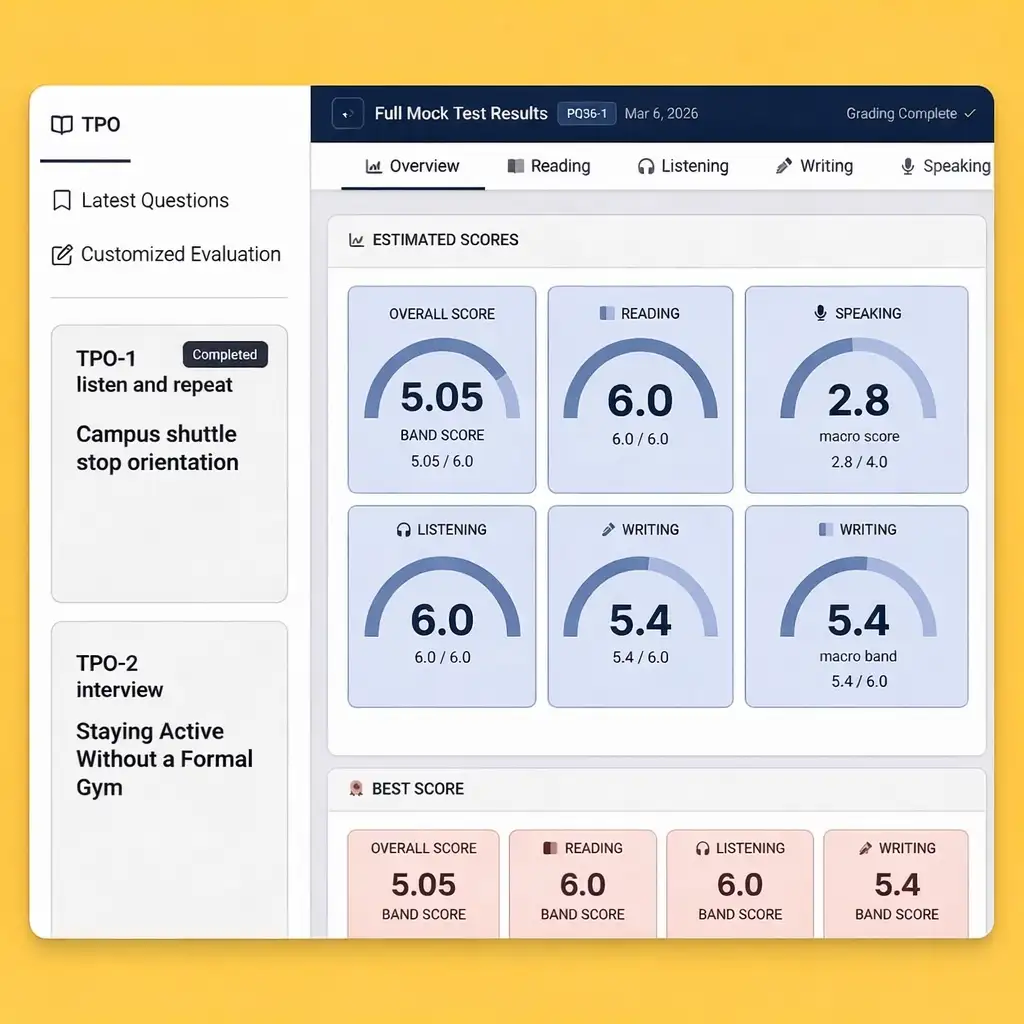
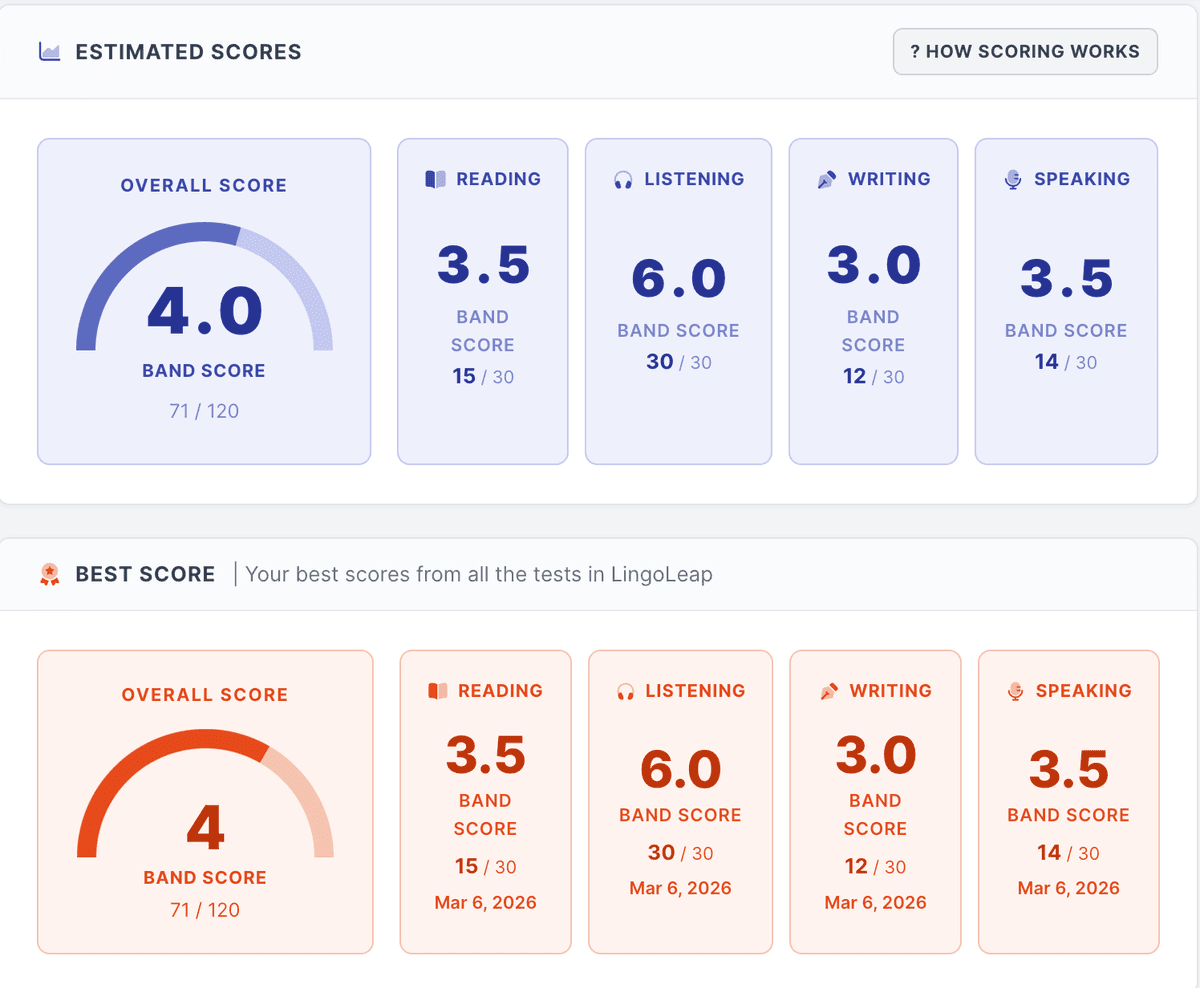
The new TOEFL reports scores on a 1–6 band scale aligned with CEFR levels. LingoLeap provides instant estimated scores and detailed feedback to help you track your progress.

AI TOEFL Evaluation Engine

Practice with realistic TOEFL simulations and receive detailed AI feedback on your speaking and writing.

1. Realistic TOEFL 2026 Mock Tests

Practice with high-fidelity TOEFL simulations featuring adaptive Reading and Listening sections and real exam timing.

2. AI Writing Evaluation

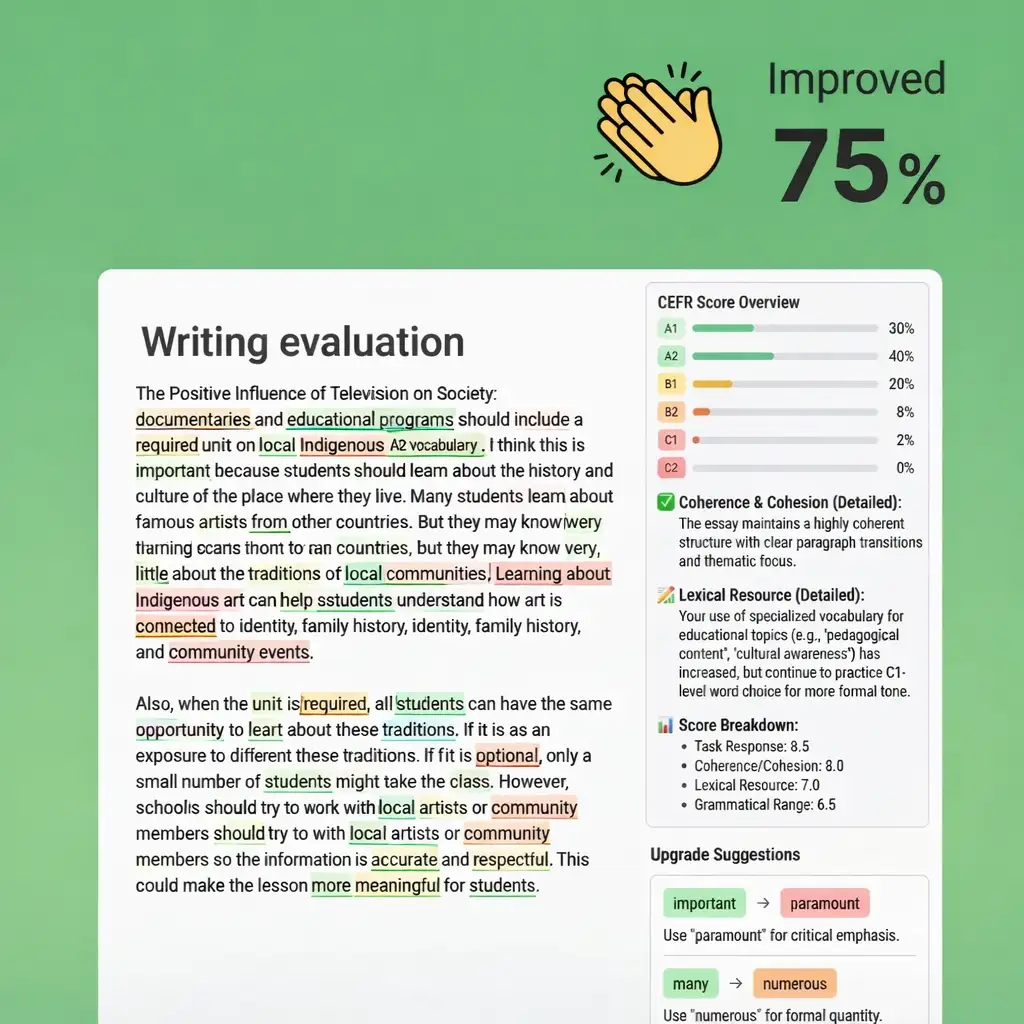
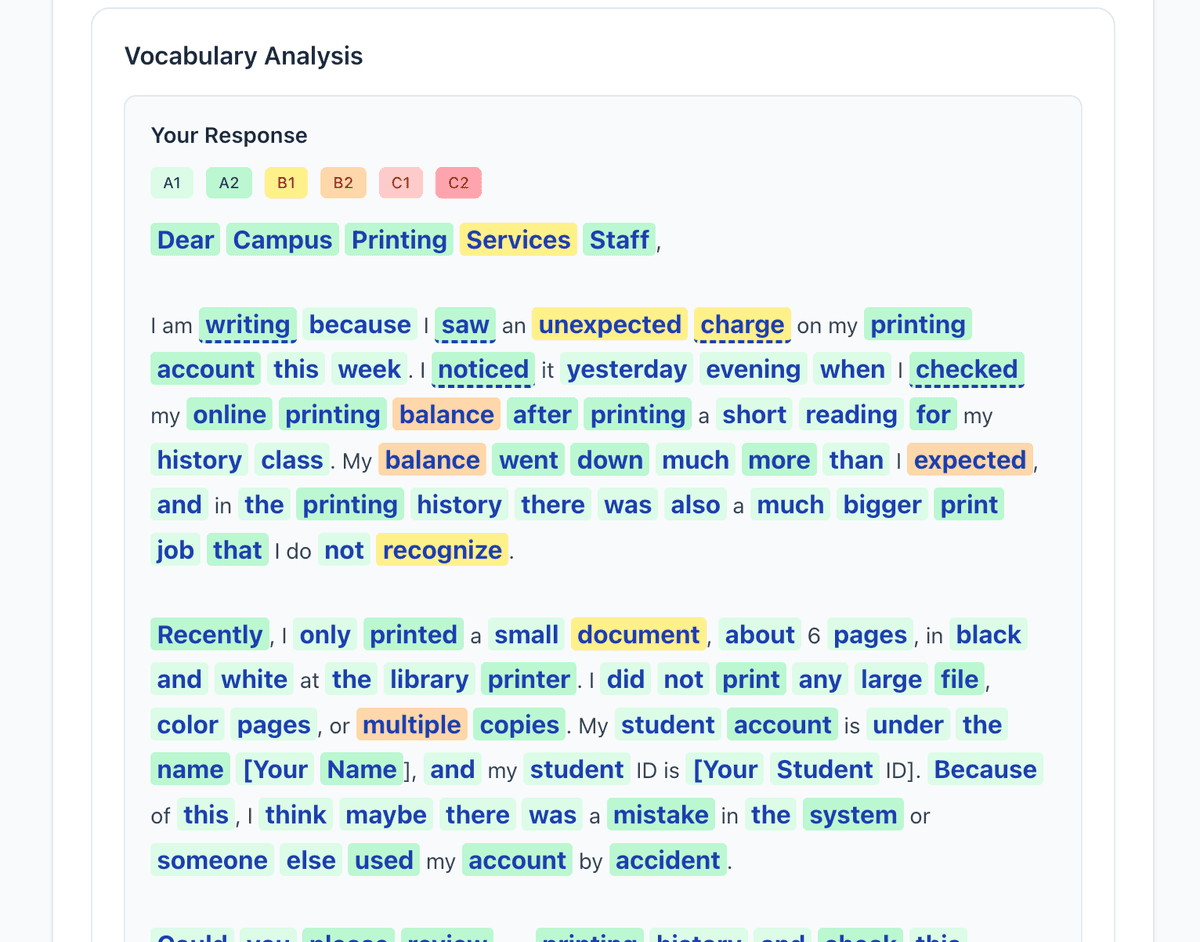
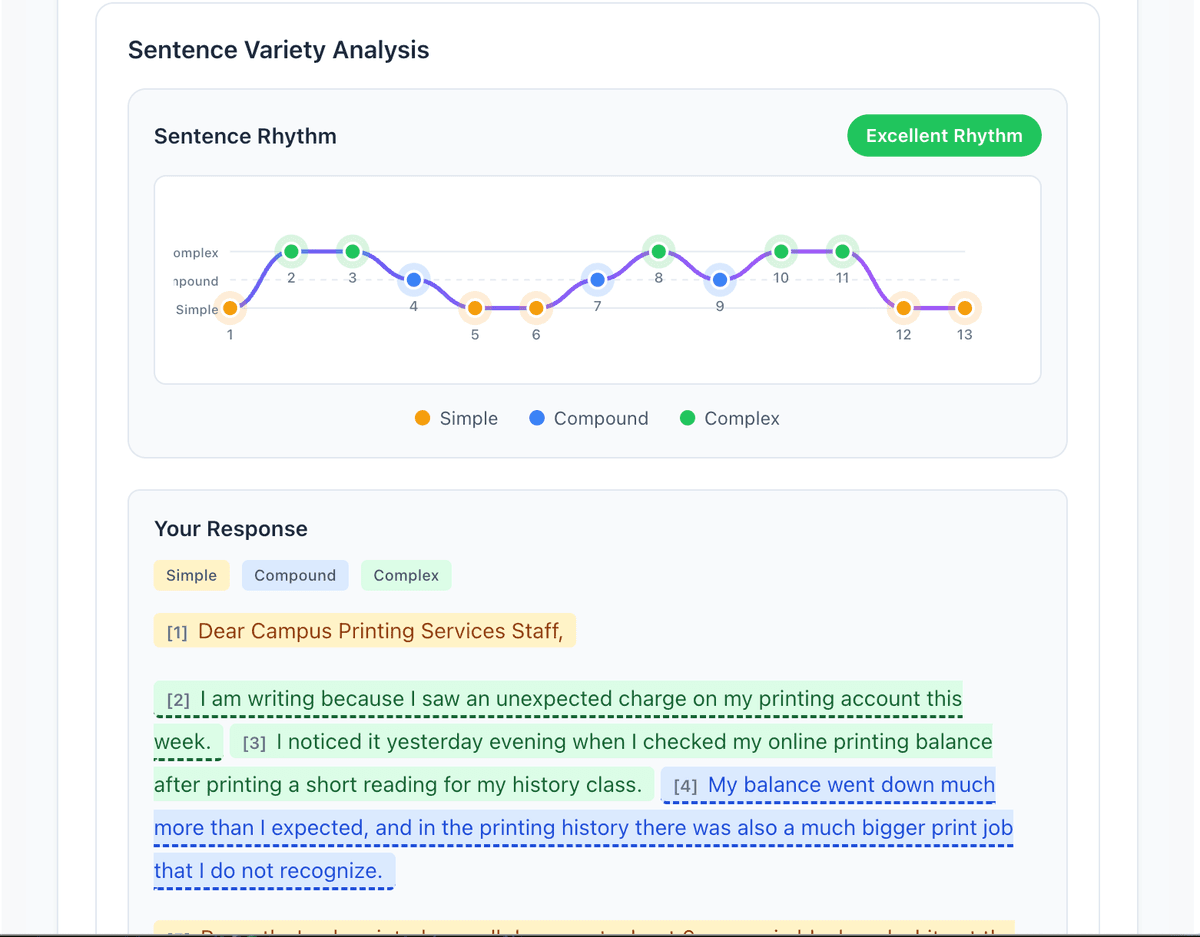
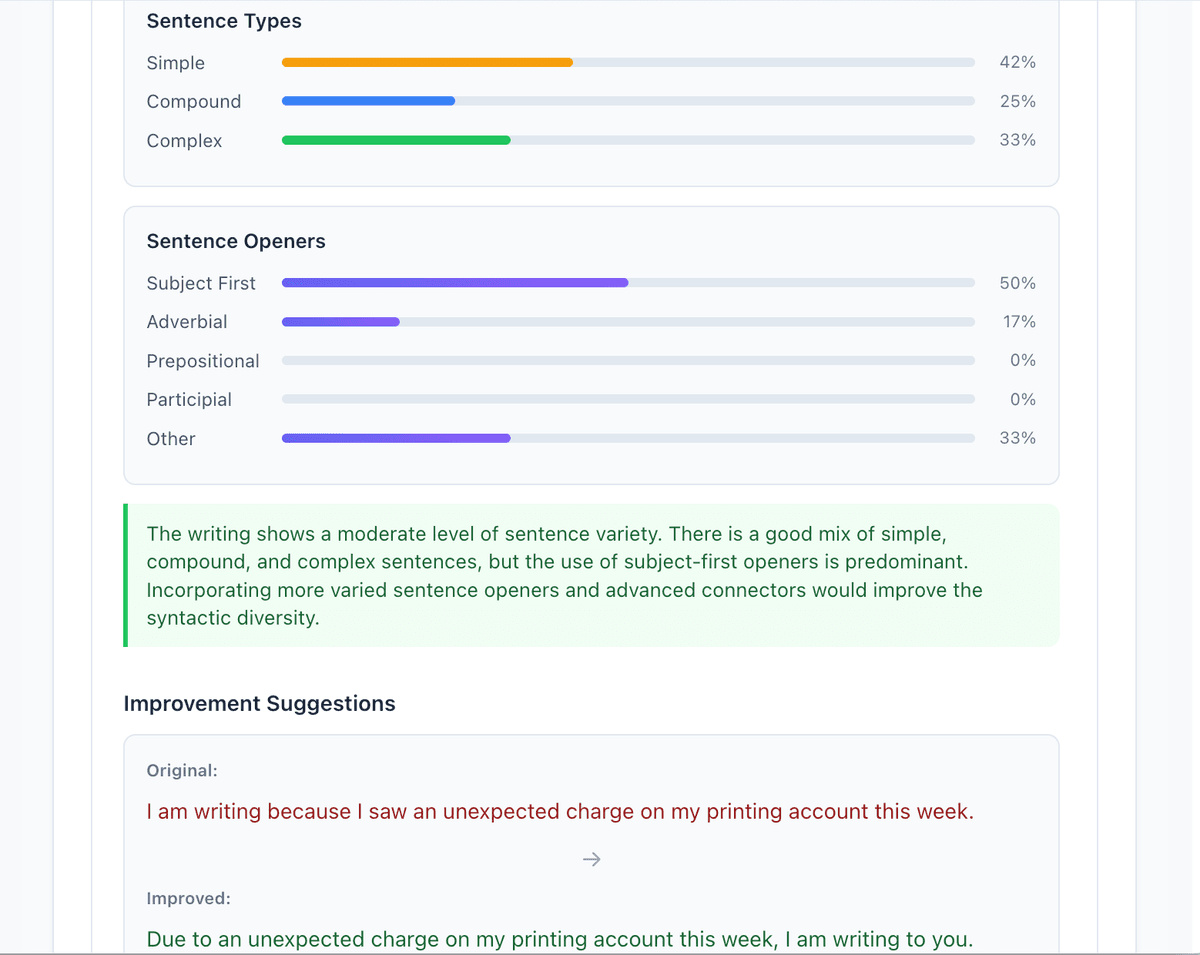
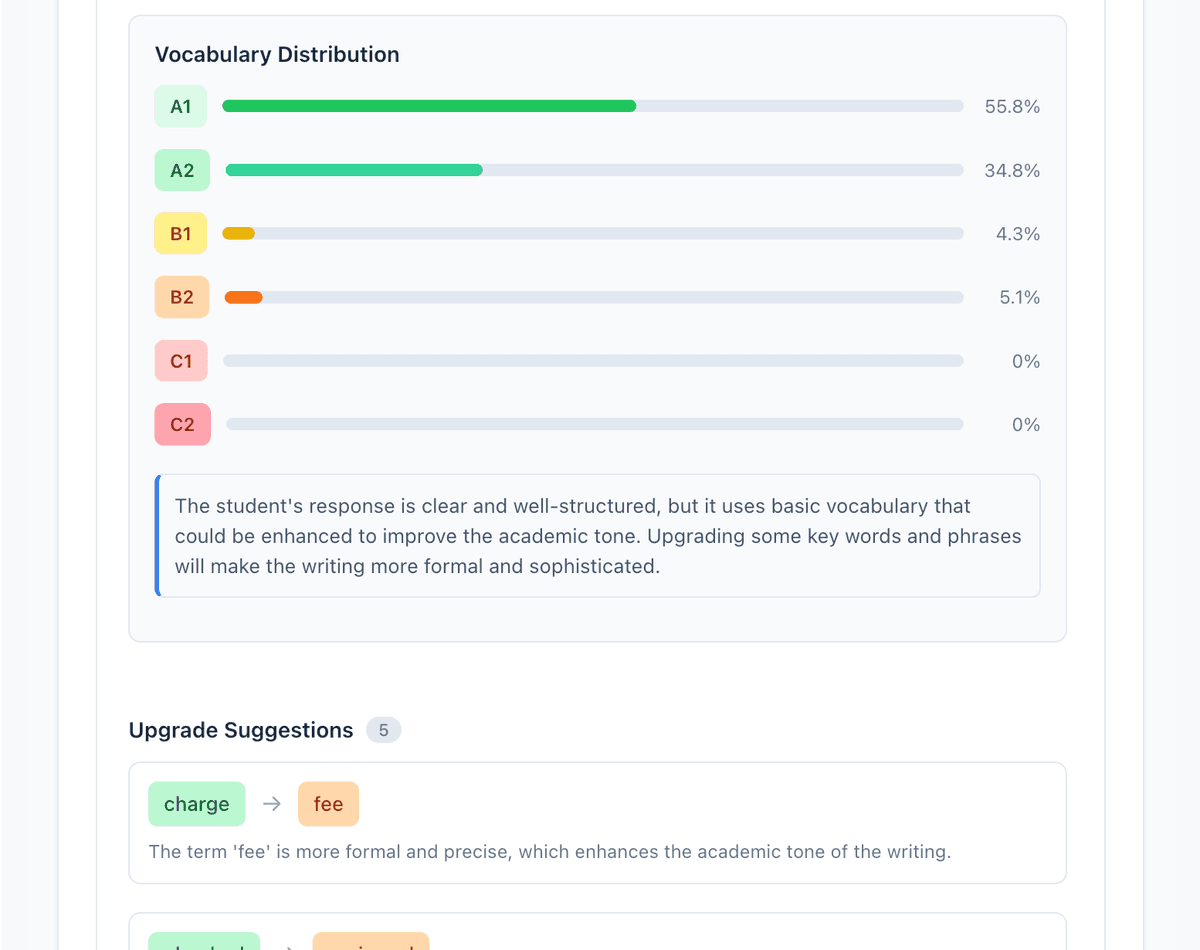
Receive detailed feedback on your TOEFL writing tasks with rubric-based scoring, grammar correction, vocabulary upgrades, and high-score rewrites.

3. AI Speaking Evaluation

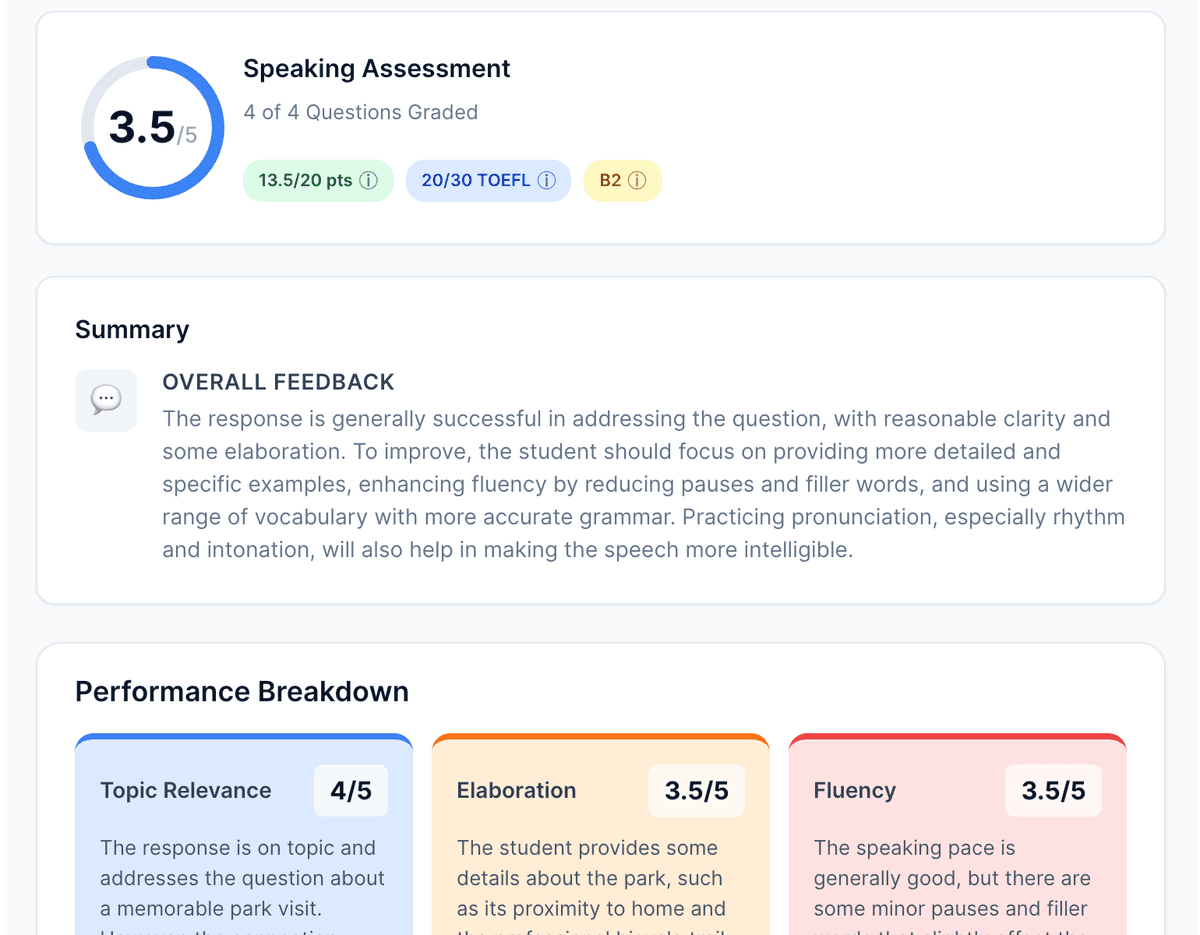
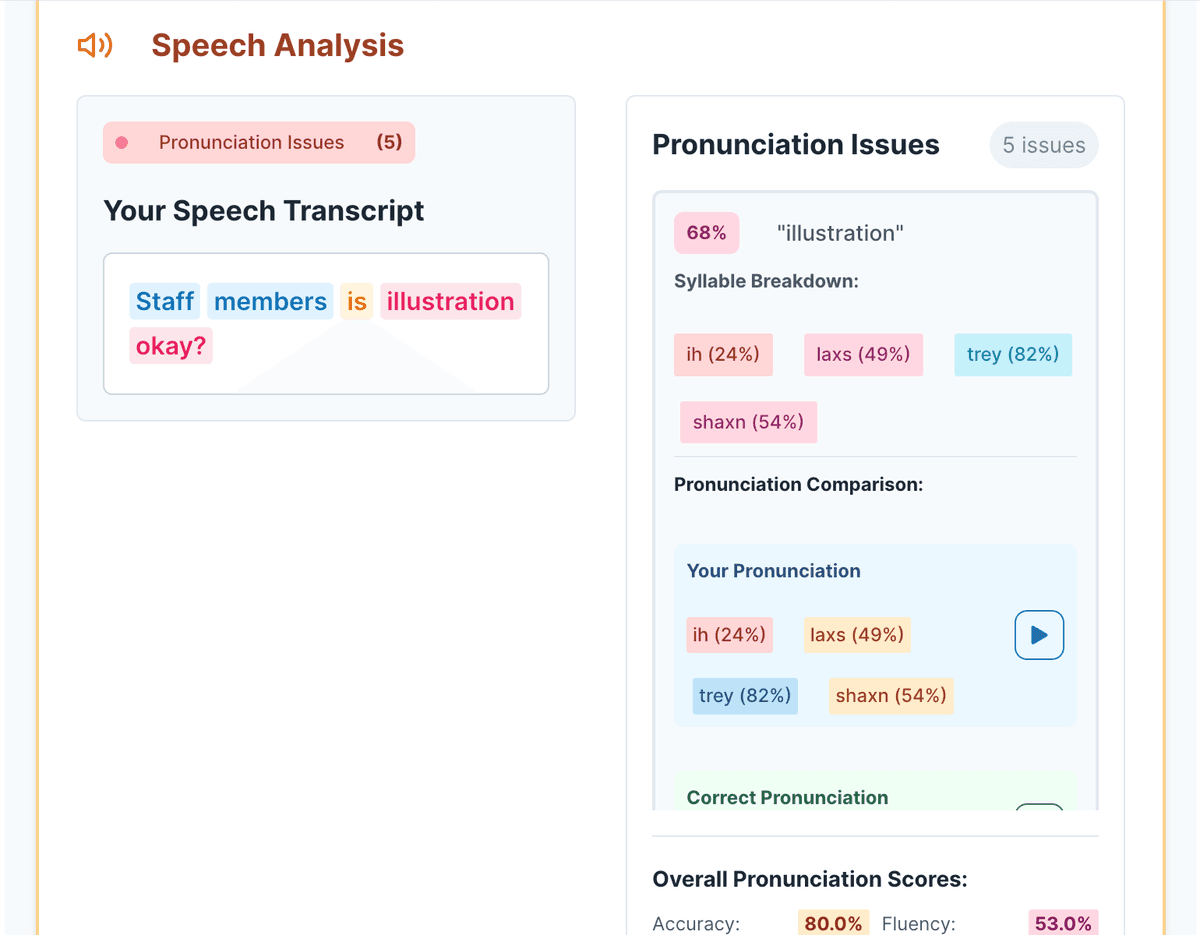
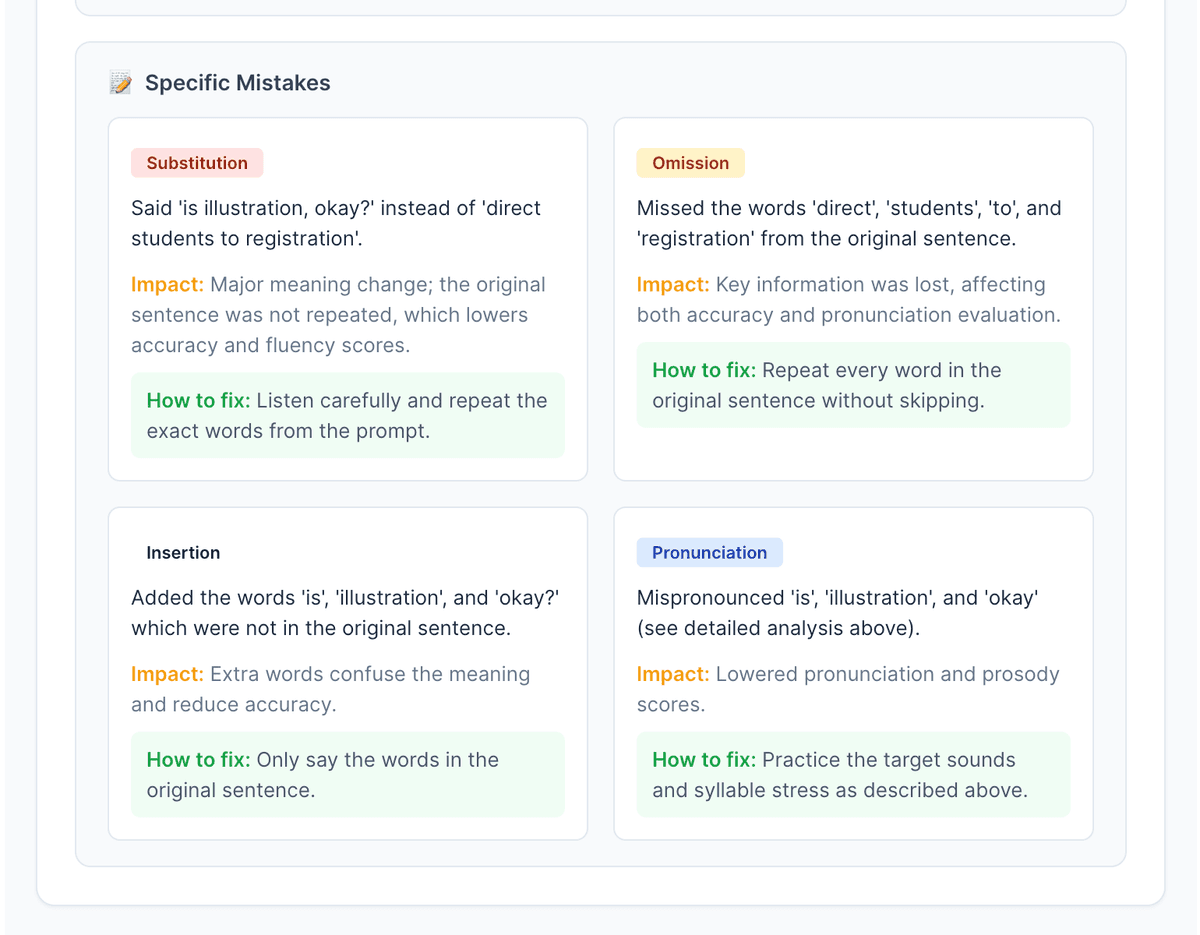
Get detailed feedback on pronunciation, fluency, and speaking responses based on publicly available ETS scoring rubrics.

4. Extensive TOEFL Question Bank

Access a large collection of TOEFL practice questions across Reading, Listening, Writing, and Speaking, including new TOEFL 2026 task types.

Estimated Scores · Full Report
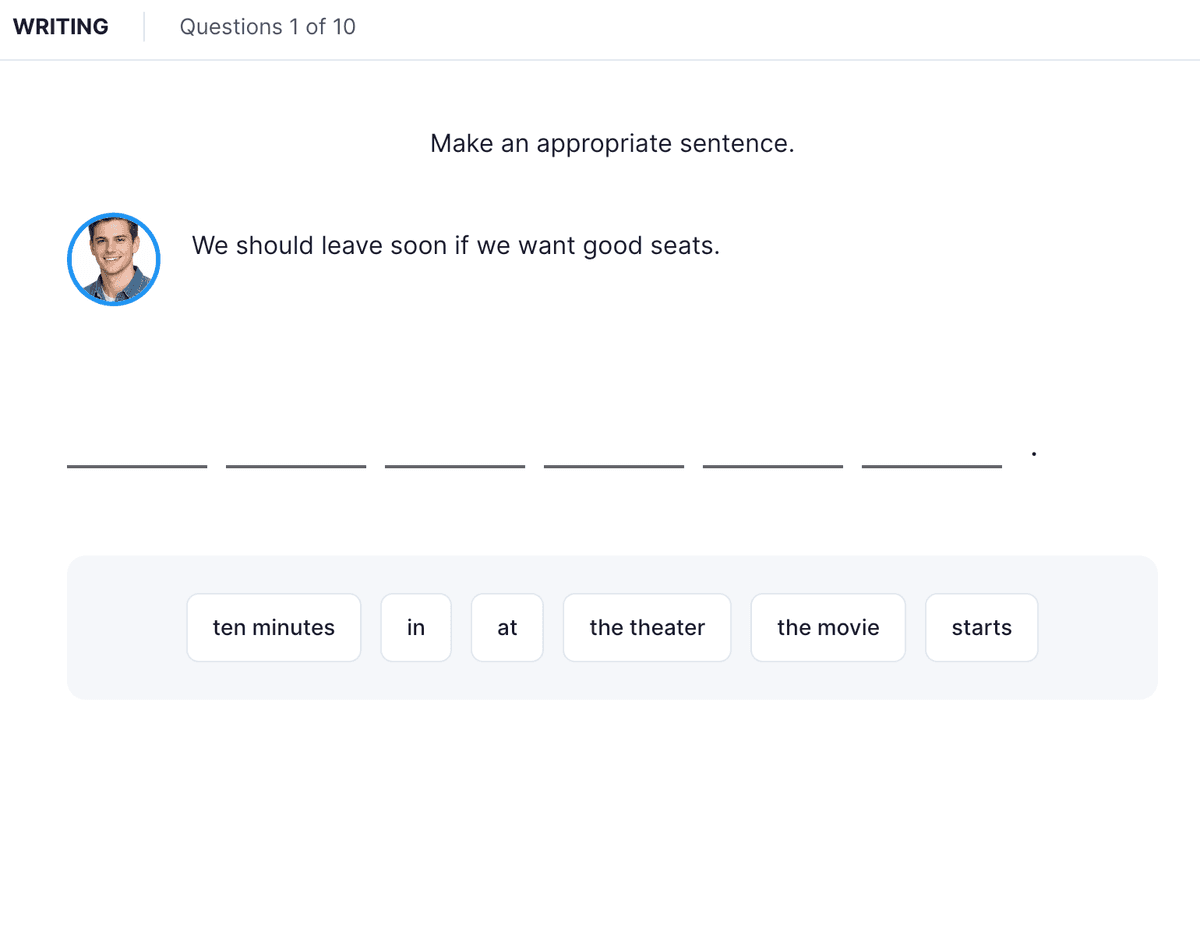
TOEFL 2026 · Build a Sentence
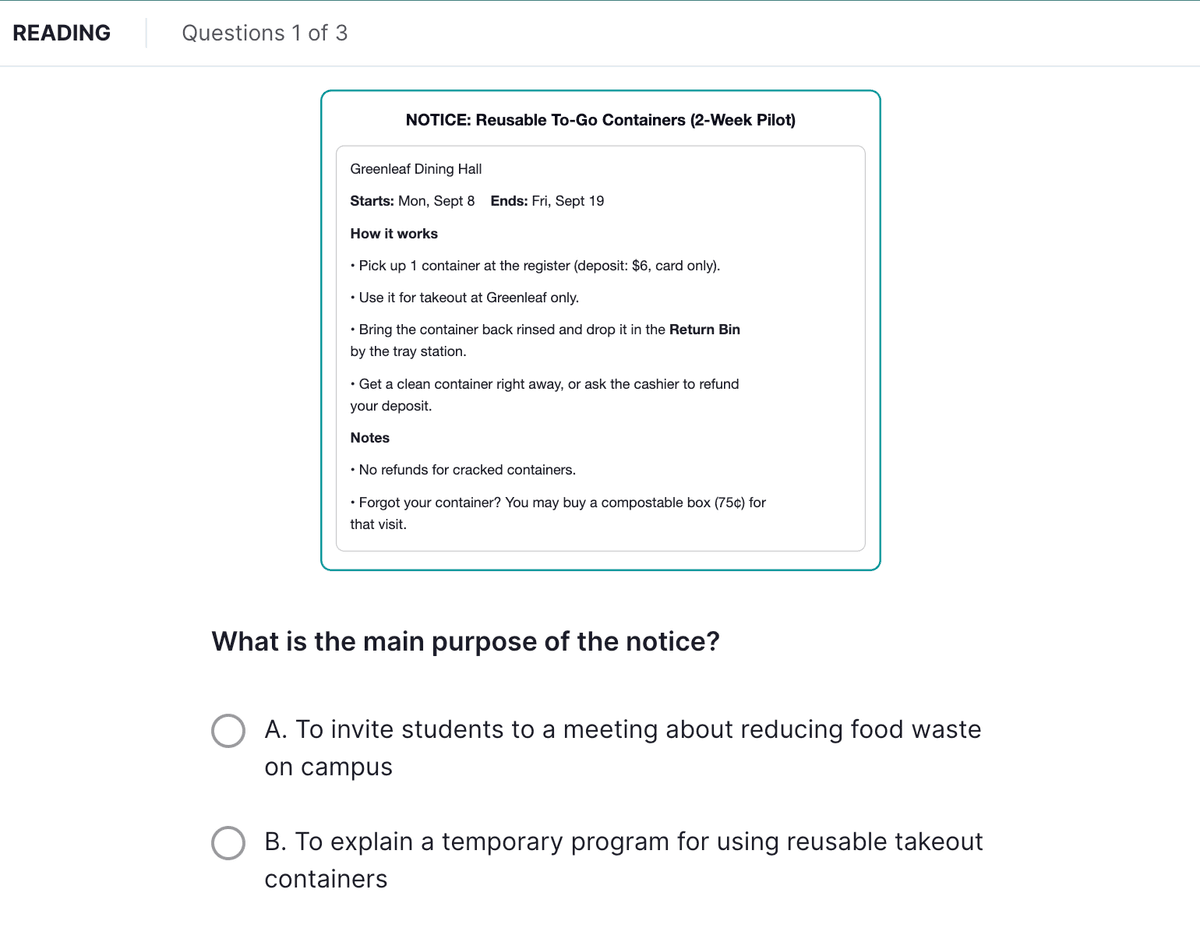
TOEFL 2026 · Read in Daily Life
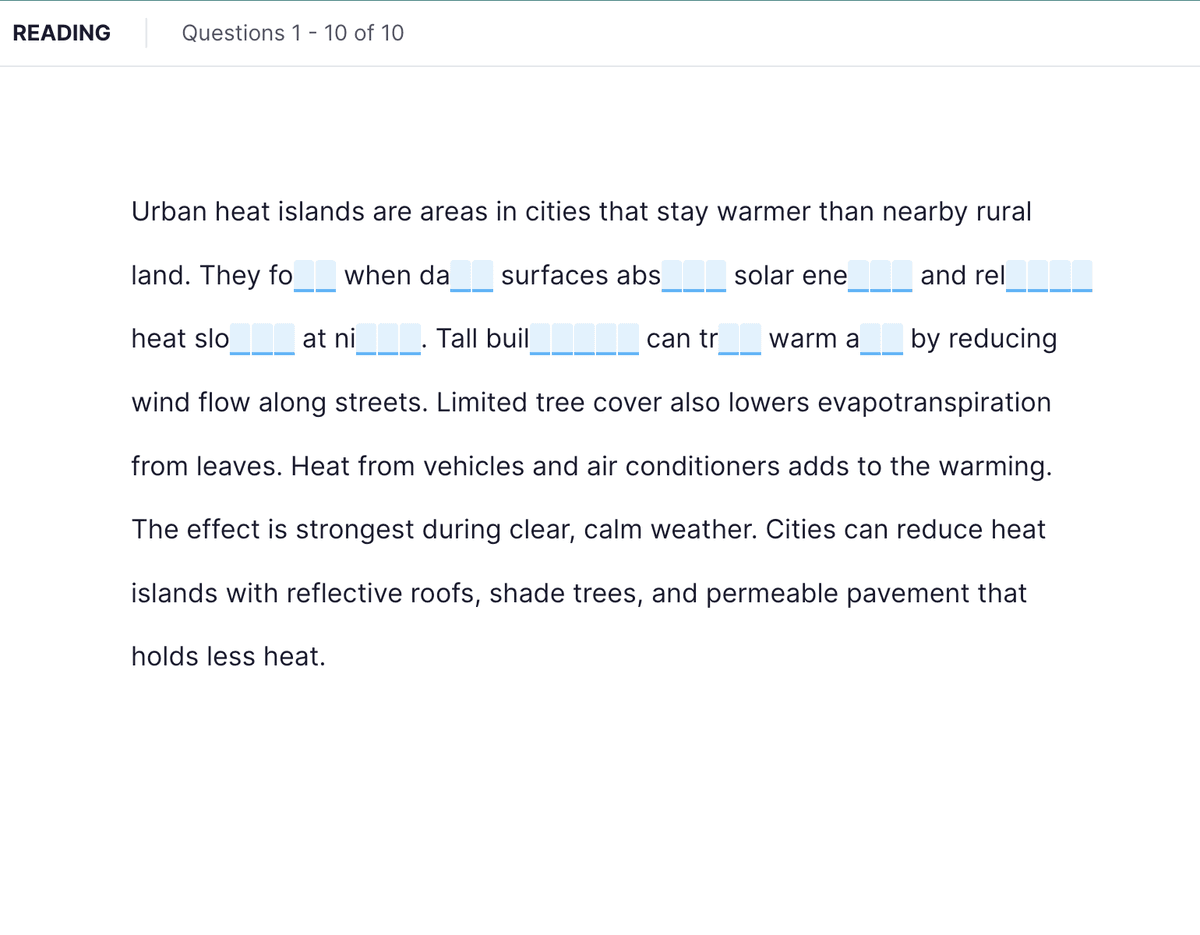
TOEFL 2026 · Complete the Words
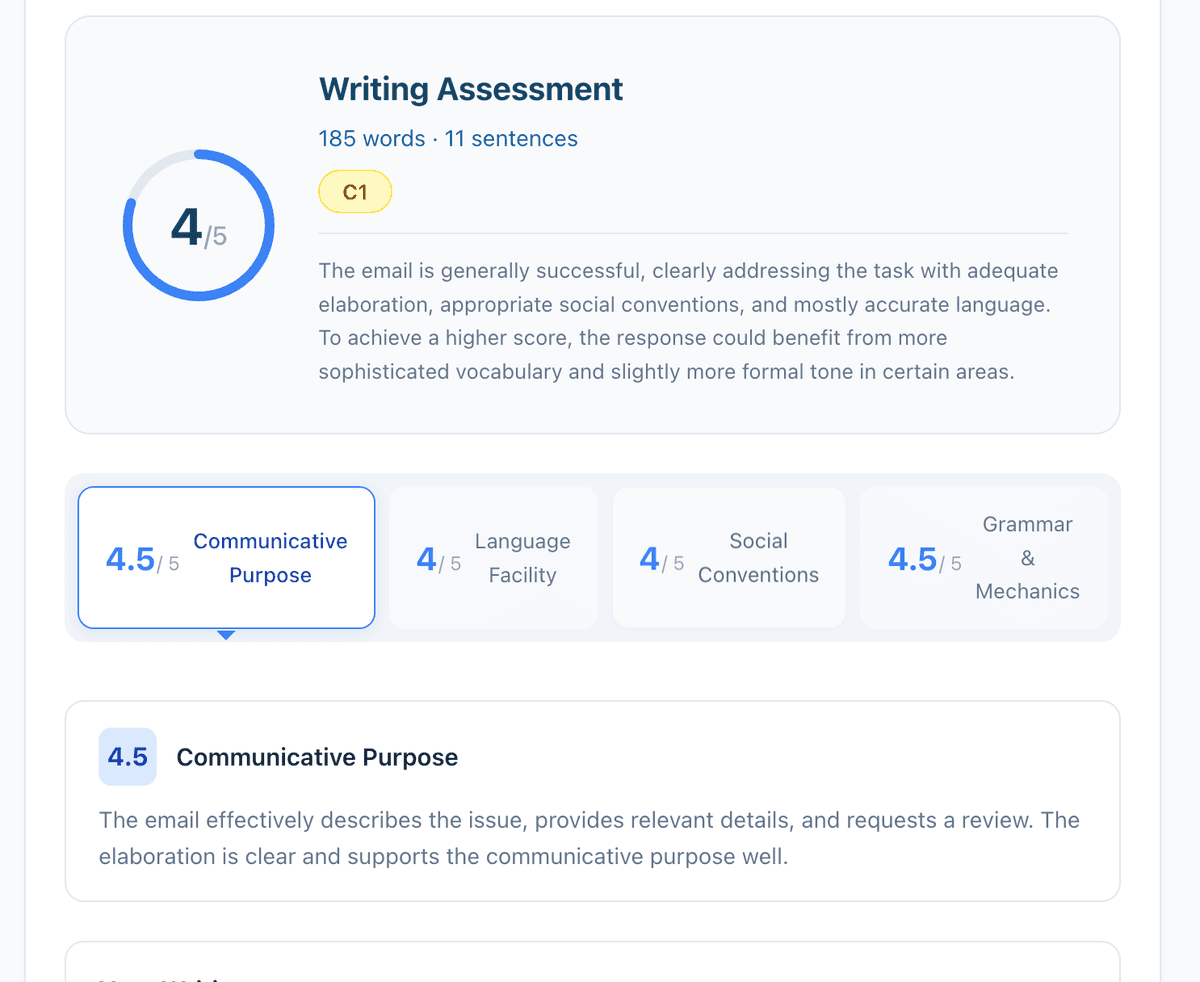
Writing Score Report
Vocabulary Analysis
Vocabulary Distribution
Sentence Variety Analysis
Improvement Suggestions
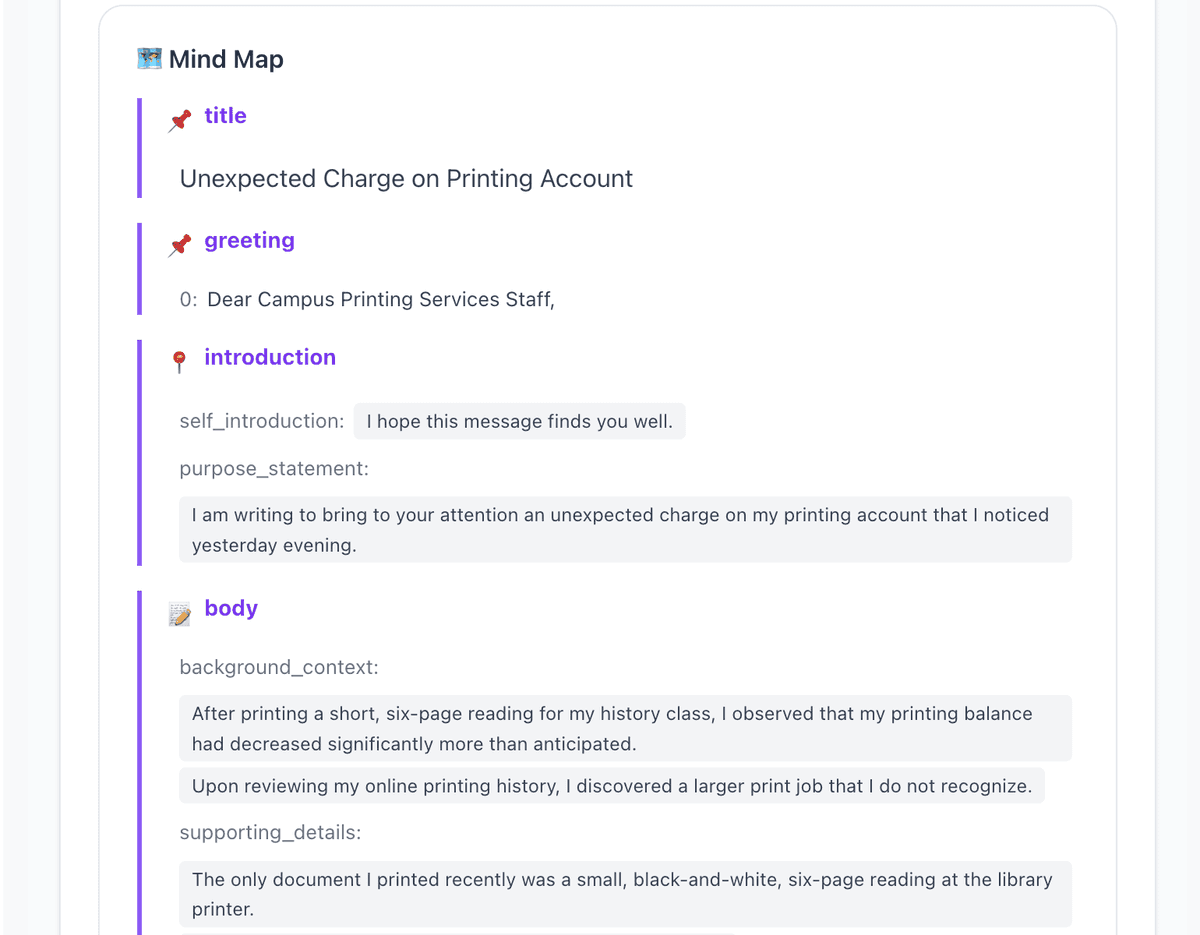
Writing Structure · Mind Map
Speaking Score Report
Speech & Pronunciation Analysis
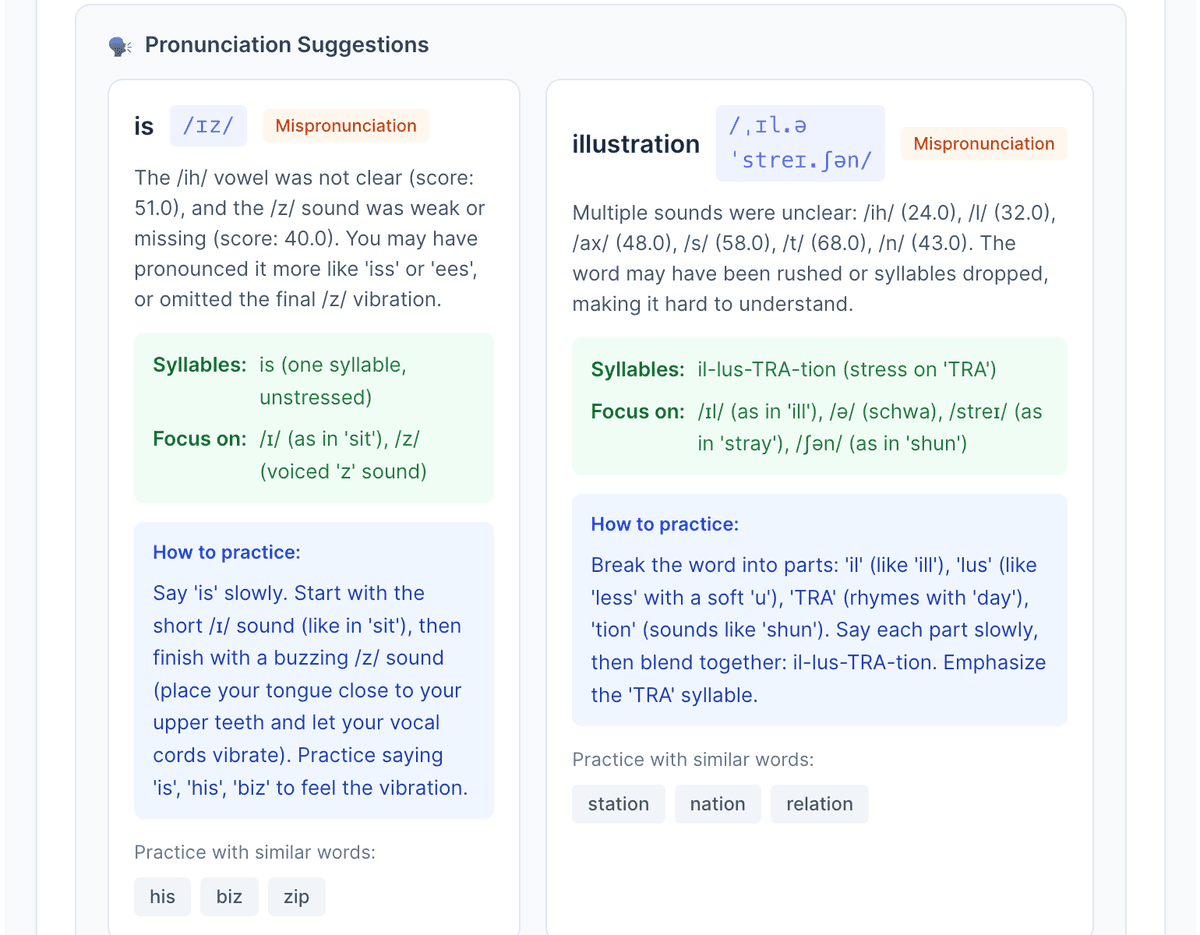
Specific Mistakes & How to Fix
Pronunciation Practice Guide
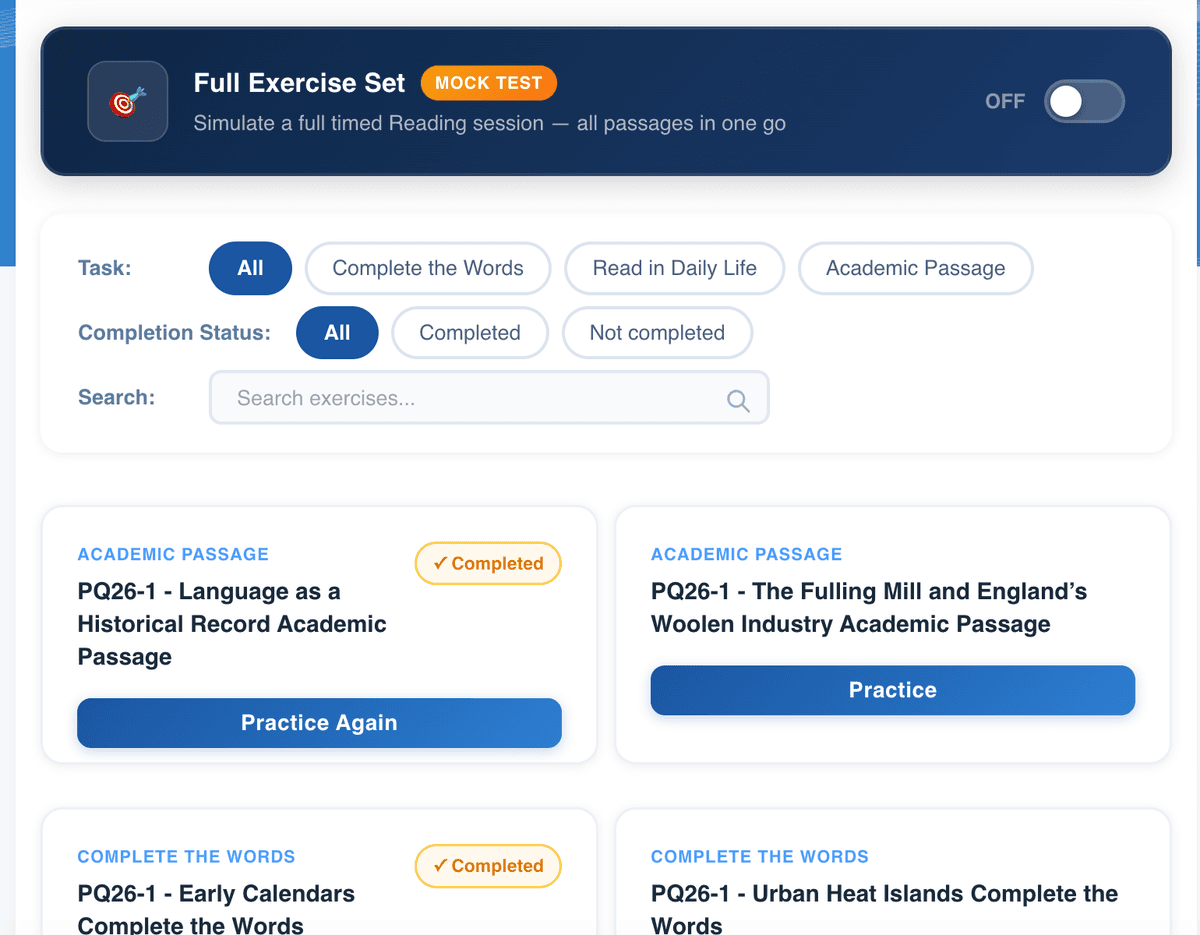
Reading · Question Bank
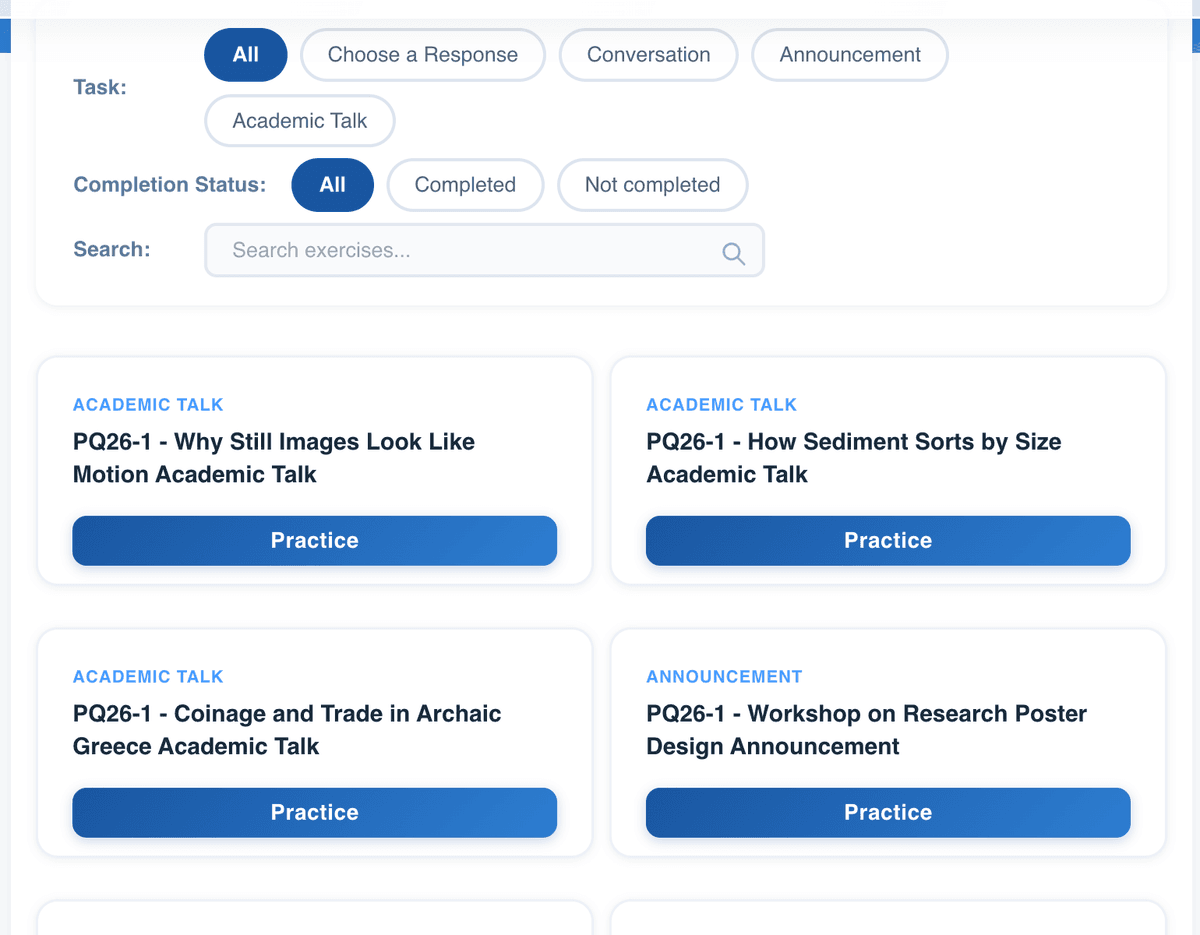
Listening · Question Bank
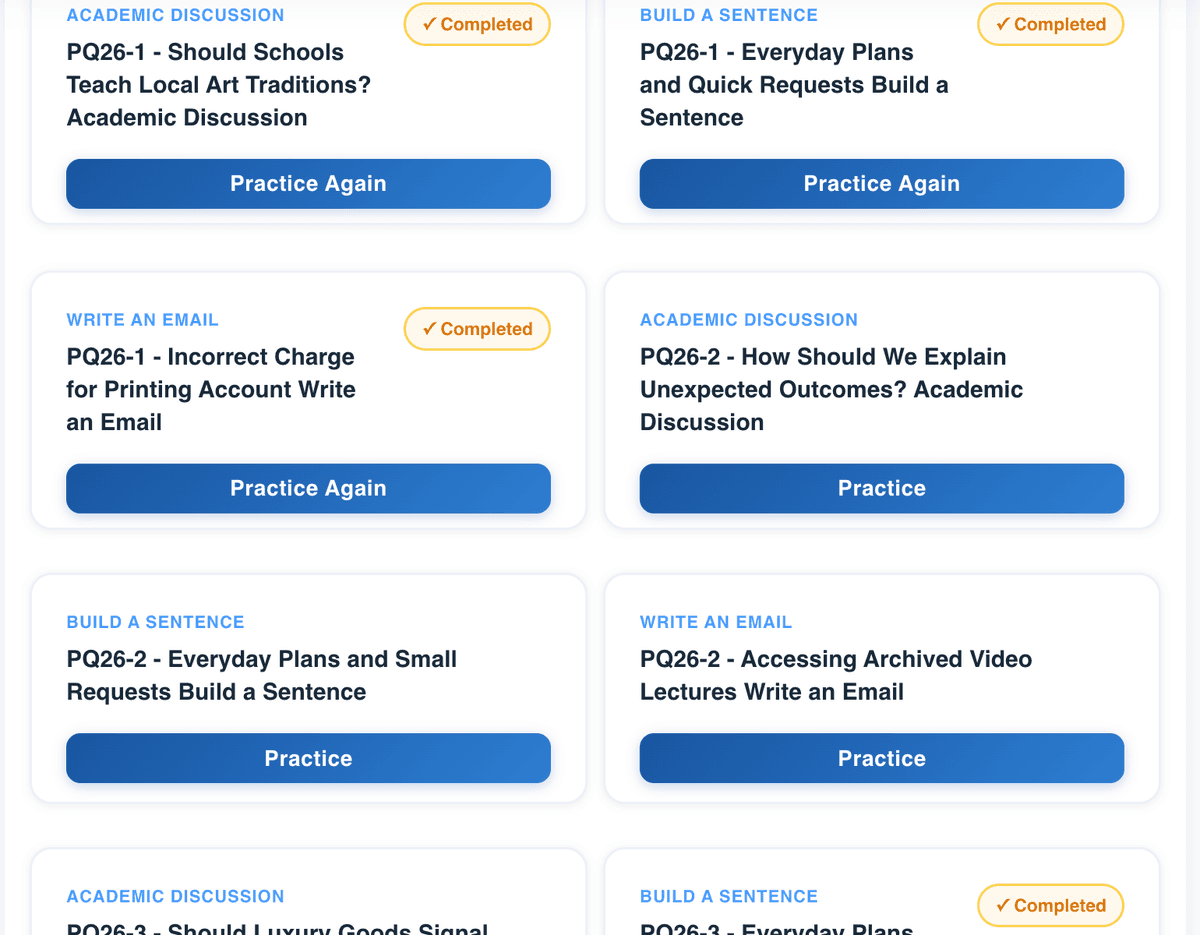
Writing · Question Bank
Speaking · Question Bank
Estimated Scores · Full Report

Practice TOEFL by Section

TOEFL Reading • Listening • Writing • Speaking Practice

Practice Reading, Listening, Writing, and Speaking with realistic TOEFL practice tasks.

TOEFL Reading Practice

Practice with adaptive reading tasks from the new TOEFL format, including:

Complete the WordsRead in Daily LifeAcademic Passage
Practice Reading

TOEFL Listening Practice

Practice with adaptive listening tasks similar to the real TOEFL exam:

Choose a ResponseConversationAnnouncementAcademic Talk
Practice Listening

TOEFL Writing Practice

Practice writing tasks with instant AI evaluation and feedback, including:

Build a SentenceWrite an EmailAcademic Discussion
Practice Writing

TOEFL Speaking Practice

Improve your speaking with AI voice feedback on tasks like:

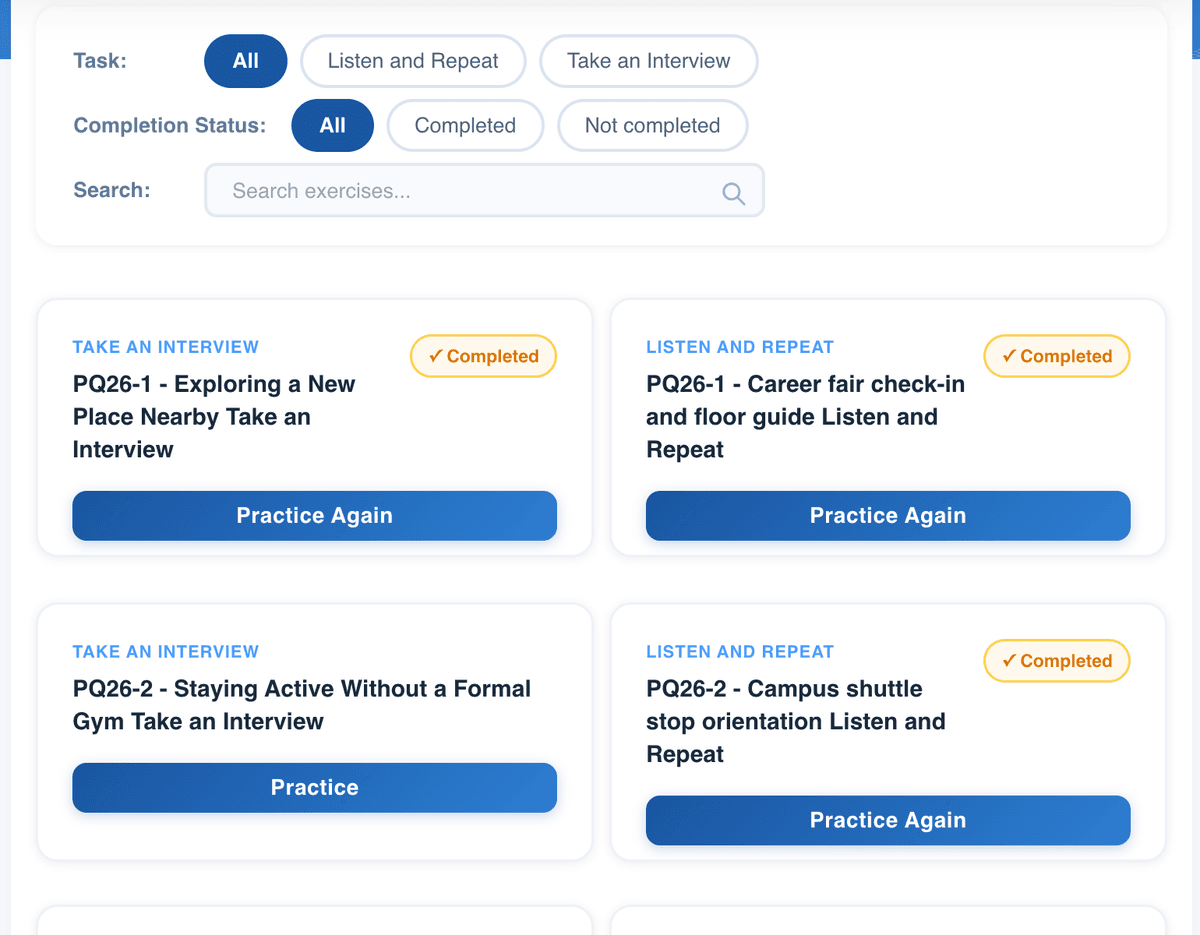
Listen and RepeatTake an Interview
Practice Speaking

See What Students are Saying about LingoLeap

Video cover
3:01
Testimonials background

Ivanka

I used LingoLeap.AI to improve my TOEFL writing, focusing on effective essay structuring, refining sentences, and generating compelling examples to support my arguments. I found the Mind Map feature particularly valuable for organizing my ideas and building a cohesive essay structure. Thanks to LingoLeap, I felt more confident and ultimately scored 28 in the writing section of my TOEFL exam.

5.5/after using LingoLeap

Read our Blog

Free vs Paid TOEFL Mock Tests: Which One Is Worth It?

YutingJune 12, 2026

Free vs Paid TOEFL Mock Tests: Which One Is Worth It?

Free or paid TOEFL mock tests? Discover the key differences, who should use each option, and how to choose the best TOEFL 2026 practice platform.

How to Review Your TOEFL Mock Test Results and Improve Faster

YutingJune 12, 2026

How to Review Your TOEFL Mock Test Results and Improve Faster

Learn how to review TOEFL mock test results effectively. Analyze mistakes, identify weak areas, and create a targeted study plan to improve faster.

Best TOEFL 2026 Preparation Resources and Tools

YutingJune 8, 2026

Best TOEFL 2026 Preparation Resources and Tools

Discover the best TOEFL 2026 preparation resources, including ETS materials, mock tests, AI feedback tools, and study platforms to improve your score.

TOEFL Practice FAQ

Common questions about TOEFL practice, AI scoring, and the new TOEFL format.

What is LingoLeap?

LingoLeap is an AI-powered TOEFL practice platform that helps students improve their TOEFL Writing and Speaking scores.

The platform provides realistic TOEFL practice questions, mock tests, and AI evaluation tools. Students can submit their responses and receive instant feedback on grammar, vocabulary, organization, and pronunciation.

How does LingoLeap help improve TOEFL scores?

LingoLeap combines realistic TOEFL practice tests with AI-powered feedback.

After completing a task, the system analyzes:

  • grammar accuracy
  • vocabulary usage
  • sentence structure
  • idea development
  • speaking fluency and pronunciation

Students receive a practice score estimate (typically within 1–2 minutes) and detailed suggestions to improve their responses.

Does LingoLeap support the new TOEFL 2026 format?

Yes. LingoLeap supports the latest TOEFL exam format, including new question types such as:

Reading: Complete the Words, Read in Daily Life, Academic Passage

  • Listening: Choose a Response, Conversation, Announcement, Academic Talk
  • Writing: Build a Sentence, Write an Email, Academic Discussion
  • Speaking: Listen and Repeat, Take an Interview

These tasks simulate the new TOEFL exam experience.

How many TOEFL practice questions are available?

LingoLeap has 10,000+ answerable questions across Reading, Listening, Writing, and Speaking, spanning 100+ full-length TOEFL 2026 mock tests, with new questions added every month.

One TOEFL task can include multiple independently answerable sub-questions, which is how this total is counted.

Create a free account to access 1,000+ free questions and receive 200 free AI-feedback credits.

Can AI evaluate TOEFL Writing responses?

Yes. LingoLeap provides AI TOEFL writing evaluation based on publicly available ETS scoring rubrics.

The system analyzes:

  • grammar accuracy
  • vocabulary level
  • sentence structure
  • organization and idea development

Students also receive high-score rewrite suggestions and detailed feedback.

Can AI evaluate TOEFL Speaking responses?

Yes. LingoLeap offers AI TOEFL speaking evaluation based on publicly available ETS scoring rubrics, with pronunciation and fluency analysis.

The system evaluates:

  • pronunciation accuracy
  • speaking fluency
  • vocabulary usage
  • response structure

Students receive detailed feedback and a speaking score estimate, typically within 1–2 minutes.

Are the TOEFL practice questions similar to the real exam?

Yes. LingoLeap practice tasks are designed to closely simulate the real TOEFL test environment.

Students can practice with:

  • realistic question formats
  • adaptive reading and listening tasks
  • real exam timing

This helps learners prepare for the actual TOEFL testing experience.

Is LingoLeap suitable for beginners?

Yes. LingoLeap is suitable for both beginners and advanced learners.

Beginners can improve grammar and vocabulary through structured feedback, while advanced learners can focus on high-score strategies for TOEFL Writing and Speaking.

How are LingoLeap credits used?

New accounts receive 200 free AI-feedback credits to get started. After that, LingoLeap uses a credit-based system for AI evaluations.

Typical usage:

  • speaking evaluation: 100–200 credits
  • writing evaluation: 200 credits

This allows students to practice flexibly based on their learning needs.

Is LingoLeap better than traditional TOEFL practice?

LingoLeap offers several advantages over traditional TOEFL preparation methods:

fast AI scoring and feedback (practice score estimates typically within 1–2 minutes)

  • realistic TOEFL mock tests
  • personalized improvement suggestions
  • flexible, credit-based practice at your own pace

Students can improve their TOEFL skills faster and more efficiently.

How accurate are LingoLeap's practice score estimates?

Across 5,000+ paired records comparing a LingoLeap mock-test score estimate with the same learner's official TOEFL score, the mean absolute score difference is within 0.5 points on the TOEFL 1–6 scale.

LingoLeap estimates are for practice only. Official TOEFL scores are issued exclusively by ETS, and LingoLeap is independent of and not endorsed by ETS.

See verified student score-improvement stories at lingoleap.ai/toefl/success-stories.

Can I prepare for TOEFL 2026 in two weeks?

Yes. LingoLeap includes a study-plan generator, a 4-week intensive plan, and a daily scheduler you can adapt to a shorter timeline.

Many students see meaningful score and fluency gains within two weeks, though results vary based on starting level and time invested.

Build your plan at lingoleap.ai/toefl/planner.

Does LingoLeap support Chinese TOEFL test takers?

Yes. LingoLeap has a dedicated Chinese-language platform at lingoleap.cn, with the same TOEFL 2026 mock tests, AI feedback, and question bank fully localized in Simplified Chinese.

How does LingoLeap compare to TestGlider and other TOEFL platforms?

LingoLeap and TestGlider both offer full-length TOEFL 2026 mock tests. See a detailed, side-by-side comparison — including mock test volume, AI feedback depth, and credit pricing — at lingoleap.ai/vs/testglider.