Best TOEFL 2026 Preparation Resources and Tools
YutingJune 8, 2026
Preparing for the new TOEFL 2026 can feel overwhelming. The exam has introduced several significant changes, including a new scoring scale, an adaptive testing system for Reading and Listening, and updated Writing and Speaking tasks.
With so many preparation resources and tools available online now, students still often ask:
What are the best resources for preparing TOEFL 2026?
The answer depends on what you're looking for. Some resources help you understand the official exam format, while others provide realistic mock tests, AI-powered feedback, or skill-specific practice. In this guide, we'll break down the most useful TOEFL 2026 preparation resources and explain who each one is best suited for.
1. ETS Official Resources
Best for: Understanding the official test format
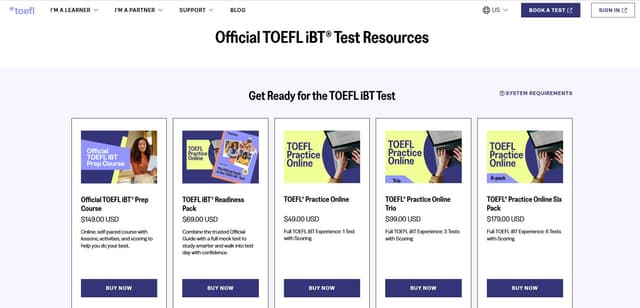
When preparing for TOEFL 2026, official ETS materials should be the starting point. The most useful official resources include:
- The Official Guide to the TOEFL iBT (OG)
- TOEFL TestReady
- ETS sample questions
- Official TOEFL 2026 blueprint documents
These resources help students understand question types, timing requirements, scoring criteria, the structure of the new exam, as well as all the most updated news or announcements about the new TOEFL exam.
Pros:
- Created by the test maker
- Most accurate representation of the exam
- Useful for learning format and expectations
Cons:
- Limited number of practice questions
- Limited mock-test volume
- Feedback is relatively basic
- Costs can add up if you need extensive practice
For most students, ETS materials are essential but usually not sufficient as a complete preparation solution.
2. LingoLeap
Best for: Full mock tests, targeted tasks practice, complete TOEFL 2026 preparation and score improvement
LingoLeap is an online TOEFL preparation platform that offers targeted section practice and full-length mock tests for TOEFL learners. It enables students to practice individual sections, take realistic exam simulations, review detailed feedback, and stay up to date with the latest test formats. As one of the few platforms specifically designed around the new TOEFL 2026 format, LingoLeap brings together a wide range of preparation resources in a single learning environment.
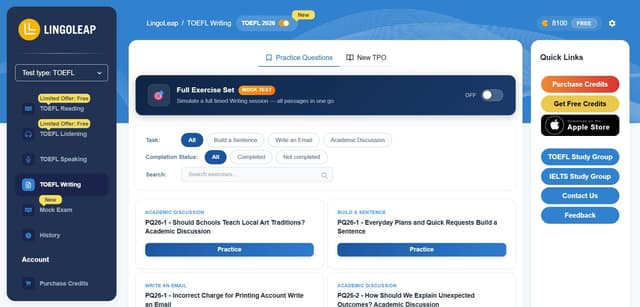
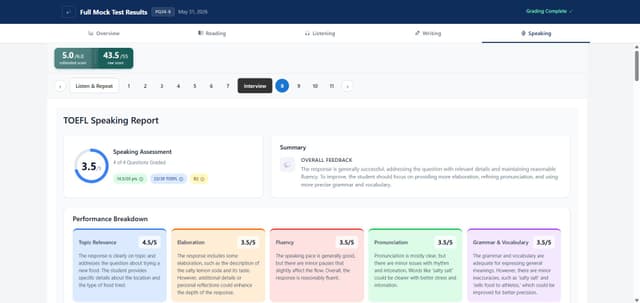
Many TOEFL learners study independently and lack access to feedback aligned with official scoring rubrics. LingoLeap addresses this gap by providing answer explanations for Reading and Listening, detailed performance feedback for Writing and Speaking, as well as grammar, vocabulary, pronunciation, and fluency corrections. Learners also receive comprehensive practice reports that help them track progress, identify weaknesses, and focus their preparation more effectively.
Pros:
- Clear Target: Built around TOEFL 2026 preparation
- Rich Question Bank: Full-length mock tests and skill-specific practice
- Detailed AI Review: Rubric-aligned scoring, grammar corrections, pronunciation analysis
- Comprehensive Study Support: Post-practice reports with vocabulary building, useful sentence patterns, and writing/speaking mind maps
- Strong Value for Money: Only $16.6/mo for Plus and $41/mo for Premium
Cons:
- Question bank is TOEFL-like, but not official ETS content
- AI scores are estimates and do not guarantee official TOEFL results
- Limited human review and personalized feedback
3. Magoosh
Best for: Structured, long-term study
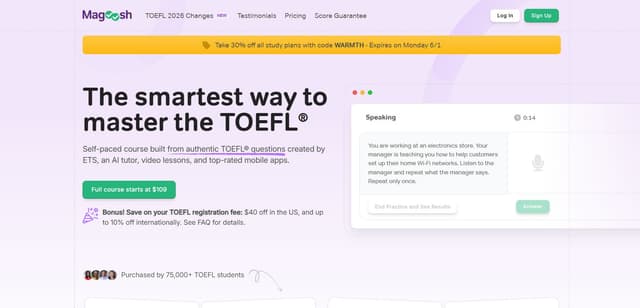
Magoosh has been one of the most popular TOEFL preparation platforms for years. Its biggest strength is its structured learning experience and abundant learning materials. Students can follow organized study plans and video lessons that explain key concepts and strategies.
Pros:
- Beginner-friendly
- Strong video lesson library
- Clear study plans
Cons:
- Less emphasis on realistic TOEFL 2026 simulation
- Feedback is less detailed than specialized AI platforms
- Mock-test experience may not feel as exam-like as dedicated simulation platforms
- Less cost-effective for learners with a short preparation timeline ($109/month)
4. TestGlider
Best for: Score estimation and practice testing
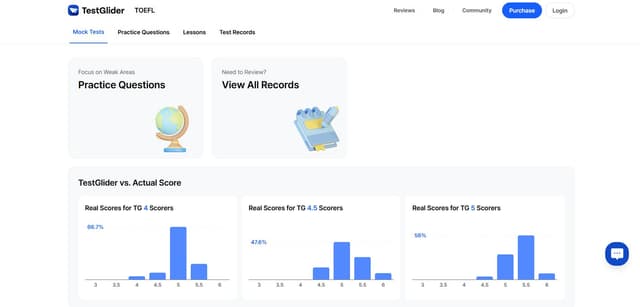
TestGlider is one of the most established TOEFL practice platforms and is widely used by students who want to estimate their current level before taking the official exam. Its practice tests and score predictions make it a useful benchmark for understanding where you stand during your preparation. Its primary value lies in assessment and score prediction. Learners can see how they are performing, but some may need additional resources to build a more structured improvement workflow after receiving their results.
Pros:
- Popular score prediction system
- Large question bank
- Established reputation
Cons:
- Focuses more on score estimation than improvement planning
- Feedback may be less actionable for self-study learners
- Limited support for personalized study guidance
- Learners may need additional resources for revision and review
5. Grammarly
Best for: Improving writing quality
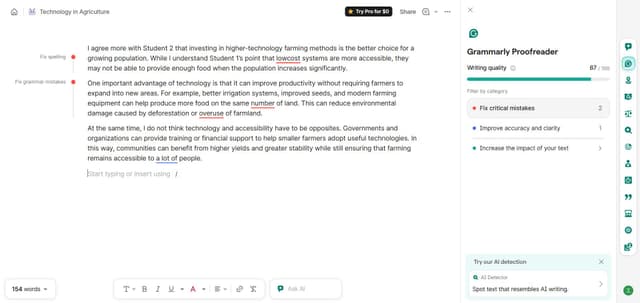
Grammarly is not a TOEFL-specific tool, but it remains one of the most useful writing resources available. It helps students improve grammar, clarity, word choice, sentence structure
Pros:
- Easy to use
- Excellent grammar correction
- Helpful for revision
Cons:
- Not designed around TOEFL scoring criteria
- Does not provide TOEFL-specific feedback
- Cannot evaluate task fulfillment or TOEFL writing strategy
For TOEFL preparation, Grammarly works best as a supplementary tool. Students who want TOEFL-specific scoring and feedback may find dedicated TOEFL platforms more useful.
6. Speechling
Best for: Pronunciation practice
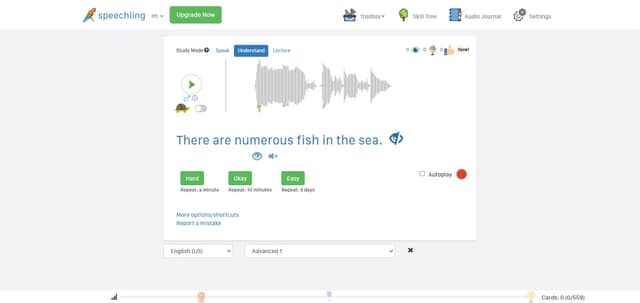
Speechling focuses on speaking improvement through pronunciation and repetition exercises. It is especially useful for students who want to sound more natural and confident when speaking English.
Pros:
- Strong pronunciation practice
- Speaking repetition exercises
- Helpful for building confidence
Cons:
- Not designed specifically for TOEFL tasks
- Does not simulate TOEFL speaking questions
- Limited TOEFL-specific scoring
Students preparing for TOEFL Speaking often combine pronunciation tools with platforms that provide exam-style speaking tasks and scoring.
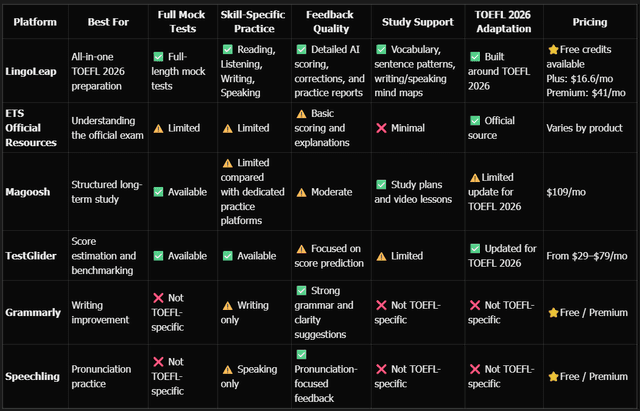
🔥 TOEFL 2026 Resource Comparison
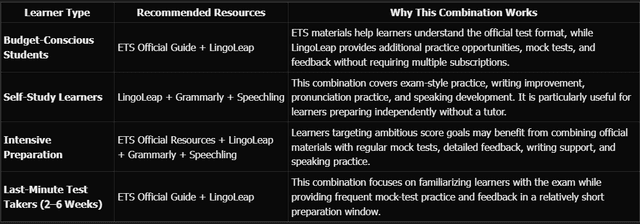
⭐ Recommended TOEFL 2026 Study Combinations
Final Thoughts
No single resource can cover every aspect of TOEFL 2026 preparation.
Official ETS materials remain the best way to understand the exam format, question types, and scoring expectations. At the same time, many learners benefit from additional practice opportunities and feedback throughout their preparation journey.
For most students, the most effective approach is to combine official resources with a practice-and-feedback platform that supports regular mock tests, skill-specific practice, and performance review. This allows learners not only to become familiar with the test, but also to build a consistent study routine and identify what to improve next.
Platforms such as LingoLeap can play a valuable role in this process by bringing practice, feedback, and review together in one place. Whether you are preparing for a few weeks or a few months, the goal is not simply to go through as many questions as possible, but to make each practice session more meaningful and actionable.