TOEFL Listening Sample 2025: Format, Tips, and Practice Resources
LingoLeapMay 23, 2025
TOEFL Listening Sample: What to Expect & How to Practice Effectively
So, you’re preparing for the TOEFL Listening section and wondering, “What does a TOEFL listening sample look like?” Great question—and you’re in the right place!
Whether you’re taking your first TOEFL listening practice test or you’ve tried a few already, this guide will break things down in simple, easy-to-follow steps. We’ll walk you through:
- What’s in the TOEFL Listening section
- A full TOEFL listening sample + explanation
- How to practice smarter
- Tips to avoid common mistakes
What Is the TOEFL Listening Section?
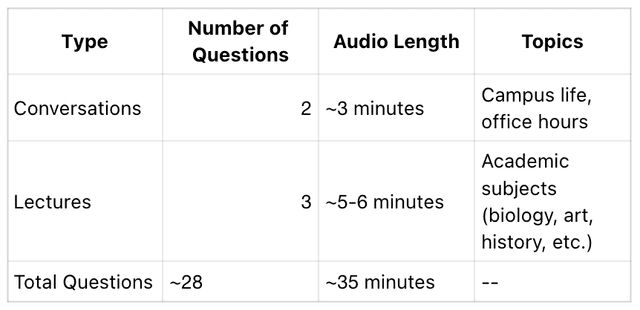
The TOEFL Listening section measures your ability to understand spoken English in academic settings. You'll hear conversations between students and professors, as well as lectures.
TOEFL Listening Format:
TOEFL Listening Sample: Try This Test Question
Let’s walk through a real TOEFL listening sample from a campus conversation. These are very common in the test, and they typically happen between a student and a university staff member or professor.
🎧 Listening Context: You will hear a conversation between a student and a university librarian.
Transcript: Campus Conversation Sample
Narrator: Listen to a conversation between a student and a librarian.
Student: Hi, I was wondering if you could help me find some sources for my paper. It’s about the economic impact of renewable energy in small towns.
Librarian: Sure. Do you need books, journal articles, or something else?
Student: Mostly journal articles. I need to cite recent studies—within the last five years.
Librarian: Got it. Have you used our academic database search yet?
Student: I tried, but I wasn’t getting anything useful. Maybe I was using the wrong keywords?
Librarian: That could be. Try searching for terms like “local economic development” and “renewable energy.” And use the filter for publication date—select only articles from the last five years.
Student: Okay, I’ll try that. Oh, and one more thing—I’m supposed to include at least one government report.
Librarian: You’ll probably find that on the Department of Energy’s website. They publish a lot of research on renewable energy.
Student: Perfect! Thanks for your help.
Librarian: No problem. Let me know if you need anything else.
📝 Sample Question:
What is the student's main purpose in speaking with the librarian?
A. To ask for help locating appropriate research materials
B. To get clarification on her research topic
C. To complain about the lack of library resources
D. To reserve a study room for group work
✅ Correct Answer: A. To ask for help locating appropriate research materials
Explanation: The student starts the conversation by saying, “I was wondering if you could help me find some sources for my paper.” This makes it very clear that her goal is to get research materials, specifically journal articles and government reports. The other options might sound reasonable at first glance, but they’re not supported by the actual conversation.
🏫 How to Practice with TOEFL Listening Samples
You don’t need to listen to 10 lectures a day to improve. Just follow this smart practice method:
1. Listen Actively
Don’t just hear—listen. Pay attention to:
- The speaker’s attitude (Are they confused? Angry? Explaining something?)
- Main ideas vs. supporting details
- Transitions like “however,” “on the other hand,” and “for example”
2. Use TOEFL Listening Practice Tests
You’ll find authentic TOEFL sample listening test questions on platforms like:
- LingoLeap TOEFL Listening Practice
- Official ETS TOEFL resources
- LingoLeap’s timed mock tests with audio + answer explanations
Try to simulate test conditions without pausing or replaying.
3. Take Notes Like a Pro
You don’t need full sentences. Just write:
- Keywords
- Speaker attitude (happy? skeptical?)
- Examples and contrasts
Here’s a sample note for a lecture on volcanoes: lava pressure ↑ → eruption; ex: Mt. St. Helens
4. Check and Reflect
After each TOEFL listening practice test:
- Check your answers
- Re-listen and pause to analyze: Why did I choose A instead of B?
- Make flashcards for new vocabulary
⚠️ 3 Common Mistakes in TOEFL Listening Practice
❌ 1. Listening Without Questions
It’s not a podcast—you need active recall. Always follow listening with questions.
❌ 2. Writing Too Much in Notes
This slows you down and makes you miss info. Focus on keywords only.
❌ 3. Ignoring Answer Choices
Sometimes, all options seem right. Practice elimination. If B sounds off-topic, cross it out!
Practice Makes Confident (If Not Perfect)
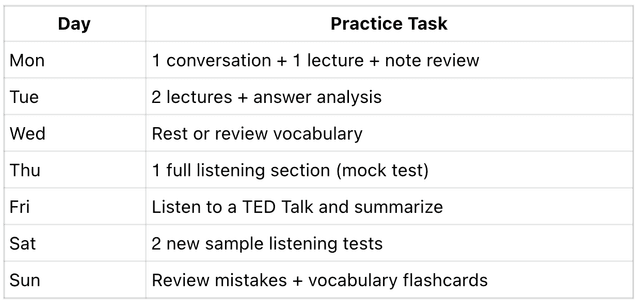
One full TOEFL listening sample test won’t boost your score magically—but 10 smart sessions will.
Here’s a sample weekly plan:
📚 Top Resources for TOEFL Listening Practice
Includes AI explanations, instant scoring, and authentic audio recordings.
- ETS Official TOEFL Practice Tests
Great for simulating real exam questions.
- 📺 TED Talks, NPR podcasts, and BBC Learning English
For expanding your listening range beyond the TOEFL world.
Ready to Boost Your TOEFL Listening Score?
TOEFL books can help, but they don’t give you interactive feedback, AI-based question analysis, or real-time scoring.
That’s where LingoLeap comes in. With our free trial, you’ll get:
- Full-length TOEFL listening practice tests
- Instant, personalized feedback and explanations
- Mock tests with authentic interfaces that simulate the real TOEFL
- Reliable scoring based on the official rubric
Practice smarter with LingoLeap. Try it free today!