TOEFL iBT Speaking Topics 2025: Tips, Prompts & Practice That Actually Work
LingoLeapMarch 31, 2025

So you’ve learned the TOEFL speaking template, practiced answering questions like a campus news anchor, and you’re lowkey crushing it. But deep down, you're wondering:
How do I stop freezing when a weird question pops up? Am I saying the right things? Why is 45 seconds suddenly the fastest time in the universe?!
We got you.
This guide will help you:
- Master common TOEFL speaking prompts
- Practice smarter (and less boring)
- Use feedback like a pro to actually improve
Oh, and we’re keeping it chill, clear, and a little fun — because language learning shouldn’t feel like dental work. 🦷✨
🎯 Common TOEFL iBT Speaking Topics (And Why They’re Not So Random)
Whether you're tackling the Independent Speaking Task or the Integrated Speaking Task, TOEFL loves throwing familiar—but slightly academic—situations your way.
Here's what typically shows up in TOEFL speaking prompts:
Independent Speaking Topics (Question 1)
These usually ask about:
- Personal preferences “Do you prefer studying at home or at a library?”
- Lifestyle choices “Is it better to have one close friend or a big group of friends?”
- Opinions on school policies “Should students be required to wear uniforms?”
The trick? Don’t overthink it. Choose a side, give 2 clear reasons, and wrap it up. Confidence > perfection.
Integrated Speaking Topics (Questions 2–4)
Now we’re cooking with gas:
- Campus-related prompts: Dorm policies, library hours, tuition changes
- Academic concepts: Marketing strategies, animal behavior, social theories
- Lecture summaries: Explaining a process or comparing two ideas
These TOEFL iBT speaking topics can feel intimidating — but they’re just mini TED Talks. With structure and strategy, you’ll breeze through.
⏱️ Practice Tips for Mastering TOEFL Speaking Prompts
Let’s talk practice that actually works. You don’t need 5 hours and a whiteboard. You need consistency, feedback, and a dash of creativity.Here’s your new TOEFL speaking prep routine:
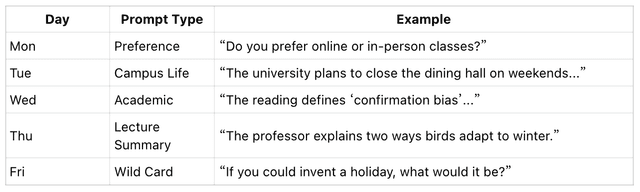
🔄 1. Rotate Different TOEFL Speaking Topics Daily
Don’t just answer the same two questions over and over. Mix it up! Here’s a quick weekly plan:
🎙️ 2. Always Speak Out Loud — For Real
You’re not preparing for a writing test. Say it with me (out loud): “Speaking means speaking!”
Even if your dog is your only audience, get used to:
- Saying full answers
- Timing yourself
- Using transition words like “first of all,” “in addition,” and “for example”
This builds muscle memory so when test day comes, you sound fluent — not frozen.
🎧 3. Record → Listen → Learn → Repeat
This step is pure gold. Use your phone to record answers to real TOEFL speaking prompts. Then listen back.
Here’s what to listen for:
- Did I answer the question?
- Was I organized?
- Did I speak clearly (not too fast or mumbly)?
- Did I finish on time?
Bonus: You’ll hear your progress and start self-correcting like a pro.
🤓 4. Evaluate Like a TOEFL Rater
Open up the TOEFL Speaking Rubric and score yourself. Seriously.
Ask:
- Was my response complete?
- Was my language use (grammar & vocab) appropriate?
- Was my delivery smooth?
You’ll quickly see patterns — maybe you need to work on transitions, or maybe you’re great at content but rush the conclusion. Once you know, you grow.
💬 5. Get Feedback (From Humans or AI)
You don’t have to do this alone. Try:
- A teacher or language exchange partner
- TOEFL Reddit or Discord groups
- Or… LingoLeap’s AI-powered feedback tool 👇
Upload your recording, and LingoLeap will:
- Score your response instantly
- Show fluency + grammar insights
- Highlight areas for improvement
- Compare your answer to high-scoring samples
It’s like having a coach, grader, and hype squad in your pocket. 🎧📱
Start your free trial on LingoLeap and see what your answers actually sound like to the algorithm.
Smart Tricks to Boost Your TOEFL Speaking Score
Let’s sprinkle in some expert-level, underappreciated tips:
1. Use “Speaking Filler Phrases” Wisely
They buy you time and sound natural. Try:
- “Let me think for a moment...”
- “That’s an interesting question...”
- “One example that comes to mind is...”
Just don’t overuse them — you’re not a broken record.
2. Practice Answering With Structure
No matter the prompt, use this winning formula:
- Intro Sentence — State your main point
- Reason 1 + Example
- Reason 2 + Example
- Conclusion — Reaffirm your opinion or summarize
Use this structure even with unexpected TOEFL iBT speaking topics, like:
“If you could design a new course for your university, what would it be?”
Boom — easy plug-and-play. For more detailed breakdowns, examples, and ready-to-use sentence starters, check out our full guide on the TOEFL speaking template.

3. Mirror Practice = Confidence Booster
Yes, we said it. Stand in front of your mirror and speak your answers. Watch your expressions. Pretend you're explaining it to a friend.
You’ll catch awkward habits, build natural delivery, and boost your confidence tenfold.
Final Thoughts: Master TOEFL iBT Speaking Topics Like a Pro
Here’s the truth: You can become that person who says, “Oh, speaking? That’s the easiest part.”You just need:
✅ Smart strategy
✅ A system to practice real TOEFL speaking prompts
✅ Honest, actionable feedbackWhether you’re aiming for 23+ or a full 30, the right tools make all the difference.
👉 Try LingoLeap to access:
- Hundreds of TOEFL iBT speaking topics
- Instant AI scoring
- Sample answers + personalized feedback
- A growing community of learners just like you
✨ Your voice is ready. Let’s make it shine on test day. Start your free trial today →