The English Grammar Corrections view places highlighted writing beside proposed changes. Read the change in context before using it. This recording illustrates report navigation, not a second attempt or a score increase.
Text walkthrough · no audio
- Find the highlighted wording in the original writing.
- Compare it with the suggestion on the right and decide whether the change preserves your intended meaning.
Open the result for the right attempt
In the TOEFL app, open History, locate the completed practice and select View result. Check the question, task type and exam version. A full-mock summary and an individual-task report describe different amounts of work.
Understand the scale before comparing scores
For the 2026 TOEFL format, section and overall bands use 1–6 in half-point steps. Earlier TOEFL reports use 0–30 per section and 0–120 overall. LingoLeap can also show a comparable traditional score; it is not an extra official result. A task-level 0–5 mark is not the same scale as a 1–6 section band.
Check the label beside each number. A task estimate, section estimate, accuracy percentage and overall estimate answer different questions. Do not average unlike scales yourself. These are practice estimates; only ETS issues official TOEFL scores. See ETS’s explanation of TOEFL scores for the examination scale.
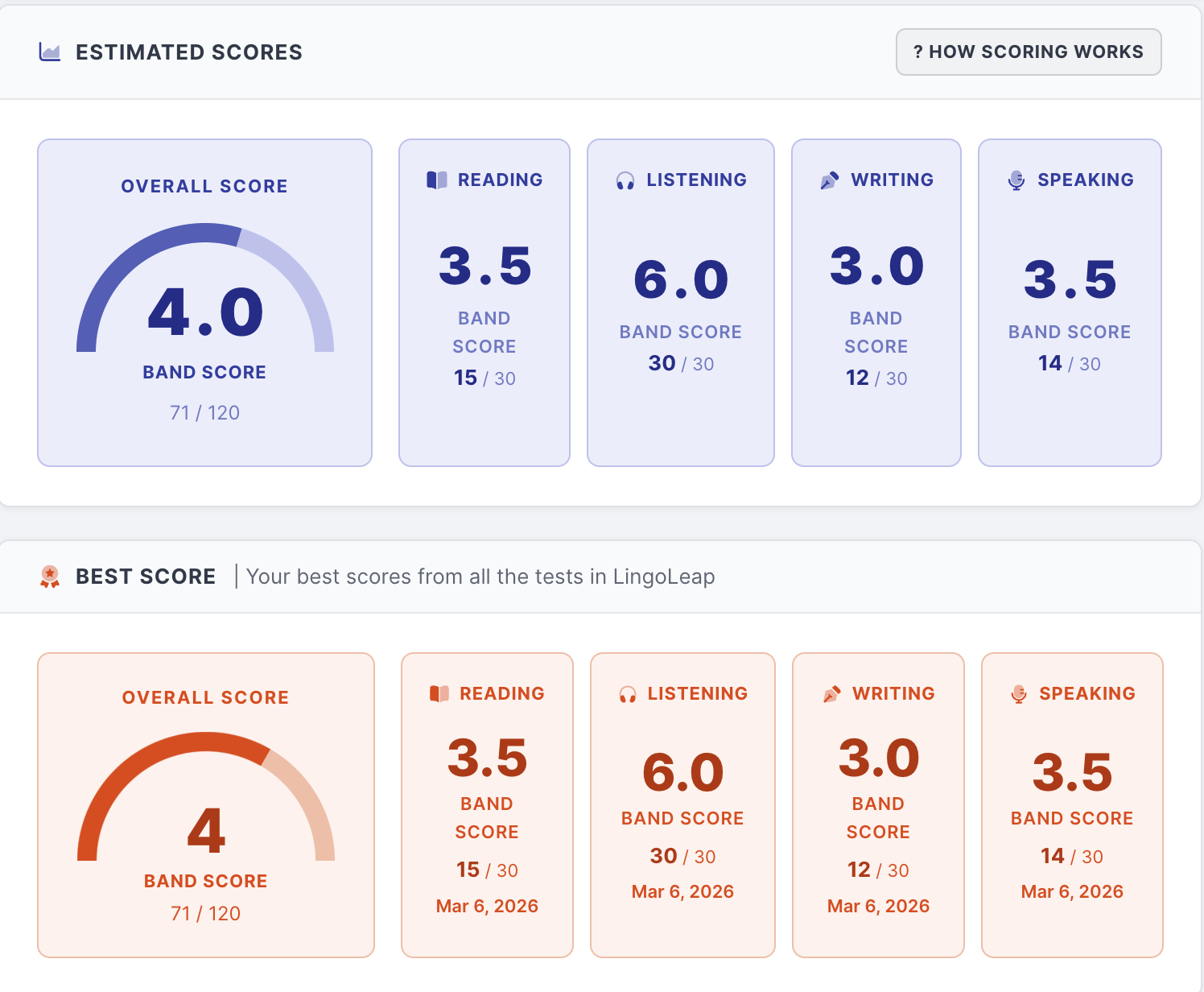
Estimated Scores describe the illustrated mock. Best Score is a separate summary across tests, not a new score awarded for reading a suggested rewrite. These are practice estimates.
Open full-size imageRead the fields in context
- Your answer and answer review
- For Reading, Listening and Build a Sentence, compare your response with the accepted answer. Return to the passage, audio or sentence to understand the difference.
- Score and dimension feedback
- For evaluated Speaking and Writing, read the comments for the specific task. Email feedback can address content, language variety, social conventions and accuracy. Discussion feedback focuses on the response to the discussion as well as support and language.
- Transcript and speech analysis
- Replay the recording before treating a transcript word as something you actually said. Pronunciation or fluency analysis is a practice aid, not another official examination score.
- Corrections, suggested revision and sample answer
- Compare these with your own answer. Keep changes that preserve your meaning and answer the prompt; do not assume every generated sentence is suitable.
Teaching example: make a request clear
This teaching example shows one way to make a request easier to understand. It illustrates a sentence-level revision, not a question-bank item, personal report or new score.
Original response
I hope your confirmation at this building, requesting confirmation my return will be recorded correctly.
Suggested revision
Could you please confirm that my return will be recorded correctly?
Why it helpsThe revision makes the request explicit: you want the recipient to confirm that the return will be recorded correctly.
Try this nextFind the main request in your own email. Write it as one clear sentence, then check it against the task.
Teaching example for Write an Email. The revision illustrates a clear request; it is not a personal report or a measured second attempt.
Turn feedback into your next practice
- Choose one issue: for example, an unclear request, missing supporting detail or a sentence-form error.
- Explain to yourself why the suggestion helps the task.
- Apply that one change in a new response, then review that attempt’s result separately.
A different prompt, recording, timing or scoring judgement can change a practice estimate. A suggested answer is not evidence of a measured improvement. Use repeated practice as a learning record, not a promise of a particular test-day score.
Put it into practice
Open TOEFL HistoryYour account and responses
Use My Account for account details. Read the international Privacy Policy for the published data terms, including its statements about content and model use. Contact support if you need clarification before submitting personal information.