TOEFL 2026 Score Calculator
Average four section scores into your overall TOEFL 2026 band — or set a target and see exactly what your remaining sections need to score.
⚡ Unlike most TOEFL calculators, this one also reverse-engineers missing section scores from a target band.
By Erin, LingoLeap Content & SEO Specialist · Reviewed by the LingoLeap TOEFL Content Team · Last reviewed:
Enter Your Section Scores
Select your band score (1.0–6.0) for each section. Leave a section empty to exclude it.
Know your score — now improve it
Move from your current band to your target with adaptive mock tests and AI-scored Speaking & Writing.
How Your Score Is Calculated
Mode 1 — Section-score average
- •Each section is scored 1.0–6.0 in 0.5 increments.
- •Overall band = simple average of all four sections.
- •Result is rounded to the nearest 0.5.
- •All sections are weighted equally — no section counts more than another.
Overall = (R + L + S + W) ÷ 4
Example
(4.0 + 4.5 + 3.5 + 4.0) ÷ 4 = 4.0
Mode 2 — Target + partial scores
- •Pick your target overall band and enter the section scores you already know.
- •Leave at least one section blank — those are the ones the calculator solves for.
- •Math: needed total = 4 × target − sum of filled; even split across missing sections.
- •Adjust your filled sections or target to play with realistic combinations.
Example — Target Band 4.5
R = 4.5 · L = 4.5 · S = ? · W = ?
Needed total = 4 × 4.5 − 9.0 = 9.0
Average needed in S & W = 4.5
How to Use This TOEFL Score Calculator
Two short workflows depending on what you already know. Whichever mode you start with, you can switch to the other any time without losing your inputs.
How do I calculate my TOEFL 2026 band from my section scores?
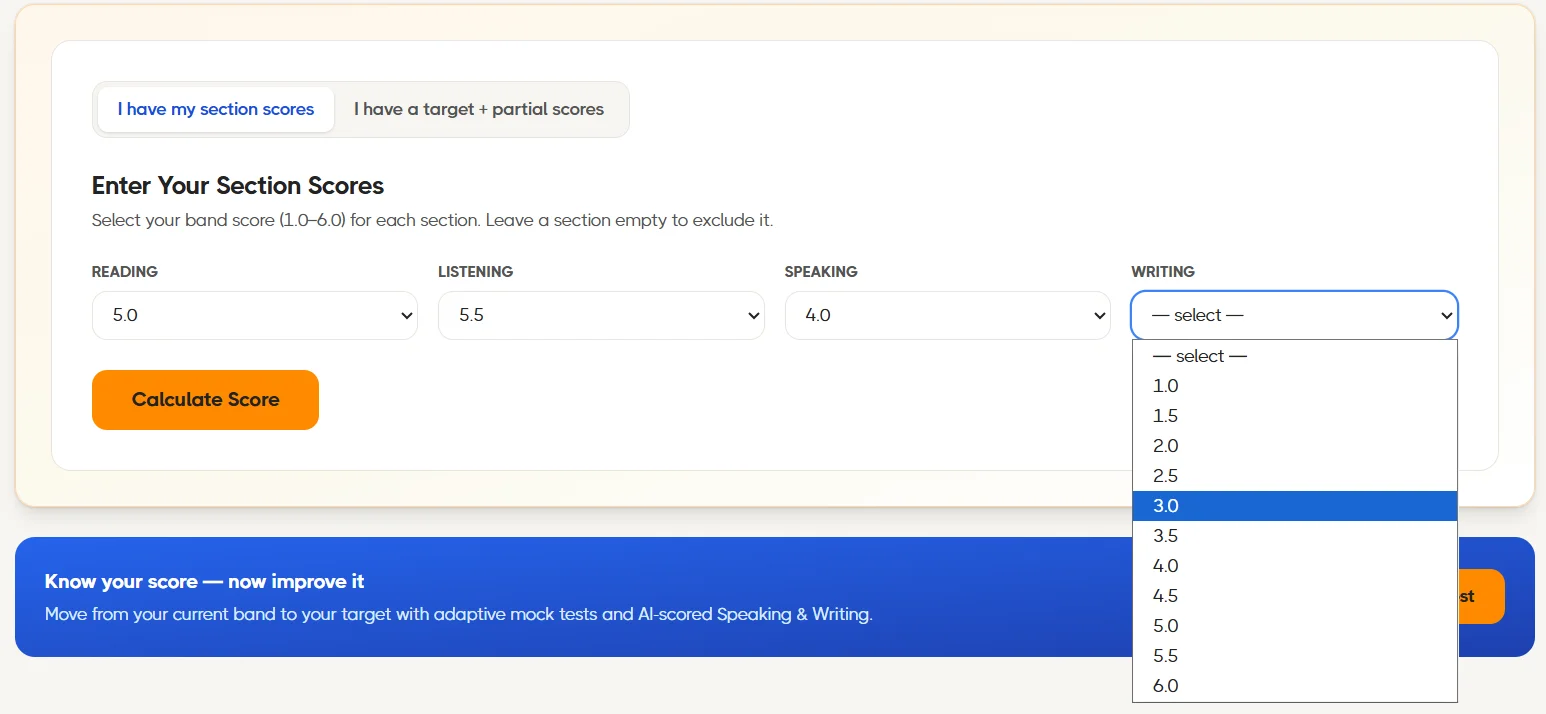
- 1Make sure the toggle is on "I have my section scores".
- 2Pick your band (1.0–6.0 in 0.5 increments) for each of Reading, Listening, Speaking, Writing. Empty sections are excluded — useful if you only have partial scores from a recent practice round.
- 3Click Calculate Score. The result panel shows your overall band, level (e.g. "Advanced"), and a per-section breakdown color-coded against the average so you can spot weak sections instantly.
How do I figure out what my missing sections need to score?
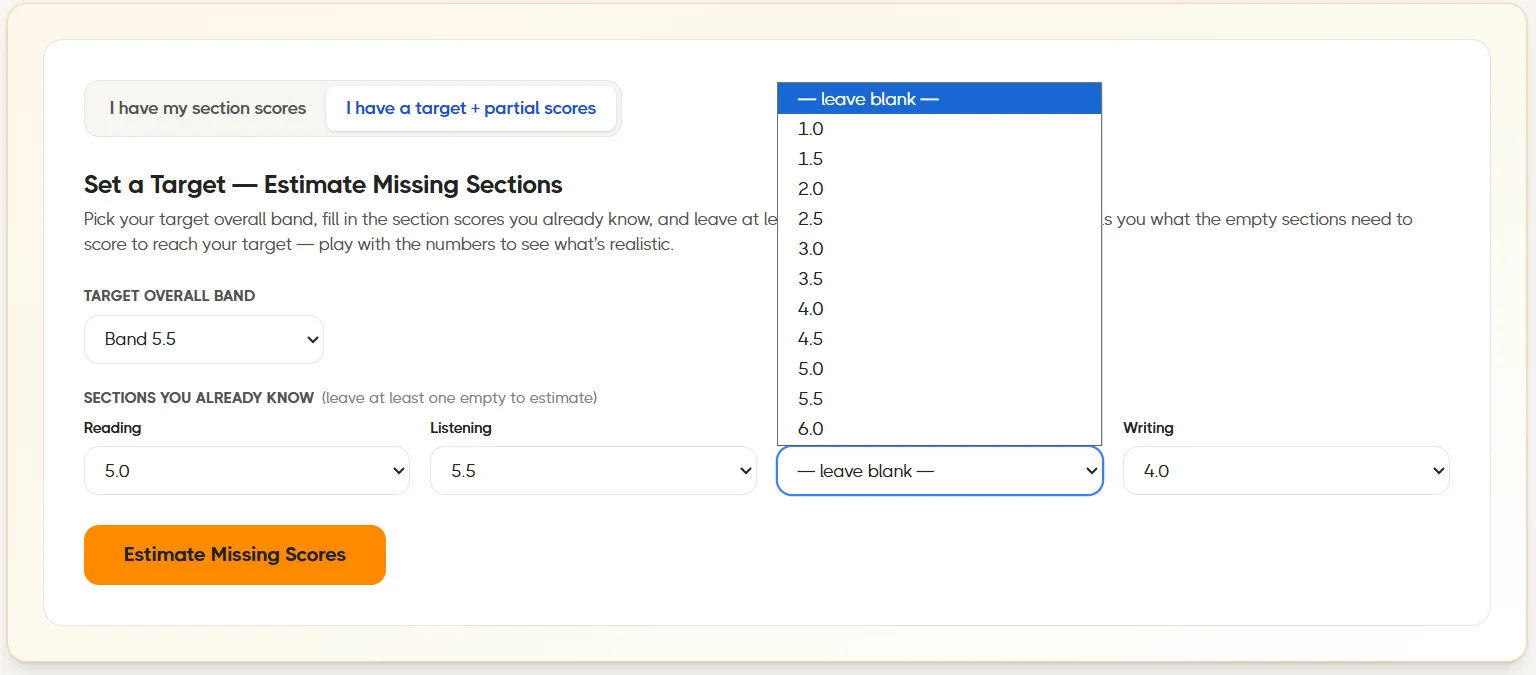
- 1Switch the toggle to "I have a target + partial scores".
- 2Pick your target overall band. This is usually the published minimum at your top-choice school plus a 0.5 buffer — check the University Admission Calculator if you don't know it yet.
- 3Fill in the section scores you already have, leave at least one blank.
- 4Click Estimate Missing Scores. The calculator returns the average band needed across the empty sections to hit your target. Adjust your filled scores or target to explore which combinations are realistic.
Pro tip — take a full mock first
The calculator is most useful when your section scores come from a full timed mock rather than untimed exercises. LingoLeap's 2026-aligned mock tests give you AI-scored Speaking & Writing bands you can plug straight into either workflow.
Take a 2026-aligned mock test →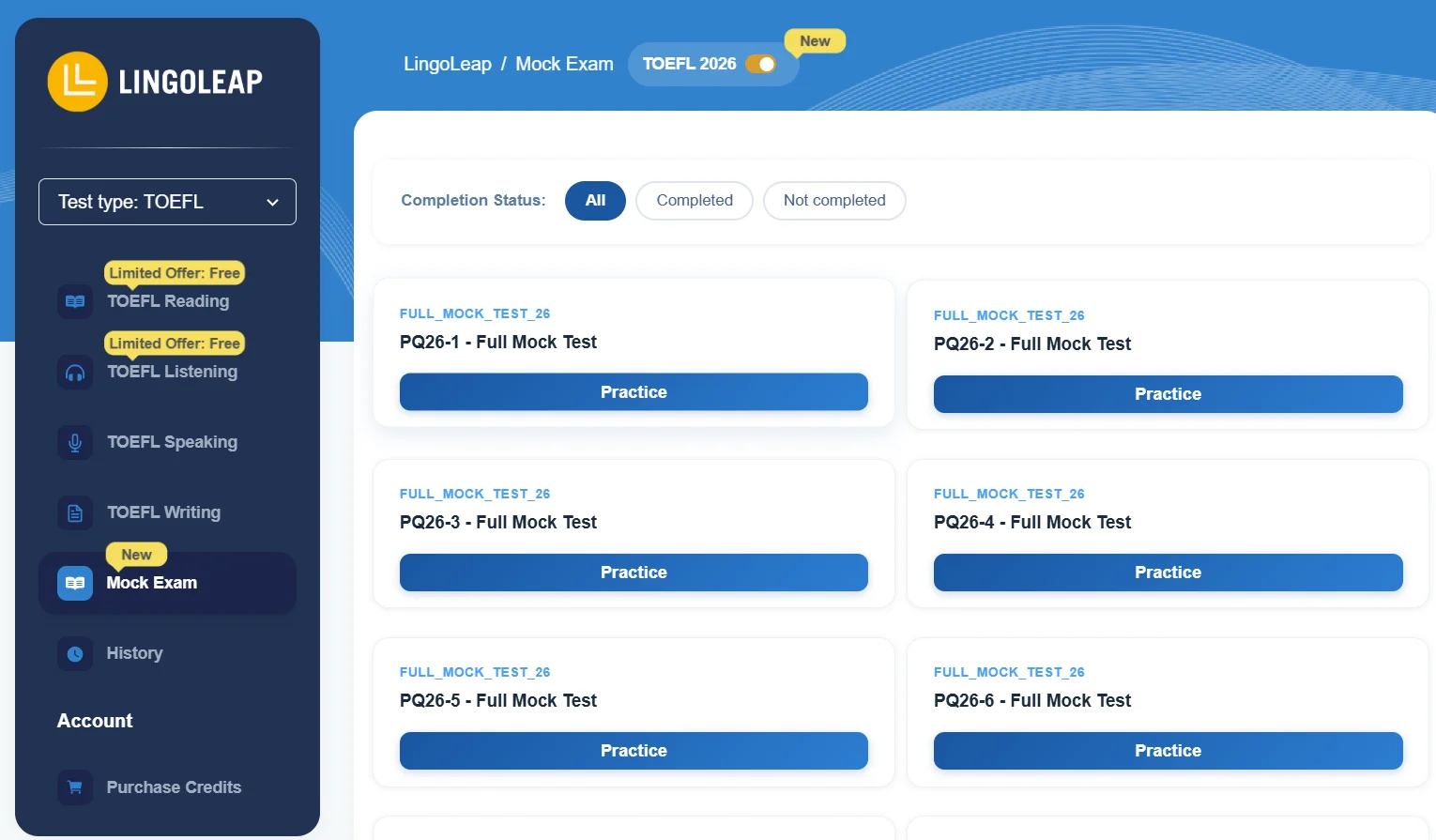
Score data based on official ETS TOEFL scoring guidelines. ETS TOEFL Official Site · Score Requirements
Frequently Asked Questions
How is the TOEFL 2026 overall score calculated?
How does the target + partial scores mode work?
4 × target − sum of filled), then divides evenly across the empty sections so you see the average band each missing section needs. If the target is unreachable even with Band 6.0 in the missing sections, the tool tells you; if your filled sections already exceed the target, it tells you that too. Use this mode after a partial mock test to see whether your weakest sections still need to lift, then take that figure into the Score Gap Planner for a prioritized study plan.What if I only have scores for some sections?
What is the minimum TOEFL 2026 section score?
Can I improve my score by focusing on one section?
What overall band score do most universities require?
Ready to Hit Your Target Score?
Practice with AI-powered TOEFL exercises and full mock tests. Get instant feedback and track your progress.
Start Free Practice