
Companion study · first-language comparison
Which English Sounds Are Hardest for Chinese TOEFL Learners?
Helen He, CEO, LingoLeap · September 2026
Quick answer
Across 6,057 sessions that set an interface language, Chinese-interface learners (4,904 sessions) and English-interface learners (1,045 sessions) score within 1.4 points of each other on almost every English sound. The one clear divergence is /θ/: it is the hardest sound for the Chinese-interface group (63.5/100), about 9 points below that group’s next-hardest sound — and it does not even reach the English-interface group’s ranked difficulty list.
The main study kept first language out of scope, because it is unavailable for most sessions. This page runs the one first-language cut the data can support: Chinese-interface versus English-interface learners.
We expected the boring, easily-misread result — “Chinese learners score lower overall.” The data says something more interesting: the two groups are almost identical everywhere, and diverge at exactly one sound. That near-parity is what makes the exception credible — it is not a by-product of general ability, but a specific, trainable target.
Phương pháp nghiên cứu
Learners did not declare a first language. We use their chosen LingoLeap interface language as a proxy. Two consequences follow: interface language is not the same as native language, and only about 26% of learners set one (6,057 of 23,390 sessions). This page therefore describes that subset and does not represent all TOEFL learners or support population-level claims.
Otherwise the method matches the main study: each recording is scored by automatic pronunciation assessment (0–100 per phoneme), and word-final -s is recovered by aligning the target to the recognised words. A sound is ranked within a group only when it accumulates roughly 1,000+ measurements in that group; rarer sounds are left unranked. We report denominators, means, and group differences, but no significance tests — repeated learners and prompts are not independent observations.
- Mẫu
- 6,057 of 23,390 TOEFL 2026 Listen and Repeat sessions set a LingoLeap interface language: 4,904 Chinese-interface sessions (32,231 scored attempts) and 1,045 English-interface sessions (6,879 attempts). The number of distinct learners is not recorded.
- Thời gian
- From 1 January 2026. The end of the extraction window is not recorded in this study's data file.
- Nguồn
- A read-only, offline aggregation of LingoLeap practice records, joined to each learner's interface-language setting, which stands in for first language. Aggregates only: no recordings, transcripts, user IDs or individual attempts.
- Cách tạo điểm số
- Phoneme accuracy (0–100) comes from automatic speech pronunciation assessment; sentence scores (0–5) are LingoLeap AI platform scores. None of these are ETS scores.
- Loại trừ
- The 17,333 sessions with no interface language are outside the comparison. A sound is ranked within a group only with roughly 1,000+ measurements in that group, so /θ/ is unranked for English-interface learners.
- Hạn chế
- Interface language is a proxy, not a declared first language, and covers only about 26% of sessions. Observational: no significance tests, and repeated learners and prompts are not independent. Pronunciation is judged by a machine, not a phonetician.
Pattern 1: The one sound that actually diverges is /θ/
/θ/ is the hardest sound for the Chinese-interface group at 63.5/100; for the English-interface group it does not rank as a difficulty at all.
Nhúng biểu đồ này
Dán đoạn HTML này vào trang của bạn. Đây là ảnh tĩnh kèm liên kết ghi nguồn: không có script, không có iframe.
<figure style="margin:0;max-width:660px">
  <img src="https://lingoleap.ai/research/charts/chinese-learners-phoneme-compare.svg" alt="Figure 1. Accuracy by sound, both groups" width="660" height="472" style="max-width:100%;height:auto" loading="lazy">
  <figcaption>Nguồn: <a href="https://lingoleap.ai/research/chinese-learners-toefl-pronunciation">LingoLeap, Which English Sounds Are Hardest for Chinese TOEFL Learners?</a></figcaption>
</figure>
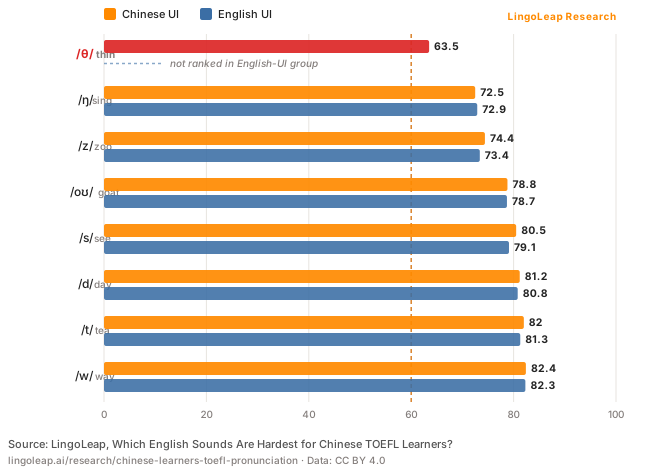
The size of the gap is worth pausing on. The Chinese group’s second-hardest sound, /ŋ/ (72.5), already sits about 9 points above /θ/. So /θ/ is not “one more slightly hard sound” — it is a single outlier, cleanly separated from the rest. Of its 3,252 measured occurrences, 36.0% fell below the 60-point threshold.
› Why this particular sound?
Mandarin and most Chinese varieties have no /θ/ in their inventory, and learners often substitute the nearest sounds, /s/ or /t/ — exactly the phoneme-specific variation cross-language speech research predicts [2]. That is a plausible reading of the pattern, not a substitution mechanism this page tested directly.
Pattern 2: Almost everything else is the same
This section is really the control for the last one. If the two groups differ only at /θ/ and match everywhere else, the /θ/ gap is more likely a real linguistic effect than an artefact of sampling or overall level.
| Sound | Chinese UI | English UI | Difference |
|---|---|---|---|
| /θ/ | 63.5 | unranked | — |
| /ŋ/ | 72.5 | 72.9 | -0.4 |
| /z/ | 74.4 | 73.4 | +1.0 |
| /oʊ/ | 78.8 | 78.7 | +0.1 |
| /s/ | 80.5 | 79.1 | +1.4 |
| /d/ | 81.2 | 80.8 | +0.4 |
| /t/ | 82 | 81.3 | +0.7 |
| /w/ | 82.4 | 82.3 | +0.1 |
Sentence length behaves almost identically too. Reproduction falls as sentences grow in both groups, and the curves nearly overlap — 79.5% vs 81.2% on the shortest sentences, 51.5% vs 53.2% on the longest.
Nhúng biểu đồ này
Dán đoạn HTML này vào trang của bạn. Đây là ảnh tĩnh kèm liên kết ghi nguồn: không có script, không có iframe.
<figure style="margin:0;max-width:660px">
  <img src="https://lingoleap.ai/research/charts/chinese-learners-sentence-length.svg" alt="Figure 2. Reproduction by sentence length, both groups" width="660" height="320" style="max-width:100%;height:auto" loading="lazy">
  <figcaption>Nguồn: <a href="https://lingoleap.ai/research/chinese-learners-toefl-pronunciation">LingoLeap, Which English Sounds Are Hardest for Chinese TOEFL Learners?</a></figcaption>
</figure>
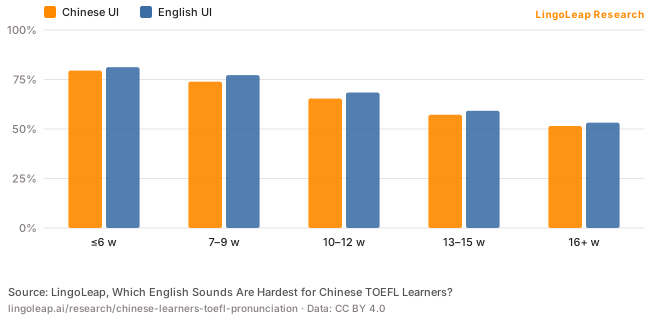
Word-final -s tells the same story: 10.7% dropped in the Chinese-interface group versus 9.6% in the English-interface group. Put together, the picture is clear — the two Listen and Repeat profiles largely overlap, and the one meaningful crack is at /θ/.
How to read this
The largest group — learners who set no interface language — also ranks /θ/ hardest, at about 61, matching the Chinese-interface group. Given LingoLeap’s heavily Chinese-speaking user base, that is consistent with the unset group being largely Chinese-first-language. It corroborates the pattern but is not independent confirmation.
For a Chinese-first-language test-taker, this narrows a vague worry (“my pronunciation isn’t good enough”) into a concrete target: /θ/ is worth isolating and prioritising, while on most other sounds your gap to English-interface learners is small. It also argues for targeting the few sounds that actually diverge by first language, rather than “practising pronunciation” in general.
What this study cannot show
- Interface language is a proxy for, not the same as, first language; it cannot separate heritage speakers, bilinguals, and similar cases.
- Limited coverage: only about 26% of learners set a UI language, and the English-interface group has just 1,045 sessions — a much smaller sample than the Chinese group.
- /θ/ is unranked for the English-interface group because its measurement count fell below the threshold, so we say only that it does not enter the difficulty ranking — not that it is easy for English-interface learners.
- These are automatic-assessment outputs, not phonetician judgements; the /θ/ substitution mechanism (/s/ vs /t/) is not tested directly here.
- The design is observational: no significance tests and no causal claims.
Turn the finding into practice
If you are a Chinese-first-language learner, the most practical next step is to train /θ/ inside real sentences, not in isolation. These two entry points cover the method and the practice:
The Listen and Repeat method guide
Turns pronunciation and reproduction targets into a practice routine.
Back to the main study
Length, pauses, endings, and phonemes across 152,218 attempts.
Beyond pronunciation, the interview companion study finds Chinese- and English-interface learners score almost identically on Delivery, Language Use, and Topic Development.
Dữ liệu
Các bảng tổng hợp của nghiên cứu này, dưới dạng tệp CSV.
- Accuracy by sound, Chinese- vs English-interface learnerschinese-learners-phoneme-compare.csv
- Reproduction by sentence length, both groupschinese-learners-sentence-length.csv
- Tài liệu cho giáo viên (PDF)Một trang, khổ A4 và Letter: ba phát hiện, một bài luyện tập trên lớp và lưu ý về phương pháp.
Giấy phép: Chỉ số liệu tổng hợp, theo giấy phép CC BY 4.0: bạn có thể dùng lại khi ghi nguồn LingoLeap và dẫn liên kết về trang này. Không công bố bài làm, bản ghi âm hay điểm cá nhân của người học.
Cách trích dẫn
APA 7
He, H. (2026, September 6). Which English sounds are hardest for Chinese TOEFL learners? (Version 1.0). LingoLeap. https://lingoleap.ai/vi/research/chinese-learners-toefl-pronunciation
MLA 9
He, Helen. “Which English Sounds Are Hardest for Chinese TOEFL Learners?” LingoLeap, 6 Sept. 2026, lingoleap.ai/vi/research/chinese-learners-toefl-pronunciation.
Phiên bản 1.0 · Xuất bản 6 Sep 2026 · DOI: chưa được cấp · Giấy phép: CC BY 4.0
Notes and sources
- [1] Best, C. T., & Tyler, M. D. (2007). Nonnative and second-language speech perception. In Language Experience in Second Language Speech Learning (pp. 13–34). John Benjamins.
- [2] Saito, K. (2019). Effects of second language pronunciation teaching revisited. Language Learning, 69(3), 652–708.
- [3] Microsoft. (2026). Use pronunciation assessment. Microsoft Learn.
Questions we hear from learners
What is the hardest English sound for Chinese TOEFL learners?
/θ/ — the "th" in "thin" — is the hardest by a wide margin. Among Chinese-interface learners it averaged 63.5 out of 100, about nine points below the next-hardest sound, and 36% of its measured occurrences fell below the 60-point accuracy threshold. Mandarin and most Chinese varieties have no /θ/, which is the usual explanation.
Do Chinese learners pronounce English worse overall?
No. In this data the two groups are nearly identical on almost every sound: /ŋ/ (72.5 vs 72.9), /z/ (74.4 vs 73.4), /s/ (80.5 vs 79.1) and others differ by less than 1.5 points. The gap is specific to /θ/, not a general difference in ability.
How was a learner's first language determined?
It was not declared. We use the learner's LingoLeap interface language as a proxy for first language, joined by user. This is imperfect and only about a quarter of learners set a UI language, so the comparison describes that subset rather than all TOEFL learners.
How can Chinese learners practice the /θ/ sound?
Place the tongue tip lightly between the teeth and push air out without voicing, avoiding the /s/ substitution. Practice minimal pairs (think/sink, thin/sin) and target the sound inside real Listen and Repeat sentences rather than in isolation.