2026 TOEFL Email Writing Template and Sample Essay: Addressing an Academic Project Issue
YutingFebruary 25, 2026

Campus & Academic Communication questions are among the most common scenarios in the TOEFL 2026 email writing task. While some prompts involve coordinating with classmates or requesting permission from a professor, others test your ability to manage academic conflict.
These peer-facing emails are particularly challenging because they require emotional control, clarity, and solution-focused communication. If you’d like a deeper understanding of how tone and organization influence scoring, you can refer to our detailed breakdown of the 2026 TOEFL Writing Rubrics, where we explain what raters prioritize in high-level responses.
In this case study, we examine a common academic scenario: addressing a group member who has not been actively contributing to a project. We’ll apply the 3+1 TOEFL email writing structure, analyze the prompt, review a high-scoring sample email, and highlight reusable language for constructive peer communication.
Example Question & Prompt Analysis
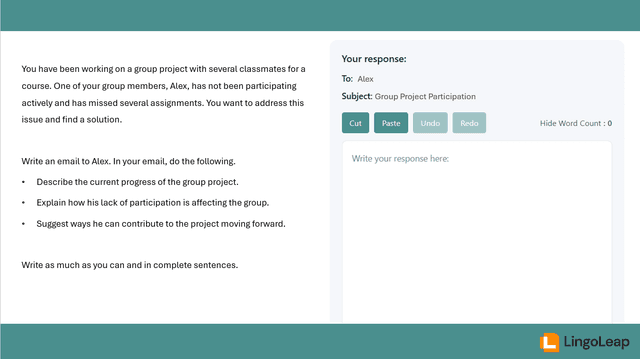
To Analyze This Prompt:
1️⃣ Identify Recipient & Tone
- Scenario type: Campus & Academic Communication
- Recipient: Classmate—Alex
- Tone: Direct but calm, constructive, and respectful
This is not a formal email, but it is also not casual peer chatting. The key difficulty is balance:
- Honest, not accusatory
- Clear, not emotional
- Solution-oriented, not complaining
2️⃣ Convert Bullet Points into 3+1 Structure
- Bullet point 1 → Discuss group progress
- Bullet point 2 → Describe current situation and impact
- Bullet point 3 → Offer solutions moving forward
- Closing → Encourage cooperation
If you follow this order, your message remains organized and professional.
A High-Scoring Writing Sample & Analysis
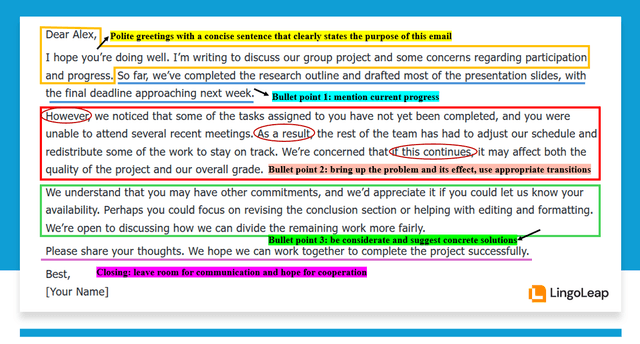
1. Clear and Polite Opening
The email begins with a brief and polite greeting, followed by a concise statement of purpose: addressing concerns about participation and project progress. This makes the intention clear without sounding confrontational.
2. Bullet Point 1 – Stating Current Progress
The writer first explains what the group has already completed and mentions the upcoming deadline. This provides objective context before discussing the issue, which helps keep the tone professional.
3. Bullet Point 2 – Addressing the Issue Without Accusation
This is the most challenging part of the task. Instead of directly accusing Alex, the writer states observable facts:
- Tasks assigned to him remain incomplete
- Meetings were missed
The focus then shifts to the impact on the group rather than personal blame. Transitions such as “however”, “as a result”, and “if this continues help the message” flow logically and firmly express concern without sounding emotional. The tone is balanced—clear but not aggressive.
4. Bullet Point 3 – Proposing Solutions
Rather than simply criticizing, the writer suggests specific ways Alex can contribute moving forward. There is some flexibility (“we understand you may have other commitments”), but the message does not weaken the expectation of participation.
Importantly, the email invites response and discussion, leaving room for cooperation instead of ending with a demand.
5. Polite and Collaborative Closing
The closing remains calm and constructive. It expresses hope for continued teamwork and successful completion of the project, reinforcing a solution-oriented tone.
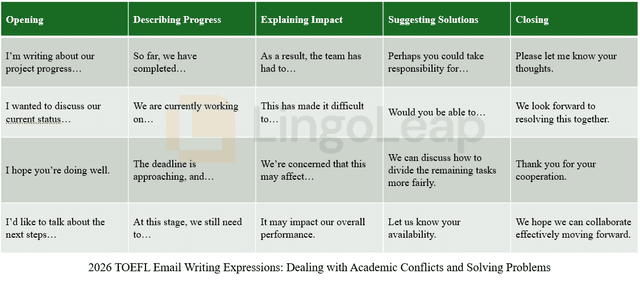
Expression Bank: Email Language You Can Reuse When Dealing with Academic Conflicts and Solving Problems
Practice More with LingoLeap
In peer-conflict scenarios, organization and tone matter equally. Completing the bullet points is essential—but how you frame the issue determines whether your response feels mature and professional.
If you:
- Present facts before opinions
- Focus on impact rather than accusation
- Offer practical next steps
You’ll produce a response that feels realistic and earns a strong score.
Writing with a strong organization and the 3+1 structure reduces cognitive load under timed conditions. However, developing this level of calm, structured writing requires practice with realistic prompts, exam-style timing, and structured feedback.
For TOEFL 2026 test-takers, mastering email writing takes deliberate training. LingoLeap combines AI-powered email simulations, timed writing practice, and rubric-aligned evaluation to help learners internalize structured academic writing patterns efficiently.
Start a free trial and get your hands muddy with 2026 TOEFL Writing practices now!