TOEFL Exam Preparation| 10 tips for improving your writing
LingoleapDecember 20, 2023
After the" TOEFL reform", the duration of the writing section has been reduced to half an hour.
However, it's quite challenging to write two complete essays within 30 minutes.
Today, Leapy will share some TOEFL writing tips: (The first five tips are applicable to the TOEFL Integrated Writing Task, i.e., Task 1. The last five tips are applicable to the TOEFL Academic Discussion Writing, which is Task 2)
Here are all the tips:
Tip 1: While listening to the audio material, also pay attention to the reading material, as the audio often refutes the opinions made in the reading.
Tip 2: Since the audio material is played only once, note down key words while listening.
Tip 3: Paraphrase the material content. One of the TOEFL scoring criteria is vocabulary range, and you would get a low score if you copy directly from the material.
Tip 4: Use a variety of transitional words and phrases to help connect your points.
Tip 5: Manage your time.
Tip 6: In the Discussion, add your own thoughts; don't just repeat the existing viewpoints.
Tip 7: Avoid using a lot of complex tenses, try to use simpler tenses.
Tip 8: Use a variety of sentence structures and make good use of clauses.
Tip 9: Leave at least 1 minute to check for grammatical or spelling errors in your essay.
Tip 10: Practice writing regularly and pay attention to writing evaluations.
1. Integrated Writing - Task 1
Tip 1: Read first, then listen
Task 1 includes an audio material and a reading material.
The reading passage will appear first, and you will have 3 minutes to read the article and take notes.
Afterward, the reading passage will disappear, the audio material will begin to play, and then you have 20 minutes to write your essay.
The initial reading material is crucial because sometimes the points in the audio material directly contradict those in the reading.
Therefore, if you get distracted during the reading time, you might miss some important information that needs to be included in your writing because you didn't catch the contradictions between the listening and reading materials.
Tip 2: Write down key words
In the Task 1, especially during the listening segment, taking good notes is very important because:
The reading material will reappear on the screen after the listening material has finished playing and will remain visible during your writing time. Therefore, while it's important to note the points in the reading material during the first read, you don't need to take too many notes on the reading part.
On the other hand, the listening material is longer than the reading material and will only be played once. Therefore, it's essential to maintain 100% focus and take good notes while the listening material is playing.
Tip 3: Do not quote directly
For Task 1, you must explain the positions of the author and the professor in your own words, especially for the reading material.
Since the reading material will always be displayed on the screen during writing, some students tend to quote directly from the text. However, it can lower your writing score.
Therefore, in our regular practice, we need to accumulate vocabulary and train our ability to rephrase.
Tip 4: Use transitional words and phrases
Transitional words and phrases are an essential part of writing, especially in Task 1. You must transition between contrasting viewpoints in the reading and listening sections.
The best way to keep your writing coherent is to use these transitional words.
Tip 5: Manage your time
Task 1 only allows 20 minutes for writing! Therefore, it is essential to pay attention to time management and allocation.
Leapy's own time allocation is as follows:
First 2 minutes: Organize notes and outline the framework.
Minutes 3-5: Write the introduction.
Minutes 6-16: Write the body paragraphs.
Minutes 17-18: Conclusion.
Minutes 19-20: Review your essay for any grammatical or spelling errors.
2. Writing for an Academic Discussion - Task 2
Tip 6: Add your own opinions
The format of Task 2 is as follows:
A professor poses a question, and two students have differing opinions, requiring the test taker to express their own view.
For Task 2, you have only 10 minutes for reading and writing, and the word count must exceed 100.
In this section, you can choose and support one side's viewpoint, but be careful not to directly quote arguments from the material. You must incorporate your own ideas.
Tip 7: Use simple tenses
Many TOEFL candidates believe that they must use complex grammar in the TOEFL writing section to score high. However, this is not the case. The more complex the tense used, the more likely it is to make mistakes.
For the TOEFL Writing Task 2, you only need to use the following tenses: simple present, simple past, and present perfect.
Tip 8: Make good use of Clauses
The TOEFL writing scoring system (e-rater) prefers sentences with clause structures.
You don't need to use clauses in all your sentences, but you can apply different sentence structures and make good use of clauses where appropriate.
Tip 9: Reserve at least 1 minute to edit your essay
In Task 2, with a total writing time of only 10 minutes, you need to finish your writing around the 9-minute mark, leaving at least 1 minute to check your essay.
Since spelling mistakes and inadvertent grammatical errors are the most annoying reasons for losing points, make sure not to let these minor details cause extra deductions in your essay score. Therefore, always pay attention to checking!
Tip 10: Regularly practice writing and pay attention to writing evaluation
Writing corrections are not only a process to know about your writing status but also a process of self-reflection and organizing thoughts.
However, when seeking manual corrections, you often only get basic scores and suggestions for expression improvement, making it hard to completely reorganize thoughts and adjust logic. This is where the benefits of AI writing correction become evident.
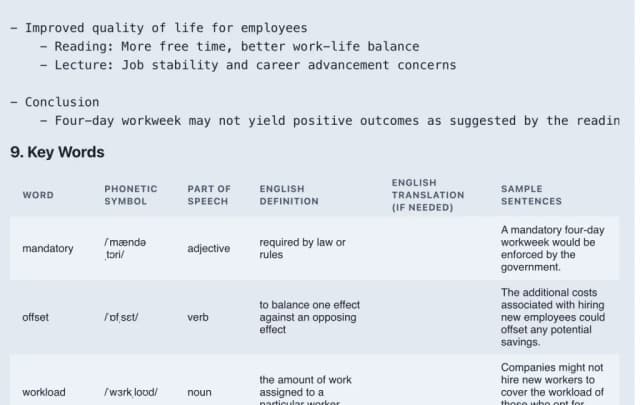
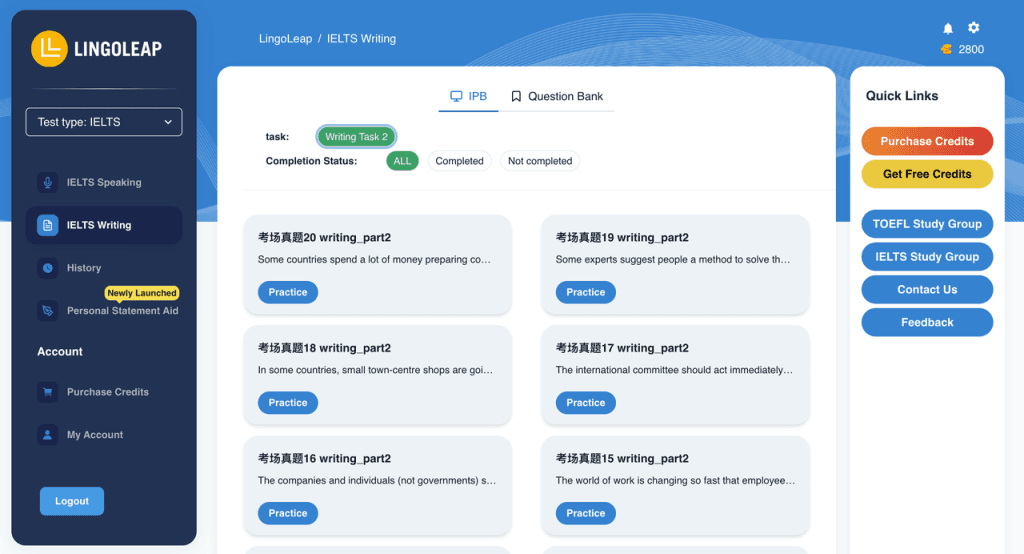
Lingoleap can provide precise scoring and explanations based on your answers, with scores fully referencing the official grading criteria. Moreover, Lingoleap can also modify and polish your answers, and summarize them into mind maps and keywords, organizing your thoughts.
Lingoleap is like a TOEFL writing tutor on standby. With this tool, self-reviewing your writing becomes much easier.