Listen and Repeat Strategies and Daily Practice Tips for 2026 TOEFL Speaking
YutingFebruary 11, 2026
In the redesigned Speaking section of the new TOEFL iBT test in 2026, Listen and Repeat stands out as a new type of question that challgenes test-takers. At first glance, Listen and Repeat seems simple. You hear a sentence and repeat it. However, in real-tests and in practice, many test-takers struggle more with this task than expected.
There is no preparation time, the sentence is played only once, and small errors can reduce your score significantly. To perform well, you must combine listening accuracy, memory control, and clear speech under strict time pressure. If you are unfamiliar with the task format or scoring, reviewing Listen and Repeat in 2026 TOEFL Speaking: Task Format, Scoring, and Sentence Types is a useful starting point.
Core Test-Day Strategies for Listen and Repeat
Do Not Paraphrase 🚫
This task rewards exact repetition. Substituting synonyms or changing sentence structure almost always lowers your score. Even small changes such as expanding a contraction can prevent a top score. Remember as much as you can and just say the words you hear are better than paraphrasing or making up new words according to the context.
🔍 Use Visual Context
The on-screen illustration is not decorative. It anchors the sentence in a real situation and helps you anticipate vocabulary and meaning, which improves retention and can be a helpful hint for nouns if you didn't hear them clearly.
Prioritize Intelligibility
Speaking too fast or blending words together often reduces clarity. A natural conversational pace with clear articulation is more effective than rushing through the sentence. Do not rush or panic when speaking. The time is limited, but it is enough for you to finish the sentence as long as you stay calm.
⭐ Thought Grouping: The Most Important Skill
Attempting to memorize sentences word by word quickly overwhelms short-term memory. High scorers rely on thought grouping, also known as chunking.
Instead of recalling isolated words, divide the sentence into two to four logical units, such as subject, action, and location. Use brief natural pauses between groups. This reduces cognitive load and produces clearer, more listener-friendly speech.
What to Do If You Miss a Word
Missing part of a sentence is common. When this happens:
- Preserve the core content words and structure
- Use the visual cue to support context
- Avoid inventing synonyms or restructuring the sentence
According to the scoring rubric, an incomplete but mostly accurate response scores higher than silence or heavy paraphrasing. Speaking confidently, even with minor omissions, is always better than stopping.
Daily Practice Strategies That Get You Well-prepared
Effective preparation focuses on skill automation rather than rule memorization.Recommended methods include:
- Shadowing practice without transcripts to build natural rhythm
- Dictation to strengthen retention and accuracy
- Recording and reviewing your responses
- Color-coded error analysis to identify recurring issues
Because speaking accuracy depends heavily on receptive vocabulary, strengthening Listening and Reading skills first is a highly effective long-term strategy. These priorities are consistent with the evaluation principles outlined in 2026 TOEFL Speaking Rubrics Explained.
Practice with Authentic Questions and Concrete Feedbacks
Listen and Repeat rewards stable performance under real time pressure, which is why generic speaking practice often falls short. As noted in the Official Guide to the TOEFL iBT Test (2026), effective preparation requires recording your own responses and carefully comparing them with the original audio to identify gaps in accuracy and intelligibility. This is where LingoLeap becomes especially useful.
LingoLeap’s 2026 TOEFL Speaking practice is built around the actual logic of the Listen and Repeat task. You work with sentences that gradually increase in length and complexity, respond under authentic timing conditions, and receive AI-driven feedback aligned with official TOEFL speaking rubrics.
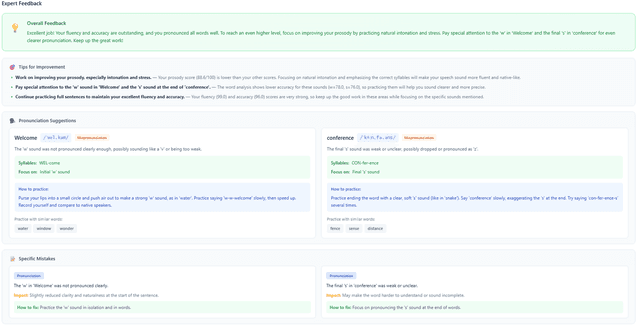
With this feedback, you can pinpoint whether your difficulties stem from memory load, pronunciation stability, or sentence-level accuracy and adjust your training with purpose rather than guesswork.
Start a free trial today and prepare for the 2026 TOEFL Speaking section the way ETS actually evaluates it.