ETS Releases the TOEFL iBT 2026 Official Guide: What Changed from the Previous Edition
YutingFebruary 11, 2026
ETS has recently released a limited digital Pocket Edition of The Official Guide to the TOEFL iBT Test for the redesigned 2026 TOEFL.
But many test takers are also holding the previous Official Guide, Seventh Edition and asking the same practical question: What exactly changed and what does that mean for my prep?
This article breaks down the most important differences between the 2026 Pocket Edition and the older Seventh Edition, with a focus on task formats, timing and test day details, and the new skills ETS is now rewarding.
Change 1: Score Reporting
In the Seventh Edition era, TOEFL scores were reported on the familiar legacy scale: 0 to 30 per section and 0 to 120 total.
In the 2026 Pocket Edition, ETS explains that tests taken before Jan 21, 2026 use old reporting, but new score reports include an overall score on a new 1 to 6 scale, plus a comparable legacy score during a transition period.
What this means for prep is simple: you cannot rely on old “30 scale” instincts to judge how strong a response is. You need to understand what top band performance looks like under the new rubrics, especially in Speaking and Writing. To learn about how to get top scores in these 2 sections under this new 1-6 scale scoring system, you can refer to our previous articles: How to Score a 6 in 2026 TOEFL Writing and How to Score a 6 in 2026 TOEFL Speaking.
Change 2: Speaking—from 4 integrated tasks to 2 communication tasks with zero prep time
According to the old OG:
The older TOEFL Speaking section was built around four speaking tasks, and performance was scored across delivery, language use, and topic development.
According to the 2026 new OG:
There are only 2 types of questions in the 2026 new TOEFL speaking section. In the 2026 Pocket Edition, the biggest test day shock is this: there is no preparation time for either speaking task, and you must answer immediately.
The Pocket Edition also highlights concrete timing rules:
Listen and Repeat responses are 8, 10, or 12 seconds depending on sentence length Take an Interview gives 45 seconds per question
Prep implication:
Old speaking prep often emphasized planning, outlining, and integrated note based delivery. New speaking prep needs a different core skill: instant response control. This is why it helps to drill a helpful answer template you can prepare beforehand like the ADS structure and practice full interview sets under real timing, not just brainstorm ideas.
Change 3: Writing—from integrated academic writing to sentence level control and campus communication
According to the old OG:
The Seventh Edition clearly frames writing as academic, with an emphasis on integrated writing, summarizing, paraphrasing, and connecting what you read and hear. It also states a total response time of 30 minutes for two writing tasks, including an integrated read listen write task.
According to the 2026 new OG:
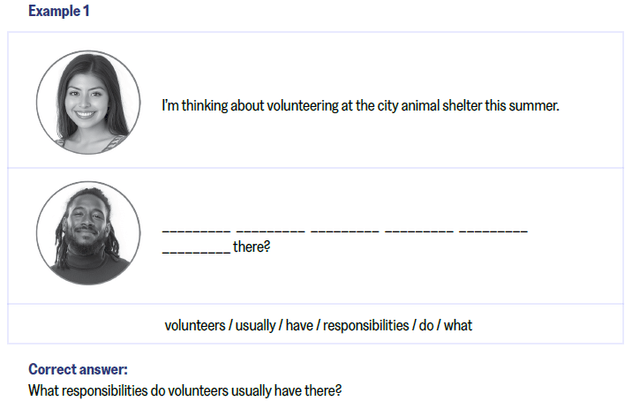
The 2026 Pocket Edition defines the Writing section as communication across academic and everyday campus contexts, and it explicitly lists three task types: Build a Sentence, Write an Email, and Write for an Academic Discussion.
It also gives unusually concrete Build a Sentence details that did not exist before: about 10 questions, about 6 minutes, and scoring that is strictly correct or incorrect with no partial credit. It further clarifies that Build a Sentence may include an extra word or phrase you do not use, and again confirms no partial credit.
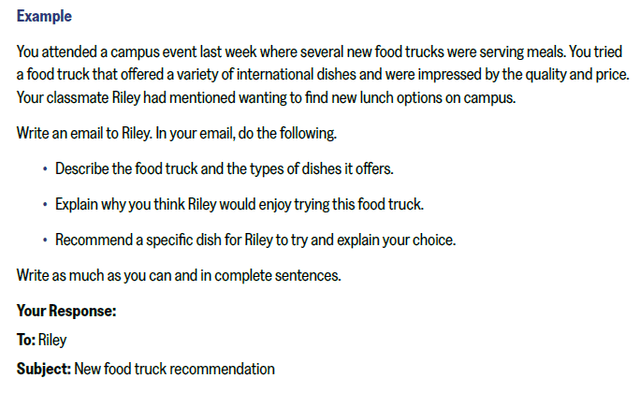
Similarly, Write an Email marks a clear departure from traditional essay-based writing. The 2026 Pocket Edition defines this task as functional campus communication, where clarity, tone, and task completion matter more than length or stylistic sophistication. Many prompts fall into recurring situations such as requests, explanations, or problem solving. These patterns are summarized in Common TOEFL 2026 Email Writing Topics, while practical response frameworks and expressions that fit the 7-minute time limit are outlined in TOEFL 2026 Email Writing Template and Format and Common Email Phrases and Expressions for 2026 TOEFL Writing.
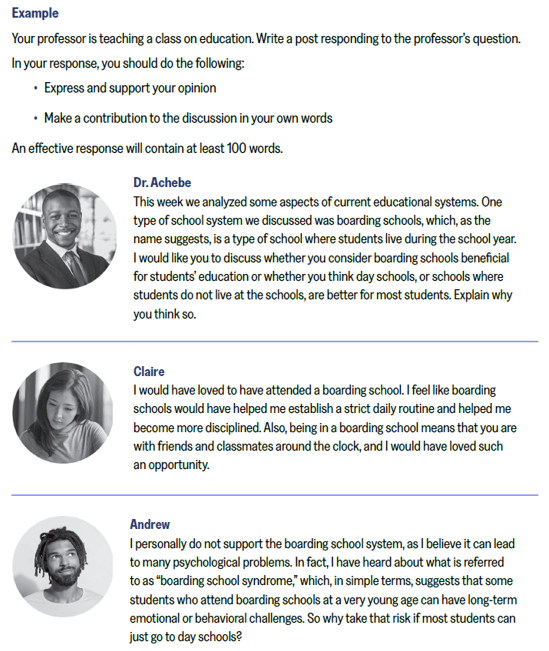
At the same time, Write for an Academic Discussion remains largely consistent in format, but the new Official Guide clarifies what separates adequate responses from high-scoring ones. Typical prompt themes and scoring-aligned response structures are discussed in Common 2026 TOEFL Academic Discussion Topics and Common Expressions and Logical Connectors for 2026 TOEFL Academic Discussion, which reflect how discourse-level coherence is evaluated under the 2026 rubric.
Prep implication:
This is a major shift in what gets rewarded: old prep leaned on structure and content development across longer responses. New prep demands fast, accurate sentence construction under time pressure, then flexible writing for email and discussion tasks without memorized text.
Change 4: Reading and Listening—MST system introduced
The 2026 Pocket Edition confirms that Reading and Listening now use Multi-Stage Adaptive Testing (MST). Unlike item-by-item adaptation, MST adjusts difficulty at the stage level based on a test-taker’s overall performance in earlier sections. The Guide also makes it clear that different test-takers may see different question sets, even if they end up with similar scores. Scores are therefore based on an estimated proficiency level rather than the number of questions answered correctly.
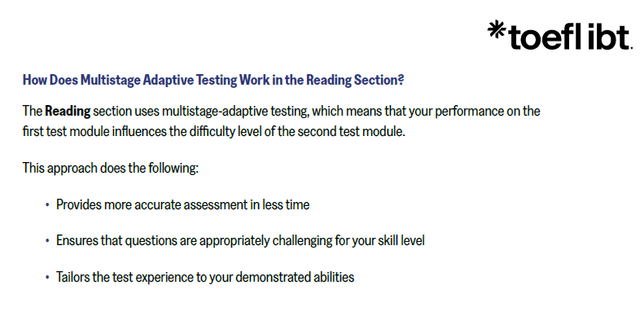
While the new OG clarifies the existence of MST, it intentionally avoids technical details. It does not specify how many questions appear in each stage, how difficulty thresholds are determined, or how errors affect later stages. However, the repeated emphasis on early-stage performance strongly suggests that initial accuracy plays a critical role in ability placement, even if this is not stated directly. This marks a quiet but meaningful shift from the linear testing logic implied in earlier TOEFL editions.
Prep implication:
Taken together, the new OG implies a change in preparation strategy. In an adaptive system, consistent accuracy matters more than late-stage recovery or guessing strategies. Test-takers can no longer rely on “making up points later.” Instead, preparation must focus on stable performance, especially in early Reading and Listening sections, using practice that mirrors real difficulty progression and scoring logic. This is why rubric-aligned, test-like practice becomes essential in the 2026 TOEFL era.
What the two OGs quietly imply about new prep priorities
If you read both OGs back to back, a pattern is obvious:
The old OG rewarded:
- integrated academic comprehension and synthesis
- longer response control with traditional timing blocks
The new OG rewards:
- immediate speaking with no planning time
- sentence accuracy as a scored foundation, with strict right or wrong scoring for Build a Sentence
- task realism in campus contexts across Writing tasks
So your prep plan should shift accordingly:
- Train sentence patterns daily, not random grammar drills
- Practice speaking in real time, not scripted speeches
- Build small, reusable topic banks for interview and email contexts
- Use rubrics to evaluate, not vibes
Level up with LingoLeap, fully upgraded for TOEFL 2026
The 2026 Pocket Edition makes it clear that success now comes from rubric aligned task practice, not general English improvement alone. For example, Speaking is timed and has no prep time and Writing includes strict correct or incorrect Build a Sentence scoring with no partial credit.
That is exactly why LingoLeap has been upgrading alongside the new TOEFL. We have added 2026 style practice sets and rubric aligned feedback so you can train the exact behaviors ETS now measures, not just “sound better.”
If you want a fast starting point, go straight to LingoLeap’s 2026 TOEFL question bank and begin practicing under real timing and receive a detailed feedback and helpful suggestion to improve. Start a free trial today and build your TOEFL 2026 skills the way the new Official Guide actually describes them.