2026 New TOEFL Email Writing Template and Format
YutingJanuary 26, 2026
In the TOEFL iBT 2026 Writing section, Write an Email is one of the most practical yet time-pressured tasks. Although the scenarios are realistic and familiar, test-takers have only 7 minutes to read the prompt, organize ideas, and produce a clear, well-structured response that meets all rubric requirements.
Based on the official practice tests released so far, we have identified several email writing scenarios and topics that are likely to appear on the new TOEFL test. In this article, we introduce a reliable “3+1” email structure, summarize reusable sentence patterns for typical situations, walk through how to read an official sample response, and end with practical tips to avoid common scoring pitfalls.
The “3+1” Email Structure: A Reliable Framework for 7 Minutes
To manage time pressure without sacrificing clarity, a “3+1” structure works especially well for TOEFL 2026 Email tasks. The idea is simple: respond directly to the three required bullet points, plus a short, polite closing.
General Email Framework
- Salutation: Dear [Name / Editor / Professor],
- Section 1 (Opening - State Your Purpose - Bullet Point 1)
- Briefly state the purpose of the email. This section may include a short greeting, appreciation, or context-setting sentence. Examples:
- I hope you are doing well.
- I am writing to inquire about…
- Thank you for organizing the workshop on…
- Briefly state the purpose of the email. This section may include a short greeting, appreciation, or context-setting sentence. Examples:
- Section 2 (Body - Elaborate - Bullet Point 2)
- Describe the situation, issue, or experience clearly and directly. Focus on clarity rather than complex vocabulary. Examples:
- However, I experienced some problems when…
- The main issue was that…
- Unfortunately, the experience was disappointing.
- Describe the situation, issue, or experience clearly and directly. Focus on clarity rather than complex vocabulary. Examples:
- Section 3 (Action - CTA - Bullet Point 3)
- Make a request, offer a suggestion, or ask for an update. Examples:
- Could you please let me know if…
- I would appreciate it if you could…
- I suggest that we consider…
- Make a request, offer a suggestion, or ask for an update. Examples:
- Section 4 (Closing - Polite Ending)
- End politely and professionally. Examples:
- Thank you for your time and assistance.
- I look forward to your response.
- Best regards,
- [Your Name]
- End politely and professionally. Examples:
This structure helps ensure that all task requirements are covered while keeping the email easy to follow.
Common Sentence Patterns and Email Formats
Rather than memorizing full templates, it is more effective to prepare reusable sentence patterns that can be adapted across scenarios.
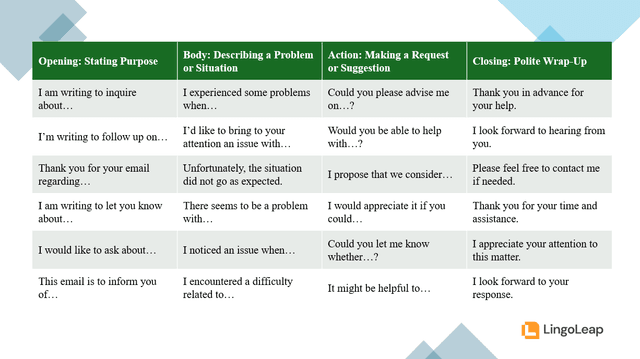
Analyzing an Official Sample Email: What to Notice
The image above shows an official Write an Email sample task and response released by ETS. At first glance, the response looks simple, but it clearly demonstrates what the new TOEFL Writing rubric values.
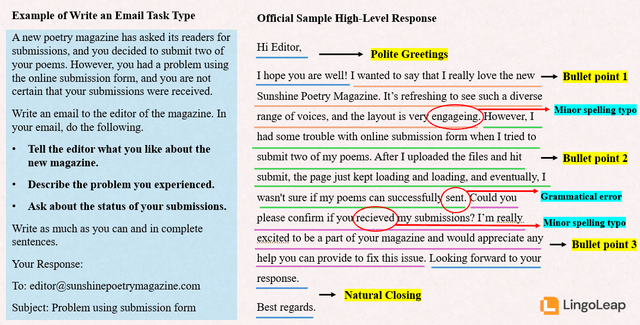
Several key features stand out:
- Clear task coverage: All three required bullet points are fully addressed in order: expressing appreciation for the magazine, describing the submission problem, and asking about submission status. Nothing essential is missing.
- Appropriate tone and politeness: The email opens with a friendly but professional greeting, maintains a respectful tone throughout, and ends with a natural closing that fits the editor-writer relationship.
- Language variety without overcomplexity: The sentences are not long or flashy, but they show controlled variety in structure and vocabulary, which aligns well with rubric expectations.
- Functional clarity over perfection: The message is easy to follow and achieves its communicative goal efficiently.
At the same time, this response is likely not a perfect-score answer. As highlighted, there are a few minor spelling issues and one grammatical error. Under the 2026 TOEFL Writing rubric, such small mistakes are tolerated as long as they do not interfere with meaning or task completion. This makes the sample especially useful for test-takers: it illustrates that a high-scoring email does not need to be flawless. A response like this would realistically fall in the upper band (around 4–5), showing that clarity, tone, and task fulfillment matter more than error-free writing.
The takeaway is clear: ETS is not testing how well you can polish prose, but how effectively you can communicate in a real academic or social situation—clearly, politely, and on point. We can also tell that high-scoring sample emails typically:
- Address all three bullet points clearly and in order
- Use simple but precise language
- Maintain a consistent tone appropriate to the recipient
- Avoid unnecessary background or repetition
Final Tips: Using Templates Effectively
Email templates are tools, not scripts. When used flexibly, they help you write faster under time pressure, maintain a clear structure, and stay aligned with rubric expectations. The key is adaptability. Adjust wording, tone, and emphasis based on the scenario instead of forcing one fixed format onto every task.
To put this into practice, working with real TOEFL-style email prompts and rubric-based feedback is far more effective than memorizing phrases alone. LingoLeap’s 2026 TOEFL Email Writing practice allow you to practice common email scenarios under test-like conditions and receive AI-driven feedback aligned with the 2026 scoring criteria. This makes it easier to see how templates should be adapted in different situations and where small language choices affect scores.
If you want to place this task in the broader exam context, reviewing thenew TOEFL 2026 overviewhelps clarify how email writing fits into the redesigned test, while understanding the new TOEFL scoring system gives you a clearer sense of how writing performance contributes to your overall band score.