TOEFL 2026 · Realism & Simulation
Realistic Online TOEFL 2026 Mock Test
A realistic TOEFL 2026 mock test should help students practice TOEFL-style timing, section flow, speaking response timing, writing tasks, and post-test review. The Lingoleap TOEFL 2026 mock test focuses on exam-like practice plus AI-powered feedback so students can review their performance before test day.
By Erin, LingoLeap Content & SEO Specialist · Reviewed by the LingoLeap TOEFL Content Team · Published · Updated
What Makes a TOEFL 2026 Mock Test Realistic?
Four things. A mock test that drops any of them slides from simulation to general practice.
TOEFL-style timing
Same windows as the real 2026 iBT — Reading ~27–30 min, Listening ~25–29 min, Writing 23 min, Speaking 8 min, locked.
Section flow that matches the 2026 iBT
Same order, same 2026 task pool, same 2-stage adaptive Reading and Listening as the real exam.
Speaking and Writing feedback
AI-graded against the same ETS rubric — exactly how the real 2026 iBT scores Take an Interview, Write an Email, and Write for an Academic Discussion.
Score report and next steps
Same 1–6 band scale, same machine-/AI-grading, same per-section presentation as the real ETS report.
The deep-dive on each feature — including how Lingoleap delivers it — is in the Why These Realistic Features Matter & How Lingoleap Delivers Them section below. For the underlying ETS spec, see the 2026 TOEFL iBT guide and the Multi-Stage Adaptive Test Strategy breakdown.
Why Students Search for “Closest to Real TOEFL”
When students ask for the “closest” TOEFL mock test, they are rarely asking a literal question about feature parity. The phrase is usually a stand-in for one of four underlying concerns about test-day readiness:
Test-day uncertainty is the biggest cost
Students lose points to nerves, not knowledge. A close-to-real mock test reduces the test-day surface area that can surprise you — the interface, the section order, the recording flow, the pacing.
Speaking and Writing cannot be self-scored
Reading and Listening have right answers. Speaking and Writing do not. "Closest to real" is shorthand for "I want feedback on the two sections I cannot grade myself" — which is exactly where AI-scored Take an Interview, Write an Email, and Write for an Academic Discussion responses become useful.
Time is limited
Most candidates have weeks, not months. A realistic mock test compresses pacing practice, format practice, and feedback into a single sitting — far more useful than a disconnected drill bank when test day is close.
The 2026 redesign is recent
The January 2026 iBT introduced 2-stage adaptive Reading and Listening, replaced the old Independent and Integrated Speaking/Writing tasks with Listen and Repeat, Take an Interview, Build a Sentence, Write an Email, and Write for an Academic Discussion, and moved to the new 1–6 band scale. Many older "mock tests" still use pre-2026 specs. Realism now also means current.
For background on the 2026 redesign itself, see What Changed in TOEFL 2026 and the 2026 vs Old TOEFL comparison.
Why These Realistic Features Matter — and How Lingoleap Delivers Them
For each realistic feature: what the real 2026 TOEFL iBT does — and how the Lingoleap mock test mirrors it 1:1. The closer the four features match, the closer the mock test is to test day.
TOEFL-style timing
Why it matters
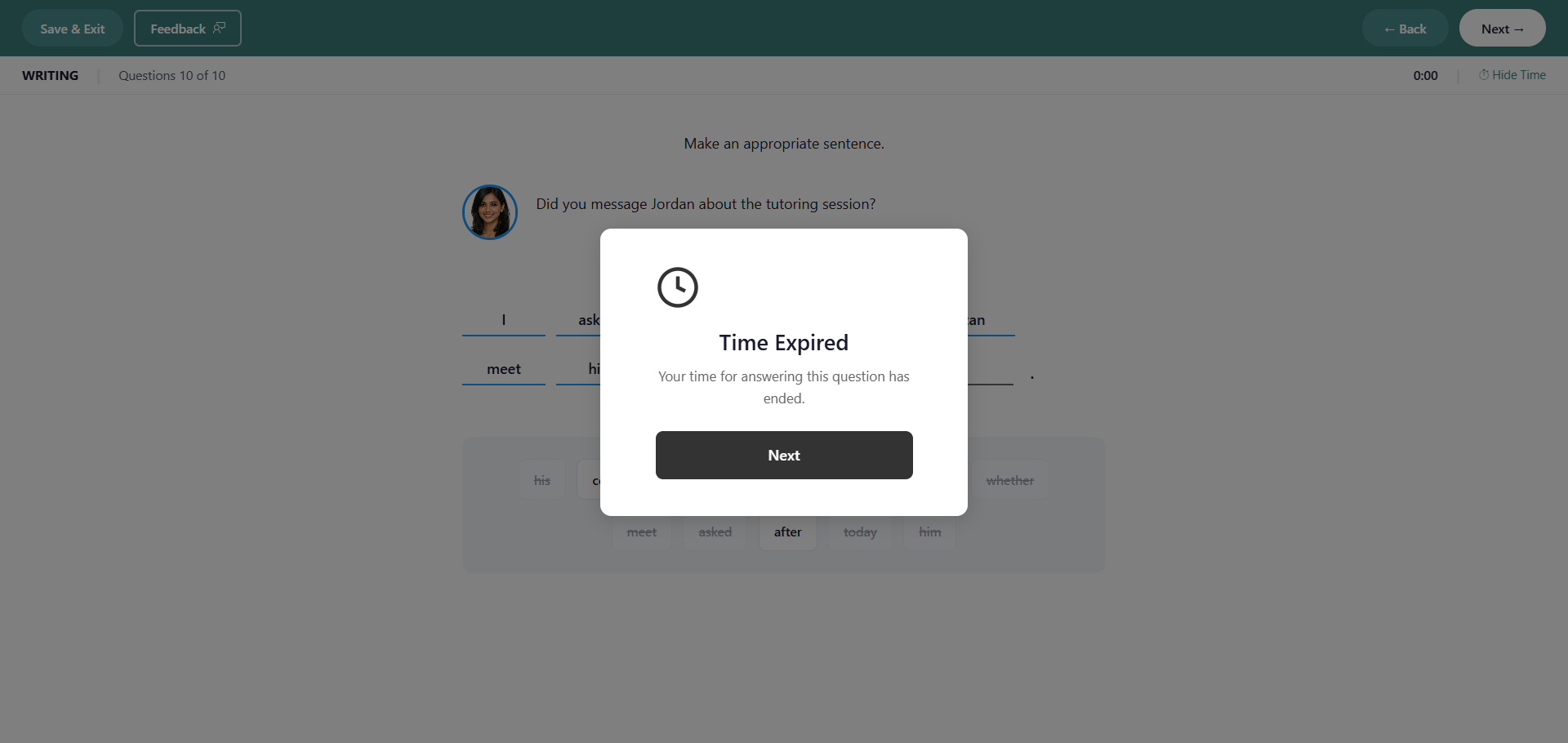
The real 2026 TOEFL iBT runs on locked per-section timers (Reading ~27–30 min, Listening ~25–29 min, Writing 23 min, Speaking 8 min, with roughly 1 hr 23–29 min of working test time). A realistic mock test has to take the same amount of time, run on the same per-section windows, and refuse to let you pause — otherwise the pacing pressure that costs students points on test day never shows up.
How Lingoleap delivers it
A Lingoleap mock test runs on the exact same windows. Each section uses a locked timer that matches the April 2026 ETS Blueprint specification, you cannot pause once a section starts, and there is no rollover time between sections. The Lingoleap mock takes the same time as the real 2026 TOEFL iBT, with the same pressure on Reading passage 2 and the Take an Interview prep clock.
Section flow that matches the 2026 iBT
Why it matters
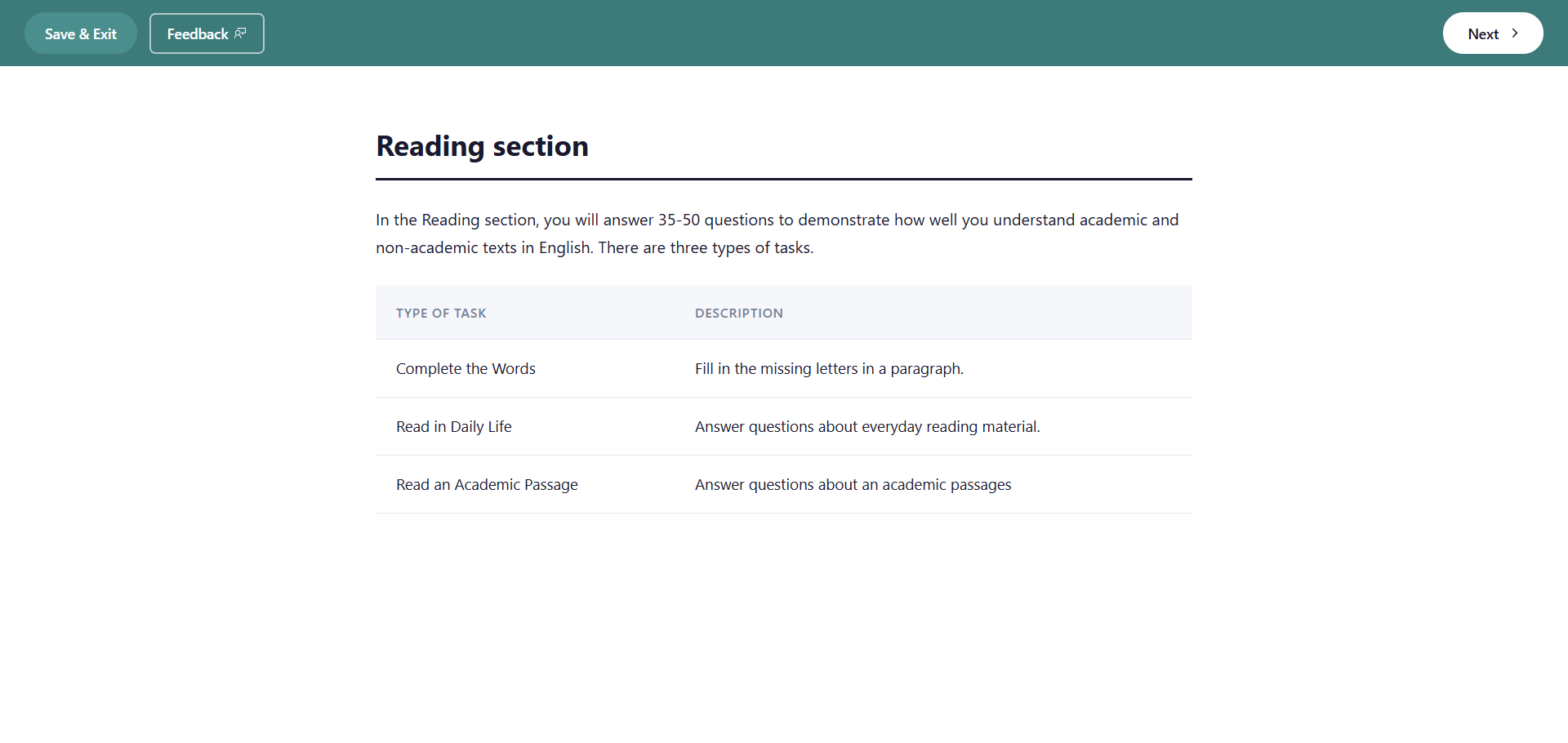
The 2026 redesign changed three things at once. The section order is now Reading → Listening → Writing → Speaking. The task pool was replaced with Build a Sentence, Write an Email, Write for an Academic Discussion, Listen and Repeat, Take an Interview, and the new Reading and Listening item types. Reading and Listening are now 2-stage adaptive — a router module places you into a lower or upper Stage 2. A mock test on the old order or the old task pool replicates none of this.
How Lingoleap delivers it
A Lingoleap mock test mirrors all three. Same section order, drawn from the 2026 task pool only, and Reading and Listening run through the same router-plus-module engine the real exam uses — so the difficulty shift, the screen layout, and the task progression you experience on a Lingoleap mock are what you will see on the ETS screen on test day.
Speaking and Writing feedback
Why it matters
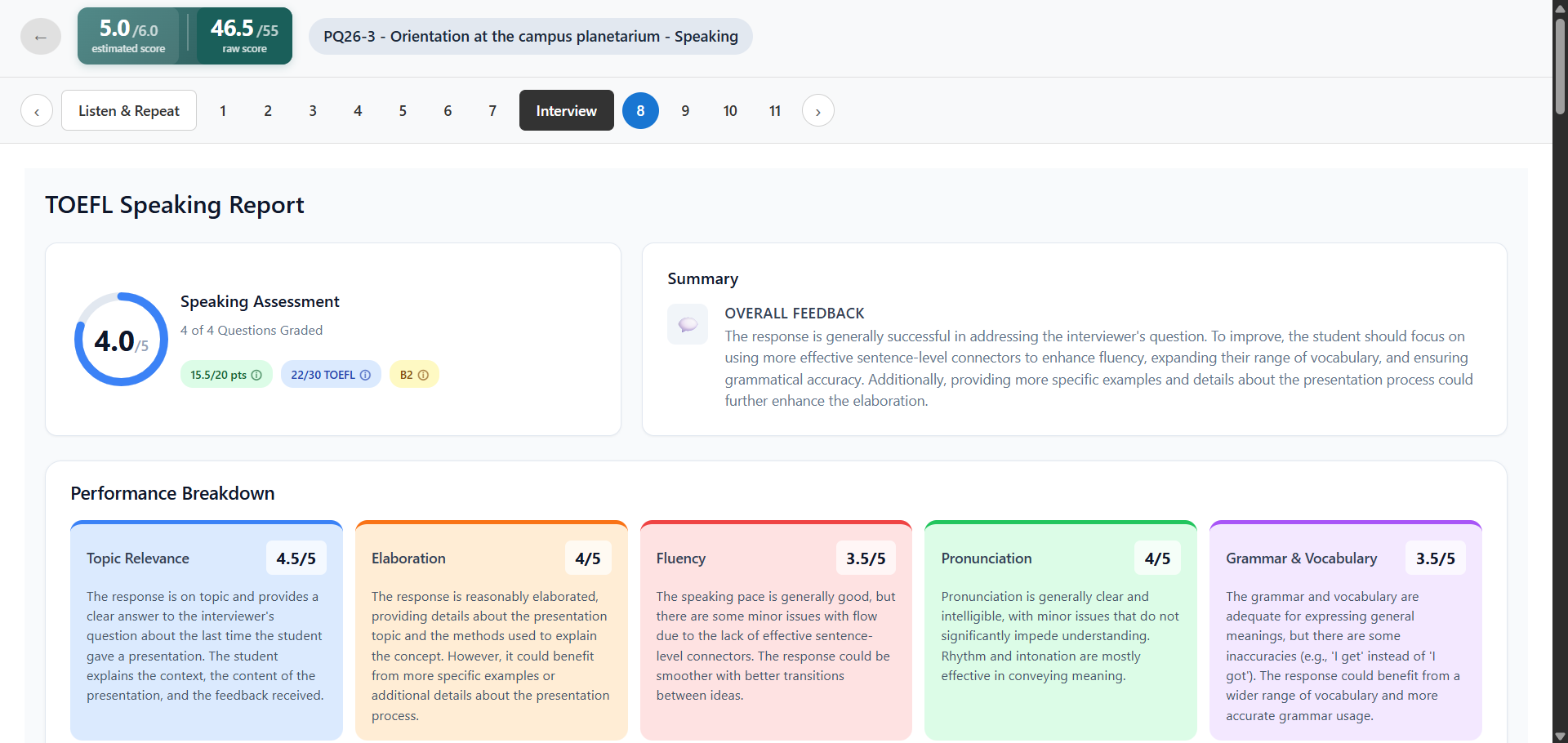
On the real 2026 TOEFL iBT, three of the highest-weight tasks — Take an Interview, Write an Email, and Write for an Academic Discussion — are AI-graded against the published ETS rubric (fluency, coherence, grammar, vocabulary, communication effectiveness). Build a Sentence and Listen and Repeat are machine-graded against predefined answers. Self-grading, generic essay feedback, or human-tutor commentary cannot replicate that scoring path. The only realistic preparation is AI-graded feedback aligned to the same rubric.
How Lingoleap delivers it
Lingoleap uses the same scoring architecture. Take an Interview, Write an Email, and Write for an Academic Discussion responses are AI-graded against the ETS rubric — fluency, coherence, grammar, vocabulary, communication effectiveness — and Build a Sentence and Listen and Repeat are machine-scored against the target sentence. The feedback you act on is the same kind of feedback the real exam produces, plus model rewrites and a response framework so you see what a higher-band attempt looks like.
Score report and next steps
Why it matters
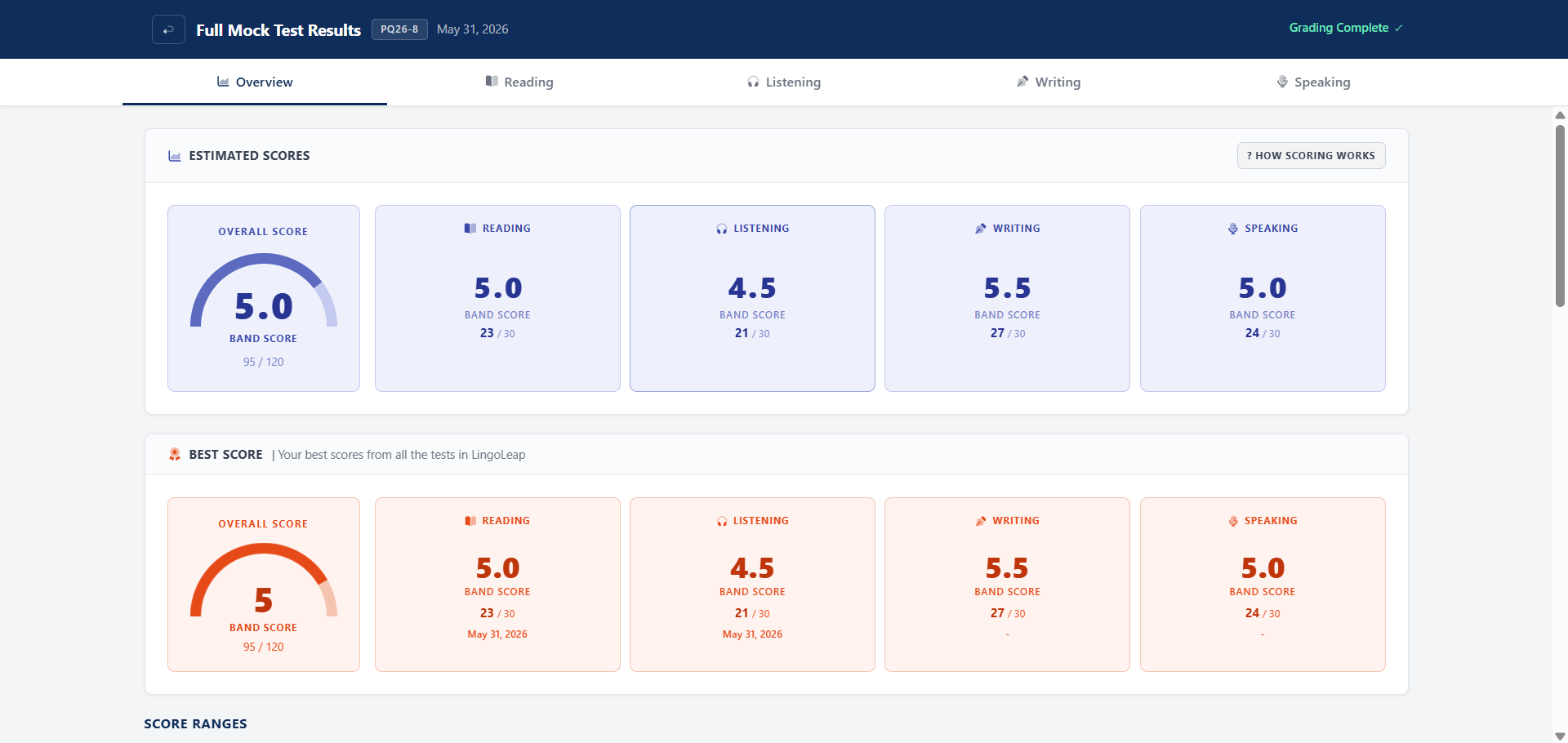
The real 2026 TOEFL iBT reports each section on a 1–6 band scale in 0.5 increments, with the overall band as the average of the four sections — produced by machine-grading (Reading, Listening, Build a Sentence, Listen and Repeat) and AI-grading against the ETS rubric (Write an Email, Write for an Academic Discussion, Take an Interview). A practice report on any other scale, or one that mixes scoring philosophies, will not feel or read like the real one.
How Lingoleap delivers it
A Lingoleap mock test produces the same shape of report. A 1–6 practice band per section in 0.5 increments, the overall as the average of the four, all rubric-aligned and machine-/AI-graded — plus a per-task-type accuracy breakdown and direct links to the targeted drills that match your weakest task types, so the next steps after a mock are concrete.
Want the full task-by-task breakdown of each section? Reading, Listening, Writing, and Speaking each have a dedicated guide. For the score scale itself, see the 2026 TOEFL 1–6 Band Scale.
The Lingoleap practice band and AI feedback are for learning reference only — they are not official TOEFL scores. Only ETS issues official TOEFL scores via the real TOEFL iBT.
Try a Realistic TOEFL 2026 Mock Test
Locked timers, the full 2026 section flow, single-take Speaking, and an AI-powered review report — designed to simulate test day, not just generate practice questions.
Take a full TOEFL mock testIs Any Online Mock Test Exactly Like the Real TOEFL?
No. Only ETS controls the official TOEFL forms and delivery interface and the at-home proctoring path. Any platform that claims to be “exactly like” the real TOEFL — or to produce ETS-accurate scores — is overselling. A realistic mock test approximates the test on the features that matter for practice; it does not replicate the official exam.
What it can reproduce well
- Per-section timing windows from the April 2026 ETS Blueprint, with locked timers.
- The 2026 section sequence — Reading → Listening → Writing → Speaking, run continuously in one session.
- 2-stage adaptive routing for Reading and Listening (router → lower or upper Stage 2 module).
- The 2026 task types — Complete the Words, Listen and Repeat, Take an Interview, Build a Sentence, Write an Email, Write for an Academic Discussion, and the rest.
- Single-take Listen and Repeat plus single-take Take an Interview recording.
- A structured post-test review report on the 1–6 band scale (0.5 increments).
What it cannot reproduce
- Official TOEFL scoring or any predictive score guarantee.
- Secured TOEFL content — passages, lectures, and prompts are original, not real items.
- The physical test-center environment or at-home ProctorU monitoring path.
- ID checks, room scans, and the human-proctor side of the experience.
For how the practice band relates to a real ETS score, use the TOEFL Score Converter (1–6 band ↔ legacy 0–120 ↔ IELTS ↔ CEFR), and see What Is a Good TOEFL Score? for university benchmarks.
Realistic TOEFL 2026 Mock Test FAQ
What makes a TOEFL mock test realistic?
Which TOEFL mock test is closest to the real exam?
Can an online mock test replicate the test-day experience exactly?
Is Lingoleap an ETS product?
Do third-party mock tests use the same content as the real TOEFL?
What is the difference between a realistic mock test and a TOEFL simulation test?
How many realistic mock tests should I take before test day?
Related Mock Test & Simulation Resources
TOEFL Mock Test Online
The full mock-test hub — score report, AI feedback, and how to use one in a prep cycle.
TOEFL 2026 Format Guide
The post-2026 task-by-task TOEFL iBT specification — Reading, Listening, Speaking, Writing.
TOEFL Preparation Plan Generator
Build a prep plan that schedules realistic mock tests at the right cadence.
TOEFL 2026 Changes
What changed in the 2026 redesign — and why some older mock tests are no longer realistic.