TOEFLIELTS
Italiano
← Score ToolsAdmissions

TOEFL University Admission Calculator

Find universities your TOEFL 2026 band qualifies you for, or check whether your score meets a specific school's official requirement — 100+ verified US & UK schools.

By Erin, LingoLeap Content & SEO Specialist · Reviewed by the LingoLeap TOEFL Content Team · Last reviewed:

School Finder by Score

Enter your TOEFL 2026 band score and filters to see which US and UK universities you likely qualify for, based on their official published requirements.

Taking the TOEFL after 21 January 2026? Not every university accepts it yet.

This calculator only lists schools that publish a 1–6 band requirement. Oxford accepts only tests taken before 21 January 2026, Cambridge does not list TOEFL for undergraduate entry and adds a Language Centre assessment for postgraduates, and Manchester reviews post-January scores case by case — so they are not in the dropdowns. The 2026 TOEFL acceptance tracker records the status of every university we have checked, with the official source and the date.

Lift your score above every threshold

Push your band comfortably past your target school's minimum with adaptive practice and AI-scored Speaking & Writing.

Start Mock Test

How to Use Each Mode

🔍

Find schools by score

Have a TOEFL band? Discover every database school you qualify for, with each labeled Safer, Match, or Reach so you can build a balanced shortlist quickly.

School listMatch badgesCountry filter

Best for: building a shortlist, exploring options, comparing across countries.
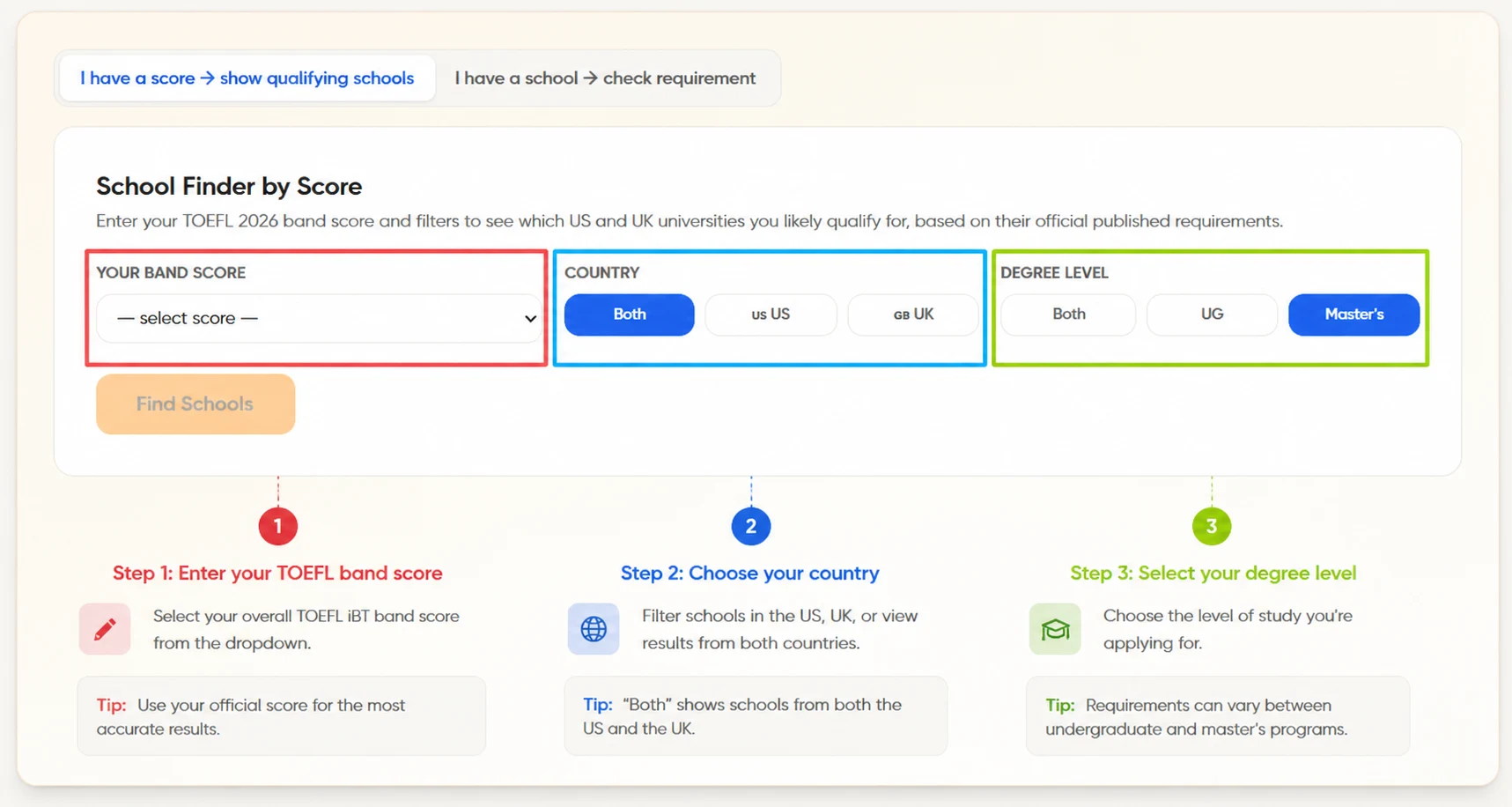
School Finder by Score: Step 1 enter your TOEFL band score in the dropdown, Step 2 choose Both / US / UK as the country filter, Step 3 select Both / Undergraduate / Master's as the degree level, then click Find Schools to see qualifying universities
🏫

Check a specific school

Have a target in mind? Get a definitive yes/no on whether your score meets every published requirement, including program-level section minimums.

Yes / No verdictSection breakdownProgram rules

Best for: confirming fit for a specific target, checking section minimums.
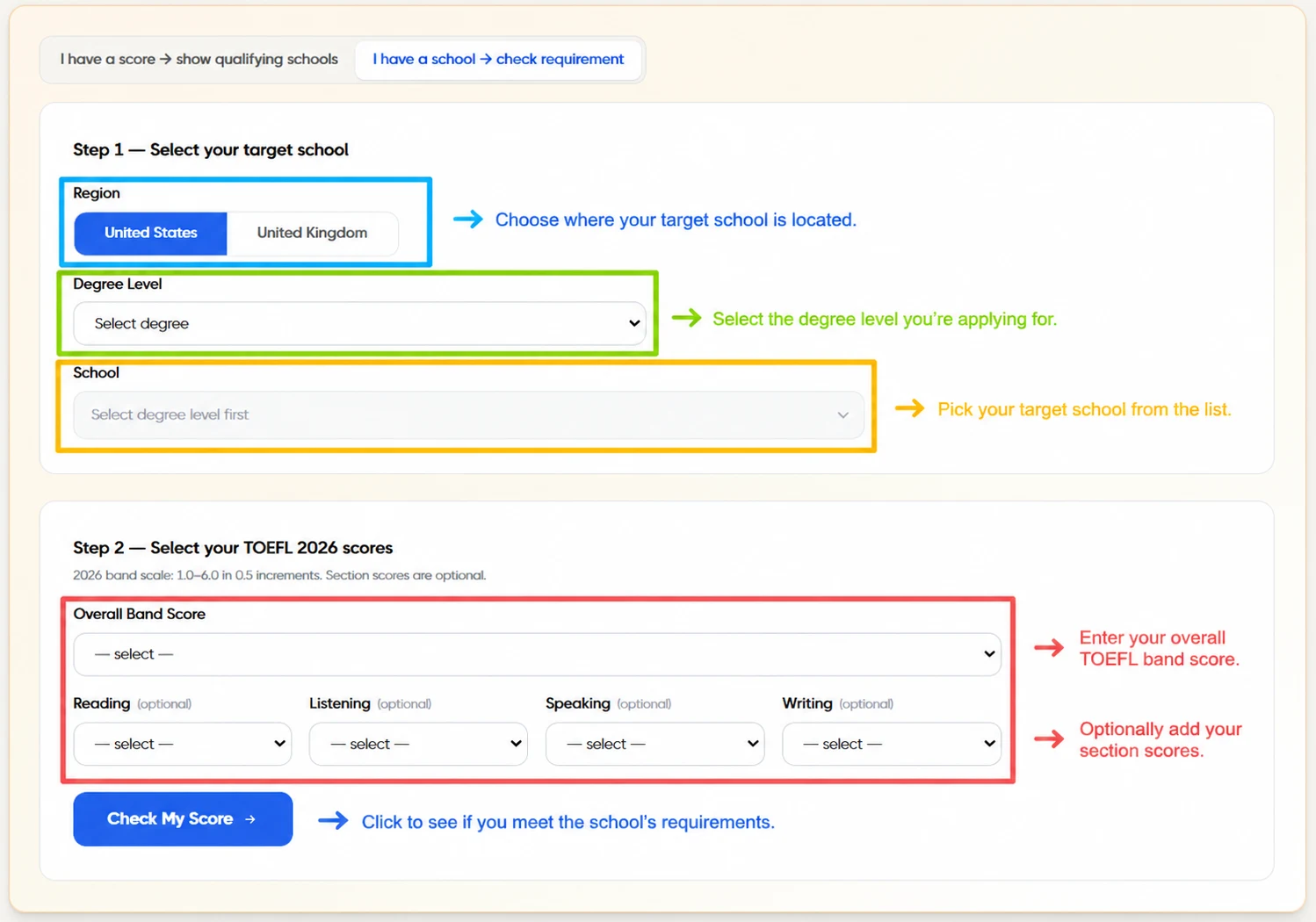
School Requirement Checker: Step 1 select region (United States or United Kingdom), choose degree level and target school. Step 2 enter your overall TOEFL band score plus optional Reading, Listening, Speaking, and Writing section scores, then click Check My Score for a yes/no verdict against every published requirement

How to Read These Results

Treat this calculator as a reference. Every requirement in our database is verified against each school's official admissions page at the time of indexing, but universities update their published minimums quietly and often. Before you submit an application — or rule a school out — open the official admissions or English-proficiency page for your specific program and confirm the current number.

Meeting the published TOEFL minimum is also one piece of the application, not a guarantee of admission. Highly selective programs use the TOEFL minimum as a baseline filter; the decision itself depends on academic record, entrance tests (GRE/GMAT), recommendations, statement of purpose, work or research experience, and program-specific factors. A score above the minimum strengthens your file; a score at or below it does not, by itself, predict an outcome.

If your current score is in the Reach range, the Score Gap Planner turns the gap into a section-level study plan; if you only have an old 0–120 score, the TOEFL Score Converter maps it to the 1–6 band scale before you compare against published minimums.

University requirements verified against each school's official admissions page. Score-scale references: ETS TOEFL scoring documentation · ETS score-use reference for admissions offices

Frequently Asked Questions

What's the difference between the two modes?
The two modes solve opposite problems. 'I have a score → show qualifying schools' takes your TOEFL 2026 band and returns a filtered list of universities you qualify for, with each school labeled Safer, Match, or Reach based on the gap between your score and their official minimum. 'I have a school → check requirement' works in the opposite direction: you pick a specific country, degree level, school, and program, and the tool tells you whether your scores meet that school's exact published requirement (overall band plus any section-level minimums). Most students use the score-first mode first to build a balanced school list, then switch to the school-first mode to confirm fit for individual targets.
What does 'Safer / Match / Reach' mean?
These labels classify schools relative to your score. Safer means your score exceeds the school's published minimum by more than 0.5 band — high confidence you meet the English requirement. Match means you meet or narrowly exceed the minimum, within 0.5 band of the threshold. Reach means your score is below the minimum but within 1.0 band — the school is a stretch target, viable only if you can realistically close the gap before your test date or if other parts of your application are exceptionally strong. If your score is in the Reach range, the Score Gap Planner can help you build a study plan to close the gap before your test date.
Does meeting the TOEFL minimum guarantee admission?
No. The TOEFL minimum is a threshold for the English-proficiency component of admissions only. Admissions decisions also depend on academic credentials (GPA, prior degree), entrance test scores (GRE / GMAT for graduate programs), essays, recommendation letters, work or research experience, and program-specific factors. At competitive schools, the majority of applicants meet the minimum — exceeding it is generally an advantage. For a sense of where your score lands relative to common university tiers, see What Is a Good TOEFL Score? and the ETS score-use reference for admissions offices.
What if my target school isn't in the database?
The database covers 100+ US and UK universities with verified TOEFL 2026 requirements. Coverage is being expanded continuously. If your target school isn't listed, check the school's official admissions page directly — TOEFL requirements are typically published under the international student or English proficiency requirements section. Some schools also publish program-specific minimums separate from the overall university minimum, particularly for writing-intensive graduate programs that may require an additional Writing band floor. If you only have an old TOEFL score, the TOEFL Score Converter can map it to the 1–6 band scale before you compare against published minimums.
How are these requirements verified?
Every requirement in the database is verified against the official admissions page of the school as of the data's generation date (March 2026). The current 1–6 TOEFL 2026 band scale was introduced January 21, 2026, and many schools updated their published minimums shortly after. The tool only includes schools that have confirmed their requirement on the new band scale — schools still publishing only the legacy 0–120 requirement are excluded because direct comparison is not reliable — the 2026 TOEFL acceptance tracker shows those schools, and the ones not accepting the revised test, with their sources. The official ETS TOEFL scoring documentation defines the underlying scale. Always confirm the latest requirement on the school's official page before submitting your application.

Need to Lift Your Score Above the Threshold?

Practice with adaptive TOEFL exercises and AI-scored Speaking and Writing to push your band above your target school's minimum.

Start Free Practice