ความหมายของ Band 6 ใน TOEFL 2026 Speaking
TOEFL 2026 รายงานคะแนน Speaking เป็นคะแนนส่วนเดียวบนสเกล 1–6 ระดับโดยรวมนี้สะท้อนผลงานรวมของคุณในทั้งสองประเภทโจทย์ Speaking ได้แก่ Listen and Repeat และ Take an Interview แต่ละประเภทโจทย์จะถูกให้คะแนนตามเกณฑ์ของตัวเอง
Listen and Repeat
ให้คะแนนจากความแม่นยำในการพูดซ้ำและความสามารถในการเข้าใจได้ ผลงานระดับ Band 6 หมายถึงคุณสามารถพูดซ้ำประโยคได้อย่างแม่นยำ ด้วยการออกเสียงที่ชัดเจนและฟังดูเป็นธรรมชาติ
Take an Interview
ให้คะแนนจากความเกี่ยวข้อง การขยายความ ความคล่องแคล่ว คำศัพท์ ไวยากรณ์ และการออกเสียง ผลงานระดับ Band 6 หมายถึงคำตอบที่เกี่ยวข้องอย่างสมบูรณ์และขยายความได้ดี ถ่ายทอดด้วยการพูดที่เป็นธรรมชาติ
Important: the official ETS TOEFL Speaking page and the ETS scoring documentation describe the dimensions evaluated for each task but do not publish the exact formula that converts task-level scores to the 1–6 section reporting band. What is clear is that consistent high performance across both task types — accuracy in Listen and Repeat, and communicative effectiveness in the Interview — is required for the highest section score.
For the full explanation of how TOEFL 2026 scores are calculated, see the คู่มือการให้คะแนนฉบับเต็มปี 2026.
Listen and Repeat: เส้นทางสู่ Band 6
The Listen and Repeat task plays a spoken sentence. Your task is to repeat it back as accurately and clearly as possible. The two core scoring dimensions are repetition accuracy and intelligibility — see the Listen and Repeat strategies guide for drill techniques.
ความแม่นยำในการพูดซ้ำ
พูดซ้ำคำ ลำดับคำ และความหมายของประโยคให้ตรงเป๊ะ การแทนที่ ตัดออก หรือสลับลำดับคำ — แม้ผลลัพธ์จะฟังดูเป็นธรรมชาติ — ก็ทำให้คะแนนของคุณลดลง ทุกคำในประโยคต้นฉบับมีความสำคัญ คำตอบระดับ Band 6 รักษาประโยคไว้ได้อย่างเที่ยงตรงเกือบสมบูรณ์แบบ
ความสามารถในการเข้าใจได้
การออกเสียงของคุณต้องชัดเจนพอที่จะทำให้สิ่งที่คุณพูดเข้าใจได้ทันที สำเนียงที่ไม่ใช่เจ้าของภาษาจะไม่ถูกหักคะแนน แต่การออกเสียงผิดที่ทำให้ระบุคำได้ยากจะลดคะแนนของคุณ ความชัดเจนที่สม่ำเสมอตลอดคำตอบคือสิ่งที่นำไปสู่ระดับคะแนนสูงสุด
การพูดที่ต่อเนื่องเชื่อมโยง
คำตอบระดับ Band 6 ถูกถ่ายทอดเป็นวลีที่เชื่อมโยงและเป็นธรรมชาติ ไม่ใช่ทีละคำ การพูดที่ขาดตอนไม่ต่อเนื่อง ถูกขัดจังหวะทุกคำ บ่งบอกถึงความยากลำบากในการจดจำประโยค และสะท้อนถึงความคล่องแคล่วในการพูดที่ต่ำกว่า
นิสัยการฝึกฝนที่สำคัญ
บันทึกคำตอบ Listen and Repeat ของคุณและเปรียบเทียบโดยตรงกับเสียงต้นฉบับ ฝึกหูของคุณให้จับการแทนที่คำ คำที่หายไป และช่องว่างในการออกเสียง การทำ shadowing ตามเสียงเจ้าของภาษาเป็นแบบฝึกหัดเดี่ยวที่มีประสิทธิภาพที่สุดสำหรับโจทย์นี้
Take an Interview: เส้นทางสู่ Band 6
The Interview task asks you to answer a spoken question with no preparation time. ETS's Interview scoring guide describes every level by four things: how on-topic and elaborated the answer is, pace, pronunciation, and grammar and vocabulary. Below, those four are split into the six habits that Band 6 answers show. For an adaptable response framework, see the Speaking Interview Template.
ความเกี่ยวข้องโดยตรง
คำตอบของคุณต้องตอบคำถามที่ถามมาอย่างตรงประเด็น คำตอบที่คลุมเครือหรือออกนอกประเด็นจะถูกหักคะแนนไม่ว่าจะพูดได้คล่องแคล่วเพียงใด ให้ระบุจุดยืนที่ชัดเจนและยึดมั่นในจุดยืนนั้น
การขยายความที่มีความสอดคล้อง
สนับสนุนจุดยืนของคุณด้วยเหตุผล ตัวอย่าง หรือรายละเอียดที่เจาะจงอย่างน้อยหนึ่งอย่าง คำตอบระดับ Band 6 ไม่หยุดอยู่แค่ประโยคแสดงความคิดเห็นประโยคเดียว แต่พัฒนาแนวคิดในลักษณะที่ตามได้ง่าย
ความคล่องแคล่วที่เป็นธรรมชาติ
การพูดควรไหลลื่นต่อเนื่องโดยลังเลน้อยที่สุด การหยุดคิดเป็นครั้งคราวตามธรรมชาติเป็นเรื่องที่คาดหวังได้ แต่การใช้คำเติมบ่อยครั้ง ความเงียบเป็นเวลานาน หรือประโยคที่เริ่มต้นใหม่ บ่งบอกถึงความยากลำบากในการผลิตคำพูด
การออกเสียงและน้ำเสียงที่เป็นธรรมชาติ
คำตอบระดับ Band 6 ใช้รูปแบบการเน้นเสียงและน้ำเสียงที่เป็นธรรมชาติ — ไม่ใช่แค่การออกเสียงที่เข้าใจได้ แต่เป็นการพูดที่ฟังดูมีประสิทธิภาพในการสื่อสาร การพูดที่ราบเรียบหรือไม่มีชีวิตชีวาอาจลดคะแนนนี้แม้เสียงแต่ละคำจะชัดเจน
คำศัพท์ที่แม่นยำ
ใช้คำศัพท์ที่หลากหลายและเหมาะสมกับหัวข้อ การพึ่งพาคำศัพท์พื้นฐานจำนวนน้อยหรือภาษาที่กว้างเกินไปบ่งบอกถึงขอบเขตคำศัพท์ที่จำกัด คำตอบระดับ Band 6 แสดงความสามารถในการแสดงความคิดที่ละเอียดอ่อนด้วยการเลือกคำที่เหมาะสม
การควบคุมไวยากรณ์
ข้อผิดพลาดทางไวยากรณ์เล็กน้อยเป็นสิ่งที่คาดหวังและยอมรับได้ที่ระดับ Band 6 สิ่งที่ยอมรับไม่ได้คือข้อผิดพลาดเชิงโครงสร้างที่เกิดซ้ำซึ่งรบกวนความหมายหรือบ่งบอกถึงการขาดความเชี่ยวชาญในโครงสร้างประโยค
TOEFL iBT Speaking Rubric 2026: Every Score Level (0–5)
ETS scores every Speaking response from 0 to 5, with a separate scoring guide for each task. The two tables below paraphrase both guides level by level in our own words; the levels, and what each one covers, are ETS's. Your 1–6 section band is then built from these task scores by a conversion ETS does not publish.
Listen and Repeat rubric
| Score | What the response does |
|---|---|
| 5 | Repeats the sentence exactly and is fully intelligible. |
| 4 | Keeps the meaning but is not exact: one or two function words missing or changed, a content word dropped (in a longer sentence) or replaced with a related word, a tense or plural marker wrong, or two words swapped. One or two words may be unclear; a self-correction is fine if the sentence is completed. |
| 3 | An essentially full sentence that no longer carries the original meaning: most content words are there, but several function words or at least one content word are missing or changed. Some words may be hard to make out. |
| 2 | A large part of the sentence is missing or wrong, often everything except its first part and last few words. The result is a fragment that a listener who did not hear the prompt would struggle to follow. |
| 1 | Only a few words of the sentence, or an attempt that is mostly unintelligible. |
| 0 | No response, nothing intelligible, no English, or content unconnected to the prompt (for example, only “I don't know”). |
The practical consequence: a single missing or changed word is already enough to move a Listen and Repeat response from 5 to 4.
Take an Interview rubric
| Score | Overall | Topic and elaboration | Pace | Pronunciation | Grammar and vocabulary |
|---|---|---|---|---|---|
| 5 | Fully successful: answers the question fully, clearly and fluently | On topic and well elaborated | Good conversational pace; pauses sound natural | Easy to understand; rhythm and intonation help carry the meaning | A range of accurate grammar and vocabulary expresses precise meanings |
| 4 | Generally successful: answers the question reasonably clearly | On topic and elaborated, though connectors between sentences may be weak | Good pace most of the time; some pauses slightly affect the flow | Does not block understanding, though a few words take minor effort | Adequate to express general meanings most of the time |
| 3 | Partially successful: answers the question with limited elaboration or clarity | Generally on topic; elaboration relatively limited | Frequent or long pauses make it choppy; filler words are frequent | Word-level pronunciation or stress sometimes gets in the way | Limited range and accuracy noticeably restrict precision and clarity |
| 2 | Mostly unsuccessful: an attempt to answer that is not supported in a meaningful or intelligible way | Barely connected to the question; little relevant elaboration, or mostly the question's own words | — | Limited; the intended meaning is often hard to work out | A very limited range |
| 1 | Unsuccessful: addresses the question only minimally | Only vaguely connected to the language of the question | — | Mostly unintelligible | Mainly isolated words or phrases |
| 0 | No response, nothing intelligible, no English, or content unconnected to the question. | ||||
“—” means the ETS guide gives no separate descriptor for that column at that level.
Official wording: ETS TOEFL iBT Speaking Scoring Guide: Listen and Repeat and Take an Interview (PDF).
รายละเอียดเกณฑ์การให้คะแนนที่ระดับ Band 6
ตารางด้านล่างสรุปว่าผลงานระดับ Band 6 มีลักษณะอย่างไรในโจทย์ Speaking ทั้งสองประเภท
| มิติของเกณฑ์การให้คะแนน | Listen and Repeat | Take an Interview |
|---|---|---|
| ความแม่นยำ / ความเกี่ยวข้อง | ถ้อยคำใกล้เคียงต้นฉบับ คงคำทุกคำไว้ | คำตอบตอบคำถามโดยตรง |
| ความสามารถในการเข้าใจได้ / การออกเสียง | ชัดเจนและเข้าใจได้ตลอดทั้งคำตอบ | ความชัดเจนสม่ำเสมอพร้อมน้ำเสียงที่เป็นธรรมชาติ |
| การถ่ายทอด | การถ่ายทอดวลีที่ราบรื่นและเชื่อมโยงกัน | ความคล่องแคล่วที่เป็นธรรมชาติ ลังเลน้อยที่สุด |
| การขยายความ | ไม่เกี่ยวข้อง (โจทย์นี้เป็นการพูดซ้ำเท่านั้น) | เหตุผลหรือตัวอย่างที่เจาะจงและขยายความอย่างชัดเจน |
| คำศัพท์ / ไวยากรณ์ | ไม่เกี่ยวข้อง (โจทย์นี้เป็นการพูดซ้ำเท่านั้น) | คำศัพท์หลากหลาย ควบคุมไวยากรณ์ได้ดี |
คำตอบระดับ Band 6 มีลักษณะอย่างไร
การรู้จักลักษณะของคำตอบระดับ Band 6 ช่วยให้คุณปรับเทียบการพูดของตัวเองได้ ต่อไปนี้คือลักษณะของผลงานที่แข็งแกร่งในแต่ละโจทย์
- ✓พูดซ้ำประโยคด้วยถ้อยคำที่ตรงหรือใกล้เคียงต้นฉบับ
- ✓ถ่ายทอดประโยคเป็นวลีที่เชื่อมโยงกันเพียงหนึ่งเดียว ไม่ใช่ทีละคำ
- ✓รักษาความชัดเจนสม่ำเสมอ — ทุกคำสามารถจดจำได้ง่าย
- ✓ควบคุมจังหวะและระดับเสียงเพื่อให้เข้าใจง่าย
- ✓ไม่มีคำที่ถูกแทนที่ ตัดออก หรือสลับลำดับ
- ✓เริ่มต้นด้วยคำตอบที่ชัดเจนและตรงประเด็นต่อคำถามที่ถามมาโดยเฉพาะ
- ✓ตามด้วยเหตุผลหรือตัวอย่างที่เจาะจงและเชื่อมโยงกันอย่างมีตรรกะอย่างน้อยหนึ่งอย่าง
- ✓พูดด้วยประโยคที่เป็นธรรมชาติและไหลลื่น โดยไม่มีการหยุดนานหรือเริ่มต้นใหม่
- ✓ใช้คำศัพท์ที่เหมาะสมกับหัวข้อพร้อมการเน้นเสียงและน้ำเสียงที่เป็นธรรมชาติ
- ✓รักษาข้อผิดพลาดทางไวยากรณ์ให้เล็กน้อยและไม่กระทบความหมายตลอดทั้งคำตอบ
ทำไมผู้เข้าสอบจึงพลาดระดับคะแนนสูงสุด
การเข้าใจสาเหตุที่พบบ่อยที่สุดที่ทำให้ผู้พูดไม่สามารถทำ Band 6 ได้ ช่วยให้คุณระบุและแก้ไขจุดบกพร่องในคำตอบของตัวเอง
คำที่ถูกแทนที่หรือตัดออก (Listen and Repeat)
ข้อผิดพลาดด้านความแม่นยำที่พบบ่อยที่สุด แม้เพียงคำเดียวที่ถูกแทนที่หรือตัดออกก็ทำให้คะแนนของคำตอบนั้นลดลง ฝึกตัวเองให้จดจำประโยคทั้งหมดไว้ในความจำใช้งานก่อนพูด
การพูดทีละคำ (Listen and Repeat)
การพูดซ้ำประโยคเป็นชุดคำที่ไม่เชื่อมโยงกันบ่งบอกถึงการแบ่งกลุ่มความจำที่ไม่ดีและความคล่องแคล่วในการพูดที่จำกัด ฝึกการถ่ายทอดประโยคที่สมบูรณ์เป็นลมหายใจที่ต่อเนื่องเดียว
คำตอบที่คลุมเครือหรือออกนอกประเด็น (Interview)
การตอบคำถามที่เกี่ยวข้องแต่แตกต่างออกไป หรือการให้คำกล่าวทั่วไปที่ไม่ตอบสนองต่อโจทย์โดยตรง เป็นหนึ่งในข้อผิดพลาดที่เสียหายที่สุดใน Interview
ความคิดเห็นที่ไม่มีการสนับสนุน (Interview)
การระบุความชอบหรือความคิดเห็นแล้วหยุดอยู่แค่นั้นยังไม่เพียงพอสำหรับ Band 6 ทุกคำตอบใน Interview ต้องการรายละเอียดสนับสนุนที่ชัดเจนและเจาะจงอย่างน้อยหนึ่งอย่าง
ข้อผิดพลาดในการออกเสียงที่ส่งผลต่อความเข้าใจ
การออกเสียงผิดอย่างต่อเนื่องของคำที่ใช้บ่อยจะลดความสามารถในการเข้าใจได้ในทั้งสองประเภทโจทย์ สำเนียงไม่ถูกหักคะแนน — แต่การขาดความชัดเจนถูกหัก
การพูดที่ราบเรียบ (Interview)
การพูดที่ราบเรียบและฟังดูเหมือนหุ่นยนต์บั่นทอนเกณฑ์ด้านน้ำเสียง แม้เสียงแต่ละคำจะออกเสียงได้ถูกต้อง ภาษาอังกฤษที่พูดตามธรรมชาติมีระดับเสียง การเน้นเสียง และจังหวะที่หลากหลาย
กลยุทธ์การฝึกฝนสำหรับ Band 6
การเตรียมตัวสำหรับ Band 6 ที่มีประสิทธิภาพต้องจัดการแต่ละประเภทโจทย์ตามเงื่อนไขของมันเอง ต่อไปนี้คือสิ่งที่การฝึกฝนอย่างสม่ำเสมอควรมี
ฝึก shadowing ทุกวัน
ทำ shadowing ตามเสียงเจ้าของภาษาโดยพูดซ้ำประโยคทันทีหลังจากได้ยิน เริ่มต้นด้วยประโยค 8–10 คำแล้วค่อย ๆ เพิ่มความยาว วิธีนี้ฝึกทั้งความจุของความจำและความคล่องแคล่วในการพูดไปพร้อมกัน
การเปรียบเทียบและวิเคราะห์ช่องว่าง
บันทึกการพูดซ้ำของคุณและเปรียบเทียบกับเสียงต้นฉบับ ระบุการแทนที่คำ คำที่หายไป และความแตกต่างในการออกเสียง ติดตามช่องว่างของคุณทุกสัปดาห์
ฝึกเสียงที่เป็นปัญหาบ่อย ๆ
ระบุว่าเสียงภาษาอังกฤษใดที่คุณออกเสียงผิดอย่างต่อเนื่องและฝึกแยกเสียงนั้นโดยเฉพาะ จากนั้นนำกลับมารวมเข้ากับการฝึกประโยคที่สมบูรณ์อีกครั้ง
ใช้โครงสร้างคำตอบที่เป็นระบบ
ฝึกรูปแบบ 3 ส่วนที่เชื่อถือได้: คำตอบโดยตรง → เหตุผลที่เจาะจง → การขยายความสั้น ๆ วิธีนี้ช่วยให้คำตอบของคุณเป็นระเบียบภายใต้แรงกดดันด้านเวลาโดยไม่ต้องพึ่งพาสคริปต์ที่ท่องจำมา
ฝึกตอบแบบจับเวลา
ตั้งเวลาและตอบคำถามสไตล์ Interview ของ TOEFL ภายในกรอบเวลาเป้าหมาย จังหวะที่สม่ำเสมอจะลดความลังเลในการสอบจริง
สร้างคำศัพท์ตามกลุ่มหัวข้อ
ศึกษาคำศัพท์ที่จัดกลุ่มตามหัวข้อทั่วไปของ Interview ใน TOEFL — การศึกษา เทคโนโลยี สิ่งแวดล้อม ประสบการณ์ส่วนตัว ความชอบ ฝึกใช้แต่ละกลุ่มอย่างเป็นธรรมชาติในประโยคที่พูด
บันทึกเสียงและประเมินตัวเอง
ฟังคำตอบของคุณอีกครั้งโดยใช้เกณฑ์ Band 6: เกี่ยวข้องหรือไม่? ขยายความหรือไม่? ถ่ายทอดอย่างเป็นธรรมชาติหรือไม่? ควบคุมไวยากรณ์ได้หรือไม่? ระบุช่องว่างหนึ่งอย่างต่อการฝึกหนึ่งครั้งและมุ่งเน้นแก้ไขในวันถัดไป
LingoLeap's TOEFL Speaking practice environment covers both Listen and Repeat and Interview tasks. Your responses are evaluated using scoring criteria that reflect what the rubric rewards, giving you actionable feedback on each session.
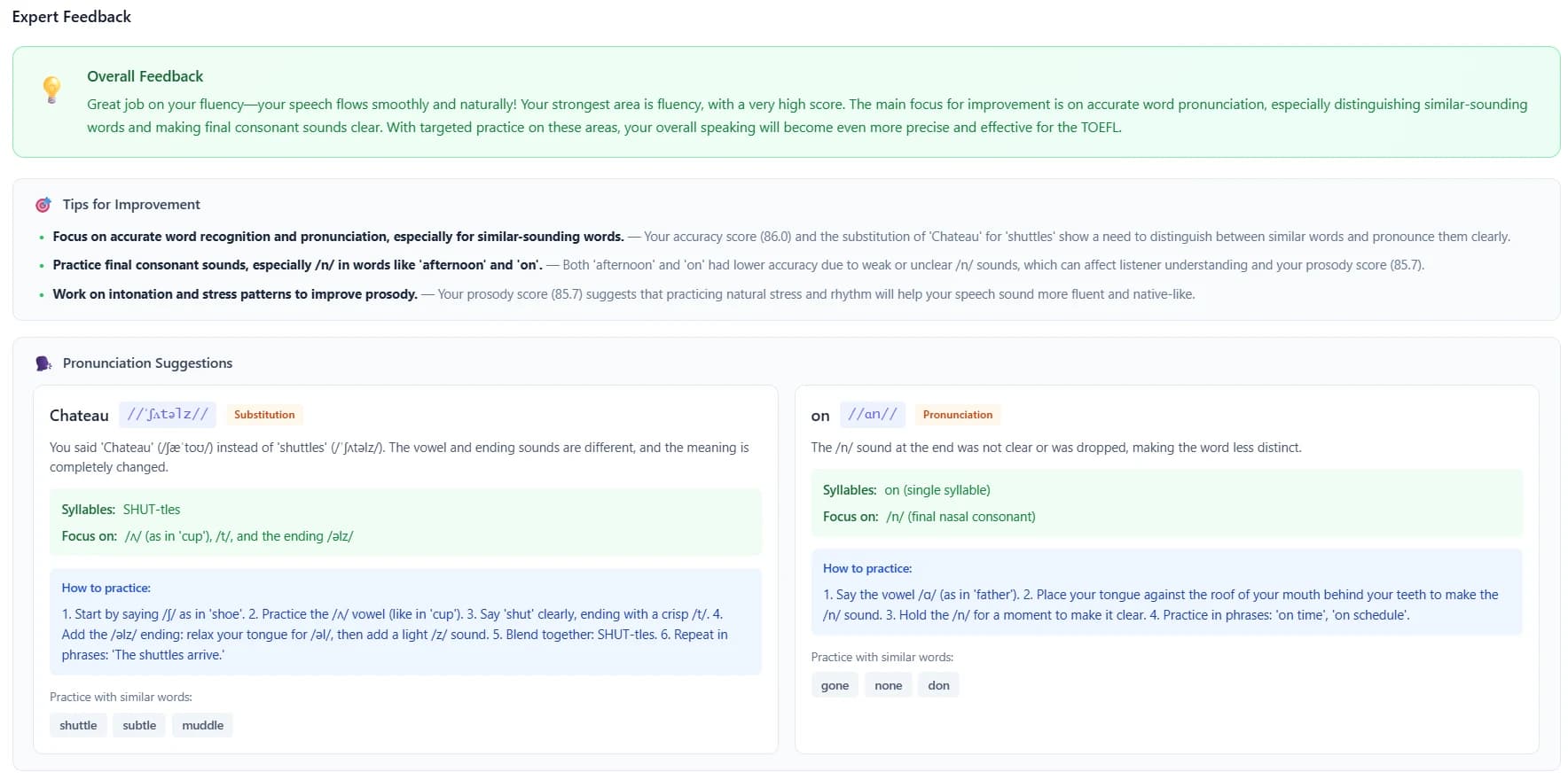
ฝึก TOEFL Speaking พร้อมข้อเสนอแนะที่อิงตามเกณฑ์การให้คะแนน
AI ของ LingoLeap ประเมินคำตอบ Speaking ของคุณโดยใช้เกณฑ์ที่สอดคล้องกับแต่ละประเภทโจทย์ — เพื่อให้การฝึกฝนของคุณมุ่งตรงไปยังสิ่งที่เกณฑ์การให้คะแนนให้รางวัลอย่างแม่นยำ
เริ่มฝึก TOEFL Speakingคำถามที่พบบ่อย
คะแนน TOEFL 2026 Speaking สูงสุดคือเท่าไร?⌄
The highest Speaking section score is Band 6 on the TOEFL 2026 1–6 scale. This corresponds to approximately a 27–30 score on the old 0–30 per-section scale and reflects consistently strong performance across both Listen and Repeat and Take an Interview tasks. For mappings between bands and the legacy 0–120 / IELTS / CEFR scales, see the TOEFL Score Converter.
Listen and Repeat หรือ Interview สำคัญกว่ากันสำหรับคะแนน Speaking ที่สูง?⌄
Both task types contribute to your Speaking section score, and consistently strong performance in both is needed to reach Band 6. The Take an Interview task is evaluated on more dimensions (relevance, elaboration, vocabulary, grammar, fluency, pronunciation), which makes it a higher-stakes area for most test-takers. However, accuracy errors in Listen and Repeat are easy to avoid with targeted practice and should not be a weak point — see the Listen and Repeat strategies guide.
ฉันสามารถทำ Band 6 ได้หรือไม่หากสำเนียงของฉันหนัก?⌄
Yes. TOEFL Speaking scoring does not penalize for a non-native accent. What matters is intelligibility — whether what you say can be clearly understood — and naturalness of intonation. You do not need to sound like a native speaker; you need to speak clearly and naturally. Many test-takers with strong accents achieve Band 6 by prioritizing clarity and correct stress patterns. See the official ETS TOEFL Speaking criteria for the full description.
คำตอบ Interview ของฉันควรยาวแค่ไหน?⌄
TOEFL Interview responses are not measured by length alone, but Band 6 responses generally include a clear answer and sufficient elaboration. In practice, this typically means 3–5 sentences delivered naturally within the available response time. A response that is too short suggests a lack of elaboration; a response that rushes through content without development is also insufficient. For a structured response framework you can practice with, see the Speaking Interview Template.
ฉันควรท่องจำเทมเพลต speaking เพื่อทำ Band 6 หรือไม่?⌄
No. Memorized templates are detectable and can actually lower your score if they make your response sound formulaic or if the template does not fit the specific question. What helps is having a reliable response structure (answer → reason → detail) that you internalize, not memorize. The content of every response should be original and specific to the prompt — see the Speaking Templates collection for adaptable frameworks rather than fixed scripts.
คู่มือที่เกี่ยวข้อง
TOEFL Score Hub
All TOEFL score tools and guides in one place.
อ่านคู่มือ →
ภาพรวม TOEFL Speaking 2026
ทำความเข้าใจโครงสร้าง ประเภทโจทย์ และเวลาของส่วน Speaking
อ่านคู่มือ →
เทมเพลต TOEFL Speaking
โครงสร้างคำตอบที่เป็นระบบสำหรับโจทย์ Interview
อ่านคู่มือ →
รูปแบบและการให้คะแนน TOEFL 2026
การให้คะแนนทำงานอย่างไรในทั้งสี่ส่วนของ TOEFL 2026
อ่านคู่มือ →
คะแนน TOEFL ที่ดีคืออะไร?
ดูว่า Band 6 มีความหมายอย่างไรสำหรับการรับเข้ามหาวิทยาลัยและการวางแผนคะแนนเป้าหมาย
อ่านคู่มือ →
วิธีทำคะแนน 6 ใน Writing
แนวทางที่อิงตามเกณฑ์การให้คะแนนแบบเดียวกัน นำไปใช้กับส่วน Writing
อ่านคู่มือ →
About this guide
Written by Erin (LingoLeap Content & SEO Specialist) and reviewed by the LingoLeap TOEFL Content Team — preparation specialists who analyse ETS official scoring rubrics, test-taker performance data, and examiner feedback reports to produce accurate, rubric-aligned TOEFL 2026 content. All scoring criteria referenced in this guide are derived from ETS published materials. Last reviewed April 30, 2026.