2026 New TOEFL Writing Section Explained: Task Types, Question Formats, and Preparation Strategies
LingoLeapJanuary 18, 2026
Overview of the TOEFL iBT 2026 Writing Section
The TOEFL iBT 2026 Writing section has undergone a fundamental redesign. Traditional long-form essays have been removed, and writing is now assessed through task-based, real-world communication.
In the 2026 new TOEFL, test-takers will complete three task types, with a total of 12 questions. These tasks focus on sentence construction, functional writing, and academic participation, placing greater emphasis on grammar accuracy, vocabulary control, and communicative effectiveness rather than length or rhetorical structure.

Task Type 1: Build a Sentence
Task Description
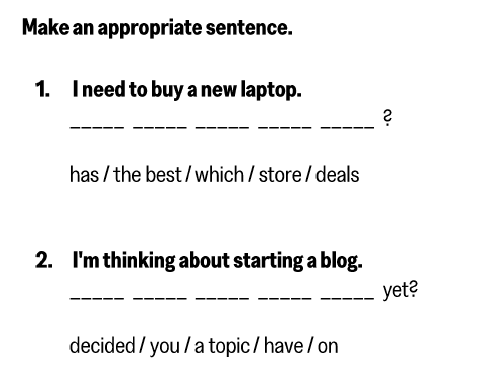
This is a foundational writing task where you are given scrambled words or phrases and must arrange them into a grammatically correct and coherent sentence. You build the sentence by moving items from boxes into the correct order.
Key Skills Assessed
- Syntactic Accuracy
- Correct placement of subjects, verbs, objects, modifiers, and introductory elements.
- Grammatical Logic
- Maintaining proper word order in more complex structures, such as dependent clauses or introductory adverbs.
Preparation Tips
- Practice identifying subject–verb–object patterns and the placement of adverbs (e.g., Unfortunately, Actually).
- Pay close attention to dependent clauses (e.g., She wanted to know if…) and ensure tense consistency across the sentence.
Example Questions from Official Sample Tests
🚩Click to try more "Build a Sentence" practice tests on LingoLeap for free!
Task Type 2: Write an Email
Task Description
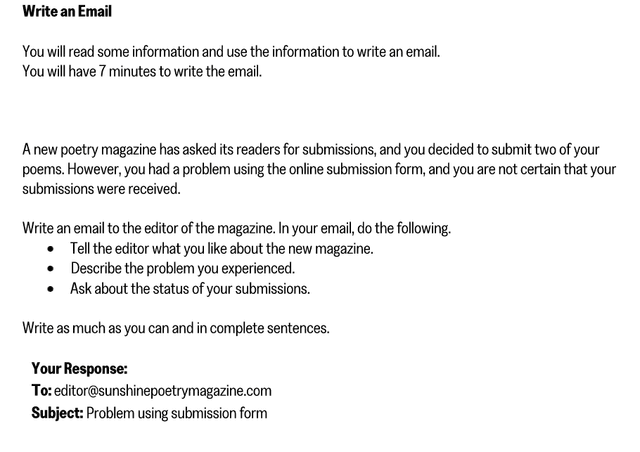
You are given a specific real-life scenario (such as a group project issue or a maintenance problem) and asked to write an email using the provided information. You typically have 7 minutes to complete this task.
Key Skills Assessed
- Task Completion
- Addressing all required bullet points (e.g., describing a problem, explaining its impact, and making a request).
- Functional Language Use
- Using appropriate tone, transitions, and expressions for requests, explanations, or complaints.
- Sentence Control
- Writing efficiently while maintaining complete, grammatically sound sentences.
Preparation Tips
- Practice writing short, targeted responses under a strict time limit.
- Memorize common email conventions, including standard openings and closings (e.g., Dear Ms. Green, / Best regards,).
Example Questions from Official Sample Tests
🚩Click to try more "Write an Email" practice tests on LingoLeap for free!
Task Type 3: Write for an Academic Discussion
Task Description
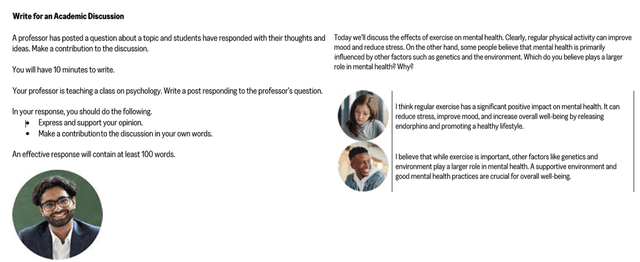
This task simulates an online academic forum. A professor posts a discussion question, followed by responses from other students. You must contribute your own response within 10 minutes.
Key Skills Assessed
- Relevance and Contribution
- Adding new ideas or expanding on existing points rather than repeating what others have said.
- Coherence and Development
- Clearly stating a position and supporting it with reasons or examples.
- Academic Tone
- Maintaining a formal yet conversational style appropriate for a university setting.
Preparation Tips
- Practice quick brainstorming to form a clear stance within the first minute.
- Study sample academic discussions to learn how to agree, disagree, or extend ideas smoothly.
Example Questions from Official Sample Tests
🚩Click to try more "Write an Academic Discussion" practice tests on LingoLeap for free!
How the New TOEFL Writing Section Differs from the Old TOEFL
The 2026 Writing section represents a clear shift away from traditional essay-based assessment.
Key Structural Changes
- Integrated writing (reading + listening + writing) has been removed.
- The 300+ word independent argumentative essay has been removed.
- Writing is now evaluated through short, task-based formats focused on real communication.
Direct Impact on Test-Takers
- Weak grammar and disorganized writing are penalized more clearly. Errors are no longer hidden in long essays.
- Template-based writing strategies are far less effective. Email and discussion tasks expose formulaic responses that do not meet task requirements.
- The importance of grammar, vocabulary, and functional language (making requests, giving suggestions, apologizing, agreeing/disagreeing) has increased significantly.
Final Tips: Preparing for the TOEFL iBT 2026 Writing Section
Effective preparation for TOEFL 2026 Writing should follow a clear priority order, focusing on sentence control before task performance.
1. Strengthen Sentence-Level Grammar First
Sentence construction underpins all writing tasks, especially Build a Sentence.Focus on:
- Clause types (independent vs. dependent)
- Conjunctions and punctuation
- Common sentence patterns used in functional writing
A systematic grammar review pays off across all writing tasks.
2. Build Scenario-Based Email Frameworks
Common email scenarios include:
- Complaints and feedback
- Scheduling or rescheduling
- Information requests
- Invitations, recommendations, and thanks with requests
For each scenario, prepare:
- One opening sentence
- 2–3 core expressions
- One closing sentence
Practice under strict 7-minute conditions, training yourself to quickly identify and respond to all required task points.
3. Practice Academic Discussions with Structure
For discussion tasks:
- Spend 3 minutes planning and 7 minutes writing
- Aim for 100–130 words
- Ensure each opinion is supported by a reason or example
After writing, review your response using the rubric:
- Did you answer the question directly?
- Did each point include support?
- Did you vary sentence structures?
4. Use Tools and Resources Strategically
Start by using official ETS sample tests and lesson plans to make sure your preparation aligns with the redesigned Writing section. These materials help clarify what each task type is actually testing and how responses are evaluated.To further improve efficiency and personalization, tools like Lingoleap.ai can play a complementary role. LingoLeap provides task-specific practice that directly mirrors the new Writing section. More importantly, it also evaluates your writing based on official TOEFL scoring criteria rather than generic grammar checks. Its AI-powered feedback focuses on:
- Grammar accuracy and sentence structure
- Task fulfillment and functional language use (e.g., making requests, giving suggestions, agreeing or disagreeing)
- Clarity, coherence, and appropriateness of tone
Instead of simply pointing out errors, the system provides revision suggestions and alternative phrasing, helping you understand how to improve and why certain choices work better. Over time, this creates a personalized improvement path, allowing you to focus on the specific weaknesses exposed by the new task-based Writing format.When used alongside official materials, platforms like Lingoleap help turn Writing practice from repetitive drilling into targeted, feedback-driven training, which is exactly what the TOEFL iBT 2026 Writing section now demands.
You can get limited-time free practice tests for TOEFL Writing now with LingoLeap!