Train for Accuracy: Shadowing Practice for TOEFL 2026 Listen and Repeat
YutingFebruary 24, 2026
With the 2026 update to the TOEFL iBT, the Speaking section introduces a task that looks simple but is scored with surprising precision: Listen and Repeat.
If you’ve already read our 2026 TOEFL Speaking Changes Overview, you know that this year’s reform shifts the focus toward more real-time processing and foundational speaking control. Listen and Repeat is one of the clearest examples of that shift.
Many students may assume this task is about pronunciation quality or sounding natural. However, this task prioritizes content accuracy and completeness above everything else.
If your goal is a score of 5, the real question is not:
“Do I sound super native and fluent?”
It is:
“Did I reproduce the sentence exactly and intelligibly?”
Shadowing practice is one of the most effective ways to train for that precision. If you’re looking for broader test-day strategy and structured routines, our articleListen and Repeat Strategies and Daily Practice Tips for TOEFL Speaking 2026 covers pacing, simulation, and daily drills in more detail. In this article, we focus specifically on how shadowing improves precision.
What the Listen and Repeat Task Really Measures
Before jumping into shadowing, we'd like to re-emphasize what's the core of the Listen and Repeat Task.
In the Listen and Repeat task, test-takers:
- Hear seven sentences related to campus life
- See an accompanying illustration
- Have no preparation time
- Must immediately repeat each sentence
The sentences will also increase in length and complexity. If you need a full breakdown of format and sentence patterns, see our detailed guide: Listen and Repeat in 2026 TOEFL Speaking: Task Format, Scoring, and Common Sentence Types.
From a scoring perspective, the priorities are clear. As explained in our TOEFL Speaking Rubric Breakdown, high scores depend on how faithfully you reproduce the original sentence.
According to the rubric:
- Score 5: The response exactly repeats the prompt and is fully intelligible.
- Score 4: Minor changes may occur, but meaning is preserved.
- Score 3: Some content words are missing or substantially changed.
- Score 2–1: Large portions are missing or unintelligible.
Notice the pattern:
The higher the score, the closer your response must be to the original. Pronunciation and intonation matter—but mainly because they help ensure intelligibility. They are supportive, not decorative.
What Shadowing Actually Trains
Shadowing is often described as a pronunciation technique. But for this task, its value is more strategic. It can also train real-time retention and faithful reproduction.
1. It Builds a Repetition Reflex
During shadowing, you:
- Start speaking 1–2 seconds after the audio begins
- Follow continuously without stopping
- Depend entirely on listening
This conditions your brain to convert sound into speech without hesitation.
Instead of: Hear → Process → Reconstruct → Speak
You move toward: Hear → Retain → Reproduce
That shortened pathway reduces omissions and word substitutions under exam pressure.
2. It Strengthens Short-Term Memory for Full Sentences
Because shadowing forces you to handle full-length sentences repeatedly, your brain becomes more comfortable with:
- Multi-clause structures
- Embedded phrases
- Time and location modifiers
You begin processing in thought groups rather than isolated vocabulary.
For example:
The biology department / is hosting / a guest lecture / next Wednesday afternoon.
Chunking reduces cognitive load and increases the likelihood of complete reproduction.
3. It Improves Intelligibility — As Support for Accuracy
In Listen and Repeat, pronunciation is not about sounding native.
It is about ensuring that what you repeat is clearly recognizable as the original sentence.
Shadowing helps you maintain:
- Clear plural endings (students, gains)
- Accurate contractions (there’s, not there is)
- Stable word boundaries
- Consistent pacing
These features increase intelligibility, which supports your accuracy score.
A Practical Shadowing Practice Routine
To make shadowing effective for this task, structure your practice carefully.
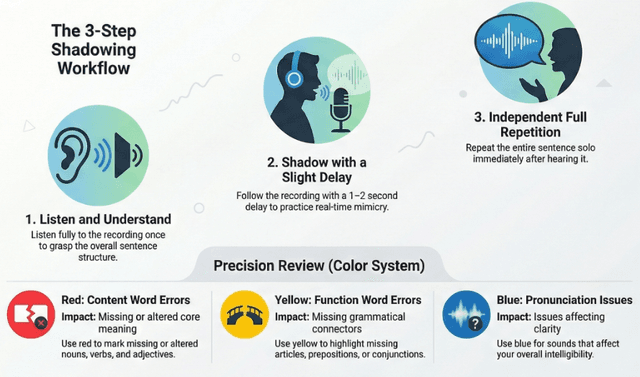
Step 1: Listen Fully Once
Understand the overall sentence structure.
Step 2: Shadow with a Slight Delay
Follow 1–2 seconds behind the recording.
Step 3: Independent Full Repetition
After hearing the sentence once, repeat it entirely on your own.
Step 4: Precision Review (Color System)
- Red – Missing or altered content words
- Yellow – Missing function words
- Blue – Pronunciation issues affecting intelligibility
This review process reveals exactly why points would be lost.
Combine Shadowing with Real "Listen and Repeat" Practice
Shadowing builds the mechanism. But progress becomes visible only when you test it under real task conditions. This transition matters. Shadowing trains repetition accuracy in motion; simulation reveals whether that accuracy holds when you are fully on your own.
Once you’ve incorporated shadowing into your routine, return to Listen and Repeat practice and try the task again in full exam format. Hear the sentence once, without transcript support, and reproduce it immediately—just as you would on test day. Use the same evaluation approach to review your performance and compare it with earlier attempts. Many learners notice that sentences feel more stable, fewer words are lost, and longer structures are easier to complete without hesitation. That shift indicates that repetition reflex is becoming automatic.
To make this stage meaningful, practice conditions need to closely resemble the real TOEFL environment. Accuracy gains are easiest to verify when timing, interface, and task constraints mirror the actual test.
LingoLeap offers Listen and Repeat simulations built around these exact requirements. You practice in a timed, computer-based interface with one-time audio playback and a timed response—closely matching the updated TOEFL format.
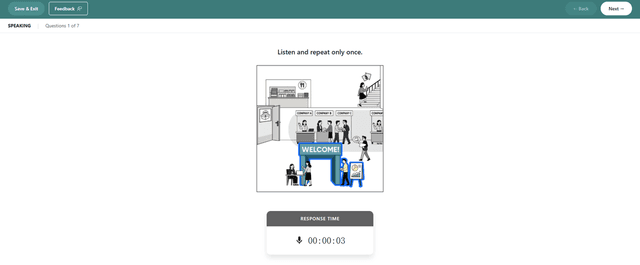
After each response, the system:
- Compares your sentence directly with the standard answer
- Identifies missing or altered words
- Analyzes pronunciation clarity and intelligibility
- Provides targeted feedback and concrete improvement guidance
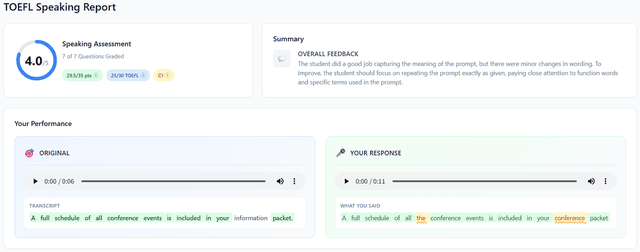
Instead of relying on subjective judgment, you receive sentence-level analysis that shows whether your repetition accuracy is improving.
Shadowing strengthens control. Realistic simulation verifies stability.
Together, they create a preparation cycle aligned with how the TOEFL 2026 Listen and Repeat task is actually scored.