2026 New TOEFL Email Writing Task: Common Topics and Scoring Focus
YutingJanuary 26, 2026
The 2026 new TOEFL has been restructured across sections, with updates to task design, scoring logic, and how language ability is interpreted, as outlined in the New TOEFL 2026 overview. At the same time, score reporting and conversion have been refined, making it important to understand how performance maps to target bands under the new system, as explained in the New TOEFL scoring system.
Within the 2026 TOEFL Writing section, one of the most significant changes is the introduction of email writing as a core task. While the task itself may appear straightforward, achieving a high score under the official rubric is not as simple as it seems. This article draws on those official examples to summarize the most likely email scenarios and topics in the 2026 TOEFL and explains what each type is actually testing, helping you prepare more strategically for this deceptively simple task.
How TOEFL 2026 Email Tasks Are Designed
Although the contexts vary, ETS applies stable assessment logic across all Email tasks. Responses are evaluated on whether they:
- Address all required points
- Use a tone appropriate to the situation
- Communicate efficiently and clearly under time pressure
See an example question format and try LingoLeap for free now!
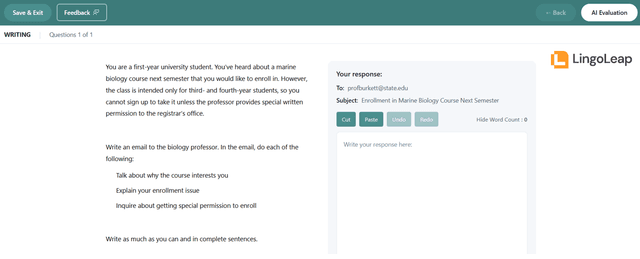
Common Scenarios and Topics for 2026 TOEFL Email Writing
1. Academic and Campus Scenarios
Academic and campus-related contexts are the most common source of Write an Email prompts. These scenarios test your ability to communicate clearly and politely in an educational environment.
Academic Topics and Example Questions
- Submission issues: Writing to a poetry magazine editor to ask about submission status while explaining a technical problem encountered during online submission.
- Group collaboration problems: Emailing a disengaged group member to describe current progress, explain the impact of repeated absences, and suggest ways to contribute going forward.
- Study organization: Inviting classmates to join a study group, explaining its purpose and covered topics, and proposing a first meeting time and location.
- Post-event follow-up: Thanking a speaker for a workshop, explaining why it was helpful, and requesting additional learning resources.
- System or administrative issues: Reporting problems with assignment submission systems, course registration errors, or billing and receipt discrepancies.
What ETS Is Testing in Academic Emails
In these scenarios, ETS focuses on whether you can:
- Organize information logically under clear task requirements
- Maintain a polite, appropriate academic tone
- Explain problems or requests efficiently without unnecessary detail
The goal is not to sound impressive, but to write an email that would be considered clear and effective in a real campus setting.
2. Workplace Scenarios
Workplace-style prompts simulate professional communication with colleagues, where clarity and diplomacy matter as much as content.
Workplace Topics and Example Questions
- Giving negative feedback: Writing to a colleague who recommended a restaurant to describe a disappointing team visit, explain the group’s reaction to the food and service, and discuss options for future team lunches.
- Travel-related inquiries: Asking a colleague or restaurant and activity recommendations during a business trip, while explaining preferences and listing places to avoid.
What ETS Is Testing in Workplace Emails
These tasks emphasize your ability to:
- Communicate criticism tactfully
- Balance honesty with professionalism
- Maintain a cooperative tone throughout the message
Strong responses show awareness that workplace emails are not just informational, but relational.
3. Daily-Life Scenarios
Daily-life scenarios are less formal but still carefully structured. They test whether you can make clear requests or suggestions in familiar situations.
Common Topics and Example Questions
- Complaints and suggestions: Writing to a community association chair about park maintenance issues, explaining why they matter, and proposing practical solutions.
- Giving personal advice: Offering concrete suggestions to a friend who has just moved to a new city, covering adjustment, social life, and everyday routines.
What ETS Is Testing in Daily-Life Emails
Here, ETS evaluates whether you can:
- Explain situations clearly to a general audience
- Offer specific, relevant suggestions
- Match tone to the relationship with the recipient
Even in informal contexts, clarity and task completion remain central.
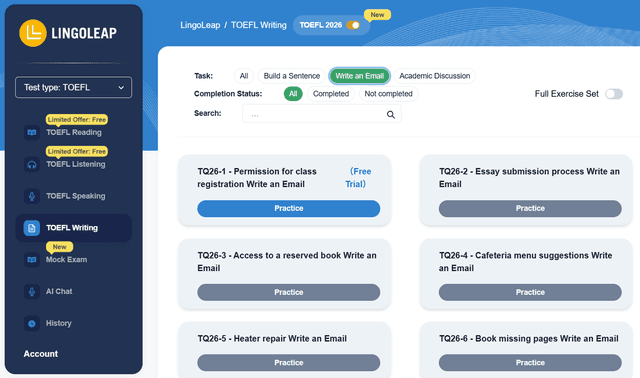
Want to explore and practice more on your own?
Tips and Strategies for TOEFL 2026 Email Writing
Across all email scenarios, several principles consistently align with higher scores:
- Treat the bullet points as a scoring checklist.
- Every required point must be clearly addressed. Missing one often limits your score.
- Always re-read your email and check if you include all the bullet points.
- Write with purpose, not length.
- High-scoring emails are efficient. Each sentence serves a clear communicative function.
- Do not go too far for fancy vocabulary or complex sentence structure.
- Minor errors are acceptable as long as meaning remains clear and the task is fulfilled.
- Match tone to context.
- Academic, professional, and personal emails differ. Appropriateness matters more than complexity.
- Build a topic bank to summarize phrasing and expressions that fit into different scenarios.
- Build Flexible Email Templates.
- Learn about and practice with flexible email templates and structures that can be adapted quickly under time pressure.
- Memorizing reusable openings, transitions, and closings helps save time. But always use them adaptively without sounding memorized.
- Practice Makes Perfect
- Working with real TOEFL-style email prompts, such as giving constructive feedback to a colleague, helps build confidence and control under time pressure.
- LingoLeap’s TOEFL Email Writing practice provides realistic scenarios and AI-driven feedback aligned with the 2026 rubric, helping you improve tone, structure, and task coverage more efficiently.