O que Significa uma Banda 6 no TOEFL 2026 Speaking
O TOEFL 2026 reporta o Speaking como uma única pontuação de seção na escala de 1 a 6. Essa banda geral reflete seu desempenho combinado nos dois tipos de tarefa de Speaking: Listen and Repeat e Take an Interview. Cada tipo de tarefa é avaliado com seu próprio conjunto de critérios.
Listen and Repeat
Avaliada pela precisão da repetição e pela inteligibilidade. Um desempenho de Banda 6 significa reproduzir as frases com precisão, com uma fala clara e de som natural.
Take an Interview
Avaliada por relevância, desenvolvimento, fluência, vocabulário, gramática e pronúncia. Um desempenho de Banda 6 significa respostas totalmente relevantes e bem desenvolvidas, entregues com fala natural.
Important: the official ETS TOEFL Speaking page and the ETS scoring documentation describe the dimensions evaluated for each task but do not publish the exact formula that converts task-level scores to the 1–6 section reporting band. What is clear is that consistent high performance across both task types — accuracy in Listen and Repeat, and communicative effectiveness in the Interview — is required for the highest section score.
For the full explanation of how TOEFL 2026 scores are calculated, see the guia completo de pontuação 2026.
Listen and Repeat: Caminho para a Banda 6
The Listen and Repeat task plays a spoken sentence. Your task is to repeat it back as accurately and clearly as possible. The two core scoring dimensions are repetition accuracy and intelligibility — see the Listen and Repeat strategies guide for drill techniques.
Precisão da Repetição
Reproduza exatamente as palavras, a ordem das palavras e o significado da frase. Substituir, omitir ou reordenar palavras — mesmo que o resultado soe natural — reduz sua pontuação. Cada palavra da frase original importa. Respostas de Banda 6 preservam a frase com fidelidade quase perfeita.
Inteligibilidade
Sua pronúncia precisa ser clara o suficiente para que o que você diz seja compreendido imediatamente. Um sotaque não nativo não é penalizado, mas pronúncias incorretas que dificultam a identificação das palavras reduzem sua pontuação. A clareza constante ao longo de toda a resposta é o que garante a banda máxima.
Fala Conectada
Respostas de Banda 6 são entregues como uma frase conectada e natural — não palavra por palavra. Uma fala truncada, interrompida a cada palavra, sugere dificuldade em reter a frase na memória e sinaliza menor fluência oral.
Hábito de prática essencial
Grave suas respostas de Listen and Repeat e compare-as diretamente com o áudio original. Treine seu ouvido para identificar substituições, palavras omitidas e falhas de pronúncia. Fazer shadowing com áudio de falantes nativos é o exercício individual mais eficaz para essa tarefa.
Take an Interview: Caminho para a Banda 6
The Interview task asks you to answer a spoken question with no preparation time. ETS's Interview scoring guide describes every level by four things: how on-topic and elaborated the answer is, pace, pronunciation, and grammar and vocabulary. Below, those four are split into the six habits that Band 6 answers show. For an adaptable response framework, see the Speaking Interview Template.
Relevância Direta
Sua resposta precisa responder exatamente à pergunta feita. Respostas vagas ou que fogem do tema são penalizadas independentemente de quão fluentemente são entregues. Estabeleça uma posição clara e mantenha-a.
Desenvolvimento Coerente
Apoie sua posição com pelo menos um motivo, exemplo ou detalhe específico. Respostas de Banda 6 não param em uma única frase de opinião — elas desenvolvem a ideia de forma fácil de acompanhar.
Fluência Natural
A fala deve fluir continuamente com hesitação mínima. Pausas naturais ocasionais para pensar são esperadas, mas preenchimentos frequentes, silêncios longos ou frases reiniciadas sugerem dificuldade na produção oral.
Pronúncia e Entonação Naturais
Respostas de Banda 6 usam padrões de acentuação e entonação naturais — não apenas pronúncia inteligível, mas uma fala que soa comunicativamente eficaz. Uma entrega monótona ou plana pode reduzir essa pontuação mesmo quando os sons individuais são claros.
Vocabulário Preciso
Use vocabulário variado e apropriado ao tema. Depender de um conjunto pequeno de palavras básicas ou de linguagem excessivamente genérica sinaliza um alcance lexical limitado. Respostas de Banda 6 mostram a capacidade de expressar ideias sutis com escolhas de palavras apropriadas.
Controle Gramatical
Pequenos erros gramaticais são esperados e aceitáveis na Banda 6. O que não é aceitável são erros estruturais repetidos que interferem no significado ou sugerem falta de domínio da estrutura das frases.
TOEFL iBT Speaking Rubric 2026: Every Score Level (0–5)
ETS scores every Speaking response from 0 to 5, with a separate scoring guide for each task. The two tables below paraphrase both guides level by level in our own words; the levels, and what each one covers, are ETS's. Your 1–6 section band is then built from these task scores by a conversion ETS does not publish.
Listen and Repeat rubric
| Score | What the response does |
|---|---|
| 5 | Repeats the sentence exactly and is fully intelligible. |
| 4 | Keeps the meaning but is not exact: one or two function words missing or changed, a content word dropped (in a longer sentence) or replaced with a related word, a tense or plural marker wrong, or two words swapped. One or two words may be unclear; a self-correction is fine if the sentence is completed. |
| 3 | An essentially full sentence that no longer carries the original meaning: most content words are there, but several function words or at least one content word are missing or changed. Some words may be hard to make out. |
| 2 | A large part of the sentence is missing or wrong, often everything except its first part and last few words. The result is a fragment that a listener who did not hear the prompt would struggle to follow. |
| 1 | Only a few words of the sentence, or an attempt that is mostly unintelligible. |
| 0 | No response, nothing intelligible, no English, or content unconnected to the prompt (for example, only “I don't know”). |
The practical consequence: a single missing or changed word is already enough to move a Listen and Repeat response from 5 to 4.
Take an Interview rubric
| Score | Overall | Topic and elaboration | Pace | Pronunciation | Grammar and vocabulary |
|---|---|---|---|---|---|
| 5 | Fully successful: answers the question fully, clearly and fluently | On topic and well elaborated | Good conversational pace; pauses sound natural | Easy to understand; rhythm and intonation help carry the meaning | A range of accurate grammar and vocabulary expresses precise meanings |
| 4 | Generally successful: answers the question reasonably clearly | On topic and elaborated, though connectors between sentences may be weak | Good pace most of the time; some pauses slightly affect the flow | Does not block understanding, though a few words take minor effort | Adequate to express general meanings most of the time |
| 3 | Partially successful: answers the question with limited elaboration or clarity | Generally on topic; elaboration relatively limited | Frequent or long pauses make it choppy; filler words are frequent | Word-level pronunciation or stress sometimes gets in the way | Limited range and accuracy noticeably restrict precision and clarity |
| 2 | Mostly unsuccessful: an attempt to answer that is not supported in a meaningful or intelligible way | Barely connected to the question; little relevant elaboration, or mostly the question's own words | — | Limited; the intended meaning is often hard to work out | A very limited range |
| 1 | Unsuccessful: addresses the question only minimally | Only vaguely connected to the language of the question | — | Mostly unintelligible | Mainly isolated words or phrases |
| 0 | No response, nothing intelligible, no English, or content unconnected to the question. | ||||
“—” means the ETS guide gives no separate descriptor for that column at that level.
Official wording: ETS TOEFL iBT Speaking Scoring Guide: Listen and Repeat and Take an Interview (PDF).
Detalhamento da Rubrica na Banda 6
A tabela abaixo resume como é o desempenho de Banda 6 nas duas tarefas de Speaking.
| Dimensão da Rubrica | Listen and Repeat | Take an Interview |
|---|---|---|
| Precisão / Relevância | Redação quase exata, todas as palavras preservadas | A resposta aborda diretamente a pergunta |
| Inteligibilidade / Pronúncia | Clara e compreensível do início ao fim | Clareza constante com entonação natural |
| Entrega | Entrega fluida e conectada da frase | Fluência natural, hesitação mínima |
| Desenvolvimento | N/A (a tarefa é apenas repetição) | Motivo ou exemplo específico claramente desenvolvido |
| Vocabulário / Gramática | N/A (a tarefa é apenas repetição) | Vocabulário variado, controle gramatical |
Como São as Respostas de Banda 6
Reconhecer as características de uma resposta de Banda 6 ajuda a calibrar sua própria produção. Veja como é um desempenho forte em cada tarefa.
- ✓Reproduz a frase com redação exata ou quase exata
- ✓Entrega a frase como uma única frase conectada, não palavra por palavra
- ✓Mantém clareza constante — cada palavra é facilmente reconhecida
- ✓Controla o ritmo e o volume para facilitar a compreensão
- ✓Nenhuma palavra substituída, omitida ou reordenada
- ✓Começa com uma resposta clara e direta à pergunta específica feita
- ✓Continua com pelo menos um motivo ou exemplo específico e logicamente conectado
- ✓Fala em frases naturais e fluentes, sem pausas longas ou reinícios
- ✓Usa vocabulário apropriado ao tema com acentuação e entonação naturais
- ✓Mantém os erros gramaticais pequenos e sem comprometer o significado durante toda a resposta
Por que os Candidatos Não Alcançam a Banda Máxima
Entender os motivos mais comuns pelos quais os falantes não alcançam a Banda 6 ajuda você a identificar e corrigir lacunas em suas próprias respostas.
Palavras Substituídas ou Omitidas (Listen and Repeat)
O erro de precisão mais comum. Mesmo uma única palavra substituída ou omitida reduz sua pontuação para aquela resposta. Treine-se para reter a frase completa na memória de trabalho antes de falar.
Entrega Palavra por Palavra (Listen and Repeat)
Repetir uma frase como uma sequência de palavras desconectadas sinaliza uma má segmentação da memória e fluência oral limitada. Pratique entregar frases completas como um único fluxo conectado.
Respostas Vagas ou Fora do Tema (Interview)
Responder a uma pergunta relacionada, mas diferente, ou dar uma afirmação genérica que não aborda diretamente o enunciado, é um dos erros mais custosos no Interview.
Opiniões Sem Suporte (Interview)
Declarar uma preferência ou opinião e parar por aí não é suficiente para a Banda 6. Toda resposta do Interview precisa de pelo menos um detalhe de apoio claro e específico.
Erros de Pronúncia que Afetam a Compreensão
A pronúncia incorreta constante de palavras de alta frequência reduz a inteligibilidade nos dois tipos de tarefa. O sotaque não é penalizado — a falta de clareza, sim.
Entrega Monótona (Interview)
Uma fala plana e de som robótico compromete o critério de entonação mesmo quando os sons individuais são pronunciados corretamente. O inglês falado natural tem tom, acentuação e ritmo variados.
Estratégias de Prática para a Banda 6
Uma preparação eficaz para a Banda 6 aborda cada tipo de tarefa de acordo com seus próprios critérios. Veja o que uma prática consistente deve incluir.
Prática diária de shadowing
Faça shadowing com áudio de falantes nativos, repetindo as frases imediatamente após ouvi-las. Comece com frases de 8 a 10 palavras e aumente a extensão progressivamente. Isso treina a capacidade de memória e a fluência da fala ao mesmo tempo.
Comparação e análise de lacunas
Grave suas repetições e compare-as com o áudio original. Identifique substituições, palavras omitidas e diferenças de pronúncia. Acompanhe suas lacunas semana a semana.
Treine os sons problemáticos mais frequentes
Identifique quais sons do inglês você pronuncia incorretamente de forma constante e pratique-os isoladamente. Depois, reintegre-os na prática de frases completas.
Use uma estrutura de resposta organizada
Pratique um formato confiável de 3 partes: resposta direta → motivo específico → breve elaboração. Isso mantém suas respostas organizadas sob pressão de tempo, sem depender de roteiros memorizados.
Prática de resposta cronometrada
Configure um cronômetro e responda a perguntas no estilo Interview do TOEFL dentro de uma janela de tempo alvo. Um ritmo consistente reduz a hesitação durante a prova real.
Construa vocabulário por grupo temático
Estude vocabulário agrupado pelos temas comuns do Interview do TOEFL — educação, tecnologia, meio ambiente, experiência pessoal, preferências. Pratique usar cada grupo naturalmente em frases faladas.
Grave-se e faça autoavaliação
Reescute suas respostas usando os critérios da Banda 6: Foi relevante? Desenvolvida? Entregue naturalmente? Com controle gramatical? Identifique uma lacuna por sessão e trabalhe nela no dia seguinte.
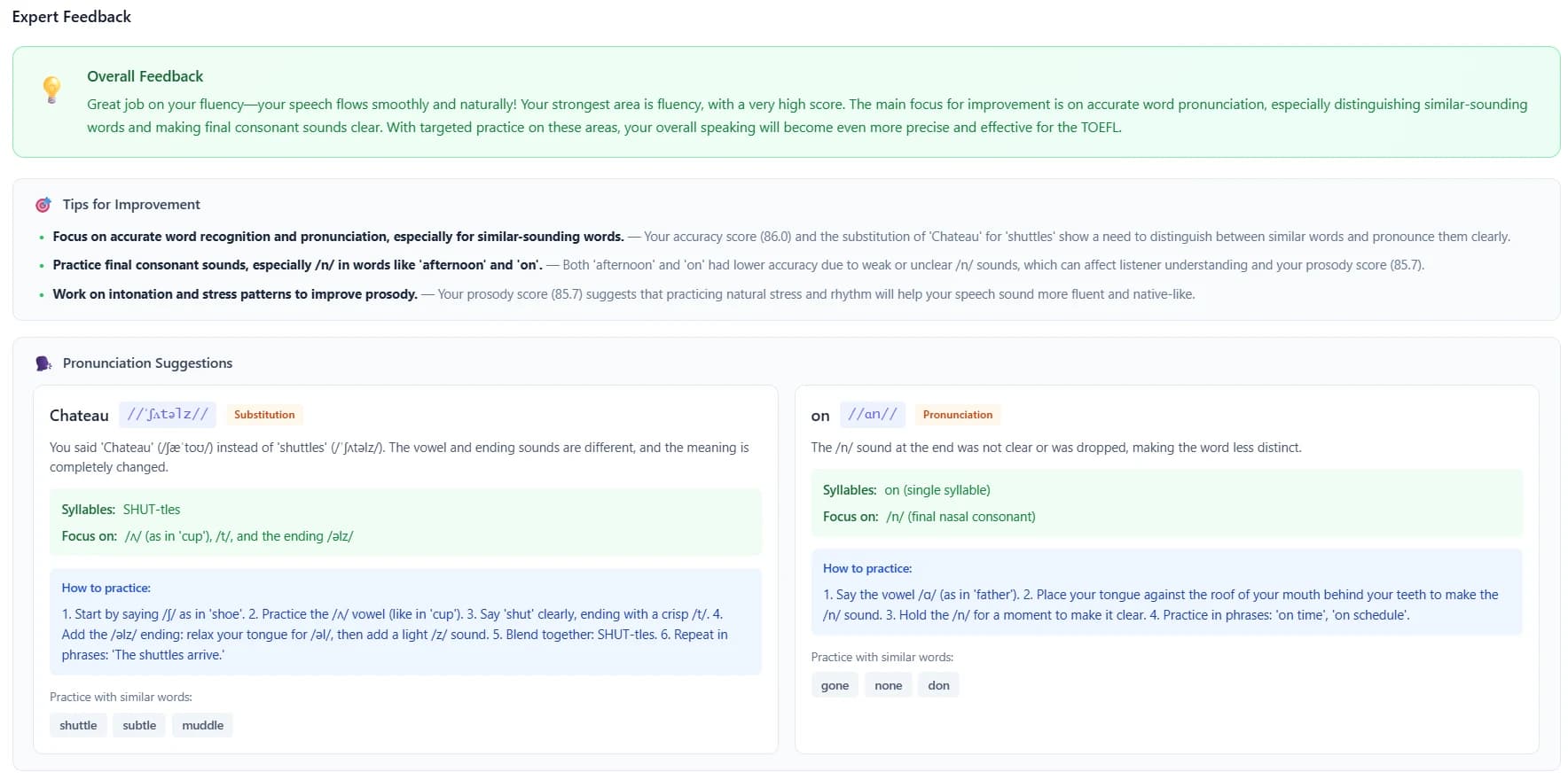
LingoLeap's TOEFL Speaking practice environment covers both Listen and Repeat and Interview tasks. Your responses are evaluated using scoring criteria that reflect what the rubric rewards, giving you actionable feedback on each session.
Pratique TOEFL Speaking com Feedback Baseado em Rubricas
A IA da LingoLeap avalia suas respostas de Speaking usando critérios alinhados a cada tipo de tarefa — para que sua prática mire exatamente no que a rubrica premia.
Começar a Praticar TOEFL SpeakingPerguntas Frequentes
Qual é a maior pontuação do TOEFL 2026 Speaking?⌄
The highest Speaking section score is Band 6 on the TOEFL 2026 1–6 scale. This corresponds to approximately a 27–30 score on the old 0–30 per-section scale and reflects consistently strong performance across both Listen and Repeat and Take an Interview tasks. For mappings between bands and the legacy 0–120 / IELTS / CEFR scales, see the TOEFL Score Converter.
Listen and Repeat ou o Interview é mais importante para uma pontuação alta em Speaking?⌄
Both task types contribute to your Speaking section score, and consistently strong performance in both is needed to reach Band 6. The Take an Interview task is evaluated on more dimensions (relevance, elaboration, vocabulary, grammar, fluency, pronunciation), which makes it a higher-stakes area for most test-takers. However, accuracy errors in Listen and Repeat are easy to avoid with targeted practice and should not be a weak point — see the Listen and Repeat strategies guide.
Posso alcançar a Banda 6 se meu sotaque for forte?⌄
Yes. TOEFL Speaking scoring does not penalize for a non-native accent. What matters is intelligibility — whether what you say can be clearly understood — and naturalness of intonation. You do not need to sound like a native speaker; you need to speak clearly and naturally. Many test-takers with strong accents achieve Band 6 by prioritizing clarity and correct stress patterns. See the official ETS TOEFL Speaking criteria for the full description.
Quanto tempo devem durar minhas respostas do Interview?⌄
TOEFL Interview responses are not measured by length alone, but Band 6 responses generally include a clear answer and sufficient elaboration. In practice, this typically means 3–5 sentences delivered naturally within the available response time. A response that is too short suggests a lack of elaboration; a response that rushes through content without development is also insufficient. For a structured response framework you can practice with, see the Speaking Interview Template.
Devo memorizar modelos de speaking para alcançar a Banda 6?⌄
No. Memorized templates are detectable and can actually lower your score if they make your response sound formulaic or if the template does not fit the specific question. What helps is having a reliable response structure (answer → reason → detail) that you internalize, not memorize. The content of every response should be original and specific to the prompt — see the Speaking Templates collection for adaptable frameworks rather than fixed scripts.
Guias Relacionados
TOEFL Score Hub
All TOEFL score tools and guides in one place.
Ler guia →
Visão Geral do TOEFL Speaking 2026
Entenda a estrutura, os tipos de tarefa e o tempo da seção Speaking.
Ler guia →
Modelos de TOEFL Speaking
Estruturas de resposta organizadas para a tarefa Interview.
Ler guia →
Formato e Pontuação do TOEFL 2026
Como funciona a pontuação nas quatro seções do TOEFL 2026.
Ler guia →
O que É uma Boa Pontuação no TOEFL?
Veja o que a Banda 6 significa para admissões universitárias e planejamento de pontuação-alvo.
Ler guia →
Como Tirar 6 em Writing
A mesma abordagem baseada em rubricas aplicada à seção Writing.
Ler guia →
About this guide
Written by Erin (LingoLeap Content & SEO Specialist) and reviewed by the LingoLeap TOEFL Content Team — preparation specialists who analyse ETS official scoring rubrics, test-taker performance data, and examiner feedback reports to produce accurate, rubric-aligned TOEFL 2026 content. All scoring criteria referenced in this guide are derived from ETS published materials. Last reviewed April 30, 2026.