2026 TOEFL Email Writing Template and Sample Essay: Requesting Permission from a Professor
YutingFebruary 24, 2026
Campus & Academic Communication questions are among the most common scenarios in the TOEFL 2026 email task. While some prompts involve coordinating with classmates, others require writing to someone in a position of authority—such as a professor, a guest speaker, or academic advisor.
These professor-facing emails are more challenging because they test not only structure, but tone, clarity, and professional awareness. If you’d like a deeper understanding of how these tasks are evaluated, you can refer to our detailed breakdown of the 2026 TOEFL Writing Rubrics, where we explain what raters prioritize in high-level responses.
In this case study, we examine a common academic request scenario: asking a professor for special permission to enroll in a restricted course. We’ll apply the 3+1 structure, analyze the prompt, review a high-scoring sample email, and highlight reusable expressions specific to formal academic requests.
Example Question & Prompt Analysis
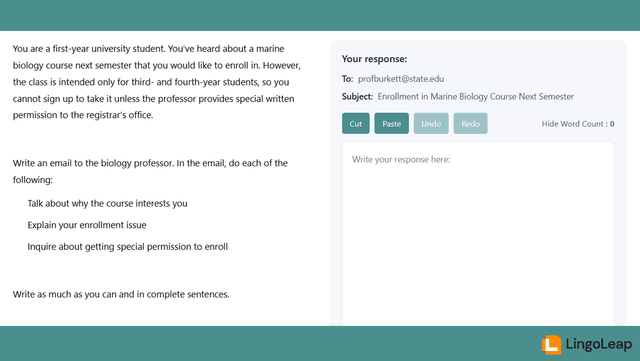
To Analyze This Prompt:
1️⃣ Identify Recipient & Tone
- Scenario type: Campus & Academic Communication
- Recipient: Professor
- Tone: Formal and respectful, and unlike classmate emails, this one requires:
- Polished language
- Clear reasoning
- No casual phrasing
- No demanding tone
2️⃣ Convert Bullet Points into Structure
This prompt naturally maps into 3+1:
- Purpose → Express interest in the course
- Explanation → Clarify enrollment limitation
- Request → Ask about special permission
- Closing → Appreciation + acknowledgement
The key difficulty here is balance.
- You must sound confident, not entitled.
- Interested, not desperate.
- Professional, not casual.
A High-Scoring Writing Sample & Analysis
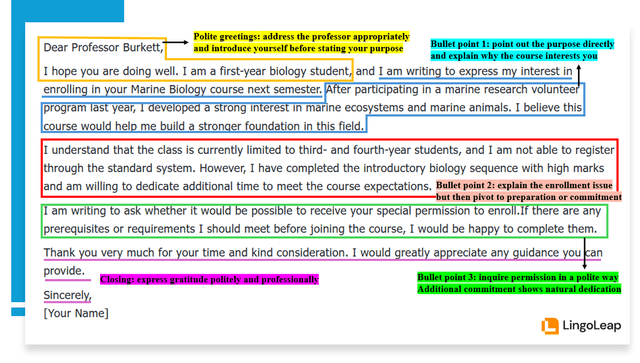
1. Polite and Natural Opening
When writing to a professor, it’s important to briefly introduce yourself before stating your request, especially since the professor is unlikely to know who you are in this scenario. Beginning directly with a request may sound abrupt. Although self-introduction is not listed in the bullet points, appropriate tone and audience awareness are essential for a high-scoring response.
2. Clear Academic Motivation
The writer explains why the course is meaningful by mentioning a previous marine research volunteer experience. Instead of simply saying “I’m interested,” the email connects past experience to future academic goals. This shows seriousness and purpose.
3. Professional Explanation of the Enrollment Issue
The restriction is acknowledged clearly and respectfully: “I understand that the class is currently limited…”
There is no complaint or frustration. The student accepts the policy and simply explains the situation. This demonstrates maturity and awareness.
4. Polite and Indirect Request
The request is phrased carefully: "I am writing to ask whether it would be possible…” This sounds respectful, not demanding. The additional sentence offering to complete extra requirements strengthens the request logically.
5. Formal and Appropriate Closing
The closing is concise and professional: “Thank you very much for your time and kind consideration.” No dramatic language. No casual sign-off. The tone remains consistent throughout.
Expression Bank: Email Language You Can Reuse When Making Formal Academic Requests or Inquiries
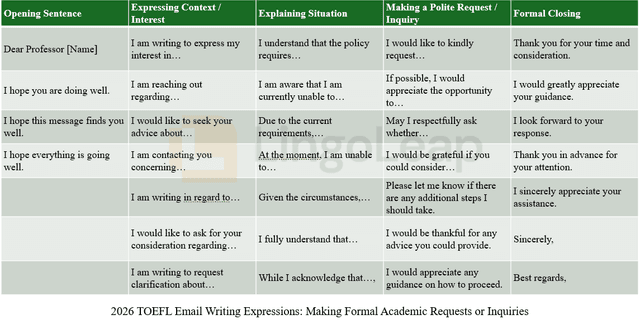
Quick Note: When writing to a professor in an academic context, always use “Dear Professor [Last Name].”
Avoid using “Mr.” or “Mrs.” unless the title is clearly specified. Using the correct academic title reflects professionalism and audience awareness.
Practice Writing in Professional Tone
The 3+1 structure is especially helpful under the strict time limits of the TOEFL email task, as strong organization reduces cognitive load during timed writing. However, structure alone is not enough—developing a formal academic tone requires consistent practice with realistic prompts, exam-style timing, and structured feedback.
For TOEFL 2026 test-takers, achieving this level of clarity and professionalism takes deliberate training. LingoLeap combines AI-powered email simulations, timed writing practice, and rubric-aligned evaluation to help learners internalize structured academic writing patterns efficiently.
The goal isn’t to memorize formal phrases. It’s to build the ability to communicate professionally under pressure. Once that skill becomes automatic, even high-stakes academic requests feel manageable.