2026 New TOEFL Speaking Section Explained: Task Types, Question Formats, and Preparation Strategies
LingoLeapJanuary 18, 2026
Overview of the TOEFL iBT 2026 Speaking Section
In the Speaking section of the new 2026 TOEFL, test-takers will answer a total of 11 questions designed to assess their ability to speak English in real-world and academic scenarios.
The redesigned format places strong emphasis on spontaneity, pronunciation accuracy, and functional communication, rather than prepared responses or memorized templates.

Task Type 1: Listen and Repeat
Task Description
This task typically appears at the beginning of the Speaking section. You are placed in a simulated training scenario, such as learning to guide visitors in a museum or assist students in a library.
You will listen to a speaker and must repeat exactly what they say, speaking immediately after the audio ends.
Key Skills Assessed
- Accuracy and Short-Term Recall
- Reproducing the sentence accurately after hearing it only once.
- Pronunciation and Intonation
- Matching the speaker’s natural rhythm, stress, and clarity.
- Immediate Response
- There is no preparation time; you must speak as soon as the prompt finishes.
Preparation Tips
- Practice shadowing short sentences (approximately 3–12 seconds) from academic or campus-life recordings.
- Train short-term memory by listening once and repeating without relying on written support.
Example Questions from Official Sample Tests
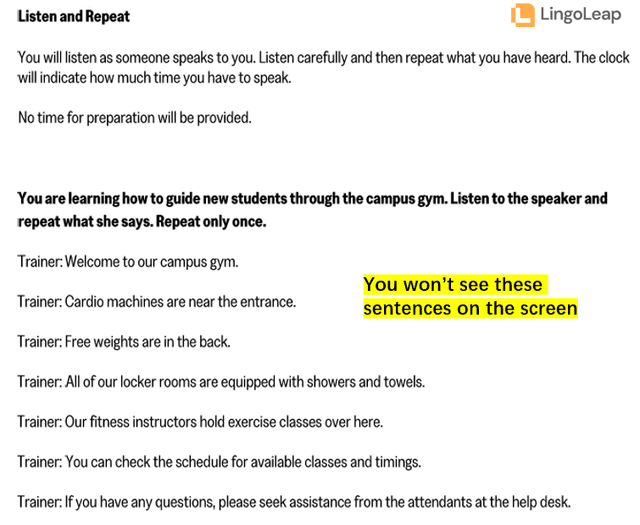
🚩Click to try more "Listen and Repeat" practice tests on LingoLeap for free!
Task Type 2: Take an Interview
Task Description
This task simulates a one-on-one interview. You will answer questions related to campus life, work preferences, or personal experiences.Responses must be given spontaneously, without any preparation time.
Key Skills Assessed
- Spontaneous Fluency
- Thinking and speaking smoothly under time pressure, showing professionalism.
- Content Development
- Speaking as fully as possible within the time limit to demonstrate vocabulary and grammatical range.
- Relevance and Coherence
- Addressing the interviewer’s question directly with logical and connected ideas.
Preparation Tips
- Practice answering common interview-style questions without notes (e.g., reasons for applying to a role or managing responsibilities).
- Record yourself to identify hesitations and filler words (such as “um” or “uh”) and improve delivery smoothness.
Example Questions from Official Sample Tests
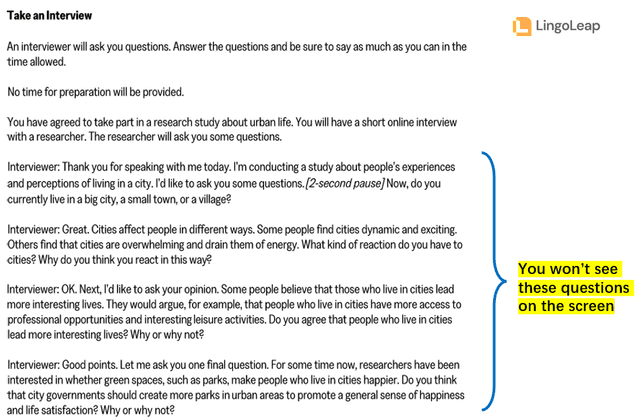
🚩Click to try more "Take an Interview" practice tests on LingoLeap for free!
How the TOEFL iBT 2026 Speaking Section Differs from the Old TOEFL
The redesigned Speaking section moves away from extended, structured responses and places greater emphasis on real-time oral communication.
Key Changes
- Less reliance on prepared or integrated responses
- Greater focus on immediate recall, pronunciation, and natural delivery
- Tasks designed to mirror everyday and academic speaking situations
Direct Impact on Test-Takers
- Hesitation and unclear pronunciation are more noticeable.
- Memorized templates are less effective due to the lack of preparation time.
- Functional spoken English—clear, accurate, and relevant—matters more than complexity.
Key Rules You Must Know
- Continuous Progress: You move through all 11 questions in a single, linear flow.
- Strict Timing per Question: Each task has its own response time displayed on screen. Unused time cannot be carried over.
- Spontaneity Is Central: Most tasks provide little or no preparation time, making immediate response ability essential.
- Visual Cues Matter: In Listen and Repeat tasks, visual highlights (such as a specific desk or area) often correspond to the content you must repeat.
Final Tips: Preparing for the TOEFL iBT 2026 Speaking Section
Effective preparation for TOEFL 2026 Speaking should focus on sentence-level control, fluency, and rapid response, rather than long answers.
1. Train Immediate Recall and Imitation
For Listen and Repeat, practice repeating sentences accurately after a single exposure, paying close attention to stress and rhythm.
2. Build Fluency for Interview-Style Responses
Prepare for common interview topics, but practice responding naturally, not memorizing scripts. Aim for clarity and completeness within the time limit.
3. Reduce Fillers and Pauses
Recording and reviewing your responses helps identify habits that interrupt fluency. Replacing fillers with brief, controlled pauses improves overall delivery.
4. Use Tools and Resources Strategically
Begin with official ETS sample questions to understand task formats and expectations.To practice more efficiently under the new Speaking format, tools like Lingoleap.ai can provide targeted support. Lingoleap offers practice tasks that mirror the redesigned Speaking section and uses AI to evaluate your responses based on official TOEFL scoring criteria. Feedback focuses on:
- Pronunciation and clarity
- Fluency and pacing
- Relevance and completeness of responses
Instead of generic suggestions, LingoLeap provides specific improvement guidance and revision strategies, helping you build a personalized path toward stronger spoken performance.
You can get limited-time free practice tests for TOEFL Speaking now with LingoLeap!