TOEFL 2026 Build a Sentence: Task Format, Scoring, and Common Sentence Types
YutingFebruary 3, 2026
With the launch of the redesigned TOEFL iBT in 2026, the Writing section has shifted away from traditional essay-style production toward task-based language use. As outlined in the 2026 TOEFL Writing section changes, ETS now evaluates how effectively test-takers control language at both the sentence and discourse level.
One of the most noticeable additions under this new design is the Build a Sentence task. This task appears at the very beginning of the Writing section and plays a foundational role in how your overall writing ability is assessed. Rather than testing ideas or argumentation, Build a Sentence focuses on something more basic—but just as critical: your control of English sentence structure.
What Is the Build a Sentence Task?
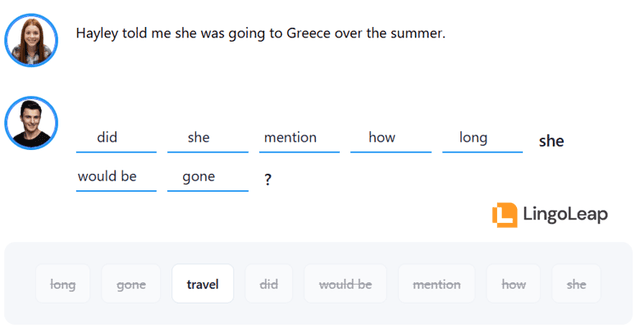
Build a Sentence is the first task in the TOEFL 2026 Writing section. In each item, you are asked to reconstruct a complete, grammatical sentence from a set of scrambled word chunks in order to respond to a short conversational prompt.
The goal is not creativity. ETS uses this task to measure whether you can:
- Recognize the correct word order
- Match subjects and verbs accurately
- Maintain logical coherence within a sentence
These skills form the grammatical backbone for all later writing tasks, including Email Writing and Academic Discussion.
Task Format and Timing
In the Build a Sentence task, you will typically see 12 questions. Each question includes:
- A brief dialogue prompt
- 5–7 clickable word chunks
- A limited number of empty slots
You do not type your answer. Instead, you click or drag the chunks into place.
There are two common variants:
1. Equal-count format: The number of word chunks matches the number of slots. Every chunk must be used.
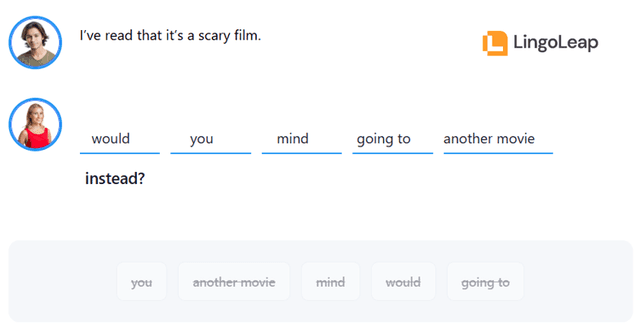
2. Distractor format: There are more chunks than slots, meaning one or more words are intentionally included as distractors.
Although the entire Writing section lasts about 23 minutes, ETS recommends spending roughly 45 seconds per sentence, totaling around 6–8 minutes for this task.
How Build a Sentence Is Scored
Each item is scored on a 0–5 scale.
Full credit is awarded when:
- The sentence uses correct grammar
- Word order follows standard English syntax
- The meaning fits the conversational context
Scoring is handled by ETS’s AI-based scoring engine, supported by Natural Language Processing (NLP) and human oversight to ensure consistency.
While ETS has not released detailed rules on partial credit, official documentation suggests that:
- Minor errors may be tolerated across the task set
- However, word order accuracy remains the core scoring criterion
In other words, this task rewards structural precision far more than stylistic variation.
Common Sentence Types You Will See
Build a Sentence items generally target CEFR A1–B1 grammar, but they are carefully designed to expose common weaknesses under time pressure.
Frequently tested patterns include:
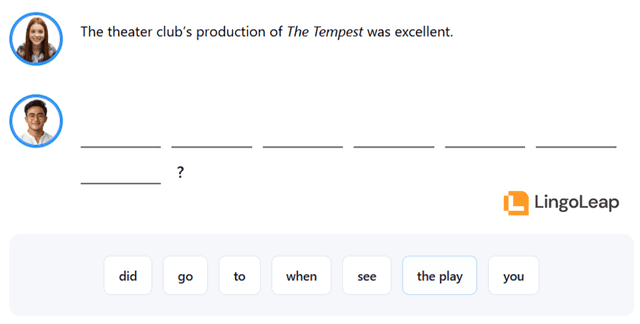
1. WH-Questions (Auxiliary Inversion)
- What time does it start?
- Where did you buy it?
These require auxiliary verbs to appear before the subject.
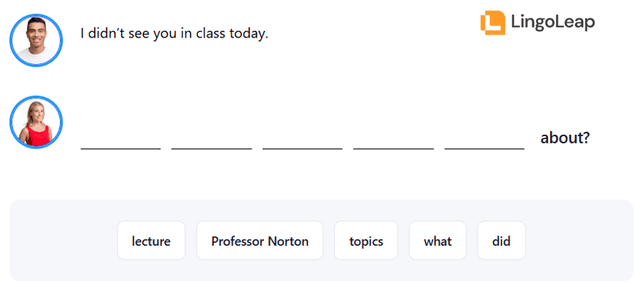
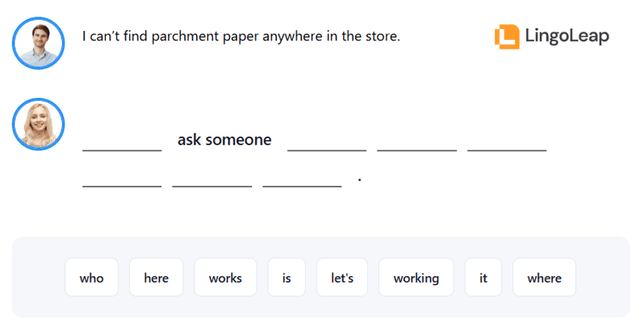
2. WH-Words as Subjects
- Which store has the best deals?
- Who made the final decision?
No inversion is needed because the WH-word functions as the subject.
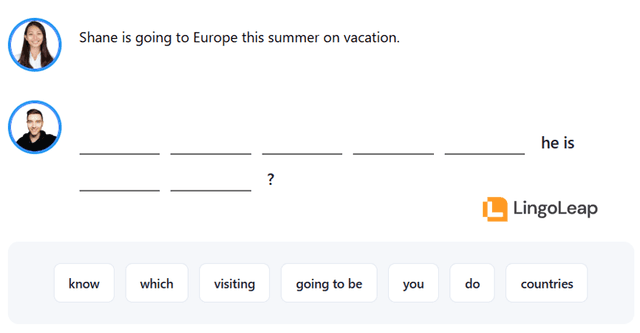
3. Indirect or Embedded Questions
- Do you know if the office is open?
- Can you tell me whether the tickets are available?
These always follow statement word order, which is one of the most common test-day traps.
4. Relative Clauses
- The tour guides who showed us around…
- The café where we met yesterday…
Relative pronouns often replace a noun or object, making extra pronouns frequent distractors.
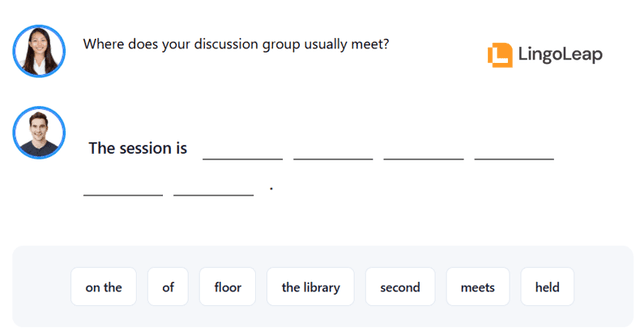
5. Passive Voice
- The information was provided by the staff.
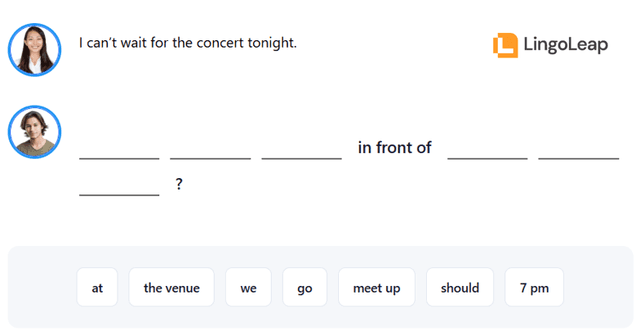
6. Comparatives and Prepositional Phrases
- more affordable than other options
- at the end of the semester
Practice the Way ETS Actually Scores
Once you understand how Build a Sentence is designed and scored, the key challenge becomes execution under time pressure. Grammar knowledge alone is not enough—effective test-day strategies and targeted daily practice are what turn structure into points. For a practical breakdown of how to approach these questions in the exam and how to train more efficiently, see Build a Sentence Strategies and Practice Tips for TOEFL 2026.
Since Build a Sentence is scored on structure, accuracy, and meaning rather than intuition, random grammar drills are often inefficient. That is where LingoLeap comes in:
LingoLeap’s 2026 TOEFL Writing practice includes Build a Sentence questions and relevent exercises that mirror real test formats, including distractor chunks and time pressure. Instead of generic grammar correction, you receive AI-driven feedback aligned with official TOEFL scoring logic, helping you understand exactly why a sentence works and where it breaks down.
With LingoLeap, you can:
- Practice Build a Sentence items under real test conditions
- Strengthen word order and sentence structure efficiently
- Build the grammatical foundation needed for Email Writing and Academic Discussion
👉 Start a free trial today and train your TOEFL Writing skills the way ETS actually evaluates them—one sentence at a time.