Common TOEFL Writing Mistakes and How to Avoid Them
TomApril 15, 2025

Scoring high on the TOEFL Writing section requires not only strong English skills but also an understanding of common pitfalls. Many test-takers lose points due to avoidable errors in structure, grammar, and coherence.
In this guide, we’ll explore the most frequent TOEFL Writing mistakes, provide actionable solutions, and share essential TOEFL exam strategies to help you maximize your score.
1. Understanding the TOEFL Writing Section
Before diving into mistakes, let’s review the TOEFL exam structure for Writing:
Task Time Description
Integrated Writing 20 min Read a passage, listen to a lecture, then summarize both. |
Academic Discussion writing 10 min Write an essay expressing an opinion on
a given topic.
Key Skills Tested:
✔ Coherence & Cohesion – Logical flow of ideas
✔ Grammar & Vocabulary – Accuracy and range
✔ Task Completion – Fully answering the prompt
2. Most Common TOEFL Writing Mistakes (And How to Fix Them)
The TOEFL Writing section is challenging, but many test-takers lose points due to repetitive mistakes that can be easily fixed. Below is an in-depth breakdown of the most common errors and how to avoid them, with real examples.
1. Misunderstanding the Integrated Task (Lecture vs. Reading)
❌ Mistake: Simply summarizing the reading and lecture without showing how they contradict.
✅ Fix: Clearly state how the lecture refutes each reading point.
☻Example:
Reading: "The dodo bird went extinct due to overhunting."
Lecture: "Scientists found no evidence of large-scale hunting; habitat loss was the main cause."
❌ Weak Response:
"The reading says hunting caused extinction, and the lecture says habitat loss did." (Just a summary, no contrast.)
✅ Strong Response:
"The reading claims dodos died from overhunting, but the lecture refutes this, stating there’s no proof of hunting. Instead, deforestation destroyed their habitat, which better explains extinction."
2. Word Count Problems
❌ Mistake: Writing too little (e.g., 80 words for Academic Discussion) or rambling beyond 300 words.
✅ Fix:
●Integrated Task: 150-225 words (enough to cover all points).
●Academic Discussion: 100+ words (but stay concise).
☻Example (Bad Discussion Post):
"I agree with Student A. Space research is good. It helps technology." (Too short, no details.)
✅ Fixed Version:
"While Student A highlights technology benefits, I’d add that space funding also drives medical breakthroughs. For example, NASA’s MRI tech originated from space research. Thus, investment has indirect Earth benefits."
3. Poor Time Management
❌ Mistake: Spending 15 minutes on one task and rushing the other.
✅ Fix:
Integrated Task: 3 min (read) + 2 min (listen) + 15 min (write).
Discussion Task: 2 min (plan) + 8 min (write).
Tip: Practice with a timer to build speed.
4. Repetitive Ideas (Academic Discussion)
❌ Mistake: Paraphrasing classmates’ opinions without adding new insights.
✅ Fix: Introduce fresh examples (studies, news, or personal experiences).
��Example Prompt: "Should schools ban smartphones?"
❌ Weak Response:
"I agree with Student B. Phones distract students, like Student B said." (Just repeats.)
✅ Strong Response:
"Beyond distractions (Student B’s point), research from Stanford shows phones reduce sleep quality due to blue light. Thus, bans could improve health and grades."
5. Grammar & Clarity Errors
❌ Mistake:
Subject-verb disagreement ("The professor argue").
Run-on sentences ("The reading says this, the lecture disagrees").
✅ Fix:
Use grammar-check tools (e.g., Grammarly).
Read aloud before submitting.
☻Example Fix:
❌ "The lecture disagree with the reading."
✅ "The lecture disagrees with the reading."
3. How to Practice TOEFL Writing Effectively
Step 1: Take Timed Practice Tests
- Use official TOEFL Writing samples from ETS.
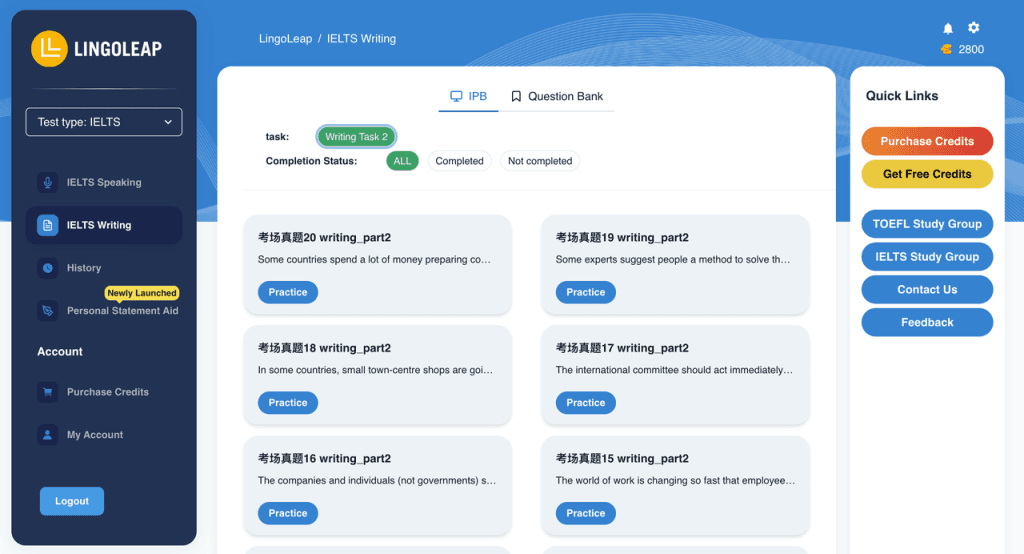
- Simulate test conditions with [Lingoleap.ai’s TOEFL prep tools](https://lingoleap.ai).
Step 2: Get Feedback
- Submit essays to teachers or AI tools like Grammarly.
- Compare your work with high-scoring TOEFL Writing examples.
Step 3: Review TOEFL Exam Results
After mock tests, analyze:
- Did I finish on time?
- Were there grammar mistakes?
- Did I answer the prompt fully?
Self-Evaluation Checklist:
Criteria Yes/No Improvement Needed?
Clear thesis? ✅ ❌
Strong examples? More details
Grammar errors? ❌ Review tenses
4. TOEFL vs. IELTS Writing: Key Differences
Feature
TOEFL Writing
IELTS Writing
Task 1
Integrated (Read+Listen+Write)
Describe a graph/chart
Task 2
Opinion essay
Discussion/Opinion essay
Word Count
150-225 (Integrated) / 300+ (Academic Discussion)
150 (Task 1) / 250 (Task 2)
Scoring
0-5 per task (scaled to 0-30)
Band 0-9
Which is easier?
- TOEFL Writing is more structured (templates work well).
- IELTS Writing requires describing data (harder for some).
5. Final Tips to Ace TOEFL Writing
✔ Use templates for faster responses.
✔ Practice typing (TOEFL is computer-based).
✔ Learn from mistakes—review TOEFL test results.
✔ Register early—[schedule TOEFL exam](https://www.ets.org/toefl) before slots fill up!
Need more help? Try Lingoleap.ai’s TOEFL Writing Grader (https://lingoleap.ai) for instant feedback!
Conclusion
Avoiding these common TOEFL Writing mistakes will significantly boost your score. Focus on structure, grammar, and time management, and practice with real TOEFL Writing prompts.
Have questions? Drop them below!