2026 TOEFL Email Writing Template and Sample Essay: Drafting a Study Group Invitation
YutingFebruary 24, 2026

Campus & Academic Communication is one of the most common email scenarios in the TOEFL 2026 writing task. You may need to email classmates about a study plan, reschedule a meeting with a professor, explain a missed group session, or coordinate academic logistics.
These prompts feel familiar—but the 7-minute limit makes them tricky. To score well, you need to write fast and sound like a real student sending a real email. If you want to understand how these emails are actually scored, you can refer to our detailed analysis and breakdown of the 2026 TOEFL Writing Rubrics, which explained what raters look for.
This case-study article focuses on one common academic scenario: inviting classmates to a study group. After a quick overview of the workflow, we’ll move straight into analyzing the prompt, applying the "3+1" email writing structure for this topic, examining a high-scoring sample email, and summarizing reusable phrases.
How to Read the Prompt: A Fast Workflow
After quickly reading through the writing prompt once, you only need three checks:
- Identify the scenario type (academic, work, or daily life), recipient, and decide the tone.
- Read the 3 required bullet points again and mark out the core content it requires you to include.
- Quickly draft a framework in "3+1" structure (Purpose → Details → Suggestion/Action → Closing), then do a 10-second scan for missing points.
If you’ve read our guide on common 2026 TOEFL Email Writing Topics, you’ll notice that most types of emails tend to follow predictable patterns. While there is no single template you can memorize and use for every task, the 3+1 structure is flexible enough to adapt to most email scenarios.
Example Question & Prompt Analysis
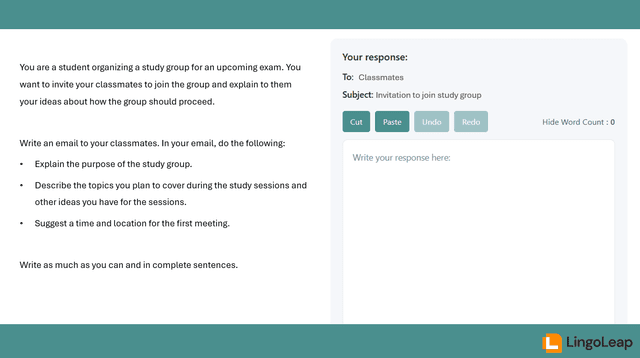
To Analyze This Prompt:
1. Identify the recipient and tone
- Scenario type: Campus & Academic Communication
- Recipient: Classmates
- Tone: semi-formal
- Friendly opening is fine.
- But keep it structured and actionable. This is planning—not chatting.
2. Convert the three bullet points into your outline
This prompt is extremely straightforward:
- Purpose → Invite classmates to join a study group for the upcoming exam
- Elaborate → Decide topics and mention other details
- CTA → Suggest a time and location and let others check their availibility
If you follow this order, you almost cannot go off-topic.
A High-Scoring Writing Sample & Analysis
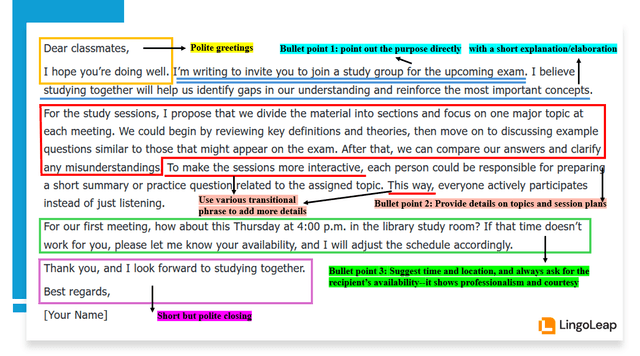
1️⃣ Clear Purpose from the Start
The email opens with a polite greeting and immediately states the purpose: inviting classmates to form a study group. The short explanation that follows adds just enough detail to show a clear communicative goal.
2️⃣ Specific and Organized Session Plan
The writer clearly states that each session will focus on one major topic. The following sentences outline both the content and the sequence of activities:
- Review key definitions and theories
- Discuss practice questions
- Compare answers and clarify misunderstandings
The use of transitions such as begin by, then, and after that makes the plan feel organized and realistic.
To further develop the session plan, the writer adds functional transitions like “To make the sessions more interactive…” and “This way…”. These phrases introduce additional ideas while explaining their purpose, which strengthens the overall coherence and practicality of the email.
3️⃣ Concrete Time + Flexible Scheduling
A specific time and location are clearly suggested, as required by the prompt. The following sentence asking about availability (“If that time doesn’t work…”) adds flexibility and reflects how authentic emails are typically written — considerate, professional, and aware that schedules may vary.
4️⃣ Polite and Natural Closing
The closing is short and appropriate for classmates. No unnecessary complexity or fancy words, just a clear sign-off and expectation of response.
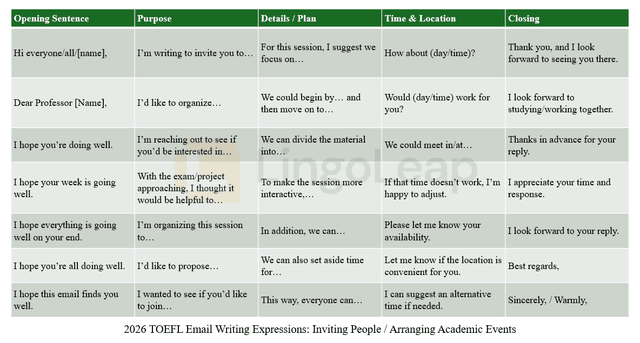
Expression Bank: Email Language You Can Reuse When Inviting People / Arranging Academic Events
Below is a practical phrase bank organized according to the 3+1 structure. These expressions are especially useful for Campus & Academic Communication tasks such as organizing study groups, arranging meetings, coordinating presentations, or planning academic discussions.
Final Takeaway: Make It Practical, Not Perfect
For Campus & Academic Communication prompts, your goal is not to sound impressive. It’s to sound clear, organized, and realistic. If you follow the three bullet points in order and use the 3+1 structure, you’ll consistently produce a stable, high-scoring response.
The real challenge, however, is speed and consistency. Under timed conditions, many test-takers struggle not because they lack vocabulary, but because they haven’t practiced applying structure quickly. That’s where focused simulation becomes essential.
For TOEFL 2026 test-takers, mastering the email task requires realistic prompts, timed conditions, and structured feedback. LingoLeap integrates AI-powered email simulations, exam-style timing, and rubric-aligned evaluation to provide exactly this kind of focused preparation.
The goal isn’t memorizing templates. It’s building structured thinking under pressure. Once that becomes a habit, the email task turns from unpredictable to manageable.