TOEFL Listening Echolocation Bats: Practice, Samples, & Tips
LingoLeapMay 10, 2025
🎧 TOEFL Listening Sample: Echolocation in Bats
Transcript of the Lecture:
Narrator: Listen to part of a lecture in a biology class.
Professor: We’ve just talked about how elephants use infrasound—low-frequency sounds. Now let’s flip to the other extreme: ultrasound, which is sound that’s too high-pitched for us to hear. Some animals produce and use these high-pitched sounds to sense their surroundings. Can anyone name one? Yes, Carol?
Carol: Umm, bats? Since bats can’t really see, they have to use sound to, uh… avoid flying into stuff.
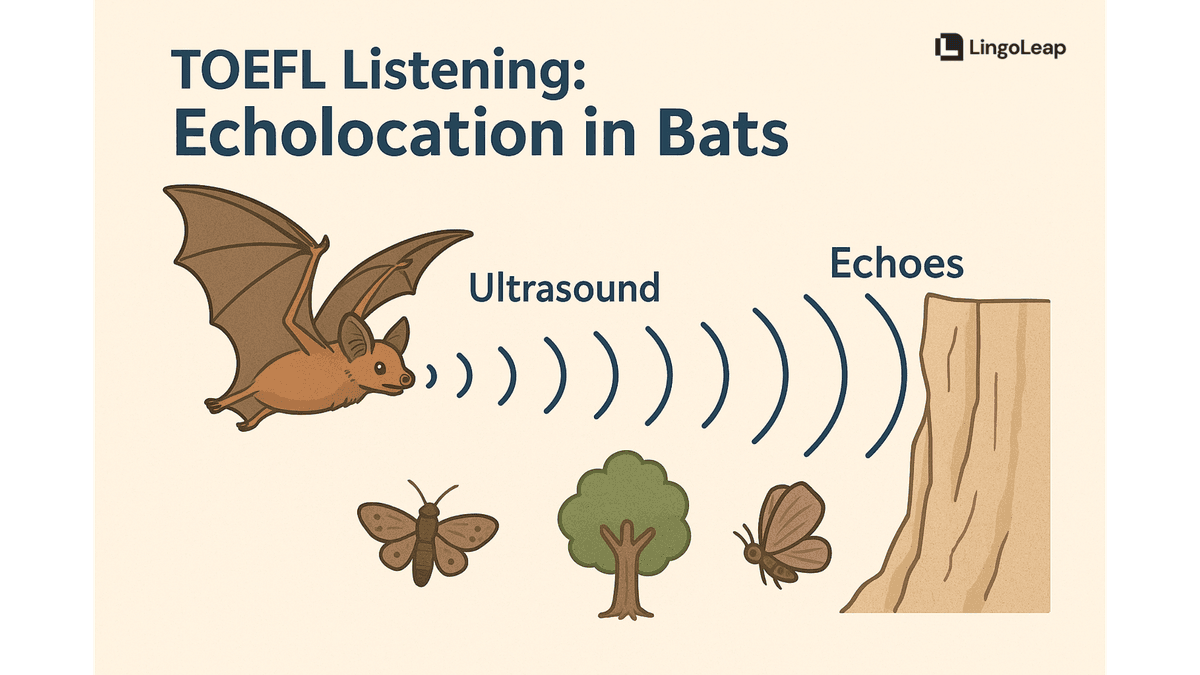
Professor: Exactly! That’s called echolocation—using sound echoes—reflected sound waves—to figure out where things are. As Carol said, bats use it to get around. But what else do you think they use it for? Mike?
Mike: Maybe to hunt for food… and also to not get eaten?
Professor: Exactly—bats use echolocation both to steer clear of predators and to find their prey, which is usually flying insects active at night. Now, before we continue, I want to go back to something Carol mentioned—the idea that bats are blind. In reality, some bat species that don’t rely on echolocation actually navigate using their vision. That said, it’s true that for many echolocating bats, their eyesight is too weak to be dependable.Let’s quickly go over how echolocation works. A bat sends out ultrasonic pulses—these are extremely high-frequency sound waves that humans can’t hear—and then listens to the echoes that return after bouncing off objects.
By processing these echoes, the bat can figure out things like whether there’s a cave wall ahead and how far away it is. It can also assess the size and shape of an object. One specific echo pattern they can recognize easily is the one produced by a moth—especially one in motion, flapping its wings—since moths are a frequent target for bats.
Interestingly, moths have a key advantage over many other insects: they can hear ultrasound. This ability allows them to detect when a bat is nearby. In response, they may either try to flee or stay completely still. If they stop flapping their wings, they become much harder for the bat to detect—because they no longer produce the distinctive movement-based echoes that help the bat tell them apart from, say, a leaf or another object.
For a long time, scientists underestimated how advanced echolocating animals really are. We often assumed they filtered out a lot of information—similar to how advanced radar systems eliminate echoes from non-moving objects, often called “ground clutter,” like hills or buildings, to focus on what’s important.
But a recent study involving lesser spear-nosed bats overturned that assumption. It found that these bats are able to interpret echoes from stationary objects with complex textures, despite the confusing acoustic signals such objects produce. This discovery shows that bats are more capable than previously believed, especially when it comes to decoding echoes from fixed objects with detailed surfaces.
Take trees, for example. A pine tree—with its many tiny, closely packed needles—creates lots of subtle reflections that blend into a “smooth” echo, meaning the sound waveform is even and consistent. An oak tree, by contrast, has fewer but larger leaves that generate stronger, more separated reflections, resulting in a jagged or “rough” echo pattern. Remarkably, bats can tell the difference—not only between tree types, but between any echoes that follow a smooth or rough structure.
TOEFL Listening Practice Test Questions 📝
- What is the primary focus of the lecture?
- The emission of ultrasonic pulses by animals
- The utilization of acoustical signals by bats
- Contrasting echolocation and radar
- Differences in bats' ultrasound usage
- Why does the professor choose against including further details in the board diagram?
- She prefers students to finish the diagram independently as part of an assignment.
- She must research certain details to ensure the diagram's accuracy.
- The extra information is unrelated to the upcoming topic she plans to cover.
- Students can find the extra information already in their textbook.
- According to the professor, what are two possible reactions of a moth upon detecting a bat? (Choose 2)
- The moth may cease wing movement.
- The moth may produce high-frequency noises.
- The moth may depart from the vicinity.
- The moth may alter its color to blend with the environment.
- What unexpected findings did a recent study uncover regarding lesser spear-nosed bats?
- They have the ability to screen echoes from specific tree varieties.
- They possess the capability to decipher echoes from immobile objects with intricate textures.
- They struggle to interpret echoes that are irregular or uneven.
- They face challenges in interpreting echoes from particular categories of small, mobile entities.
- Why does a pine tree create a "smooth" echo, as per the professor?
- Due to its smooth trunk
- Because of its large branches spaced at regular intervals
- Because it has many small, densely packed needles
- Because it remains stationary in all types of weather
TOEFL Listening Practice Test Questions + Answers
Question 1: What is the primary focus of the lecture?
Question Type: Gist–Content
Answer: ✅ B) The utilization of acoustical signals by bats
✔ Why it’s correct:
The entire lecture revolves around how bats use echolocation—high-frequency sound pulses and echo interpretation—for navigation, hunting, and even distinguishing tree types. That’s all about acoustical signals.
❌ Why the others are wrong:
- A) Mentions emission, but that’s too narrow. The lecture isn’t just about the emission process.
- C) Radar is briefly mentioned for comparison, not the focus.
- D) Too vague and misleading. It implies there’s a contrast within bat echolocation styles, which isn’t discussed.
Question 2: Why does the professor choose against including further details in the board diagram?
Question Type: Understanding Function
Answer: ✅ D) Students can find the extra information already in their textbook.
✔ Why it’s correct:
The professor explicitly says the details are available in the reading assignment, so she doesn’t need to write more on the board.
❌ Why the others are wrong:
- A) No mention of it being an assignment task.
- B) She doesn’t mention needing to double-check facts.
- C) The extra info is directly related, not unrelated.
Question 3: According to the professor, what are two possible reactions of a moth upon detecting a bat? (Choose 2)
Question Type: Multiple-Answer Detail
Answers:
✅ A) The moth may cease wing movement.
✅ C) The moth may depart from the vicinity.
✔ Why they’re correct:
The lecture says moths either stop beating their wings or try to escape when they detect bat ultrasound.
❌ Why the others are wrong:
- B) No mention of moths producing high-frequency noises.
- D) Moths do not change color—this is invented.
Question 4: What unexpected findings did a recent study uncover regarding lesser spear-nosed bats?
Question Type: Detail–Inference
Answer: ✅ B) They possess the capability to decipher echoes from immobile objects with intricate textures.
✔ Why it’s correct:
The professor describes a recent experiment showing bats’ ability to interpret complex echoes from objects like pine trees—something previously underestimated.
❌ Why the others are wrong:
- A) There’s no mention of “screening” echoes or focusing on specific tree varieties.
- C) Opposite of what’s said—bats succeeded in interpreting irregular echoes.
- D) The challenge wasn’t with mobile entities but stationary ones.
Question 5: Why does a pine tree create a “smooth” echo, as per the professor?
Question Type: Detail–Understanding a Concept
Answer: ✅ C) Because it has many small, densely packed needles
✔ Why it’s correct:
This is stated clearly—pine needles create lots of tiny, uniform reflections, which form a smooth waveform.
❌ Why the others are wrong:
- A) The trunk isn’t discussed in relation to echo.
- B) Pine trees don’t have “large” branches spaced regularly.
- D) Weather isn’t relevant—this is about structure, not movement.
How to Tackle These TOEFL Listening Question Types
Let’s break down how you can approach each question category with confidence:
1. Gist–Content (Main Idea)
- Goal: Find the central focus of the lecture.
- Tip: Pay attention to the professor’s intro and closing remarks.
- Avoid: Getting distracted by minor details or comparisons (e.g., radar vs. ultrasound).
2. Understanding Function
- Goal: Identify why the speaker says or doesn’t say something.
- Tip: Think: “What’s the professor’s intention behind this comment?”
- Watch for: Clues like “You’ll find this in the reading” or “You’ll do this as homework.”
3. Multiple-Answer Detail
- Goal: Choose two correct details.
- Tip: Listen for examples and behaviors. TOEFL loves animal reactions!
- Trap: Wrong options often sound scientific but were never mentioned.
4. Inference/Unexpected Findings
- Goal: Understand subtle shifts in the professor’s explanation or surprising new research.
- Tip: If the speaker says, “We used to think… but now we know…”, that’s your cue!
5. Understanding a Concept 🌲
- Goal: Interpret a comparison or description (like smooth vs. rough echoes).
- Tip: Draw a quick diagram in your notes—visualizing helps for questions involving shapes, structures, or patterns.
Echolocation Bats Sample: Key Takeaways
This TOEFL listening sample about echolocation in bats is packed with:
- Subtle science explanations
- TOEFL vocabulary like “ultrasound,” “reflections,” “textures”
- Real-world animal behavior examples
Mastering questions like these requires focused listening, good note-taking, and question-type awareness. Don’t just memorize answers—learn to spot traps!
Boost Your TOEFL Listening with LingoLeap
Want to practice listening with real academic-style topics like this—and get instant AI feedback on your notes, accuracy, and timing?
At LingoLeap, you’ll get:
- Real exam-style TOEFL practice tests
- Smart answer explanations like the ones above
- Real-time, personalized feedback on TOEFL speaking and writing
🎧 Start your free trial today and start mastering TOEFL Listening—bat-style!