TOEFLIELTS
Español
← Score ToolsAction Plan

TOEFL Score Gap Planner

Pick your TOEFL 2026 target band, enter your current scores — get a prioritized section-level action plan and a timeline tuned to your weekly study hours (3–40 h/wk).

By Erin, LingoLeap Content & SEO Specialist · Reviewed by the LingoLeap TOEFL Content Team · Last reviewed:

Score Gap Planner

Set your target band and optionally enter current section scores. Get a prioritized action plan to close the gap.

Not sure? Check your school's requirement →

10 h/wk

Adjusts the timeline projection. 3 h/wk suits a casual review; 10–15 h/wk is the typical sweet spot; 30–40 h/wk reflects intensive full-time prep.

Turn your plan into practice

Mock tests and AI-scored Speaking & Writing target exactly the weaknesses your gap analysis reveals.

Start Mock Test

What This TOEFL Score Gap Planner Helps You Solve

Use this planner when you have a target overall band but aren't sure which sections to attack, in what order, or how realistic your timeline is. Each output below is a direct answer the tool gives you.

How big is my gap, and is my target realistic?

Exact gap shown and classified as On Track, Close Range, Stretch, or Major Gap. If even Band 6.0 in your missing sections can't reach the target, the planner flags it and recommends a long-term plan.

Which section should I work on first?

Sections are ranked by gap size with priority badges (Critical, Improvement Needed, On Track) — start with the largest gap. The Section Leverage panel also shows the maximum overall lift each section can contribute, useful for tie-breaking similar gaps.

How many weeks of study do I need?

Weeks-range derived from your gap and the Weekly Study Hours slider (3–40 h/wk) — drag to see how more or fewer hours change the timeline.

What concrete actions should I take?

The Action Plan converts the analysis into a prioritized to-do list — what to drill, in what order, with milestone targets along the way.

From gap → to practice
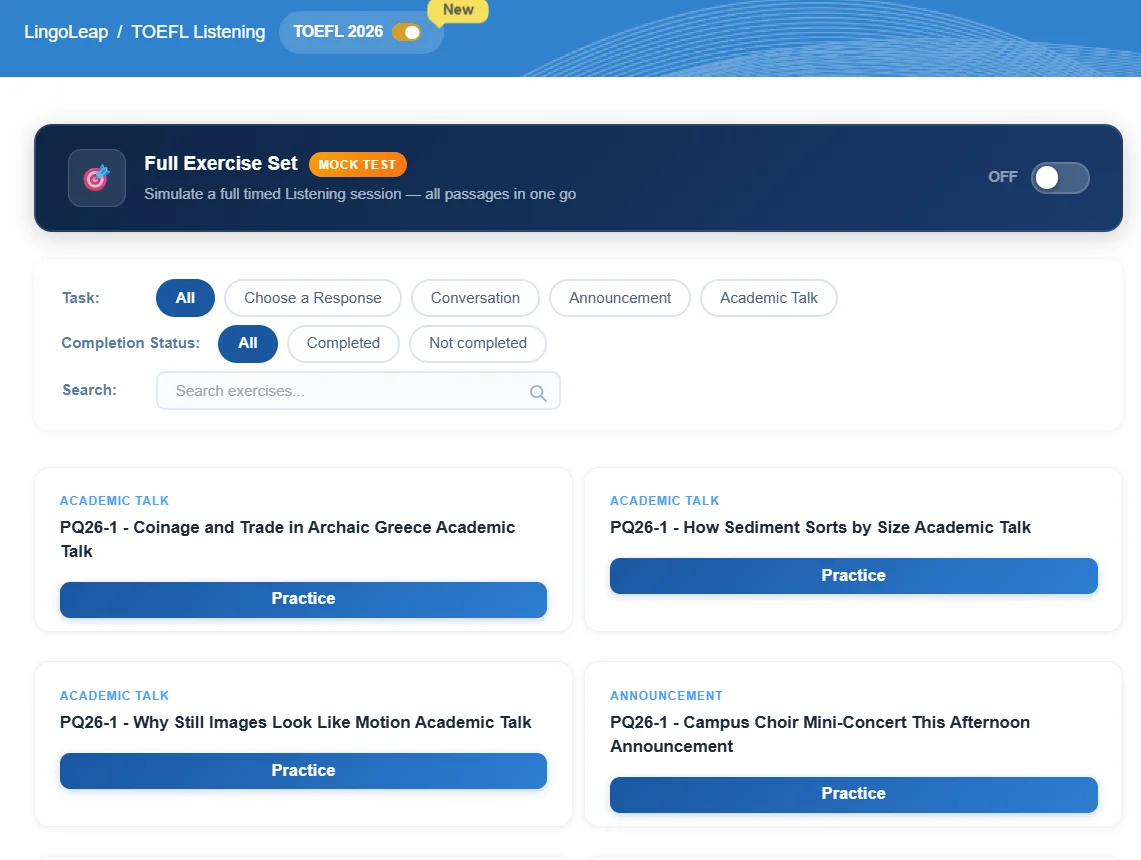
LingoLeap TOEFL Listening practice page showing the PQ26 Academic Talk and Announcement task list with a Full Exercise Set mock-test banner, Task and Completion Status filters, and Practice buttons on each card

Once you know your weakest section, jump straight into AI-scored exercises on LingoLeap practice to close the gap.

Work on your weak section on LingoLeap to close the gap and reach your target score.

AI-scored Speaking & Writing, full timed mocks, and section-level drills aligned with the TOEFL 2026 scale.

Start Practicing →

How to Read Your Plan

  • Sections are ranked by gap size — start with the largest.
  • Section-leverage shows how much overall band each section can lift.
  • Timeline assumes 10 h/wk; the slider rescales it to your schedule.
  • Speaking & Writing usually close fastest with AI-scored practice.

Critical — needs work

Gap ≥ 1.0

Highest priority — the biggest blocker between you and your target.

Improvement needed

Gap 0.5 – 0.99

Secondary priority — close after the critical sections.

On track

Gap ≤ 0

Already at or above target — maintain, don't over-invest.

Score data based on official ETS TOEFL scoring guidelines. ETS TOEFL Official Site · Score Requirements

Frequently Asked Questions

What should I set as my target score?
The right target is the official band minimum published by the admissions office of your target university or program — not an estimate. Start with the University Admission Calculator, which lists verified requirements for 100+ US and UK institutions. If you are applying to multiple programs, set your target at the highest requirement across all of them — meeting the most demanding one automatically satisfies all the others. Once you have confirmed the minimum, add a 0.5 buffer above it: test-day conditions vary, and a score at the exact minimum leaves no room for a slightly off performance. For benchmarks by university tier, see What Is a Good TOEFL Score? ETS publishes a score-use reference for admissions offices that informs many institutional minimums.
Which section should I focus on first?
Focus first on the section with the largest gap to your target — the planner sorts your section breakdown automatically by gap size, so the topmost section is your primary priority. Because the overall band is the simple average of four equally-weighted section scores, a 0.5 improvement in any single section lifts the overall by ~0.13 — see the Score Calculator for the underlying math. The Section leverage panel shows the maximum overall lift each section could contribute if you took it all the way to Band 6.0. Prioritize gap size first, then weight by which section has the most plausible improvement trajectory. Speaking and Writing typically respond fastest to AI-scored deliberate practice; Reading and Listening improve more steadily with academic exposure.
Do I need to enter section scores to use the planner?
No — you can use the Gap Planner with just a target band and no current section scores. In this mode, the planner generates a general action plan based on the gap between a baseline and your target, along with a timeline estimate. However, entering your actual current section scores significantly improves the plan: it unlocks section-by-section priority ranking, shows exactly which sections need the most attention, and makes the timeline estimate more accurate. For the most useful plan, take a full TOEFL 2026 mock test first to establish your baseline, then plug those bands into the planner — or run them through the Score Calculator first if you only have partial sections.
What does 'Critical — needs work' mean?
A section labeled Critical — needs work has a gap of 1.0 band or more between your current score and the target level for that section. This is the highest-priority category: a 1.0 gap is substantial and will require significant focused practice to close. Sections in this category should be your primary preparation focus — allocate the largest share of your study time here and start with them before working on other sections. Sections labeled Improvement needed have smaller gaps (0.5–0.99 band) and represent secondary priorities. Sections labeled On track are at or near your target and require maintenance practice rather than intensive work. The priority labels update automatically when you adjust your current or target scores.
How long does it take to close a 1.0 band gap?
At 10 hours per week of consistent, targeted practice, a 1.0 overall band gap typically closes in approximately 8–12 weeks. The Gap Planner adjusts this projection based on the weekly study hours you set (3–40 h/wk): doubling the hours roughly halves the timeline; halving the hours roughly doubles it, with sensible bounds. Speaking and Writing gaps tend to close faster with AI-scored feedback because the improvement criteria are explicit — see the official ETS TOEFL scoring documentation and the How to Score 6 in Writing guide for what graders look for. Reading and Listening gaps generally require more time — they improve through sustained exposure to academic content.

Start Closing the Gap

Practice with adaptive TOEFL exercises and get AI-scored feedback on your Speaking and Writing.

Start Free Practice