2026 New TOEFL Speaking Interview Task: Common Question Patterns and Topics
YutingFebruary 3, 2026

Within the redesign of 2026 TOEFL, the new Speaking section replaces integrated tasks with two communicative formats. One tests accurate repetition, while the other simulates a virtual interview. The overall structure and timing of these changes are explained in the 2026 TOEFL Speaking Section Changes Overview, but understanding what actually appears in the interview task requires a closer look at question flow and topic design.
This article focuses on the Take an Interview task, explaining how the four-question structure works, what topic areas ETS repeatedly uses, and what examiners are truly evaluating under the updated criteria described in 2026 TOEFL Speaking Rubrics Explained.
The Question Pattern and Logic of the Interview Task
Although topics vary, the interview follows a highly stable internal logic. The four questions almost always progress in the following order:
Q1: Personal Experience or Situation
You describe your background, routine, or current situation.Examples include your major, where you live, or how you usually spend your time.
"Tell me about yourself..."
"Which faculty or department are you part of, and why did you choose it?"
Q2: Reaction or Challenge
You explain feelings, difficulties, or responses related to the same theme.This tests your ability to describe problems and coping strategies.
"What difficulties do you face?"
"What challenges do you face, and how do you overcome them?"
Q3: Opinion
You are asked to agree or disagree with a statement, or to evaluate an idea.This is where clear stance-taking matters.
"Do you agree or disagree?"
"Do you agree with this statement? Why or why not?"
Q4: Recommendation or Future View
You propose a solution, give advice, or predict future trends.This tests reasoning and forward-looking language.
"What should be done?"
"Do you think universities should provide support for this? Why or why not?"
This "experience-challenge-opinion-future" progression makes it possible to plan responses strategically rather than improvising blindly.
To prepare for these questions, you also need a bank of essential phrases and connectors for these questions. See some common expressions for 2026 TOEFL Interview task in this article.
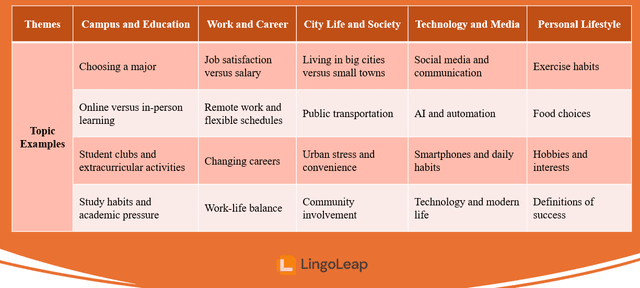
High-Frequency Topic Areas in TOEFL 2026 Interviews
Although prompts feel open-ended, interview topics repeatedly come from a limited set of domains.
What ETS Is Actually Testing
Under the updated speaking rubric, ETS rewards:
- Clear structure across responses
- Logical development within 45 seconds
- Listener-friendly pacing
- Language accuracy over sophistication
This explains why strong responses often sound simple but organized. Knowing this logic is essential before learning response frameworks.To see how these questions are best handled in real time, the next article introduces a practical response structure designed specifically for this task: ADS Speaking Template for TOEFL 2026 Interviews.
Practice with the Interview Format in Mind
Understanding question types is only the first step. Progress comes from practicing under conditions that mirror how ETS actually scores.
LingoLeap’s 2026 TOEFL Speaking Interview question bank is built around the real four-question interview structure. You practice answering full interview sets with realistic timing and receive AI-driven feedback aligned with official TOEFL rubrics. This helps you identify issues in structure, fluency, and development before test day.
Start a free trial today and train your TOEFL Speaking the way ETS evaluates it, through real interview practice rather than guesswork.