Introduction to TOEFL Test Structure and Scoring Criteria
LingoleapDecember 13, 2023
The Test of English as a Foreign Language (TOEFL) is one of the most popular English language proficiency exams worldwide, widely used to assess the English proficiency of students and professionals from non-English-speaking countries.
The test is administered by the Educational Testing Service (ETS) in the United States and aims to evaluate candidates' abilities in English listening, speaking, reading, and writing. TOEFL scores are commonly used for purposes such as applying for study abroad programs, immigration, employment, and professional certification.
The TOEFL exam is a crucial step in international education and career development, enjoying broad recognition. Whether planning to study abroad, immigrate, or explore career opportunities, TOEFL scores serve as evidence of English language proficiency.
The "TOEFL Reform" in the first half of this year has brought about many changes to the TOEFL exam.
1. Test Structure
1.1 Listening
- Basic Structure: 2 dialogues and 3 lectures, each dialogue consisting of 5 questions, and each lecture containing 6 questions.
- The listening section comprises 4 question types:
- Single-choice questions: 4 options, with only 1 correct answer.
- Multiple-choice questions: Multiple options, with more than 1 correct answer.
- Sequencing questions: Arrange the chronological order of events or steps in a process.
- Matching questions: Match objects or text with categories in a chart or mark checkboxes in cells.
- Exam Duration: 36 minutes.
1.2 Reading
Translation:
- Basic Structure: 2 passages, each passage with 10 questions.
Types of Reading Passages:
- Exposition (Explanatory/Informative)
- Argumentation (Persuasive)
- Historical (History-themed)
- 4 Question Types in the Reading Section:
- Traditional single-choice questions: Questions with 4 options, where only 1 is correct.
- Multiple-choice questions: Questions with multiple options, and more than 1 correct answer.
- Single-choice questions with insertion: Questions with 4 options, requiring candidates to "insert a sentence" at the most appropriate place in the passage.
- In-depth understanding questions: Questions with more than 4 options and more than 1 correct answer.
Exam Duration: 35 minutes.
1.3 Speaking
Translation:
- Basic Structure: 4 questions, with the first one being an independent speaking task. The topic of this question involves familiar topics for the candidate. It requires the candidate to respond based on their thoughts, opinions, and personal experiences. Candidates can also use any relevant ideas, opinions, or experiences to answer. The other 3 questions are integrated speaking tasks. When answering these types of questions, candidates must integrate various language skills. Candidates are required to read and listen first before responding orally. They can take notes and use these notes to answer the questions.
- Exam Duration: 16 minutes.
1.4 Writing
Translation:
- Basic Structure: 2 writing tasks, one integrated writing and one academic discussion writing.
For the integrated writing, candidates must:
- Take notes on the materials heard and seen, and organize information using these notes before writing.
- Accurately summarize, paraphrase, and quote information from the original materials.
- Explain how the information heard and read is connected.
For the academic discussion writing, candidates are required to express their opinions and provide evidence on a designated topic:
- Respond to the content in the prompt or express opinions based on it.
- Clearly state and explain their position or argument.
- In an academic context, use a range of grammatical structures and vocabulary accurately and meaningfully.
- Exam Duration: Around 29 minutes.
2. Scoring Criteria
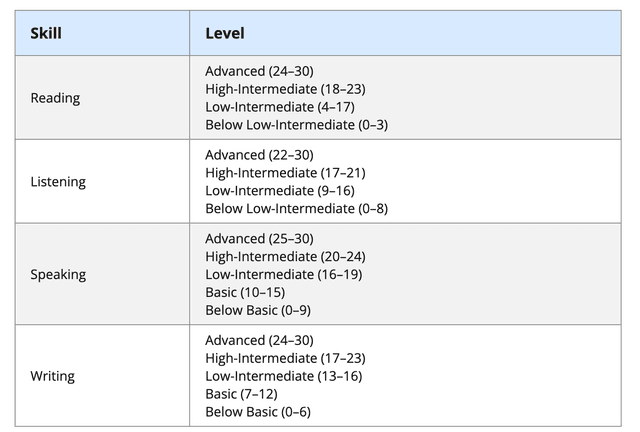
The TOEFL exam consists of four sections: Listening, Reading, Speaking, and Writing. Each section is scored on a scale of 30 points, with a total possible score of 120 points. Each section has its corresponding scoring criteria. The following is an overview of the scoring criteria for each section:
Because Listening and Reading sections have standard answers, let's just discuss the scoring criteria for Speaking and Writing.
Speaking
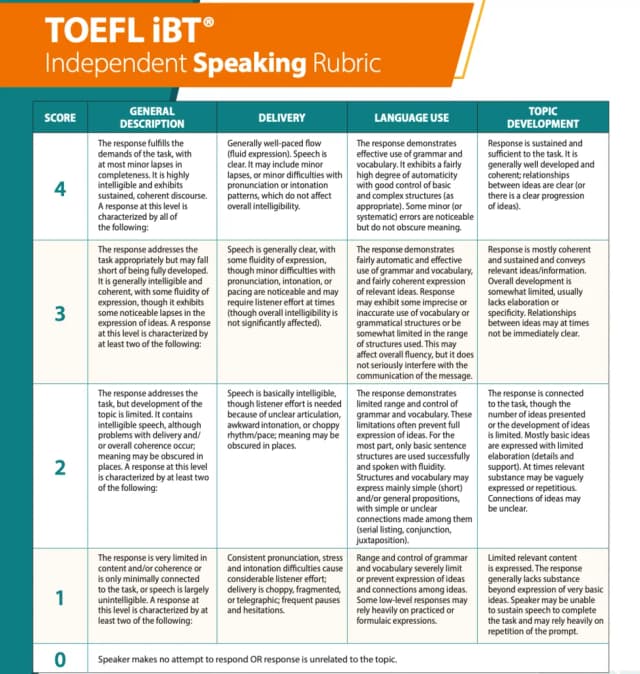
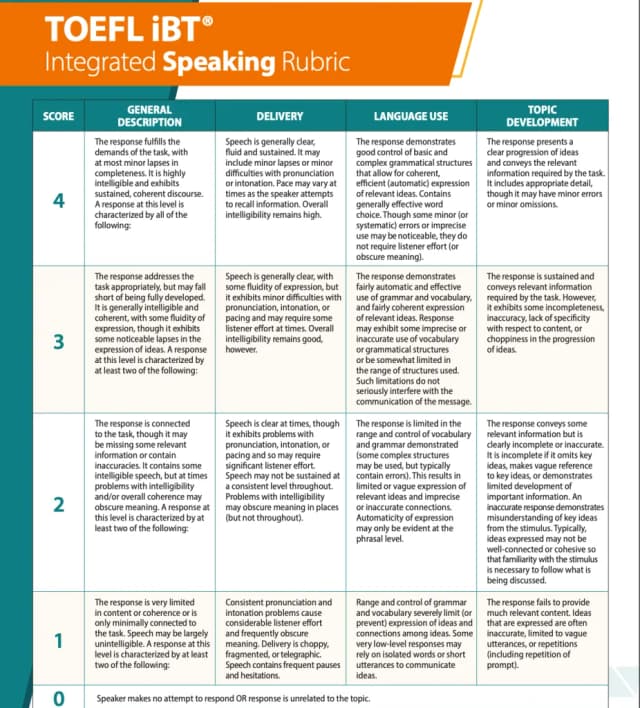
Each speaking task is initially scored by the examiner on a scale of 0-4 points, with the following scoring criteria:
- A score of 4 indicates a complete and well-organized response with accurate language use and clear expression. There may be minor issues with pronunciation and intonation.
- A score of 3 indicates the ability to convey relevant information, but the response may lack completeness in structure, and language use may be limited. There could be minor grammar and vocabulary errors, with not severe issues in pronunciation and intonation.
- A score of 2 indicates a response that addresses the question but lacks completeness in structure. The language proficiency may be lower, and there are likely to be more significant grammar and vocabulary errors. Pronunciation and intonation issues may be more noticeable.
- A score of 1 suggests a vague or confusing response with chaotic structure, poor grammar and vocabulary use, and serious issues with pronunciation and intonation.
The final score is determined by taking the arithmetic average of the initial scores for all speaking tasks and converting it into a 30-point scale.
The official detailed scoring criteria provided by the examining authority are as follows:
Writing
TOEFL writing scoring includes both automated scoring and human scoring.
Automated scoring is primarily done through E-rater, which evaluates aspects such as the correctness of grammar, appropriate word usage, and accurate spelling and capitalization in the candidate's essay. Each candidate's essay undergoes evaluation by two automated scoring systems.
Human scoring is conducted by ETS raters. For Integrated and Academic Discussion writing tasks, two different raters assign scores.
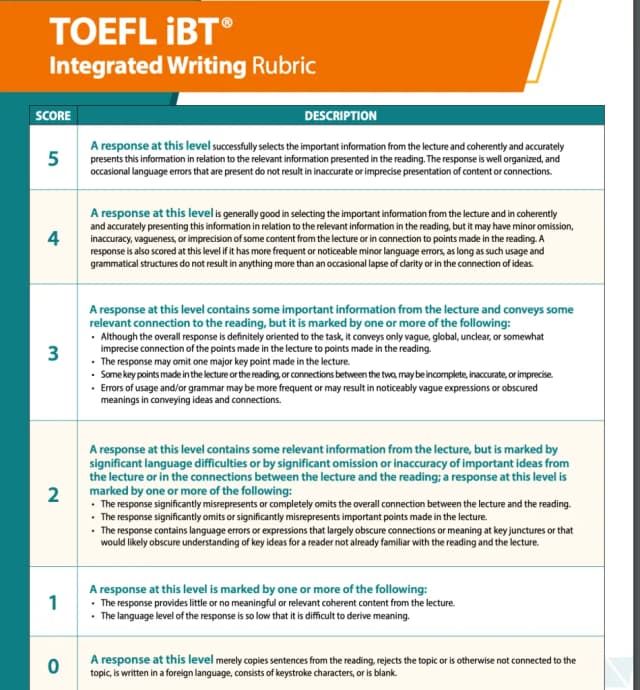
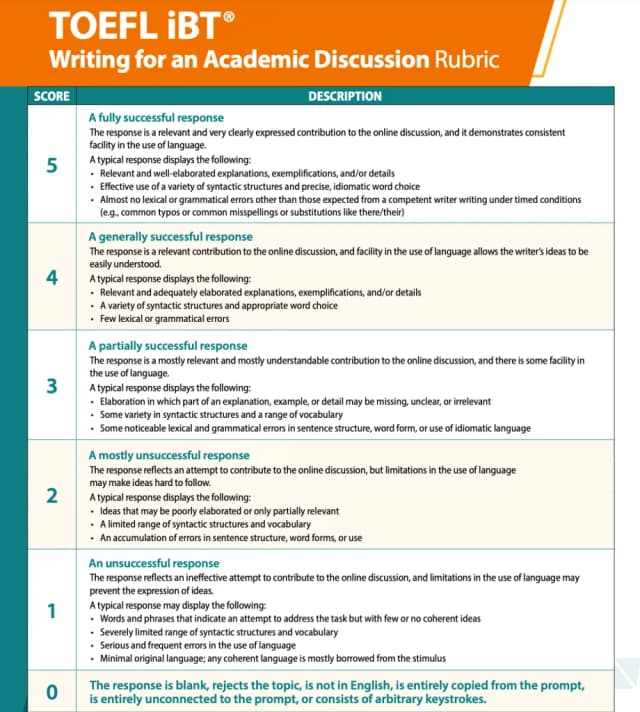
TOEFL writing raw scores range from 0 to 5 points. Candidate scores are categorized into three levels: GOOD (4.0-5.0), FAIR (2.5-3.5), LIMITED (1.0-2.0). The final score is calculated by averaging the scores of the two tasks and then converting it into a 30-point scale.
As writing is considered a challenging section of the TOEFL exam, and many candidates find it difficult to improve their scores, Leapy will now introduce the official requirements for each score range in the writing section:
Integrated Writing: