Introduction to IELTS | Understand IELTS in 10 minutes
The IELTS exam, short for the International English Language Testing System, is a globally recognised English proficiency test. IELTS is divided into two types: Academic and General Training, covering listening, speaking, reading, and writing skills to comprehensively assess your English abilities.
Whether you are applying to universities abroad or planning to immigrate, IELTS scores are a key stepping stone.
Since the majority of IELTS candidates take the Academic IELTS test, today Leapy will provide an in-depth introduction of the Academic IELTS exam from various perspectives, including its structure, scoring criteria, mode of examination,etc .
1. Basic Structure of Each Part of the IELTS
Listening
- Basic Question Types: 4 sections of monologues and dialogues (including matching, map, flow-chart, single-choice, multiple-choice, and fill-in-the-blank questions).
- Duration: 30 minutes, with an additional 10 minutes to transfer answers to the answer sheet.
Reading
- Basic Question Types: 3 sections of passages and corresponding questions (including multiple-choice, true/false/not given, information matching, etc.).
- Duration: 60 minutes in total.
Writing
- Basic Question Types: A short essay (Task 1) of 150 words, requiring candidates to analyze, describe, or explain a table, line graph, bar chart, or diagram + a longer discursive essay (Task 2) of 250 words.
- Duration: 60 minutes in total.
Speaking
- Basic Question Types: Part 1 (short answers) + Part 2 (speak about a topic with 1 minute of preparation) + Part 3 (extension from Part 2).
- Duration: 11-14 minutes in total.
2. Scoring Criteria
Unlike the TOEFL exam, the total score of the IELTS is not the sum of the scores of each test section, but rather the average score of each section.
Each part of the test has a maximum score of 9, and half marks are allowed during scoring. A rounding system of 0.25 is adopted, where if the average score has a decimal of 0.25, it is rounded up to the next half mark; if the average score has a decimal of 0.75, it is rounded up to the next whole mark.
For example:
Listening 6.5, Reading 7.0, Writing 6.0, Speaking 6.0 - The total score for the four parts is 25.5, with an average of 6.375, so the total score on the score report would be 6.5.
Listening 7.0, Reading 8.0, Writing 7.0, Speaking 7.0 - The total score for the four parts is 29, with an average of 7.25, so the total score on the score report would be 7.5.
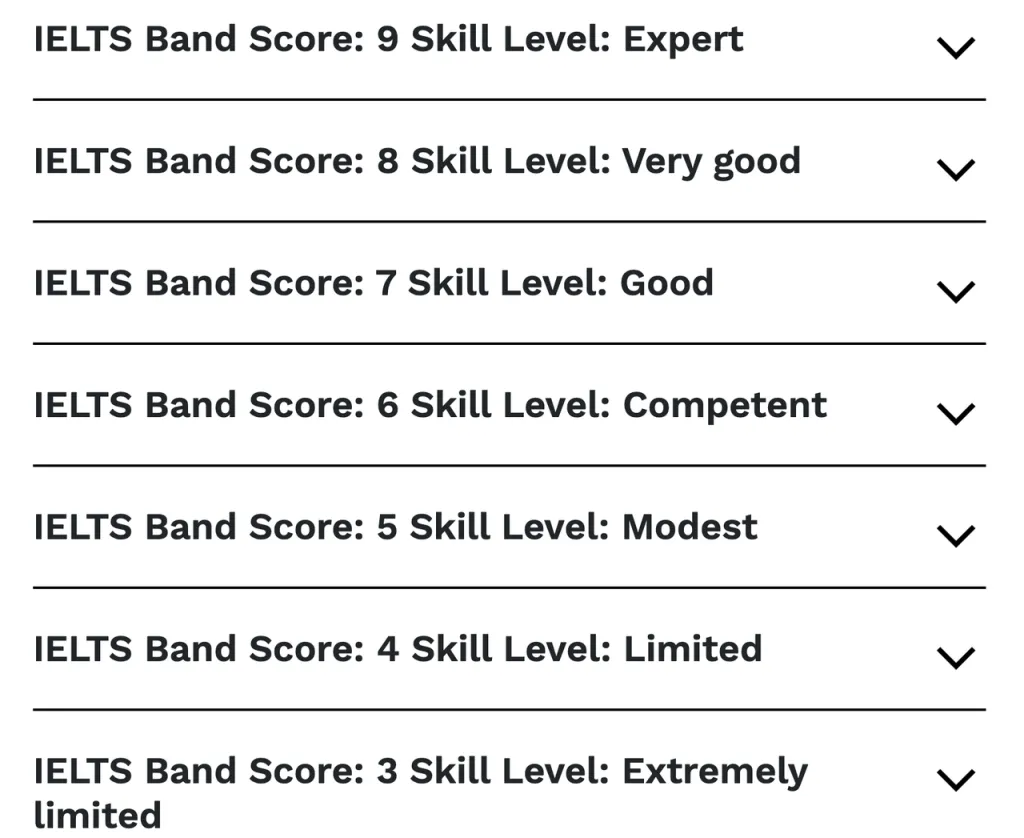
The British Council also provides different explanations for different total IELTS scores.
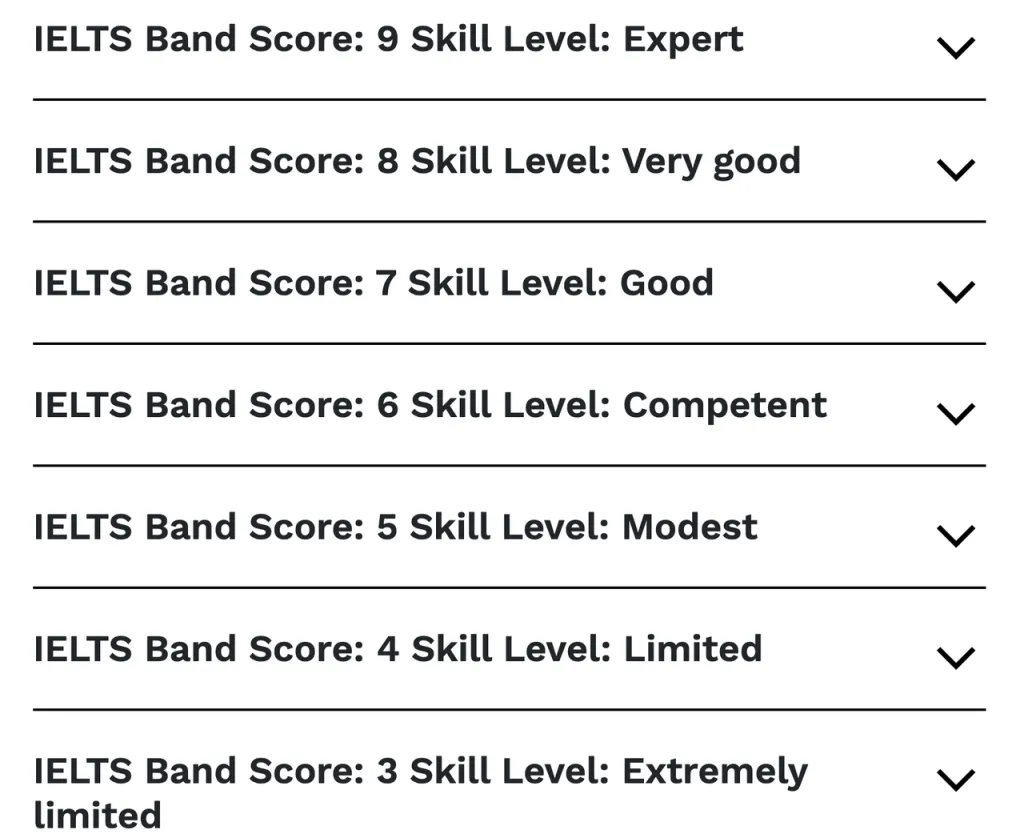
So that is the overall score mechanism, and now Leapy will introduce the different scoring criteria for the Listening, Speaking, Reading, and Writing sections.
Listening and Reading:
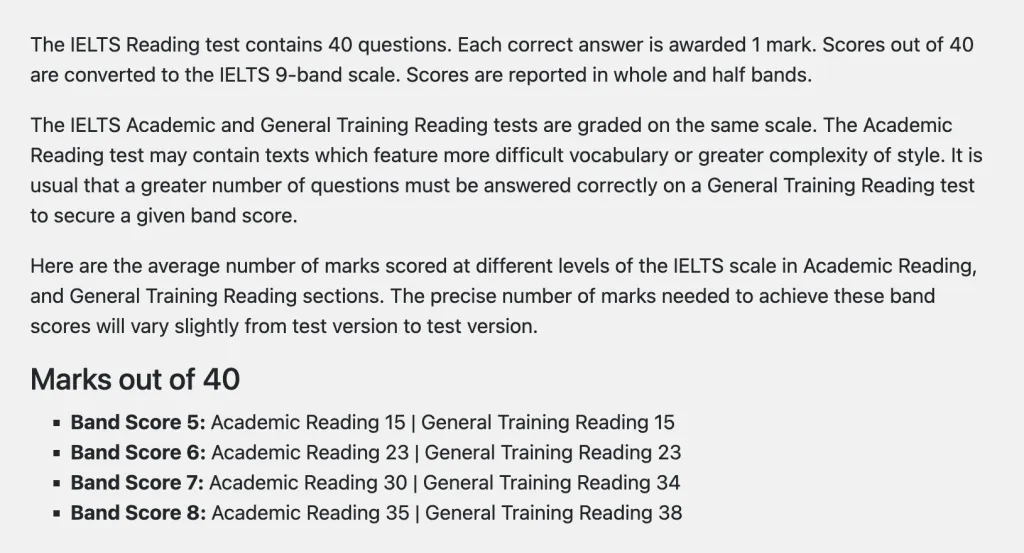
- For IELTS, both the listening and reading sections have standardized fixed answers, and the scores are calculated based on the number of correct answers.
Both the IELTS reading and listening sections consist of 40 questions each. Each correct answer earns one point. The maximum raw score for these sections is 40 points. Based on their raw scores, candidates are then converted to a scaled score ranging from 1 to 9.
Writing and Speaking:
In the writing and speaking sections, examiners grade candidates based on detailed performance criteria, evaluating where their performance falls within the 9-point scale based on their performance in the writing and speaking tests.
Writing
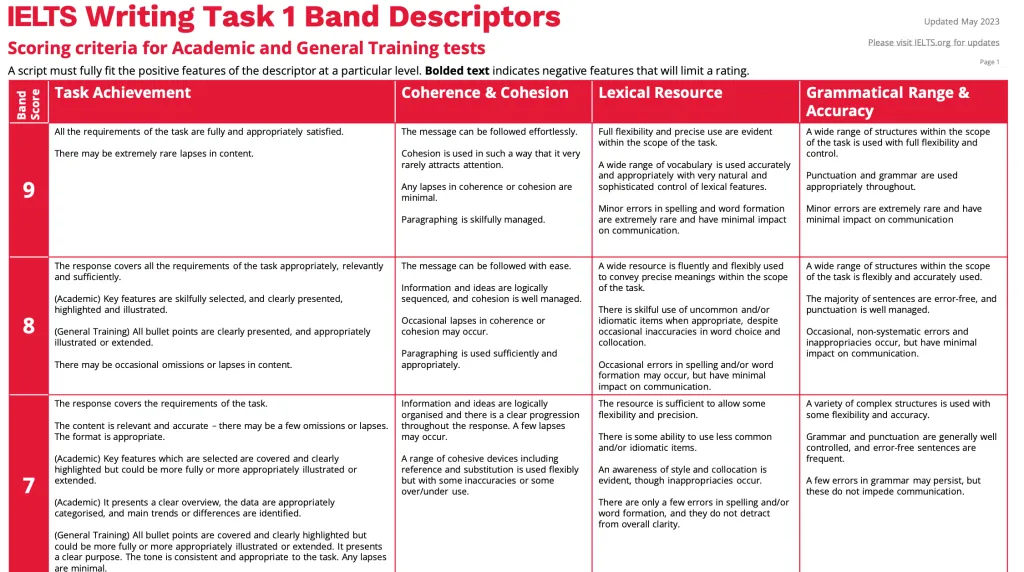
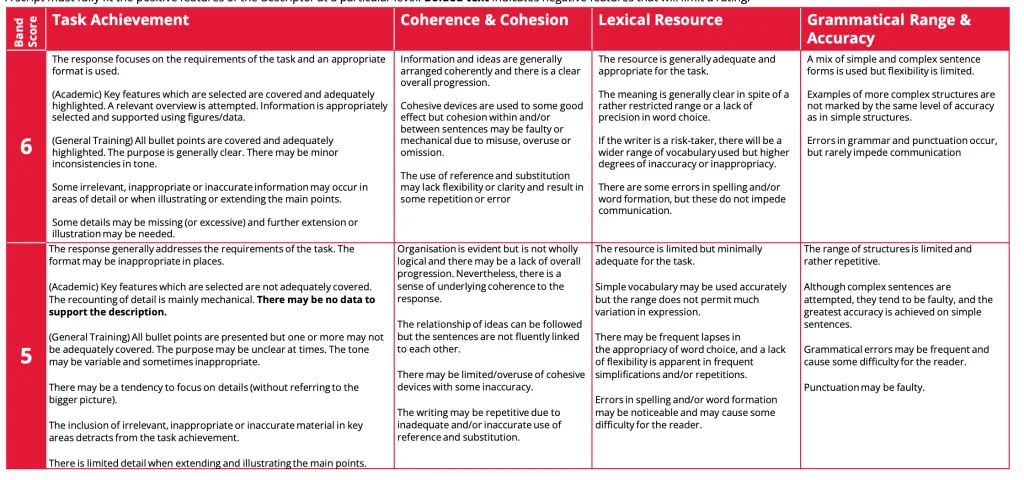
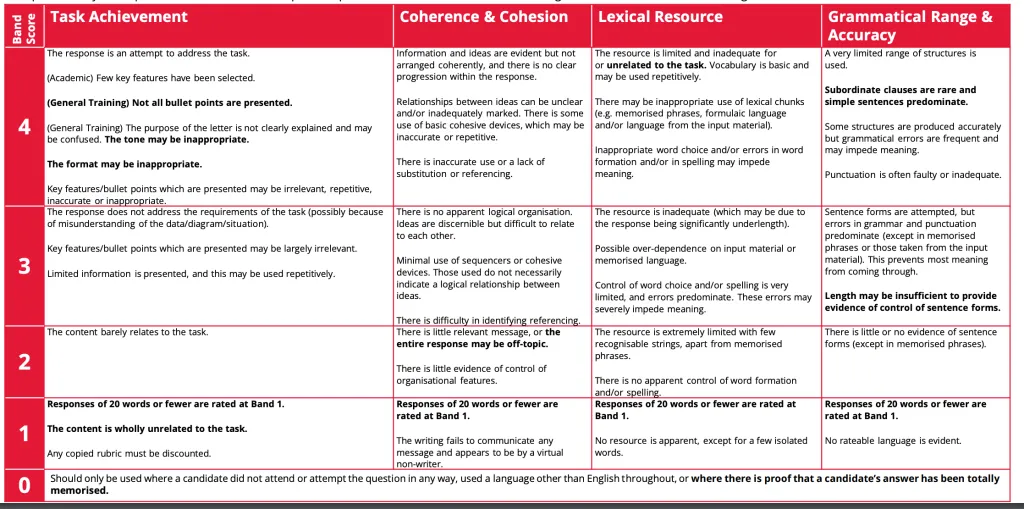
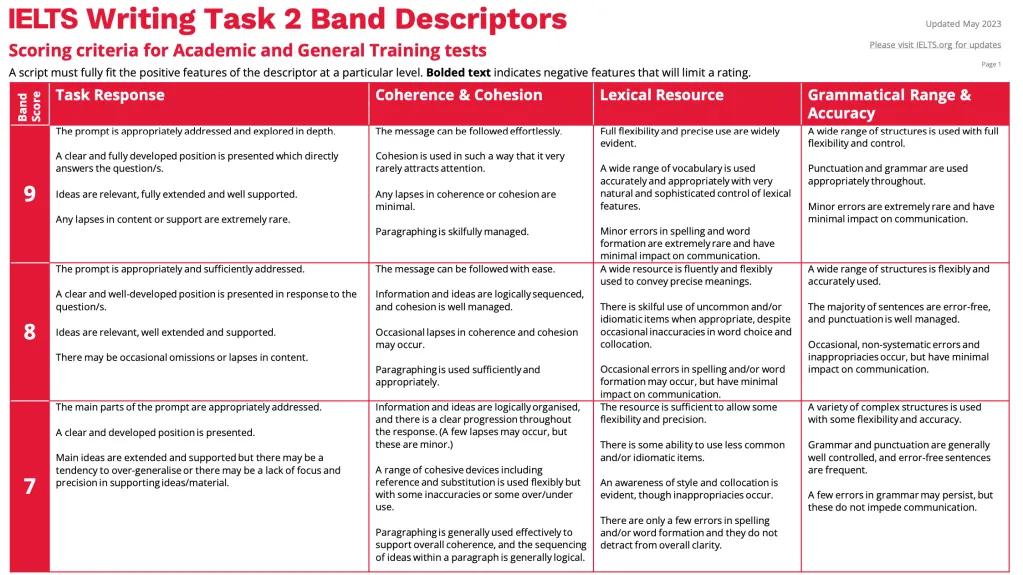
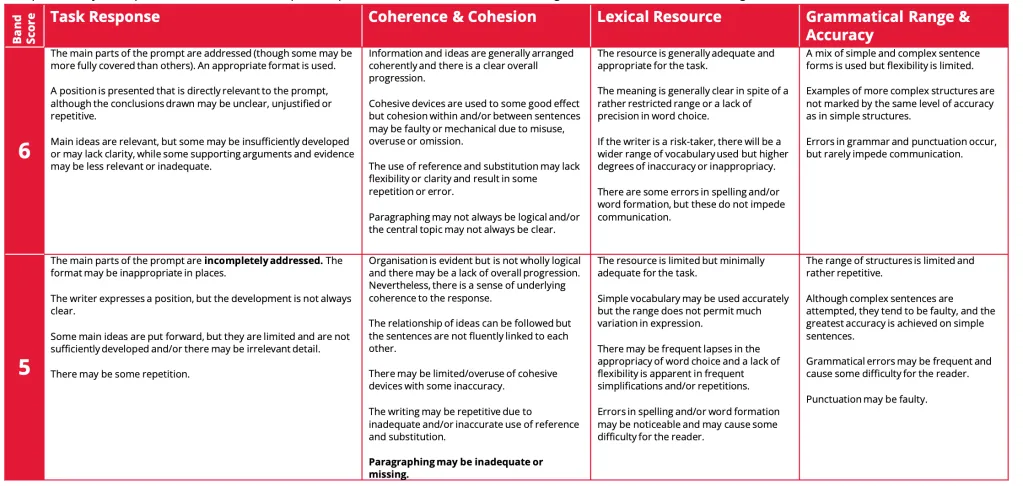
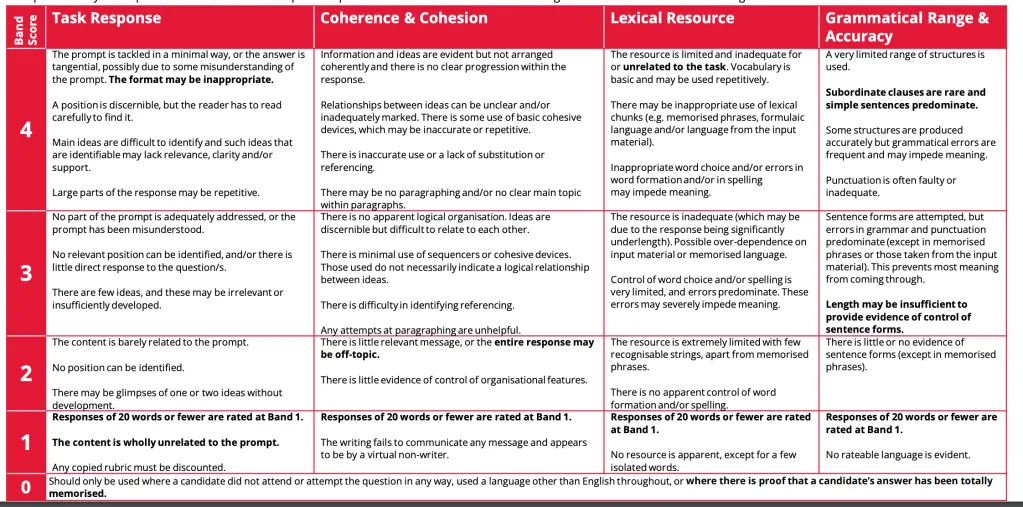
Examiners use assessment criteria to award a score for each of the following four criteria:
- Task achievement (for task 1) and task response (for task 2)
- Coherence and cohesion
- Lexical resource
- Grammatical range and accuracy.
Each task is assessed independently. The criteria are weighted equally and the score on the task is the average. The assessment of Task 2 carries twice the weight of the score for Task 1.
Task Achievement( for task 1)
This Writing task has a defined input and a largely predictable output. It is basically an information-transfer task, which relates narrowly to the factual content of a diagram, graph, table, chart, map or other visual input, not to speculative explanations that lie outside the given data.
The TA criterion assesses the ability to summarise the information provided in the diagram by:
- selecting key features of the information.
- providing sufficient detail to illustrate these features.
- reporting the information, figures and trends accurately.
- comparing or contrasting the information by adequately highlighting the identifiable trends, principal changes or differences in the data and other inputs (rather than mechanical description reporting detail).
- presenting the response in an appropriate format.
Task Response( for task 2)
For Task 2 of both AC and GT Writing tests, candidates are required to formulate and develop a position in relation to a given prompt in the form of a question or statement, using a minimum of 250 words. Ideas should be supported by evidence, and examples may be drawn from a candidate’s own experience.
The TR criterion assesses:
- how fully the candidate responds to the task.
- how adequately the main ideas are extended and supported.
- how relevant the candidate’s ideas are to the task.
- how clearly the candidate opens the discourse, establishes their position and formulates conclusions.
- how appropriate the format of the response is to the task.
Coherence & Cohesion (CC)-for task 1&2
This criterion is concerned with the overall organisation and logical development of the message: how the response organises and links information, ideas and language.
Coherence refers to the linking of ideas through logical sequencing, while cohesion refers to the varied and appropriate use of cohesive devices (e.g. logical connectors, conjunctions and pronouns) to assist in making clear the relationships between and within sentences.
The CC criterion assesses:
- the coherence of the response via the logical organisation of information and/or ideas, or the logical progression of the argument.
- the appropriate use of paragraphing for topic organisation and presentation.
- the logical sequencing of ideas and/or information within and across paragraphs.
- the flexible use of reference and substitution (e.g. definite articles, pronouns).
- the appropriate use of discourse markers to clearly mark the stages in a response, e.g. [First of all | In conclusion], and to signal the relationship between ideas and/or information, e.g. [as a result | similarly].
Lexical Resource (LR)-for task 1&2
This criterion refers to the range of vocabulary the candidate has used and the accuracy and appropriacy of that use in terms of the specific task.
The LR criterion assesses:
- the range of general words used (e.g. the use of synonyms to avoid repetition).
- the adequacy and appropriacy of the vocabulary (e.g. topic-specific items, indicators of writer’s attitude).
- the precision of word choice and expression.
- the control and use of collocations, idiomatic expressions and sophisticated phrasing.
- the density and communicative effect of errors in spelling.
- the density and communicative effect of errors in word formation.
Grammatical Range & Accuracy (GRA)-for task 1&2
This criterion refers to the range and accurate use of the candidate’s grammatical resource via the candidate’s writing at sentence level.
The GRA criterion assesses:
- the range and appropriacy of structures used in a given response (e.g. simple, compound and complex sentences).
- the accuracy of simple, compound and complex sentences.
- the density and communicative effect of grammatical errors.
- the accurate and appropriate use of punctuation.
Speaking
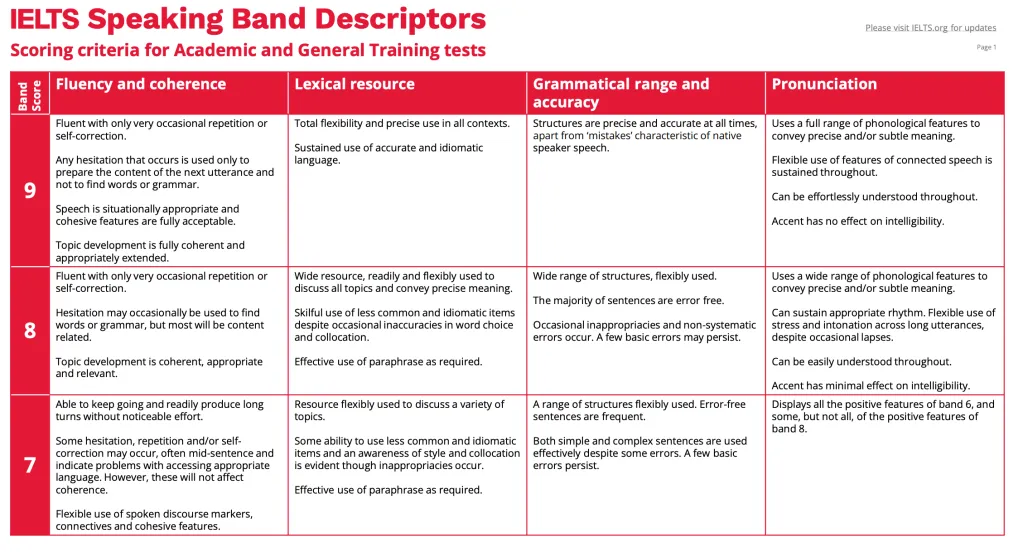
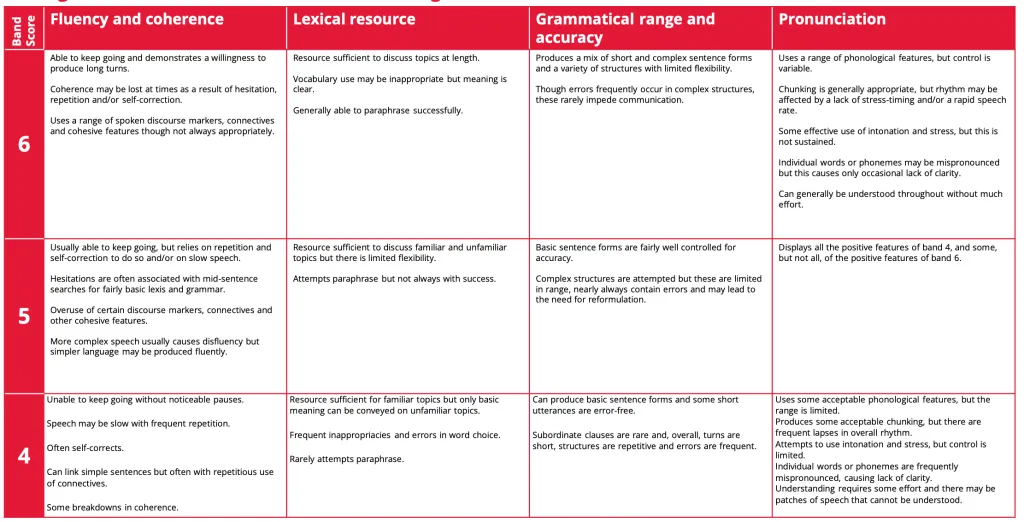
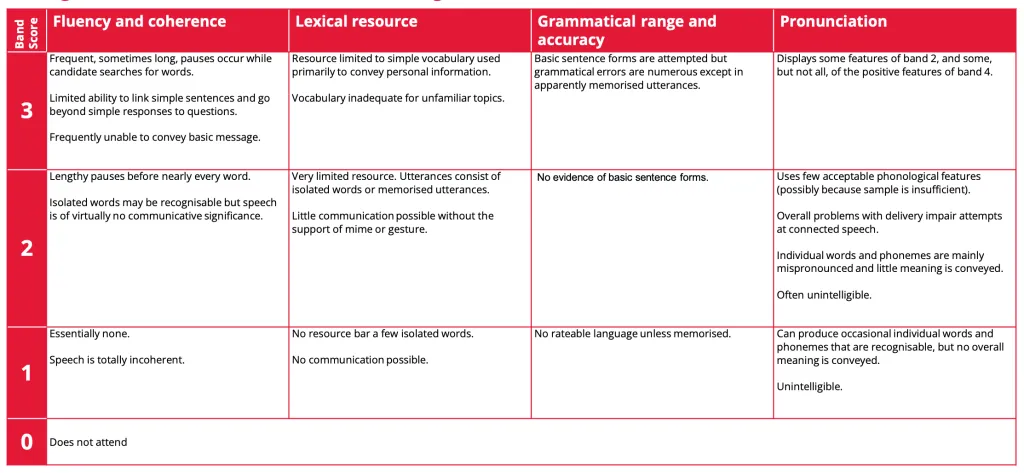
Examiners use assessment criteria to award a score for each of the following four areas:
- Fluency and coherence
- Lexical resource
- Grammatical range and accuracy
- Pronunciation
3. Mode of Examination
For the IELTS exam, candidates can choose between computer-based (CB) or paper-based (PB) testing.
Paper-based testing is more suitable for students who prefer handwriting, have slower typing speeds, or enjoy making annotations.
If you choose to complete your IELTS test on a computer, you will do the Reading, Listening, and Writing parts of the test using a computer. All answers will be typed on the screen. You will also be able to write notes on a notes sheet during the Listening test.
Taking IELTS on a computer has many benefits. For example, your results arrive a lot faster. With IELTS on computer your results will be available within 3 to 5 days.
4. How to book your IELTS test
Step 1: Register for your IELTS test
Simply visit the official IELTS website and select: “Register for test”. You’ll need to choose between an IELTS Academic or IELTS General Training.
Step 2: Select your city for your IELTS test
Choose where you would like to take the IELTS test. Of course, this is only necessary if you are taking IELTS on paper or IELTS on computer.
Step 3: Pick a date & time for your IELTS test
Choose when you would like to take your IELTS test at a date and time that suit you best.
Step 4: Complete the online IELTS application
Fill out the details required in the application form and click submit. Also, do not forget to upload a clear copy of your passport.
Step 5: Pay the application fee
You can choose to pay using a Visa or Mastercard debit or credit card. Make sure your card is valid and activated for online transactions.
Once you have completed all 5 steps, you will get an email or phone message confirming your IELTS test booking.
5. Score validity period
IELTS test results are considered valid for two years after a test has been taken. This is based on research into second-language loss. Organisations that accept IELTS can choose to accept results for a longer period, so you should check with them directly.