2026 New TOEFL Listening Section Explained: Task Types, Question Formats, and MST Strategies
LingoLeapJanuary 17, 2026
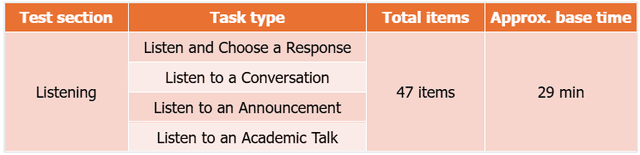
Overview of the new TOEFL iBT 2026 Listening Section
In the Listening section, test-takers will answer 47 questions designed to assess their ability to understand spoken English in a variety of academic and real-life contexts.
Like the Reading Section in 2026 new TOEFL, this section is delivered through a multi-stage adaptive testing (MST) format and consists of three task types, each targeting different listening skills.
Task Type 1: Listen and Choose a Response
Task Description
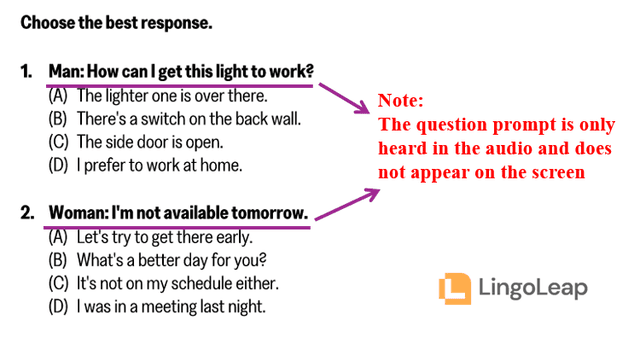
This task appears at the beginning of Module 1. You will hear a single sentence or question once, then choose the most appropriate response from four written options.
Key Skills Assessed
- Social and Functional Understanding
- Recognizing appropriate responses to requests, suggestions, or statements in natural conversation.
- Rapid Processing
- Quickly identifying the speaker’s intent, such as making a request, offering help, or expressing a complaint.
Preparation Tips
- Familiarize yourself with common American English conversational responses, especially polite forms (e.g., responding to “Would you mind…?”).
- Practice identifying the function of a sentence: request, confirmation, invitation, or suggestion.
Example Questions from Official Sample Tests
🚩Click to try more "Listen and choose a response" practice tests on LingoLeap for free!
Task Type 2: Listen to a Conversation
Task Description
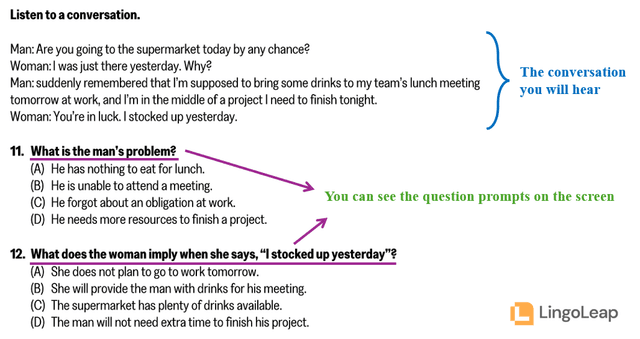
You will listen to short dialogues between two speakers, typically set in campus or everyday situations. Common topics include buying gifts, gym routines, library requests, or travel plans.
Key Skills Assessed
- Main Idea and Detail
- Understanding the overall topic as well as specific information such as dates, locations, or names.
- Inference
- Identifying a speaker’s attitude, intention, or reason behind a suggestion.
Preparation Tips
- Develop effective note-taking habits, focusing on keywords related to who, what, where, and why.
- Listen for signal words that indicate a problem or change, such as “Actually,” “However,” or “Oh no.”
Example Questions from Official Sample Tests
🚩Click to try more “Listen to a conversation" practice tests on LingoLeap for free!
Task Type 3: Listen to an Announcement
Task Description
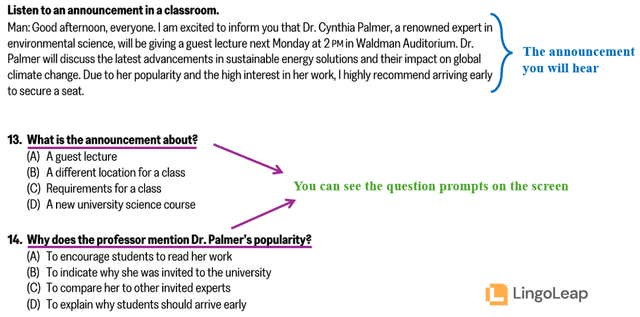
Short, formal notices about campus-related events, schedule changes, or fundraisers (e.g., a technology expo or a charity bake sale). These audio clips are typically brief and information-dense.
Key Skills Assessed
- Purpose Recognition
- Understanding the main reason for the announcement (e.g., to inform, remind, or update).
- Logistical Detail Tracking
- Locating key details such as time, location, room number, and required actions.
Preparation Tips
- Practice listening for “logistics words,” such as dates, times, locations, and deadlines.
- Train yourself to quickly capture Who / What / When / Where / What to do next in notes.
Example Questions from Official Sample Tests
🚩Click to try more "Listen to an announcement" practice tests on LingoLeap for free!
Task Type 4: Listen to an Academic Talk
Task Description
Longer monologues simulating a classroom environment. Topics are diverse, commonly ranging from:
- History (e.g., the Silk Road, Magna Carta)
- Science (e.g., bioluminescence, the honeybee waggle dance)
- Psychology (e.g., cognitive dissonance, synesthesia)
Key Skills Assessed
- Concept and Definition Understanding
- Grasping complex terms based on how they are explained in context.
- Supporting Example Identification
- Understanding why the speaker introduces a specific example (e.g., why a professor mentions “cleaner fish”).
- Lecture Organization Awareness
- Recognizing how the lecture is structured (definition → explanation → examples → conclusion).
Preparation Tips
- Practice structured note-taking rather than writing full sentences.
- Use a consistent note framework such as: Concept → Definition → Examples, so you can track relationships between ideas and avoid missing key support points.
Example Questions from Official Sample Tests
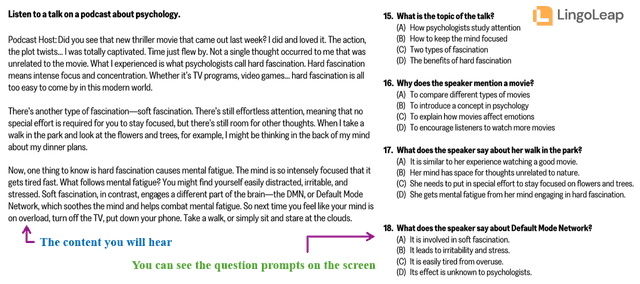
🚩Click to try more "Listen to an academic talk" practice tests on LingoLeap for free!
Multi-Stage Adaptive Testing (MST): Impact and Strategies
The Listening section consists of Module 1 and Module 2, both delivered under strict MST rules.
Key Rules You Must Know
- Point of No Return Once you submit an answer and move forward, you cannot return to previous questions.
- Adaptive Difficulty Your performance in Module 1 determines the difficulty level of Module 2.
Practical Strategies
- Commit to Your Answer If unsure, make your best decision and move on. Dwelling on a missed question will only affect your focus on subsequent audio clips.
- High-Stakes Module 1 Aim for maximum accuracy early to increase the chance of entering a higher-difficulty—and higher-scoring—module.
- Note-taking Is Essential Since each audio clip is played only once, your notes serve as your only reference when answering questions.
Final Tips: Preparing for the TOEFL iBT 2026 Listening Section
The 2026 TOEFL Listening section emphasizes intent recognition, detail retention, and consistent performance under adaptive pressure. Effective preparation should focus on how you listen and process information, not just how many questions you practice.
1. Focus on Accuracy Early
Strong performance in Module 1 has a direct impact on your scoring potential.
2. Train Functional Listening
Especially for short-response tasks, practice identifying speaker intent rather than individual words.
3. Refine Note-taking Skills
Notes should capture structure and logic, not full sentences.
4. Practice Under Realistic Conditions
Use longer, uninterrupted listening sets to simulate MST pressure.
5. Use Feedback to Study Smarter
Progress in Listening comes from targeted feedback, not repeated guessing.Tools like Lingoleap.ai can support this process by providing AI-powered evaluations aligned with the new TOEFL Listening expectations, helping you identify weaknesses in comprehension, inference, and academic vocabulary when used alongside official materials.
You can get limited-time free practice tests for TOEFL Listening now with LingoLeap!