TOEFL 2026 Speaking में Band 6 का मतलब
TOEFL 2026, Speaking को 1–6 स्केल पर एक ही सेक्शन स्कोर के रूप में रिपोर्ट करता है। यह ओवरऑल बैंड दोनों Speaking टास्क टाइप — Listen and Repeat और Take an Interview — में आपके कंबाइंड परफॉर्मेंस को दर्शाता है। हर टास्क टाइप को उसके अपने मापदंडों के सेट से स्कोर किया जाता है।
Listen and Repeat
रिपीटिशन एक्यूरेसी और इंटेलिजिबिलिटी पर स्कोर किया जाता है। Band 6 परफॉर्मेंस का मतलब है कि आप वाक्यों को सटीक रूप से दोहराते हैं, साफ़ और नैचुरल-साउंडिंग डिलीवरी के साथ।
Take an Interview
रिलेवेंस, एलैबोरेशन, फ्लुएंसी, वोकैबुलरी, ग्रामर और प्रोनन्सिएशन पर स्कोर किया जाता है। Band 6 परफॉर्मेंस का मतलब है पूरी तरह प्रासंगिक, अच्छी तरह विकसित जवाब, जो नैचुरल स्पीच के साथ दिए जाते हैं।
Important: the official ETS TOEFL Speaking page and the ETS scoring documentation describe the dimensions evaluated for each task but do not publish the exact formula that converts task-level scores to the 1–6 section reporting band. What is clear is that consistent high performance across both task types — accuracy in Listen and Repeat, and communicative effectiveness in the Interview — is required for the highest section score.
For the full explanation of how TOEFL 2026 scores are calculated, see the पूरी 2026 स्कोरिंग गाइड.
Listen and Repeat: Band 6 तक का रास्ता
The Listen and Repeat task plays a spoken sentence. Your task is to repeat it back as accurately and clearly as possible. The two core scoring dimensions are repetition accuracy and intelligibility — see the Listen and Repeat strategies guide for drill techniques.
रिपीटिशन एक्यूरेसी
वाक्य के सटीक शब्दों, शब्द-क्रम और अर्थ को दोहराएं। शब्दों को बदलना, छोड़ देना, या फिर से क्रमबद्ध करना — भले ही नतीजा नैचुरल लगे — आपका स्कोर घटाता है। ओरिजिनल वाक्य का हर शब्द मायने रखता है। Band 6 के जवाब वाक्य को लगभग परफेक्ट फिडेलिटी के साथ सुरक्षित रखते हैं।
इंटेलिजिबिलिटी
आपका उच्चारण इतना साफ़ होना चाहिए कि आप जो कहें वह तुरंत समझ में आए। नॉन-नेटिव एक्सेंट के लिए पेनल्टी नहीं दी जाती, लेकिन ऐसी गलत उच्चारण जो शब्दों को पहचानना मुश्किल बना दे, आपका स्कोर घटाती है। पूरे जवाब में लगातार स्पष्टता ही टॉप बैंड दिलाती है।
कनेक्टेड डिलीवरी
Band 6 के जवाब एक कनेक्टेड, नैचुरल फ्रेज़ के रूप में दिए जाते हैं — शब्द-दर-शब्द नहीं। हर शब्द पर टूटने वाली अटकी हुई डिलीवरी यह दर्शाती है कि वाक्य को याद रखने में कठिनाई है और यह कम स्पोकन फ्लुएंसी का संकेत देती है।
मुख्य प्रैक्टिस आदत
अपने Listen and Repeat जवाब रिकॉर्ड करें और उन्हें सीधे ओरिजिनल ऑडियो से कंपेयर करें। अपने कान को सब्स्टिट्यूशन, छूटे हुए शब्दों और उच्चारण की कमियों को पकड़ने के लिए ट्रेन करें। नेटिव-स्पीकर ऑडियो को शैडो करना इस टास्क के लिए सबसे प्रभावी सिंगल एक्सरसाइज़ है।
Take an Interview: Band 6 तक का रास्ता
The Interview task asks you to answer a spoken question with no preparation time. ETS's Interview scoring guide describes every level by four things: how on-topic and elaborated the answer is, pace, pronunciation, and grammar and vocabulary. Below, those four are split into the six habits that Band 6 answers show. For an adaptable response framework, see the Speaking Interview Template.
डायरेक्ट रिलेवेंस
आपका जवाब पूछे गए प्रश्न का ठीक-ठीक जवाब देना चाहिए। अस्पष्ट जवाब या विषय से भटकने वाले जवाब, चाहे कितने भी फ्लुएंटली दिए जाएं, पेनलाइज़ किए जाते हैं। एक स्पष्ट पोज़िशन बताएं और उस पर कायम रहें।
कोहेरेंट एलैबोरेशन
अपनी पोज़िशन को कम से कम एक स्पेसिफिक रीज़न, उदाहरण, या डिटेल के साथ सपोर्ट करें। Band 6 के जवाब एक ही राय के वाक्य पर नहीं रुकते — वे विचार को इस तरह विकसित करते हैं कि उसे फॉलो करना आसान हो।
नैचुरल फ्लुएंसी
स्पीच को न्यूनतम हिचकिचाहट के साथ लगातार बहना चाहिए। सोचने के लिए कभी-कभार नैचुरल पॉज़ की उम्मीद की जाती है, लेकिन बार-बार फिलर, लंबी खामोशी, या फिर से शुरू किए गए वाक्य स्पोकन प्रोडक्शन में कठिनाई का संकेत देते हैं।
नैचुरल प्रोनन्सिएशन और इंटोनेशन
Band 6 के जवाब नैचुरल स्ट्रेस पैटर्न और इंटोनेशन का उपयोग करते हैं — सिर्फ समझ में आने वाला उच्चारण नहीं, बल्कि ऐसी स्पीच जो कम्युनिकेटिव रूप से इफेक्टिव लगे। मोनोटोन या फ्लैट डिलीवरी इस स्कोर को घटा सकती है, भले ही अलग-अलग साउंड साफ़ हों।
प्रिसाइज़ वोकैबुलरी
विविध, टॉपिक-उपयुक्त वोकैबुलरी का इस्तेमाल करें। बेसिक शब्दों के छोटे सेट या बहुत सामान्य भाषा पर निर्भर रहना सीमित लेक्सिकल रेंज को दर्शाता है। Band 6 के जवाब उपयुक्त शब्द चयन के साथ बारीक विचार व्यक्त करने की क्षमता दिखाते हैं।
ग्रामेटिकल कंट्रोल
Band 6 पर छोटी-मोटी व्याकरण संबंधी गलतियाँ उम्मीद के अनुसार हैं और स्वीकार्य हैं। जो स्वीकार्य नहीं है वह है बार-बार होने वाली स्ट्रक्चरल गलतियाँ जो अर्थ में बाधा डालती हैं या वाक्य संरचना पर कमांड की कमी दर्शाती हैं।
TOEFL iBT Speaking Rubric 2026: Every Score Level (0–5)
ETS scores every Speaking response from 0 to 5, with a separate scoring guide for each task. The two tables below paraphrase both guides level by level in our own words; the levels, and what each one covers, are ETS's. Your 1–6 section band is then built from these task scores by a conversion ETS does not publish.
Listen and Repeat rubric
| Score | What the response does |
|---|---|
| 5 | Repeats the sentence exactly and is fully intelligible. |
| 4 | Keeps the meaning but is not exact: one or two function words missing or changed, a content word dropped (in a longer sentence) or replaced with a related word, a tense or plural marker wrong, or two words swapped. One or two words may be unclear; a self-correction is fine if the sentence is completed. |
| 3 | An essentially full sentence that no longer carries the original meaning: most content words are there, but several function words or at least one content word are missing or changed. Some words may be hard to make out. |
| 2 | A large part of the sentence is missing or wrong, often everything except its first part and last few words. The result is a fragment that a listener who did not hear the prompt would struggle to follow. |
| 1 | Only a few words of the sentence, or an attempt that is mostly unintelligible. |
| 0 | No response, nothing intelligible, no English, or content unconnected to the prompt (for example, only “I don't know”). |
The practical consequence: a single missing or changed word is already enough to move a Listen and Repeat response from 5 to 4.
Take an Interview rubric
| Score | Overall | Topic and elaboration | Pace | Pronunciation | Grammar and vocabulary |
|---|---|---|---|---|---|
| 5 | Fully successful: answers the question fully, clearly and fluently | On topic and well elaborated | Good conversational pace; pauses sound natural | Easy to understand; rhythm and intonation help carry the meaning | A range of accurate grammar and vocabulary expresses precise meanings |
| 4 | Generally successful: answers the question reasonably clearly | On topic and elaborated, though connectors between sentences may be weak | Good pace most of the time; some pauses slightly affect the flow | Does not block understanding, though a few words take minor effort | Adequate to express general meanings most of the time |
| 3 | Partially successful: answers the question with limited elaboration or clarity | Generally on topic; elaboration relatively limited | Frequent or long pauses make it choppy; filler words are frequent | Word-level pronunciation or stress sometimes gets in the way | Limited range and accuracy noticeably restrict precision and clarity |
| 2 | Mostly unsuccessful: an attempt to answer that is not supported in a meaningful or intelligible way | Barely connected to the question; little relevant elaboration, or mostly the question's own words | — | Limited; the intended meaning is often hard to work out | A very limited range |
| 1 | Unsuccessful: addresses the question only minimally | Only vaguely connected to the language of the question | — | Mostly unintelligible | Mainly isolated words or phrases |
| 0 | No response, nothing intelligible, no English, or content unconnected to the question. | ||||
“—” means the ETS guide gives no separate descriptor for that column at that level.
Official wording: ETS TOEFL iBT Speaking Scoring Guide: Listen and Repeat and Take an Interview (PDF).
Band 6 पर रूब्रिक का ब्रेकडाउन
नीचे दी गई टेबल यह बताती है कि दोनों Speaking टास्क में Band 6 परफॉर्मेंस कैसी दिखती है।
| रूब्रिक डाइमेंशन | Listen and Repeat | Take an Interview |
|---|---|---|
| एक्यूरेसी / रिलेवेंस | लगभग-एग्ज़ैक्ट शब्दावली, सभी शब्द सुरक्षित | जवाब सीधे प्रश्न को संबोधित करता है |
| इंटेलिजिबिलिटी / प्रोनन्सिएशन | पूरे समय साफ़ और समझने योग्य | नैचुरल इंटोनेशन के साथ लगातार स्पष्टता |
| डिलीवरी | स्मूद, कनेक्टेड फ्रेज़ डिलीवरी | नैचुरल फ्लुएंसी, न्यूनतम हिचकिचाहट |
| एलैबोरेशन | लागू नहीं (टास्क केवल रिपीटिशन है) | स्पेसिफिक रीज़न या उदाहरण स्पष्ट रूप से विकसित |
| वोकैबुलरी / ग्रामर | लागू नहीं (टास्क केवल रिपीटिशन है) | विविध वोकैबुलरी, ग्रामेटिकली कंट्रोल्ड |
Band 6 वाले जवाब कैसे दिखते हैं
Band 6 जवाब की विशेषताओं को पहचानना आपको अपने खुद के प्रोडक्शन को कैलिब्रेट करने में मदद करता है। यहाँ है कि हर टास्क के लिए मज़बूत परफॉर्मेंस कैसी दिखती है।
- ✓वाक्य को एग्ज़ैक्ट या लगभग-एग्ज़ैक्ट शब्दावली के साथ दोहराता है
- ✓वाक्य को एक ही कनेक्टेड फ्रेज़ के रूप में देता है, शब्द-दर-शब्द नहीं
- ✓पूरे समय लगातार स्पष्टता बनाए रखता है — हर शब्द आसानी से पहचाना जाता है
- ✓आसान समझ के लिए पेस और वॉल्यूम को कंट्रोल करता है
- ✓कोई सब्स्टिट्यूट, छूटा हुआ, या फिर से क्रमबद्ध किया गया शब्द नहीं
- ✓पूछे गए स्पेसिफिक प्रश्न का स्पष्ट, डायरेक्ट जवाब देकर शुरुआत करता है
- ✓कम से कम एक स्पेसिफिक, लॉजिकली कनेक्टेड रीज़न या उदाहरण के साथ आगे बढ़ता है
- ✓बिना लंबे पॉज़ या दोबारा शुरुआत किए नैचुरल, बहते हुए वाक्यों में बोलता है
- ✓नैचुरल स्ट्रेस और इंटोनेशन के साथ टॉपिक-उपयुक्त वोकैबुलरी का इस्तेमाल करता है
- ✓पूरे जवाब में व्याकरण संबंधी गलतियों को छोटी और अर्थ-संरक्षित रखता है
टेस्ट-टेकर टॉप बैंड क्यों मिस करते हैं
स्पीकर्स के Band 6 तक न पहुँच पाने के सबसे सामान्य कारणों को समझना आपको अपने ही जवाबों में कमियों को पहचानने और ठीक करने में मदद करता है।
बदले या छूटे हुए शब्द (Listen and Repeat)
सबसे आम एक्यूरेसी एरर। एक भी बदला हुआ या छूटा हुआ शब्द उस जवाब के लिए आपका स्कोर घटा देता है। बोलने से पहले पूरे वाक्य को वर्किंग मेमोरी में रखने का अभ्यास करें।
शब्द-दर-शब्द डिलीवरी (Listen and Repeat)
वाक्य को असंबद्ध शब्दों की एक सीरीज़ के रूप में दोहराना खराब मेमोरी चंकिंग और सीमित स्पोकन फ्लुएंसी का संकेत देता है। पूरे वाक्यों को एक कनेक्टेड सांस के रूप में देने का अभ्यास करें।
अस्पष्ट या ऑफ-टॉपिक जवाब (Interview)
किसी संबंधित लेकिन अलग प्रश्न का जवाब देना, या ऐसा सामान्य बयान देना जो प्रॉम्प्ट को सीधे संबोधित न करे, Interview में सबसे महंगी गलतियों में से एक है।
असमर्थित राय (Interview)
किसी पसंद या राय को बताकर वहीं रुक जाना Band 6 के लिए पर्याप्त नहीं है। हर Interview जवाब को कम से कम एक स्पष्ट, स्पेसिफिक सपोर्टिंग डिटेल चाहिए।
उच्चारण की गलतियाँ जो समझ को प्रभावित करती हैं
हाई-फ्रीक्वेंसी शब्दों का लगातार गलत उच्चारण दोनों टास्क टाइप में इंटेलिजिबिलिटी घटाता है। एक्सेंट पर पेनल्टी नहीं दी जाती — स्पष्टता की कमी पर दी जाती है।
मोनोटोन डिलीवरी (Interview)
फ्लैट, रोबोटिक-साउंडिंग स्पीच इंटोनेशन क्राइटेरिया को कमज़ोर करती है, भले ही अलग-अलग शब्द सही उच्चारित हों। नैचुरल स्पोकन इंग्लिश में विविध पिच, स्ट्रेस और रिदम होता है।
Band 6 के लिए प्रैक्टिस रणनीतियाँ
प्रभावी Band 6 तैयारी हर टास्क टाइप को उसकी अपनी शर्तों पर संबोधित करती है। यहाँ है कि लगातार प्रैक्टिस में क्या शामिल होना चाहिए।
रोज़ाना शैडोइंग प्रैक्टिस
नेटिव-स्पीकर ऑडियो सुनते ही तुरंत वाक्यों को दोहराकर शैडो करें। 8–10 शब्दों वाले वाक्यों से शुरू करें और धीरे-धीरे लंबाई बढ़ाएं। यह मेमोरी कैपेसिटी और स्पीच फ्लुएंसी दोनों को एक साथ ट्रेन करता है।
तुलना और गैप एनालिसिस
अपने रिपीटिशन रिकॉर्ड करें और उन्हें सोर्स ऑडियो से कंपेयर करें। सब्स्टिट्यूशन, छूटे हुए शब्दों, और उच्चारण के अंतर को पहचानें। अपने गैप्स को हफ़्ते-दर-हफ़्ते ट्रैक करें।
हाई-फ्रीक्वेंसी प्रॉब्लम साउंड्स की ड्रिल करें
पहचानें कि आप किन इंग्लिश साउंड्स का लगातार गलत उच्चारण करते हैं और उन्हें अलग से प्रैक्टिस करें। फिर उन्हें फुल सेंटेंस प्रैक्टिस में दोबारा शामिल करें।
एक स्ट्रक्चर्ड रिस्पॉन्स फ्रेमवर्क का उपयोग करें
एक भरोसेमंद 3-पार्ट फॉर्मेट का अभ्यास करें: डायरेक्ट आंसर → स्पेसिफिक रीज़न → संक्षिप्त एलैबोरेशन। यह टाइम प्रेशर के तहत भी आपके जवाबों को संगठित रखता है, बिना याद किए गए स्क्रिप्ट पर निर्भर हुए।
टाइम्ड रिस्पॉन्स प्रैक्टिस
एक टाइमर सेट करें और टारगेट विंडो के भीतर TOEFL Interview-स्टाइल प्रश्नों का जवाब दें। लगातार पेसिंग असली टेस्ट के दौरान हिचकिचाहट को कम करती है।
टॉपिक क्लस्टर के अनुसार वोकैबुलरी बनाएं
सामान्य TOEFL Interview टॉपिक्स — शिक्षा, टेक्नोलॉजी, पर्यावरण, पर्सनल एक्सपीरियंस, प्रेफरेंस — के अनुसार समूहीकृत वोकैबुलरी पढ़ें। स्पोकन वाक्यों में हर क्लस्टर का स्वाभाविक रूप से इस्तेमाल करने का अभ्यास करें।
रिकॉर्ड करें और सेल्फ-एवैल्यूएट करें
Band 6 क्राइटेरिया का उपयोग करके अपने जवाबों को दोबारा सुनें: क्या यह प्रासंगिक था? विस्तृत था? नैचुरली दिया गया? ग्रामेटिकली कंट्रोल्ड? हर सेशन में एक गैप पहचानें और अगले दिन उस पर काम करें।
LingoLeap's TOEFL Speaking practice environment covers both Listen and Repeat and Interview tasks. Your responses are evaluated using scoring criteria that reflect what the rubric rewards, giving you actionable feedback on each session.
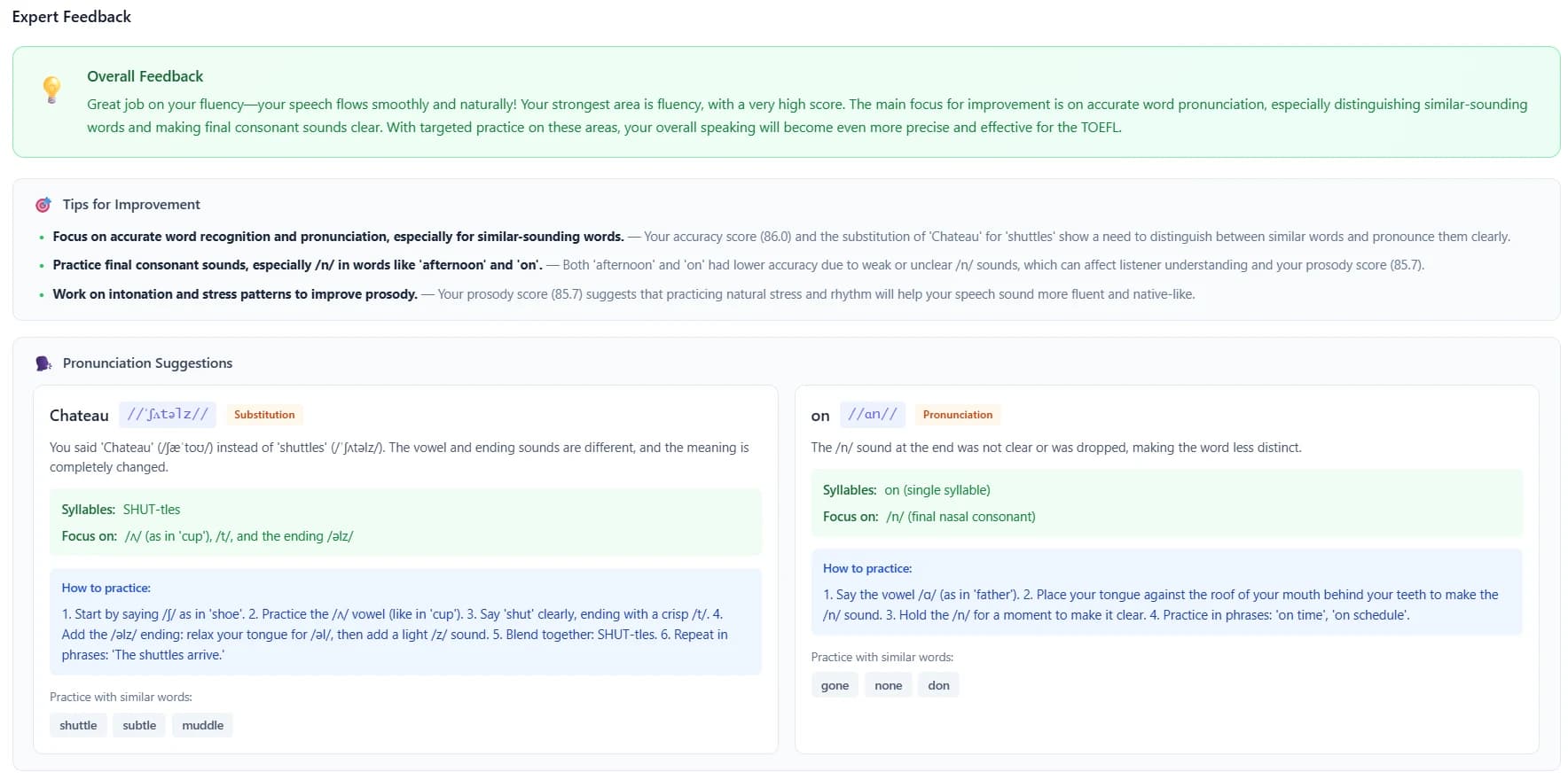
रूब्रिक-आधारित फीडबैक के साथ TOEFL Speaking प्रैक्टिस करें
LingoLeap का AI आपके Speaking जवाबों का मूल्यांकन ऐसे क्राइटेरिया से करता है जो हर टास्क टाइप के अनुरूप हों — ताकि आपकी प्रैक्टिस ठीक उसी पर टारगेट करे जिसे रूब्रिक रिवॉर्ड करता है।
TOEFL Speaking प्रैक्टिस शुरू करेंअक्सर पूछे जाने वाले सवाल
TOEFL 2026 Speaking का सबसे ऊँचा स्कोर क्या है?⌄
The highest Speaking section score is Band 6 on the TOEFL 2026 1–6 scale. This corresponds to approximately a 27–30 score on the old 0–30 per-section scale and reflects consistently strong performance across both Listen and Repeat and Take an Interview tasks. For mappings between bands and the legacy 0–120 / IELTS / CEFR scales, see the TOEFL Score Converter.
हाई Speaking स्कोर के लिए Listen and Repeat या Interview में से कौन ज़्यादा महत्वपूर्ण है?⌄
Both task types contribute to your Speaking section score, and consistently strong performance in both is needed to reach Band 6. The Take an Interview task is evaluated on more dimensions (relevance, elaboration, vocabulary, grammar, fluency, pronunciation), which makes it a higher-stakes area for most test-takers. However, accuracy errors in Listen and Repeat are easy to avoid with targeted practice and should not be a weak point — see the Listen and Repeat strategies guide.
अगर मेरा एक्सेंट स्ट्रॉन्ग है तो क्या मैं Band 6 पा सकता/सकती हूं?⌄
Yes. TOEFL Speaking scoring does not penalize for a non-native accent. What matters is intelligibility — whether what you say can be clearly understood — and naturalness of intonation. You do not need to sound like a native speaker; you need to speak clearly and naturally. Many test-takers with strong accents achieve Band 6 by prioritizing clarity and correct stress patterns. See the official ETS TOEFL Speaking criteria for the full description.
मेरे Interview जवाब कितने लंबे होने चाहिए?⌄
TOEFL Interview responses are not measured by length alone, but Band 6 responses generally include a clear answer and sufficient elaboration. In practice, this typically means 3–5 sentences delivered naturally within the available response time. A response that is too short suggests a lack of elaboration; a response that rushes through content without development is also insufficient. For a structured response framework you can practice with, see the Speaking Interview Template.
क्या मुझे Band 6 पाने के लिए स्पीकिंग टेम्पलेट याद करने चाहिए?⌄
No. Memorized templates are detectable and can actually lower your score if they make your response sound formulaic or if the template does not fit the specific question. What helps is having a reliable response structure (answer → reason → detail) that you internalize, not memorize. The content of every response should be original and specific to the prompt — see the Speaking Templates collection for adaptable frameworks rather than fixed scripts.
संबंधित गाइड
TOEFL Score Hub
All TOEFL score tools and guides in one place.
गाइड पढ़ें →
TOEFL Speaking 2026 ओवरव्यू
Speaking सेक्शन की संरचना, टास्क टाइप और टाइमिंग को समझें।
गाइड पढ़ें →
TOEFL Speaking टेम्पलेट्स
Interview टास्क के लिए स्ट्रक्चर्ड रिस्पॉन्स फ्रेमवर्क।
गाइड पढ़ें →
TOEFL 2026 फॉर्मेट और स्कोरिंग
TOEFL 2026 के सभी चार सेक्शन में स्कोरिंग कैसे काम करती है।
गाइड पढ़ें →
अच्छा TOEFL स्कोर क्या है?
जानें कि यूनिवर्सिटी एडमिशन और टारगेट स्कोर प्लानिंग के लिए Band 6 का क्या मतलब है।
गाइड पढ़ें →
Writing में 6 कैसे स्कोर करें
वही रूब्रिक-आधारित तरीका, जो Writing सेक्शन पर लागू किया गया है।
गाइड पढ़ें →
About this guide
Written by Erin (LingoLeap Content & SEO Specialist) and reviewed by the LingoLeap TOEFL Content Team — preparation specialists who analyse ETS official scoring rubrics, test-taker performance data, and examiner feedback reports to produce accurate, rubric-aligned TOEFL 2026 content. All scoring criteria referenced in this guide are derived from ETS published materials. Last reviewed April 30, 2026.