2026 TOEFL Complete the Words: Test-day Tips and Strategies
YutingMarch 13, 2026

If you have already read Complete the Words in TOEFL 2026 Reading: Task Format, Vocabulary, and Scoringand Prepare for 2026 TOEFL Complete the Words: Vocabulary, Spelling, and Word Family Practice, you may already have a solid understanding of what this task looks like and how to prepare for it in your daily practice.
However, test-day performance is a different challenge. Under real exam conditions, time pressure and mental fatigue can make even familiar blanks harder to handle, even though this is the very first task you will come across in the exam. That is why it helps to have a clear set of strategies for approaching this task quickly and efficiently.
In this article, we will focus on the test-day side of the task and the practical techniques that can help you work through it with more speed and control.
A Simple Step-by-Step Approach to Complete the Words
1️⃣ Read the whole passage first
Before filling in the first blank, quickly read through the short passage.
You do not need to analyze every detail. You just need a general sense of:
- the topic
- the sentence flow
- the logical relationship between ideas
- the overall meaning of the paragraph
This helps because the task is usually built as a coherent academic explanation. Later phrases often clarify earlier ones. If you focus too narrowly on one blank too soon, you may miss information that would have made the answer obvious.
2️⃣ Work in order from beginning to end
This task is usually easiest when done sequentially. Because the paragraph develops logically. Each sentence gives context for the next, and your understanding becomes stronger as you move forward.
Jumping randomly between blanks often increases confusion. In contrast, a top-to-bottom approach lets you build meaning progressively.
You can still skip a stubborn blank and return later, but your default method should be linear.
3️⃣ Use a four-step method for each blank
One of the best ways to stay calm and efficient is to follow the same mental routine every time.
It may look like a lot at first, but with regular practice, it becomes a habit and much easier to use efficiently on test day.
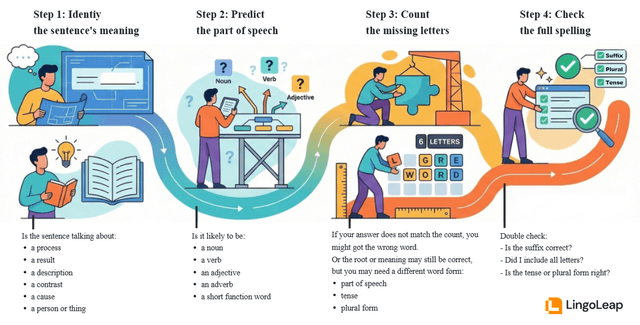
A Four-step Strategy for TOEFL 2026 Complete the Words
Step 1: Identify the sentence's meaning
Ask yourself what idea belongs there. You do not need the exact word yet. Just identify the general meaning.Is the sentence talking about a process, a result, a description, a contrast, a cause, or a person or thing?
That narrows the possibilities immediately.
Step 2: Predict the part of speech
Next, decide what kind of word the sentence requires. Is it likely to be a noun, a verb, an adjective, an adverb, or a short function word?
Grammar signals around the blank are often extremely helpful here.
Step 3: Count the missing letters
This is one of the most useful checks in the entire task.
Each underscore represents one missing letter, so if your answer does not match the count, you might got the wrong word.
In some cases, the root or meaning may still be correct, but you may need a different word form, such as a noun instead of an adjective, a plural instead of a singular noun, or a past-tense verb instead of the base form.
Step 4: Check the full spelling before moving on
Do not just type the first form that seems plausible. Confirm the complete spelling in your mind. Ask yourself:
- Is the suffix/prefix correct?
- Did I fill in all the letters?
- Is the tense or plural form right?
This final check can save easy points.
4️⃣ Save 30-60 seconds for a final scan
In your last review, scan the whole passage quickly again and focus on the most common preventable mistakes:
- wrong suffix
- missing plural ending
- wrong tense
- double-letter error
- one missing letter
- American vs. British spelling
- answer length not matching the underscores
Additional Tips to Save Time and Handle Difficult Blanks
1. If you get stuck, do not freeze
One of the worst things you can do is spend too long on a single blank. This task is designed to move quickly.
If an answer does not come within a short moment:
- make a reasonable prediction about the type of word
- enter your best logical guess if possible
- move on
You can always return at the end.
A delayed easy blank later in the passage may help unlock the earlier one.
2. Try the A-to-Z recall method for difficult blanks
If a word feels familiar but will not fully come to mind, try mentally cycling through possible next letters. This can sometimes trigger recognition.
The point is not to random-guess the whole alphabet mechanically. It is to nudge your memory when you already have a partial sense of the word. This works best when:
- you know the topic
- the visible root looks familiar
- the part of speech is already clear
- only the exact completion is missing from recall
Use it briefly, not as a time sink.
3. Manage your time deliberately
This task is short, so pacing matters.
You want to avoid two opposite mistakes:
- rushing so much that you miss obvious spelling details
- slowing down so much that one blank drains your time
A strong rhythm is:
- read the passage quickly
- answer the easy blanks first as you move through
- skip and return to difficult ones
- use the final moments for spelling and length checks
Put These Test-Day Strategies into Practice Now
Although these are called "test-day strategies", they are not the kind of tips you can simply read once right before the exam and expect to use well. To make them truly effective, you need to start applying them during your daily practice. Only through repeated use can they become habits that feel natural and automatic under real test conditions.
That is what makes targeted practice so important. LingoLeap’s 2026 TOEFL practice platform lets you work on Complete the Words tasks in the actual task format, so you can apply these methods consistently while building speed, accuracy, and control. Over time, the goal is not just to know the strategy, but to use it smoothly when it matters.

Start your free trial today and take the next step toward acing the 2026 TOEFL with LingoLeap!