2026 New TOEFL Reading Section Explained: Task Types, Question Formats, and MST Strategies
LingoLeapJanuary 16, 2026
Overview of the TOEFL iBT 2026 Reading Section
In the Reading section of the new 2026 TOEFL iBT, test-takers will answer a total of 50 questions designed to assess their ability to understand both academic and real-life written English.
Like the Listening Section, this section operates under a multi-stage adaptive testing (MST) framework and includes three distinct task types, each targeting different reading skills.
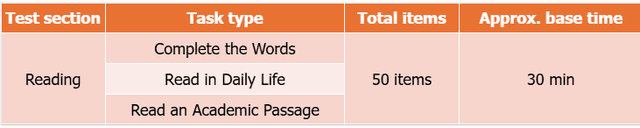
Task Type 1: Complete the Words
Task Description
In this task, candidates are required to complete partially obscured words in a short paragraph. Several words will have missing letters, and you must reconstruct them using contextual clues from the surrounding text.
Key Skills Assessed
- Vocabulary and Spelling Accuracy
- Correct spelling of both common and academic vocabulary.
- Contextual Understanding
- Using sentence meaning and logical flow to identify the intended word.
- Grammatical Awareness
- Ensuring the completed word matches the correct tense, number, or part of speech.
Preparation Tips
- Practice reconstructing texts by removing letters from the middle or end of words.
- Pay special attention to high-frequency academic prefixes and suffixes (e.g., -tion, -ment, inter-, pre-).
Example Questions from Official Sample Tests
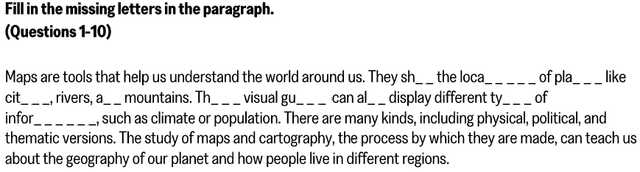
🚩Click to try more "Complete the words" practice tests on LingoLeap for free!
Task Type 2: Read in Daily Life
Task Description
This task focuses on everyday written communication, such as emails, notices, text messages, or social media posts. These materials reflect realistic academic and workplace scenarios.
Key Skills Assessed
- Main Purpose Identification
- Understanding why the message was written (e.g., to notify, confirm, or request).
- Detail Recognition and Inference
- Locating specific information or inferring tone, attitude, and next steps.
Preparation Tips
- Read common university and workplace communications, such as system maintenance notices or meeting updates.
- Practice identifying the intended audience and the tone of digital messages.
Example Questions from Official Sample Tests
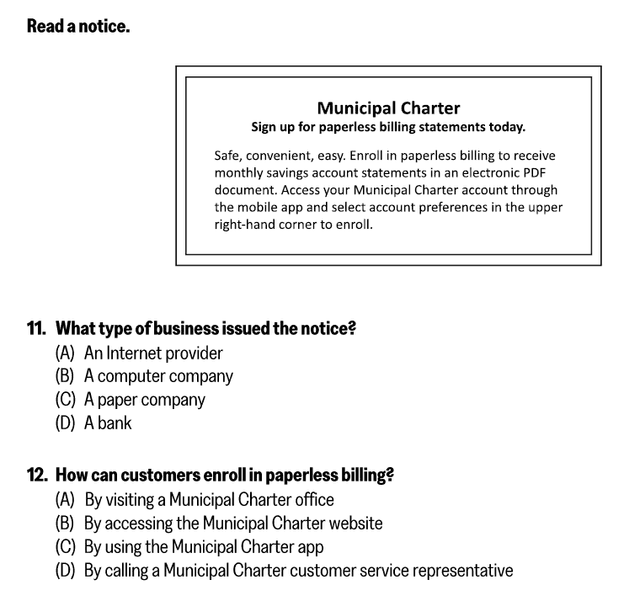
🚩Click to try more "Read in daily life" practice tests on LingoLeap for free!
Task Type 3: Read an Academic Passage
Task Description
Candidates read longer academic passages on topics such as Agricultural Economics, Cognitive Mapping, or Ocean Acidification, followed by comprehension and analysis questions.
Key Skills Assessed
- Academic Vocabulary
- Identifying words closest in meaning to highlighted terms.
- Rhetorical Purpose
- Understanding why the author introduces specific examples or concepts.
- Text Organization
- Recognizing relationships between paragraphs (e.g., cause–effect, example–argument).
Preparation Tips
- Build a strong bank of academic synonyms
- (e.g., alleviate = ease; enhance = improve; prevalent = widespread).
- Analyze how academic texts separate main arguments from supporting evidence.
Example Questions from Official Sample Tests
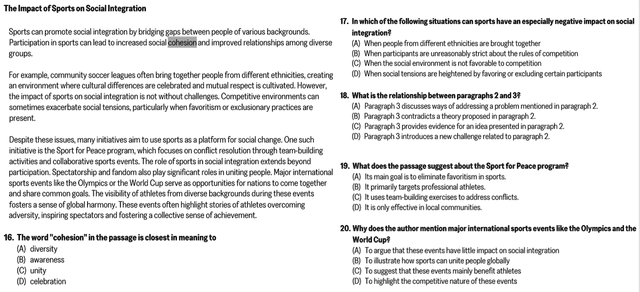
🚩Click to try more "Read an academic passage" practice tests on LingoLeap for free!
Multi-Stage Adaptive Testing (MST): Impact and Strategies
The Reading section consists of Module 1 and Module 2, each with its own time limit displayed on screen.
Key Rules You Must Know
- Irreversibility Rule
- You may move freely between questions within the same module, but once you enter Module 2, you cannot return to Module 1.
- Adaptive Difficulty
- Your performance in Module 1 generally determines the difficulty level of Module 2.
- Your accuracy in Stage 1 determines which level you enter next:
- ≥ 60% correct: You enter Upper level
- < 60% correct: You enter Lower level
Practical Strategies
- Review Carefully Before Submitting Use the Review function to confirm all answers—especially missing letters and inference-based questions.
- Strict Time Management Monitor the clock closely. Since answers cannot be revisited later, ensure every question in the current module is completed to the best of your ability.
- Consistency and accuracy matter more than speed during Stage 1 Since Stage 1 determines your route, maintaining stable accuracy and consistency, especially on "Complete the Words". It is more important than rushing through items.
Final Tips: Preparing for the TOEFL iBT 2026 Reading Section
The TOEFL iBT 2026 Reading section places greater emphasis on contextual understanding, vocabulary precision, and consistent performance under an adaptive system. Effective preparation should focus on how you read and decide, not just how many questions you complete.
1. Prioritize Accuracy in Module 1
Since the Reading section uses Multi-Stage Adaptive Testing (MST), performance in Module 1 directly affects the difficulty of Module 2. Early accuracy matters more than speed—take time to verify missing letters, vocabulary choices, and inferences before moving on.
2. Learn Vocabulary in Context
The "Complete the Words" task tests whether you can recognize word forms, grammar, and meaning together. Study vocabulary in sentences or short passages, and focus on common academic word families rather than isolated definitions.
3. Don’t Underestimate “Daily Life” Reading
Emails and notices often test purpose, tone, and implied actions, not just surface meaning. Practice identifying why a message was written and what response it expects.
4. Practice with Adaptive Logic
Since modules cannot be revisited, train with longer, mixed question sets to build confidence in committing to answers and maintaining focus under MST conditions.
5. Make Good Use of Tools and Feedback to Study Smarter
For 2026 TOEFL, progress comes from targeted, criterion-based feedback, not repeated guessing. Tools like Lingoleap.ai can support this process by offering AI-powered evaluations and practice tests aligned with the new TOEFL expectations. They help identify weak points in vocabulary use, inference, and reading logic—making practice more efficient when combined with official materials.
You can get limited-time free practice tests for TOEFL Reading now with LingoLeap!