How to Calculate Your TOEFL Score: Complete Guide for the 2026 Changes
HelenJanuary 5, 2026
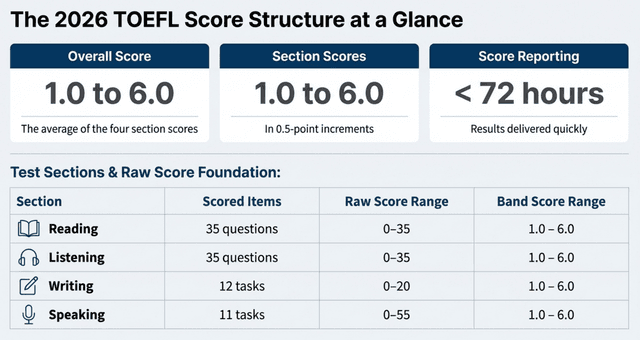
Quick Overview: TOEFL 2026 Score Structure
The information in this article is based on the official **TOEFL iBT® Technical Manual** published by Educational Testing Service (ETS) in October 2025.
Band Score System
- Section Scores: 1.0 to 6.0 (in 0.5-point increments)
- Overall Score: 1.0 to 6.0 (average of four sections)
- Score Reporting: Results available within 72 hours
Test Sections and Scoring Range
What is MST (Multistage Adaptive Testing)?
This is one of the most misunderstood aspects of the new TOEFL. There are many misconceptions online, such as "getting the first question wrong means you're doomed" or "you'll be locked into a low-score pool and can't get a high score."Let me clarify exactly how MST works based on the official TOEFL Technical Manual.
Which Sections Use MST?
MST applies ONLY to Reading and Listening sections.
- ✅ Reading: Uses MST (2 stages)
- ✅ Listening: Uses MST (2 stages)
- ❌ Writing: Linear (everyone gets wsame tasks)
- ❌ Speaking: Linear (everyone gets same tasks)
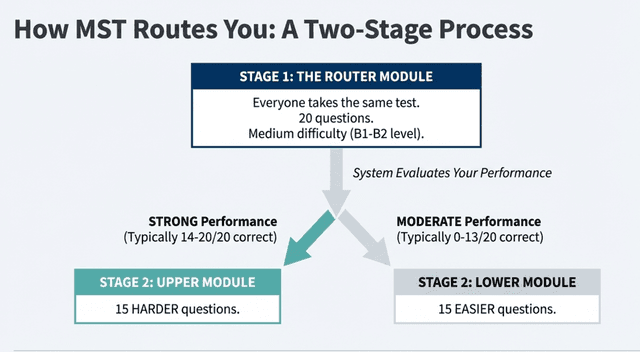
How MST Actually Works
Debunking Common Myths
❌ MYTH 1: "Getting into the Lower Module means you can't score high"
TRUTH: This is FALSE. You can still achieve a good band score from the Lower path.Why? The final score is statistically calibrated using Item Response Theory (IRT), which accounts for question difficulty.Real Example:
- Student A: Upper Module path, 25/35 correct → Band Score 4.5
- Student B: Lower Module path, 25/35 correct → Band Score 4.0
Both got 25 questions correct, but Student A scored slightly higher because they answered harder questions. However, Student B can still get 4.0, which is sufficient for many university programs!
❌ MYTH 2: "The first question determines everything"
TRUTH: Stage 1 has 20 questions, not just one question. Your routing is based on overall Stage 1 performance, not a single question.Example:
- Getting 1-2 questions wrong in Stage 1: Still likely to reach Upper Module
- Getting 14/20 correct (70%) in Stage 1: Typically routes to Upper Module
- Getting 12/20 correct (60%) in Stage 1: Typically routes to Lower Module
❌ MYTH 3: "You're locked into a score range based on your path"
TRUTH: Score ranges overlap significantly between paths.Lower Module Score Range: Band 1.0 to 5.0 Upper Module Score Range: Band 3.0 to 6.0Key Insight: If you perform well on the Lower Module (e.g., 13-15/15 correct in Stage 2), you can still achieve Band 4.5-5.0, which meets most university requirements!
Understanding Score Calculation Across Paths
The scoring system uses IRT (Item Response Theory) to ensure fairness:
Scenario 1: Upper Module Path
Stage 1: 16/20 correct (80%) → Routes to Upper Stage 2: 10/15 correct (67%) → Harder questions Total: 26/35 (74% accuracy on harder questions) IRT-Adjusted Score: ~27.5 Final Band Score: 4.5-5.0
Scenario 2: Lower Module Path
Stage 1: 12/20 correct (60%) → Routes to Lower Stage 2: 14/15 correct (93%) → Easier questions Total: 26/35 (74% accuracy on easier questions) IRT-Adjusted Score: ~24.5 Final Band Score: 4.0-4.5
Important: Both students got 26/35 correct, but because Student 1 answered harder questions, their IRT-adjusted score is slightly higher. However, both are in the B2 range and meet many university requirements!
Can You Still Get Band 5.0+ from Lower Module?
Technically possible but very difficult.To get Band 5.0 from the Lower Module path, you would need:
- Nearly perfect performance in Stage 2 (14-15/15 correct)
- Strong performance in Stage 1 (11-13/20) - just below the Upper threshold
- This combination is rare but possible
More realistic targets by path:
- Upper Module: Band 3.5 to 6.0 (realistically 4.0-5.5)
- Lower Module: Band 1.0 to 5.0 (realistically 2.5-4.5)
Strategic Implications
Should you worry about Stage 1?
Yes and no.
✅ Do focus on performing well in Stage 1 because:
- Better performance gives you access to Upper Module
- Psychologically, knowing you're in the Upper Module boosts confidence
- Slightly easier to reach Band 5.0+ from Upper path
❌ Don't panic if you feel Stage 1 was difficult because:
- You might still route to Upper Module (threshold is around 13-14/20)
- Lower Module can still get you Band 4.0-4.5, sufficient for many programs
- Score is adjusted for difficulty - you won't be "locked out" of good scores
Optimal Strategy
For Stage 1 (Router Module):
- Pace yourself: ~1 minute per question
- Don't second-guess: Your first instinct is often correct
- Answer everything: No penalty for wrong answers
- Focus on accuracy: Better to answer 18/20 correctly than rush through all 20 with many errors
For Stage 2 (Adaptive Module):
- Don't stress about difficulty: If questions seem hard, you're likely in Upper Module (good news!)
- If questions seem easy: You're in Lower Module - aim for 13-15/15 correct
- Maintain focus: Stage 2 performance significantly impacts your final score
The Bottom Line
🎯 Key Takeaway: MST is designed to measure your ability more efficiently, NOT to trap you in low scores.The system is fair because:
- Harder questions = fewer needed correct for same band score
- Easier questions = more needed correct for same band score
- Statistical calibration ensures consistent standards
Your goal: Perform your best on every question, regardless of which module you're in. The scoring algorithm will handle the rest fairly.
Band-to-Score Conversion Table
The table below shows how the new 1–6 band scores correspond to the traditional 0–30 section scores and the 0–120 total score. These ranges, published by ETS, help institutions compare new and old score sets.
Section Score Conversion (Per Section)
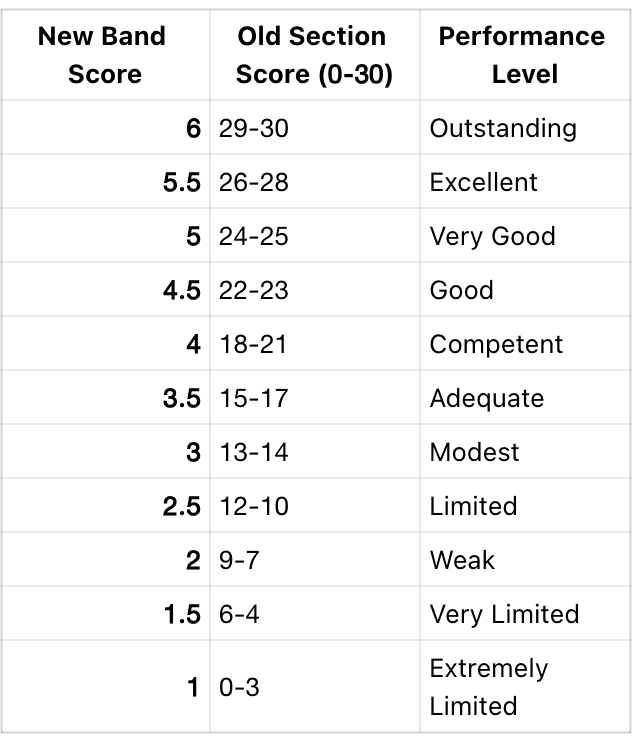
New Band ScoreOld Section Score (0-30)Performance Level629-30Outstanding5.526-28Excellent524-25Very Good4.522-23Good418-21Competent3.515-17Adequate313-14Modest2.512-10Limited29-7Weak1.56-4Very Limited10-3Extremely Limited
Total Score Conversion (Overall)
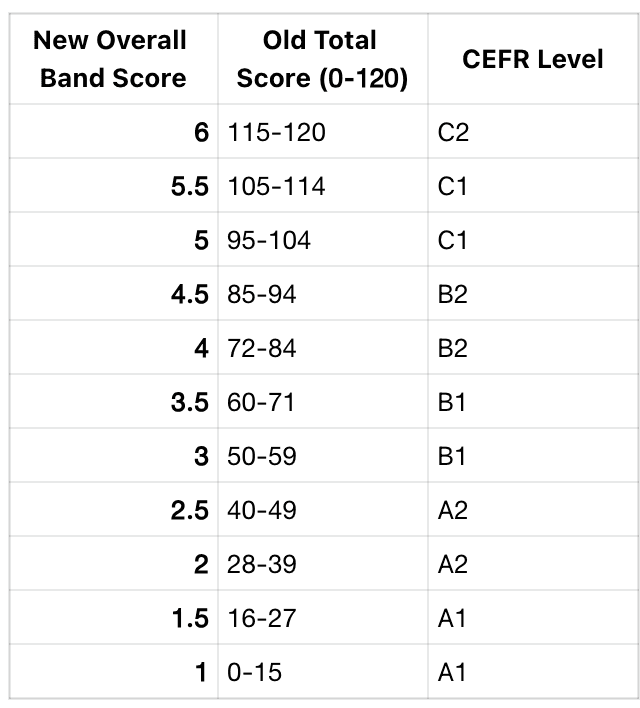
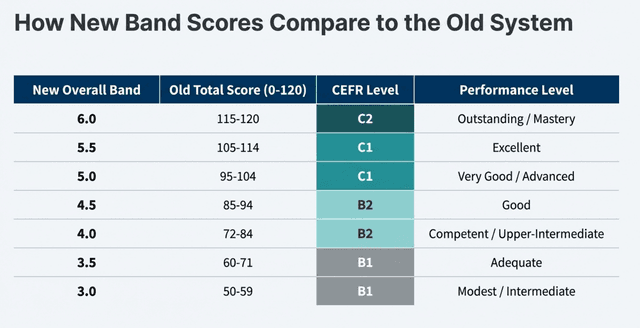
New Overall Band ScoreOld Total Score (0-120)CEFR Level6115-120C25.5105-114C1595-104C14.585-94B2472-84B23.560-71B1350-59B12.540-49A2228-39A21.516-27A110-15A1
Important Notes:
- These conversions are approximate and based on percentile distributions
- Individual section scores may vary within these ranges
- Universities may interpret scores differently
- Always check with your target institution for specific requirements
- Some institutions may prefer one scoring system over the other
Example Conversions
Example 1: New Score → Old Score Equivalent
- New Scores: Reading 5.0, Listening 4.5, Writing 5.0, Speaking 4.5
- New Overall: 4.75 (rounded to 5.0)
- Old Equivalent: ~95-100/120
Example 2: Old Score → New Score Equivalent
- Old Scores: R:25, L:23, W:24, S:22 (Total: 94/120)
- Old Overall: 94/120
- New Equivalent: ~4.5 band score
Understanding Band Scores
The TOEFL 2026 uses a band score system from 1 to 6, which is more intuitive than the previous 0-120 scale. Each section receives a band score, and your overall score is the average of these four sections.
Band Score to CEFR Mapping
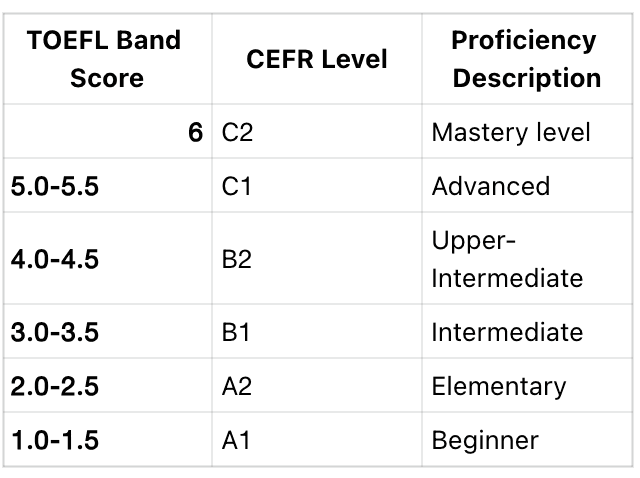
TOEFL Band ScoreCEFR LevelProficiency Description6C2Mastery level5.0-5.5C1Advanced4.0-4.5B2Upper-Intermediate3.0-3.5B1Intermediate2.0-2.5A2Elementary1.0-1.5A1Beginner
How Each Section Score is Calculated
- Reading Section Score Calculation
Format: 35 questions across multiple task types using Multistage Adaptive Testing (MST)
Task Types:
- Complete the Words (C-test): 20 questions
- Read in Daily Life: 5-10 questions (varies by path)
- Read an Academic Passage: 5-10 questions (varies by path)
How It Works:
- You complete a Stage 1 (router) module with 20 questions
- Based on your Stage 1 performance, you receive either:
- Lower difficulty module (15 questions), OR
- Upper difficulty module (15 questions)
- Your total raw score = correct answers across both stages
- Raw score is converted to band score (1-6) through IRT equating
Example Calculation:
- Stage 1: 15/20 correct (good performance → Upper module)
- Stage 2 (Upper): 10/15 correct
- Total Raw Score: 25/35
- Band Score: Approximately 4.5 (B2 level)*
*Note: Exact conversion accounts for question difficulty
2. Listening Section Score Calculation
Format: 35 questions using Multistage Adaptive Testing (MST)
Task Types:
- Listen and Choose a Response: 11-15 questions (varies by path)
- Listen to a Conversation: 8 questions
- Listen to an Announcement: 0-8 questions (varies by path)
- Listen to an Academic Talk: 4-12 questions (varies by path)
How It Works:
- Stage 1 (router): 20 questions at moderate difficulty
- Stage 2: Either lower (15 questions) or upper (15 questions) difficulty
- Raw score converted to band score using IRT equating
Example Calculation:
- Stage 1: 12/20 correct (moderate performance → Lower module)
- Stage 2 (Lower): 12/15 correct
- Total Raw Score: 24/35
- Band Score: Approximately 4.0 (B2 level)*
3. Writing Section Score Calculation
Format: 12 scored items (linear, not adaptive)
Task Breakdown:
- Build a Sentence: 10 items (1 point each) = 0-10 points
- Write an Email: 1 task (0-5 points)
- Write for an Academic Discussion: 1 task (0-5 points)
Scoring Process:
- Build a Sentence: Automatically scored (correct/incorrect)
- Email & Discussion: Scored by AI and human raters (0-5 scale)
- Raw scores combined (maximum 20 points)
- Converted to band score via weighted equipercentile linking
Example Calculation:
- Build a Sentence: 8/10 = 8 points
- Write an Email: 4/5 = 4 points
- Academic Discussion: 4/5 = 4 points
- Total Raw Score: 16/20
- Band Score: Approximately 5.0 (C1 level)*
Writing Rubric Criteria:
- Content and elaboration
- Grammar and vocabulary accuracy
- Organization and coherence
- Social conventions (for Email)
4. Speaking Section Score Calculation
Format: 11 scored tasks (linear, not adaptive)
Task Breakdown:
- Listen and Repeat: 7 tasks (0-5 points each) = 0-35 points
- Take an Interview: 4 tasks (0-5 points each) = 0-20 points
Scoring Process:
- Each response scored 0-5 by AI and human raters
- Total raw score = sum of all task scores (maximum 55 points)
- Converted to band score via weighted equipercentile linking
Example Calculation:
- Listen and Repeat (7 tasks): 4, 4, 5, 3, 4, 4, 4 = 28 points
- Take an Interview (4 tasks): 4, 4, 3, 4 = 15 points
- Total Raw Score: 43/55
- Band Score: Approximately 4.5 (B2 level)*
Speaking Rubric Criteria:
- Fluency and pace
- Pronunciation and intelligibility
- Accuracy (for Repeat tasks)
- Grammar and vocabulary
- Content relevance and elaboration (for Interview)
Calculating Your Overall TOEFL Score
Your overall TOEFL band score is simply the average of your four section scores.
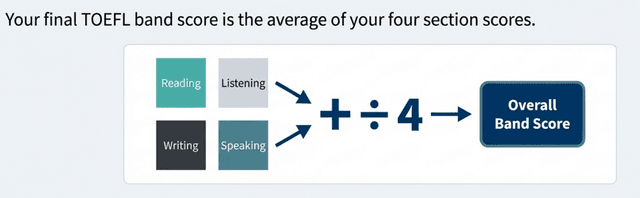
Example 1: Balanced Performance
- Reading: 4.
- Listening: 4.0
- Writing: 5.0
- Speaking: 4.5
- Overall Score: (4.5 + 4.0 + 5.0 + 4.5) ÷ 4 = 4.5 (B2)
Example 2: Mixed Performance
- Reading: 5.5
- Listening: 5.0
- Writing: 4.0
- Speaking: 3.5
- Overall Score: (5.5 + 5.0 + 4.0 + 3.5) ÷ 4 = 4.5 (B2)
What is MyBest Score?
The TOEFL program offers MyBest Scores, which combine your highest section scores from all valid tests taken within the past 2 years.Example:
- Test 1 (March 2026): R:4.5, L:4.0, W:4.5, S:3.5 = Overall 4.1
- Test 2 (May 2026): R:4.0, L:4.5, W:5.0, S:4.0 = Overall 4.4
- MyBest Score: R:4.5, L:4.5, W:5.0, S:4.0 = Overall 4.5
Understanding Score Reliability and Standard Error
Every test has some measurement error. For TOEFL 2026:
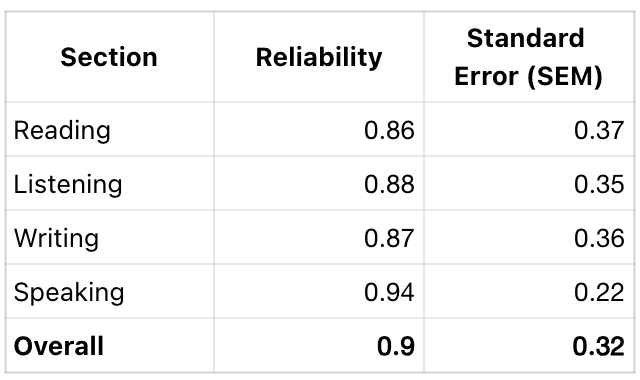
SectionReliabilityStandard Error (SEM)Reading0.860.37Listening0.880.35Writing0.870.36Speaking0.940.22Overall0.90.32What This Means: If you score 4.5, your true proficiency likely falls between:
- 68% confidence: 4.5 ± 0.32 = 4.2 to 4.8
- 95% confidence: 4.5 ± 0.64 = 3.9 to 5.1
Key Differences from Previous TOEFL Scoring
Old System (Before 2026)
- 0-30 points per section
- 0-120 total score
- Longer test duration
- Single-stage test design
New System (2026)
- 1-6 band scores per section
- 1-6 overall score
- Shorter, more efficient
- Adaptive Reading/Listening
- 72-hour score reporting
Converting Between Old and New Scores
If you know your old TOEFL score, use this quick reference:
Real-World Conversion Examples
Example 1: Strong Graduate Applicant
- Old Scores: R:27, L:26, W:25, S:24 (Total: 102)
- New Equivalent: R:5.5, L:5.5, W:5.0, S:5.0 (Overall: 5.25 → 5.0-5.5)
Example 2: Undergraduate Applicant
- Old Scores: R:22, L:21, W:20, S:19 (Total: 82)
- New Equivalent: R:4.5, L:4.0, W:4.0, S:4.0 (Overall: 4.125 → 4.0)
Example 3: Pathway Program Student
- Old Scores: R:18, L:17, W:16, S:15 (Total: 66)
- New Equivalent: R:3.5, L:3.5, W:3.0, S:3.5 (Overall: 3.375 → 3.5)
What Universities Accept
Most universities will accept either the previous 0-120 scale or the new 1-6 band scale. Common requirements:
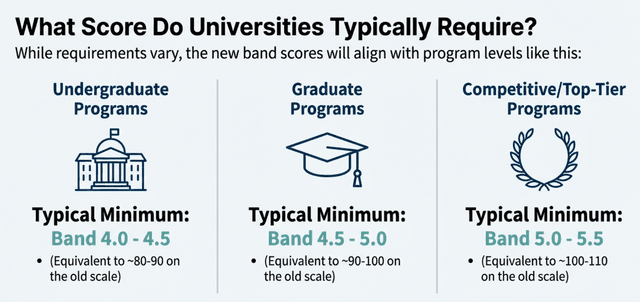
Always check specific university requirements, as they vary by institution and program.
Score Improvement Strategies
For Reading (Target: +0.5 to 1.0 band)
- Build academic vocabulary (2000-3000 words)
- Practice with 200-word passages daily
- Master skimming and scanning techniques
- Focus on inference questions
For Listening (Target: +0.5 to 1.0 band)
- Listen to academic lectures (TED Talks, podcasts)
- Practice note-taking while listening
- Focus on main ideas and supporting details
- Work on recognizing speaker purpose
For Writing (Target: +0.5 band)
- Write 2-3 practice responses weekly
- Study high-scoring sample essays
- Focus on clear organization and transitions
- Expand academic vocabulary usage
For Speaking (Target: +0.5 band)
- Record yourself daily (1-2 minutes)
- Focus on pronunciation and rhythm
- Practice organizing ideas quickly (15 seconds)
- Build response templates for common topics
Frequently Asked Questions
- How long do TOEFL scores remain valid?
TOEFL scores are valid for 2 years from the test date.
2. Can I cancel my scores?
Yes, you can cancel scores immediately after the test or request cancellation before they're reported.
3. How many times can I take the TOEFL?
You can take the TOEFL once every 3 days, with no annual limit.
4. What if I need to report only certain sections?
Some institutions accept MyBest Scores, allowing you to combine your best section scores from multiple test dates.
5. How accurate is the band score prediction?
The band score has a standard error of ±0.32, meaning your true score is within this range 68% of the time.
Where can I find practice materials for the TOEFL 2026 format?
For the latest 2026-specific preparation:🎯 LingoLeap.ai (Recommended for 2026 format)
- ✅ Complete question bank aligned with all new 2026 task types
- ✅ AI-powered scoring engine for Writing and Speaking (mirrors actual test)
- ✅ MST simulation for Reading and Listening (practice adaptive routing)
- ✅ Band score-based practice (1-6 scale)
- ✅ Instant feedback and performance analytics
- Website: https://lingoleap.ai
Official ETS Materials:
- TOEFL iBT Free Practice Test (updated for 2026)
- TOEFL Practice Online (TPO) - Latest 2026 format
- The Official Guide to the TOEFL Test (2026 edition when available)
Important Note: Many traditional TOEFL prep platforms are still updating their content for the 2026 changes. LingoLeap.ai specializes in the new format with the latest question types, MST adaptive testing simulation, and AI scoring that matches the actual test's scoring methodology.
Conclusion: Maximizing Your TOEFL Score
Understanding how the TOEFL 2026 is scored empowers you to:
- Set realistic goals based on university requirements
- Focus preparation on sections needing improvement
- Track progress effectively across practice tests
- Interpret results confidently when scores arrive
Remember: The new band score system (1-6) is designed to be more intuitive and aligned with international standards (CEFR). Whether you're aiming for a 4.0, 5.0, or 6.0, consistent practice targeting each section's specific skills will help you achieve your target score.
Next Steps
- Take a diagnostic test to establish your baseline band scores
- Try LingoLeap.ai for 2026-format practice with instant AI scoring
- Identify weakest section(s) and prioritize improvement
- Create a study schedule (recommended: 8-12 weeks)
- Practice with 2026-specific materials:
- LingoLeap.ai: Latest question types, MST simulation, AI feedback
- Official ETS materials (when available)
- Register early for your preferred test date
🚀 Start Your 2026 TOEFL Prep: Visit LingoLeap.ai for AI-powered practice aligned with the new format, including all updated task types, adaptive testing simulation, and instant band score feedback. Good luck with your TOEFL preparation!
Related Articles
- How to Calculate Your TOEFL Reading Score (2026)
- How to Calculate Your TOEFL Listening Score (2026)
- How to Calculate Your TOEFL Writing Score (2026)
- How to Calculate Your TOEFL Speaking Score (2026)
- TOEFL 2026 Changes: Complete Guide
- CEFR to TOEFL Score Conversion (2026)
![[TOEFL Score Range] What Is a Good TOEFL Score Out of 120?](/_vercel/image?url=https%3A%2F%2Fcdn.sanity.io%2Fimages%2F25652opf%2Fproduction%2Feaa25116343ae3f8bf6ef9a1109ada964bfcf0bf-2240x1260.png&w=1200&q=75)