Prepare for 2026 TOEFL Complete the Words: Vocabulary, Spelling, and Word Family Practice
YutingMarch 13, 2026

As part of the TOEFL 2026 Reading section, Complete the Words is a new task type that goes beyond reading comprehension alone. It also reveals weaknesses in spelling, grammar control, and word formation. In Complete the Words in TOEFL 2026 Reading: Task Format, Vocabulary, and Scoring, we introduced what this task looks like and the kinds of words it is most likely to test, giving you a general understanding of what to expect. The next question, then, is a practical one: how should you actually prepare for it in daily practice?
The answer is not random memorization. You do not need to collect thousands of isolated words. What you need is a smaller, more usable system of knowledge that helps you recognize the right word form quickly and produce it accurately.
This article breaks that preparation down into several key areas: vocabulary, word families, suffixes, prefixes, spelling control, and practice methods that reflect the task itself.
Build academic word families, not single-word lists
One of the most efficient ways to prepare for this task is to study word families.
A word family groups related forms built from the same root. That matters because the task often gives you part of a word and expects you to choose the correct grammatical version.
For example:
- economy / economic / economical
- analyze / analysis / analytical
- cognition / cognitive
- implement / implemented / implementation
If you only know one member of the family, you may still hesitate. But if you know the group, you can move faster from visible letters to the required form.
Focus on high-frequency academic vocabulary
Focus on high-frequency academic vocabulary across common passage themes. There is no need to start with rare or highly technical words.
Official TOEFL 2026 samples show that Complete the Words often draws on broadly useful academic vocabulary from familiar themes such as science, geography, society, and cultural explanation.
What matters is not only recognizing these words in context, but also being able to recover them from partial forms and produce the correct spelling quickly. For that reason, vocabulary building for this task should not come from random word hunting. It should come from review after practice: each time you finish a set, extract the words you missed or hesitated on, and organize them by topic, part of speech, word family, or suffix pattern. That way, your vocabulary notebook grows out of the task itself rather than away from it.
Study common suffixes strategically
Suffixes are one of the clearest shortcuts in this task because they often signal part of speech.
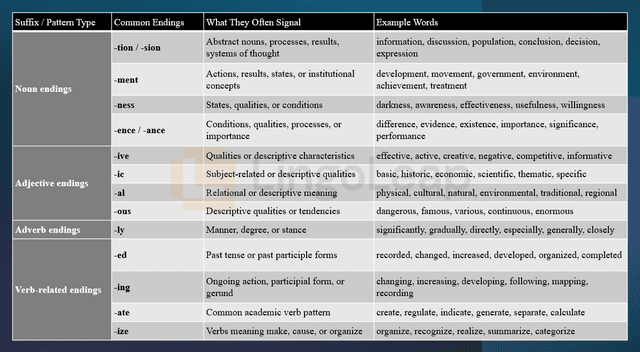
Common Suffixes in TOEFL 2026 Complete the Words
In some cases, the visible part of the word may already suggest the root, and the real challenge is supplying the right tense or derived form.
Prefixes are important indicators
Prefixes are useful clues, especially in academic vocabulary. Common examples include:
- un-
- re-
- pre-
- im- / in-
However, prefixes are usually supportive clues rather than the main decision-maker. In most blanks, what matters more is:
- the sentence meaning
- the required part of speech
- the exact ending
- spelling accuracy
So yes, study prefixes, but do not overbuild your preparation around them.
The best practice methods for this task
Preparation works best when it resembles the real task format. Passive reading is not enough. You need active reconstruction.
Step 1: Do a few Complete the Words tasks first.
Start with real or realistic task sets so your preparation stays tied to the actual format and get yourself familiar with this task.
Step 2: Review every completed set carefully.
Do not only check the blanks you got wrong. Look back at the ones you got right as well.
Step 3: Extract useful words and patterns from each set.
After each passage, collect words and patterns worth remembering, with particular attention to the ones you got wrong or were unsure about.
Step 4: Organize them into categories.
Sort your notes by areas such as word families, prefixes and suffixes, part of speech, grammar changes, and spelling patterns. Build up your own vocabulary bank gradually.
Step 5: Turn those notes into focused review material.
Use your categorized notes to review the patterns that appear repeatedly, rather than memorizing random vocabulary lists.
More importantly, this vocabulary system does not need to be limited to Complete the Words task alone. As your TOEFL preparation continues, you can keep adding useful words and patterns from other Reading tasks, Writing practice, and unfamiliar vocabulary that appears in Listening or Speaking. All of these belong to the broader vocabulary range of the TOEFL tests, and maybe some of them might appear in the Complete the Words task in some future tests.
Step 6: Connect daily practice to test-day performance.
Once your vocabulary, spelling, and word-family recognition improve, the next step is learning how to handle blanks efficiently on test day — from scanning the sentence and inferring part of speech to counting the underscores and moving on when necessary. For a closer look at those test-day strategies, see 2026 TOEFL Complete the Words: Test Day Tips and Strategies.
Practice Complete the Words tasks and build up your vocabulary bank now with LingoLeap!
Once you have a clear review system, the most important thing is to keep practicing in the actual task format.With LingoLeap’s 2026 TOEFL question bank, you can practice Complete the Words tasks directly, review each set afterward, and turn what you see into a growing vocabulary bank organized around real TOEFL patterns.

That makes it much easier to apply the method above consistently instead of studying vocabulary in isolation. Start practicing Complete the Words with LingoLeap and build your vocabulary bank for TOEFL 2026 now!