2026 New TOEFL Writing Rubrics Explained: How ETS Scores Email & Academic Discussion
YutingJanuary 25, 2026
Starting in January 2026, the TOEFL iBT has undergone a broad redesign, updating task formats and how language ability is evaluated across sections. These changes reflect a clearer shift toward real-world academic communication, as outlined in the New TOEFL 2026 Overview. The scoring framework has also been adjusted to maintain consistency across test versions, making it important to understand how performance maps onto the New TOEFL Scoring System.
Within this broader reform, 2026 TOEFL Writing has also moved away from long, template-driven essays toward task-based, purpose-driven writing. Instead of rewarding length or rigid structure, ETS now focuses on whether a response successfully completes a communicative task using accurate, appropriate language.
This article will explain ETS’s newly released rubrics for the Email and Academic Discussion tasks and highlights a few practical, rubric-driven insights.
Official TOEFL Writing Rubrics (2026 Updated)
1. Rubric for "Write an Email"
The email writing task measures how effectively you can write for a specific social or academic purpose under time pressure.
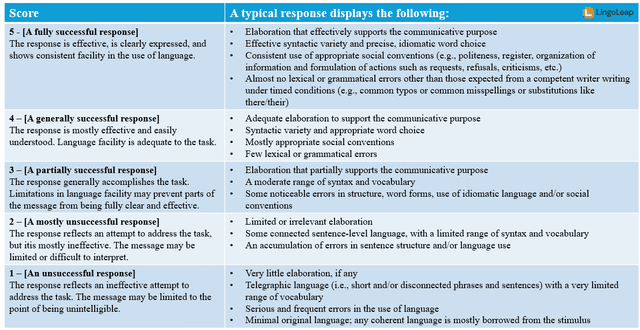
1.1 Key rubric dimensions include:
- Communicative Purpose: Does the message clearly achieve its goal?
- Social Conventions: Is the tone appropriate for the situation?
- Language Facility: Is the language precise, natural, and varied?
- Accuracy: Are grammatical and lexical errors minimal?
1.2 What this means in practice
High-scoring emails are not long—they are efficient. Each sentence serves a clear function, such as explaining a problem, making a request, or following up politely. Errors matter less when they are minor and do not interfere with meaning.
1.3 How to Get A High Score in the "Write an Email" Task
- Treat the prompt requirements as a scoring checklist, not writing inspiration. If every required point is clearly and politely addressed, you are already aligned with top-band expectations.
- Common email templates and structure still matter. While the 2026 TOEFL discourages rigid, memorized formats, email writing naturally follows certain conventions. Greetings, closings, polite phrasing, formatting, and ways of addressing or responding to others are all predictable elements that can be prepared ahead of time.
- You can now practice using LingoLeap's TOEFL email writing practice for free, which mirrors how these criteria are applied in real scoring.
2. Rubric for "Write for an Academic Discussion"
The Academic Discussion task evaluates your ability to contribute meaningfully to an ongoing academic conversation.
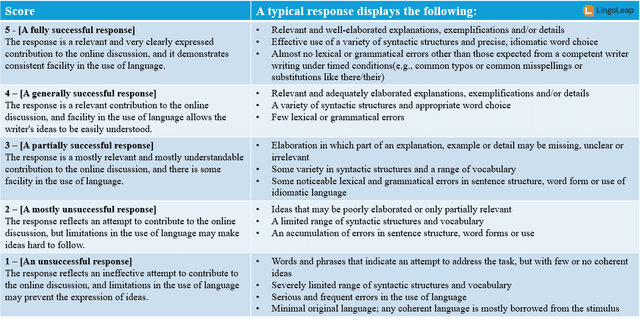
2.1 Key rubric dimensions include:
- Contribution: Does your response add new, relevant ideas?
- Support and Development: Are claims explained and supported?
- Language Quality: Is the language clear, accurate, and appropriately academic?
2.2 What this means in practice
ETS is not rewarding repetition. High scores come from responses that engage with existing viewpoints and then extend the discussion with a new angle, example, or clarification.
2.3 How to Get A High Score in the "Write an Academic Discussion" Task
- Focus on advancing the discussion, not just choosing a side. High-scoring responses acknowledge an existing idea and then add value by refining it with a condition, implication, or concrete example.
- Use a simple, flexible academic discussion response structure. Refer briefly to a peer’s point, introduce your own contribution, and support it clearly—this keeps the response coherent without sounding memorized.
- Practice with LingoLeap's Academic Discussion question bank that mirrors the new format and evaluates responses using official TOEFL scoring criteria.
How ETS Actually Scores TOEFL Writing
1. AI Scoring with Human Oversight
TOEFL Writing responses are evaluated using ETS’s proprietary AI scoring engine, which integrates advanced Natural Language Processing (NLP) techniques. Human raters supervise and continuously train the system to ensure accuracy and reliability.
This means your writing is analyzed for patterns of language use, accuracy, and task fulfillment, not surface features like length alone.
Tools such as Lingoleap.ai follow a similar evaluation logic for practice: they assess writing against official-style criteria, rather than generic grammar correction. This makes feedback more relevant to how TOEFL actually scores responses.
2. Score Consistency Across Tests
ETS uses a weighted equipercentile linking process to convert raw performance into final scores. This ensures that:
- Scores represent the same ability level across different test dates
- Rubric standards remain stable even when questions change
If you want to understand how writing performance maps to overall results, the TOEFL 1–6 score calculatorcan help clarify score interpretation.
Next Step: Practice with the Rubric in Mind
Now that you understand how TOEFL iBT 2026 Writing is actually scored, the most effective next step is rubric-driven practice.
Instead of guessing what “sounds good,” practice tasks where feedback reflects real scoring logic. For more personalized feedback, LingoLeap provides task-specific writing practice and AI-powered evaluations aligned with official TOEFL rubrics—helping you identify exactly which rubric dimensions need improvement and why.