TOEFL 2026 Blueprint Analysis: What the New Exam Trends Mean for Your Preparation Strategy
YutingMay 17, 2026
When ETS first announced the TOEFL iBT 2026 redesign, most discussions focused on visible format changes, such as new question types, adaptive Reading and Listening sections, and the new 1–6 scoring scale.
However, the newly released TOEFL iBT® Test: 2026 Update — Test Blueprint and Specifications Document reveals something much more important: what the new TOEFL is increasingly designed to measure — and therefore, how students may need to prepare differently.
Our previous article, ETS Releases New TOEFL 2026 Blueprint: Adaptive Modules, AI Scoring, and Full Exam Structure Revealed, breaks down the major newly clarified information revealed in the latest official blueprint document. While some technical details may still evolve before the official launch, the blueprint already provides strong signals about:
- the skills ETS is prioritizing,
- how AI-assisted evaluation may work,
- how adaptive testing may affect performance,
- and what kinds of practice are likely to become more important for TOEFL 2026 test takers.
In this article, we break down the biggest trends revealed in the blueprint — and what they may mean for your preparation strategy.
TOEFL 2026 Is Becoming More Communication-Focused Across All Four Sections
One of the clearest patterns across the blueprint is that TOEFL 2026 appears increasingly focused on practical communication ability rather than only traditional academic-test performance.
The exam is still academically oriented, but the updated task design repeatedly emphasizes:
- functional communication,
- spontaneous responses,
- real-world language processing,
- and intelligibility in realistic contexts.
This shift can be seen across all four sections.
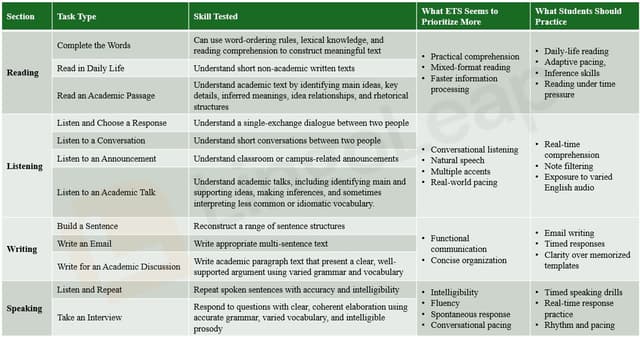
TOEFL 2026 Blueprint Section-by-section Analysis
As a result, TOEFL 2026 preparation may gradually shift away from rigid memorization, over-engineered templates, and passive drilling, and move more toward fast language processing, flexible communication, and realistic practice under pressure. For more details about specific task types and preparation tips in each section, you can also refer to our Complete Guide to Every New Question Format in TOEFL 2026.
Official AI Scoring Makes AI-Based TOEFL Practice More Important
One of the biggest clarifications in the new blueprint is ETS’s much more explicit description of AI-assisted scoring. For the first time, ETS directly labels “Write an Email,” “Write for an Academic Discussion,” and “Take an Interview” as “AI Scored” tasks in the official blueprint table.
The blueprint also explains that these responses are evaluated using natural language processing and machine learning systems designed to assess qualities such as fluency, coherence, grammar, intelligibility, and communication effectiveness.
This is important because it confirms that AI-assisted evaluation is no longer just a background technology — it is now officially part of the TOEFL 2026 scoring framework for major Speaking and Writing tasks.

That also changes what effective preparation may look like.
Traditional TOEFL preparation often relied heavily on memorized templates, pre-built examples, and highly standardized response structures. However, AI-assisted scoring systems are generally much better at detecting repetitive phrasing, unnatural language patterns, weak response flexibility, and limited real-time language control.
As a result, practicing with reliable AI-scored feedback may become increasingly valuable for TOEFL 2026 preparation itself. Students may benefit more from realistic speaking simulations, adaptive response practice, fluency-focused training, and detailed rubric-aligned feedback rather than simply memorizing polished templates.

At LingoLeap, our TOEFL 2026 practice system is already designed around many of the same scoring directions described in the blueprint, including:
- AI-scored Speaking and Writing tasks
- rubric-aligned evaluation
- adaptive mock test simulations
- fluency and pacing analysis
- personalized diagnostic feedback
Rather than only generating “sample answers,” the goal is to help students understand where they are losing points, which skills are limiting score growth, and how to improve communication effectiveness under realistic TOEFL testing conditions.
The Return of Unscored Questions May Also Change Test-Day Strategy
Another important detail officially confirmed in the blueprint is the presence of unscored questions in the Reading and Listening sections.
This is not entirely new to TOEFL iBT. Versions of the TOEFL before the 2023 redesign also included experimental or unscored questions used for test development and calibration purposes. However, this may still come as new information to some students who only became familiar with the shorter post-2023 format.
More importantly, this confirmation may also affect test-day strategy and mindset. When a passage suddenly feels unusually difficult or a question type seems unfamiliar, students may panic and assume they are performing badly. However, the existence of unscored calibration items means that not every confusing question should immediately trigger anxiety.
For TOEFL 2026, maintaining pacing, concentration, and emotional stability may become increasingly important — especially in adaptive sections where consistency matters. During Reading and Listening sections, students may benefit from:
- avoiding overthinking unusually difficult questions
- keeping a stable pace instead of trying to “recover” emotionally after one mistake
- staying focused on the next question rather than guessing which items may or may not be scored.
The MST Adaptive Model Rewards Stability
The blueprint officially confirms that Reading and Listening will use a multi-stage adaptive testing (MST) structure involving a router module followed by different lower or upper modules depending on performance.
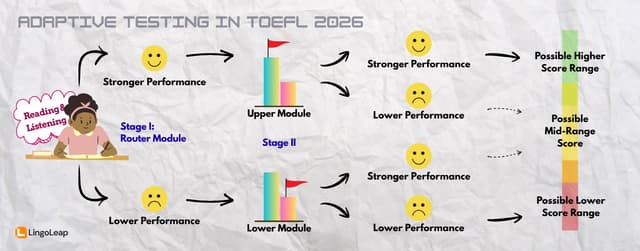
Conceptual Illustration of TOEFL 2026 Adaptive Testing Flow
For students, the biggest implication is that early-section performance may matter more than before. Because routing decisions are tied to earlier results, TOEFL 2026 may increasingly reward stable comprehension, pacing control, and consistent processing ability rather than relying on “recovering later” after a weak start.
As a result, preparation strategy may also need to change. Students may benefit more from realistic timed practice, attention control, and full-section endurance training instead of only drilling isolated question types. In adaptive sections, maintaining a stable performance level throughout the test may become just as important as getting difficult questions right.
For a deeper breakdown of how the TOEFL MST system may work in practice, you can also read our TOEFL 2026 Adaptive Testing Strategy Guide.
TOEFL 2026 Preparation Is Already Changing
Although some details of TOEFL 2026 are still not fully disclosed, the overall shape of the new exam is becoming increasingly clear through both ETS’s ongoing information releases and the real test experiences already taking place.
As the format, skill focus, and testing logic gradually come into clearer view, students should begin adapting their preparation accordingly — with more targeted practice, more communication-focused training, and mock tests that more closely reflect realistic testing conditions.
At LingoLeap, we’re building toward the version of TOEFL that ETS is actually shaping in real time: one that rewards adaptability, communication effectiveness, fluency, and stable performance under realistic testing conditions.
From full adaptive mock exams and AI-scored Speaking/Writing tasks to detailed performance diagnostics and realistic TOEFL 2026 simulations, our goal is not just to help students “practice more,” but to help them practice in ways that increasingly match how the new TOEFL is designed to evaluate them.

You can also explore:
- TOEFL Score Converter (2026) — Convert old TOEFL iBT scores (0–120) to the new 2026 band scale (1–6), IELTS bands, or CEFR levels instantly
- TOEFL Preparation Plan Generator (2026) — Get your personalized day-by-day TOEFL 2026 preparation plan by entering your target score
- The Official Guide to TOEFL 2026 — Read one of the most authoritative preparation resources published by ETS to learn more about the new TOEFL
- TOEFL 2026 Speaking Interview Topics — Learn about common topic categories, example questions and response strategies
- TOEFL 2026 Write an Email Topics — Learn about common email scenarios, example prompts, and useful email templates