How to Take Notes in TOEFL Listening: Simple Tips & Examples
LingoLeapMay 26, 2025

The TOEFL Listening section might sound simple, but it quickly becomes a challenge when you're trying to keep up with fast academic lectures and conversations.
This blog will show you 7 TOEFL listening tips, including how to take notes in TOEFL Listening and specific examples you can follow. Whether you're a first-timer or trying to break 110+, these tips will sharpen your ears and simplify your notes.
1. Understand the Format Before You Practice
Before improving your listening skills, know exactly what to expect on test day.
- 2 Conversations, 3 minutes each: Between student and professor/staff, followed by 5 questions per conversation.
- 3 Lectures, 3-5 minutes each: Academic monologues or discussions, followed by 6 questions per lecture.
- You only hear each clip once
👉 For a full breakdown, check out our TOEFL Listening Section Overview to understand timing, question types, and scoring.
2. Focus on the Big Ideas (Not Every Word)
You don’t need to write full sentences. Just capture:
- Main idea
- Structure (what comes first, second, etc.)
- Examples / details
- Signal words like “however,” “in addition,” “for example”
- Important terms (concepts, names, dates)
🎧 Example from a lecture:
“Today we’ll look at three causes of ocean current shifts: wind, salinity, and Earth’s rotation.”
Your notes could be:
✍️ Ocean current = wind + salt + Earth rot.
Fast. Simple. Easy to remember.
3. Use Shortcuts: 10+ Abbreviations and Symbols to Save Time
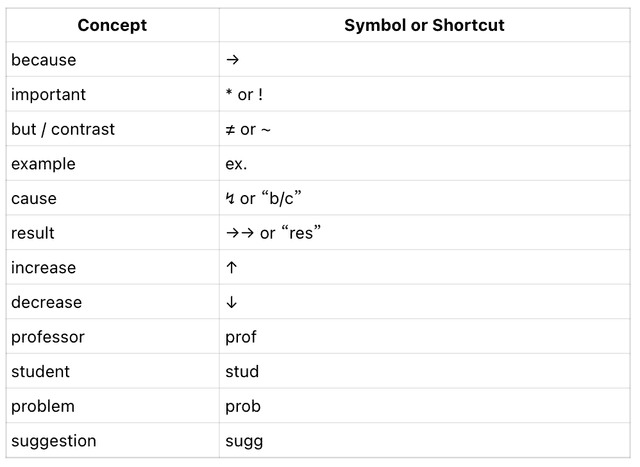
✍️ Example from a conversation:
“The student missed the deadline because her laptop crashed, but she asked for an extension.”
Notes:
Stud missed deadline → laptop crash ≠ asked prof for extQuick, clear, and effective!
4. Predict the Question Type (While You Listen)
If you can guess what question will be asked, you're already halfway to the answer. TOEFL questions follow a pattern:
- Main idea
- Detail
- Function (Why did the speaker say that?)
- Attitude
- Inference
- Organization
Practice predicting them as you listen, based on tone, transitions, and emphasis.
Want examples of all the types? Check out our TOEFL Listening Question Types Guide
5. Practice Taking Notes with Real TOEFL Samples
Listening to podcasts helps—but they aren’t structured like TOEFL audio. TOEFL clips use academic vocabulary, university settings, and logic-based explanation patterns.
👉 Practice with real samples like this: 🎧 TOEFL Listening Sample: Echolocation in Bats
📝 Sample Notes:
Bats = use echolocation → ultrasound → bounce → echo = object location = navigation + hunt prey + avoid danger
Practicing with real TOEFL material builds stamina, not just English skills.
6. Build Academic Vocabulary for Listening
You might understand every word—until a professor says something like “anecdotal evidence” or “hypothetical scenario.”TOEFL listening often includes words related to:
- Biology, history, astronomy
- Academic argument structure (e.g., “theory,” “evidence,” “claim”)
Strengthen your understanding with our TOEFL Vocabulary practice strategies.
7. After Practice, Check Your Notes Against the Transcript
Don’t just listen and move on. Review:
- Did you miss the main idea?
- Did you record too many random details?
- Were you confused because of unknown words?
- Did you use abbreviations that didn’t make sense later?
This reflection helps you improve both speed and accuracy.
Use These TOEFL Listening Tips and Level Up
With these 7 TOEFL listening tips, you’ll feel more confident, organized, and focused on test day. Remember, it’s not about listening harder—it’s about listening smarter.
Recap:
- Understand the test format
- Focus on big ideas
- Use fast abbreviations
- Predict questions
- Practice with TOEFL-style audio
- Build academic vocabulary
- Reflect and revise your notes
Want a smarter way to train? Try LingoLeap for free—it gives you authentic listening tests, AI scoring based on the official TOEFL rubric, real-time feedback, and smart TOEFL preparation tools you won’t find in any book.