ETS Releases New TOEFL 2026 Blueprint: Adaptive Modules, AI Scoring, and Full Exam Structure Revealed
YutingMay 17, 2026
On April 30, ETS released a new official document for the TOEFL iBT 2026 update, providing a much more detailed look at the redesigned exam structure than previously available.
The newly published TOEFL iBT® Test: 2026 Update — Test Blueprint and Specifications Document expands on earlier announcements about the new 1–6 scoring scale, adaptive Reading and Listening sections, and updated task types. This latest release adds concrete blueprint-level details including total item counts, raw scoring structure, adaptive module timing, AI-scored tasks, CEFR coverage, and section-specific specifications.
What Newly Released Information Does the Document Reveal?
When ETS first introduced the new TOEFL 2026 format, many details were still vague or only briefly mentioned in the Official Guide. Most students understood the big-picture changes: a shorter exam, new task types, and adaptive Reading and Listening sections.
However, this newly released TOEFL 2026 blueprint document provides much more specific clarification about:
- the adaptive testing structure
- raw score distribution and CEFR alignment
- unscored experimental questions
- and how AI-supported scoring may work in practice
Some of these details confirm earlier assumptions, while others introduce entirely new information that had not been clearly explained before. Below are four of the biggest areas that the new blueprint helps clarify.
1️⃣ ETS Clarified More Details About the Adaptive Testing Structure
Earlier MST discussions were largely based on adaptive testing principles and observed structure patterns. The newly released blueprint now confirms much of the previously inferred multi-stage framework, while still leaving some scoring mechanics undisclosed.
The document describes a clearer multi-stage adaptive (MST) structure involving a router module followed by different difficulty paths with separate "Lower" and "Upper" modules depending on performance. The blueprint also provides more specific timing and structure information for the adaptive sections, making the overall system feel much more concrete than before.
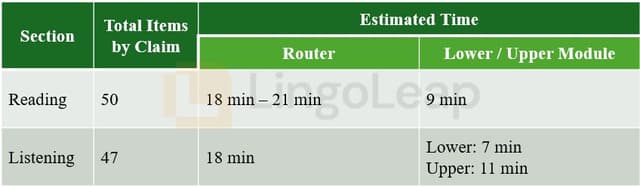
Estimated Time for Adaptive Reading and Listening (TOEFL 2026)
While ETS still has not publicly disclosed the exact logic behind item allocation, routing thresholds, or how specific question types are distributed across adaptive paths, the new document strongly confirms that TOEFL 2026 is using a true multi-stage adaptive testing framework rather than a simple difficulty adjustment system. For a deeper breakdown of how the TOEFL MST system may work in practice and to learn about strategies to score high under this framework, see our TOEFL Adaptive Testing Strategy Guide.
2️⃣ ETS Revealed More Detailed Raw Score and CEFR Alignment
Another major addition in the blueprint is the amount of detail ETS now provides about raw scoring and proficiency alignment.
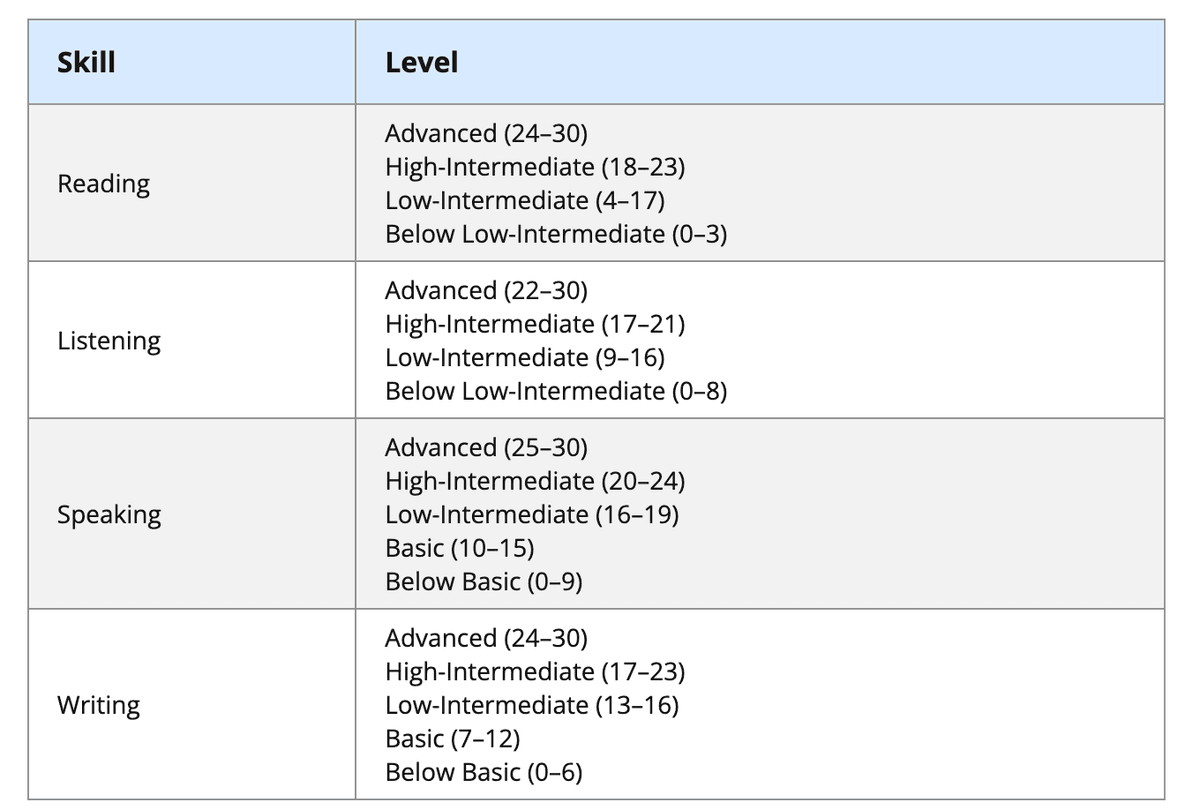
Earlier official pages mainly focused on the new 1-6 scoring scale, but the new document goes much further by explaining the exam’s raw score structure, including total raw points, item distribution across sections, and how different tasks may target different CEFR proficiency ranges.
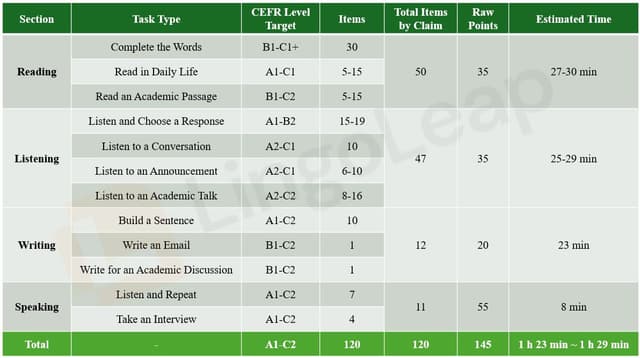
Raw Points and CEFR Level Target by Section (TOEFL 2026)
The blueprint suggests the redesigned TOEFL is intended to measure abilities spanning from A1 to C2, giving students a much clearer picture of how various question types may correspond to different levels of language proficiency and academic communication skills. It therefore makes the new scoring ecosystem feel much more standardized and CEFR-oriented than previous TOEFL versions.
3️⃣ ETS Explicitly Confirmed the Presence of Unscored Questions
One detail that many students may overlook: the blueprint explicitly states that Reading and Listening contain non-scored items. According to the document, some questions are included to “gather data on item performance for future use in scored sections of the test.”
In other words, not every question shown during the exam will necessarily contribute directly to a student’s final score. This is not completely new to the TOEFL iBT, but previous TOEFL 2026 materials did not clearly emphasize this point.
It is also important to note that the item counts shown in the blueprint already include these non-scored questions in the Reading and Listening sections. As a result, some questions test takers encounter during the exam may function primarily as experimental or calibration items rather than directly contributing to score calculation.
4️⃣ ETS Officially Identified AI-Scored Writing and Speaking Tasks
AI-supported scoring was already mentioned in earlier TOEFL 2026 announcements, but the new blueprint is the first official document to explicitly identify which task types are categorized as “AI Scored” in the blueprint table itself.
According to the document, ETS now clearly labels “Write an Email”, “Write for an Academic Discussion”, and “Take an Interview” as AI-scored task types.
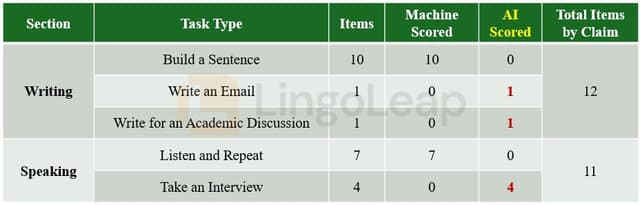
AI-Scored Writing and Speaking Tasks in the TOEFL ibt 2026 Blueprint Table
The blueprint also distinguishes these tasks from “Machine Scored” selected-response items such as multiple-choice questions. ETS further explains that:
“Machine Scored task types use rule-based algorithms to evaluate selected-response formats (e.g., multiple choice), based on exact matches or predefined scoring logic.”
“AI Scored task types involve constructed responses (e.g., speaking and writing) and are evaluated using natural language processing and machine learning to assess features like fluency, coherence, and grammar.”
This provides much clearer official confirmation that AI-assisted evaluation will play a major role in productive-response sections of TOEFL 2026, particularly in communication-focused speaking and writing tasks.
This is also one reason why AI-based evaluation systems are becoming increasingly important in modern English testing.
At LingoLeap, much of our own TOEFL practice infrastructure is built around AI-assisted scoring and rubric-aligned feedback systems designed to simulate these evolving assessment trends. As TOEFL 2026 continues moving toward adaptive testing and AI-supported evaluation, realistic practice and detailed feedback may become more important than template memorization alone.

Specifications May Still Change but Preparation Won’t Wait
As ETS continues revealing more details about TOEFL 2026, the overall direction is becoming increasingly clear: the exam is becoming more adaptive, more communication-focused, and more closely tied to AI-assisted evaluation.
For a deeper breakdown of what this newly released blueprint may reveal about ETS’s evolving testing philosophy, you can also read our analysis TOEFL 2026 Blueprint Analysis: What the New Exam Trends Mean for Your Preparation Strategy and prepare stratigically alongside the official blue print.
Although ETS still notes that the specifications outlined in the blueprint are still subject to minor revisions, the overall shape of the new exam is becoming increasingly clear through both ETS’s ongoing information releases and the real test experiences already taking place. As the format, skill focus, and testing logic gradually come into clearer view, students should begin adapting their preparation accordingly — with more targeted practice, more communication-focused training, and mock tests that more closely reflect realistic testing conditions.
At LingoLeap, we are continuing to update our TOEFL 2026 practice and mock test system accordingly, including adaptive Reading and Listening simulations, AI-scored Speaking and Writing tasks, and rubric-aligned feedback designed to reflect the direction ETS is moving toward.