How to Review Your TOEFL Mock Test Results and Improve Faster
YutingJune 12, 2026
Most students finish a TOEFL mock test, look at their score, and move on.
The problem is that a mock test is only useful if you learn something from it.
No matter what score you received, the next step should not be taking another test immediately. Instead, you should review your mistakes, identify your weakest areas, and understand why points were lost. You should also organize useful takeaways in a way that works for you, whether that means collecting new vocabulary, sentence patterns, grammar points, note-taking strategies, or test-taking techniques.
The goal is not simply to take more mock tests. The goal is to use each test to build a clearer understanding of your strengths, weaknesses, and next steps, then adjust your study plan accordingly.
This guide explains how to review TOEFL mock test results effectively and turn practice into measurable progress.
Step 1: Look Beyond the Total Score
Many students focus only on the overall score.
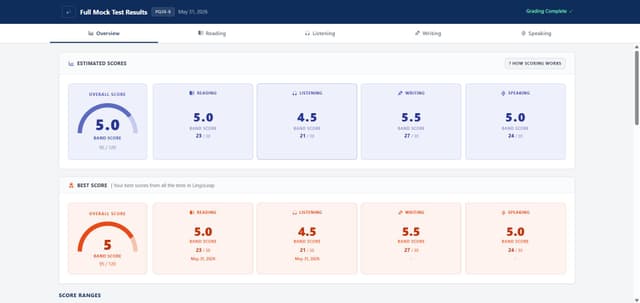
The total score may seem acceptable, but the section breakdown tells a much more useful story.
Before planning your next study session, identify which section is limiting your overall performance the most.
Step 2: Review Reading and Listening Mistakes
When reviewing Reading and Listening, don't simply count how many questions you got wrong.
Instead, ask yourself:
- Which question types caused the most problems?
- Were mistakes caused by misunderstanding the passage or audio?
- Did timing affect your performance?
- Were incorrect answers concentrated in specific passages or topics?
As you review, try to distinguish between different types of mistakes. Some errors may come from gaps in your knowledge, such as vocabulary, grammar, or academic expressions. Others may be caused by test-taking factors, including rushing, losing concentration, misreading a question, or running out of time.
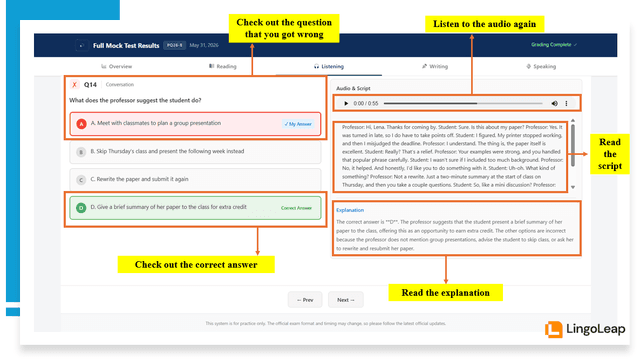
It's also important not to focus only on incorrect answers. Go back and review questions that you answered correctly but felt unsure about, guessed on, or spent a long time debating between choices. Even though you got those questions right this time, they may still represent weak areas that could cost you points on a future test.
When possible, reread the explanations, revisit the relevant part of the passage or audio, and make sure you understand why the correct answer is correct and why the other choices are wrong. These "lucky guesses" often reveal just as much about your weaknesses as your actual mistakes.
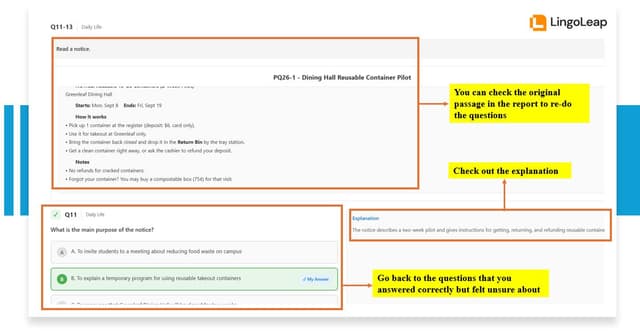
The goal is not just to identify what you got wrong, but to uncover patterns that could affect your performance again in future mock tests or on test day.
Step 3: Review Writing Performance
✒️ Complete the Sentence
For Complete the Sentence questions, start by checking the correct answer and identifying exactly where your mistake came from.
Ask yourself:
- Did I misunderstand the meaning or context of the sentence?
- Did I choose the wrong word or phrase?
- Did I place the words in the wrong order?
- Was the mistake related to grammar, such as verb tense, subject-verb agreement, pronouns, or sentence structure?
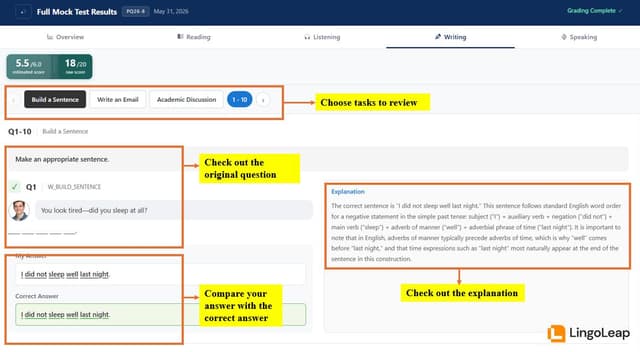
After reviewing the explanation, summarize the reason for the mistake and try creating a few similar sentences on your own. The goal is not just to understand the correct answer, but to make sure you can apply the same pattern in future questions.
📃 Write an Email and Academic Discussion
For longer writing tasks, avoid focusing only on the overall score. Instead, review the report systematically and look for patterns that you can improve in future responses.
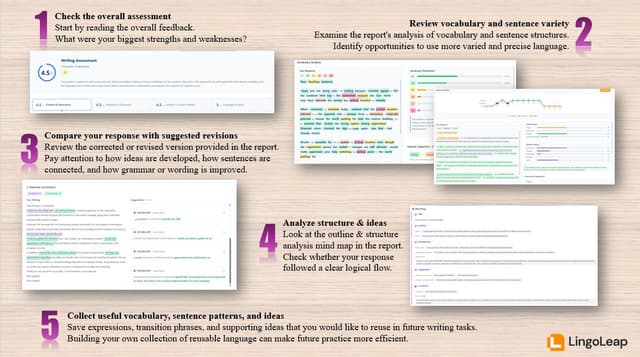
How to review your writing after a mock test
The goal of Writing review is not simply to correct mistakes. It is to build reusable language, strengthen organization, and develop a clearer understanding of how to produce stronger responses in future tasks.
Step 4: Review Speaking Performance
🗣️ Listen and Repeat
Review each sentence's score and feedback to identify specific pronunciation, fluency, or intonation issues.
- Check the score and comments for each sentence.
- Review pronunciation suggestions and speech analysis to identify mispronounced words.
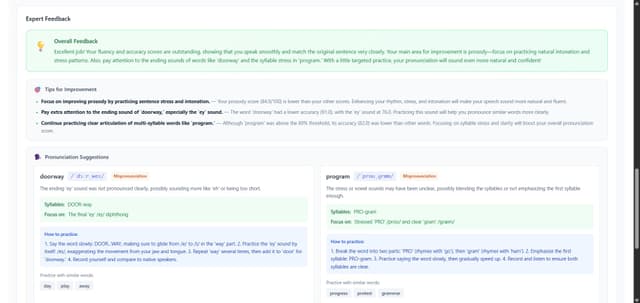
- Listen carefully to the reference audio.
- Shadow the audio by repeating along with the speaker. (Learn more about how Shadowing improves your speaking)
- Record yourself answering again.
- Compare your new recording with the original audio and focus on remaining differences.
The goal is not simply to get a higher score, but to gradually build more natural pronunciation, rhythm, and speaking confidence through repeated practice.
🎙️ Take an Interview
Focus on understanding why you received a particular score and what improvements will have the biggest impact.
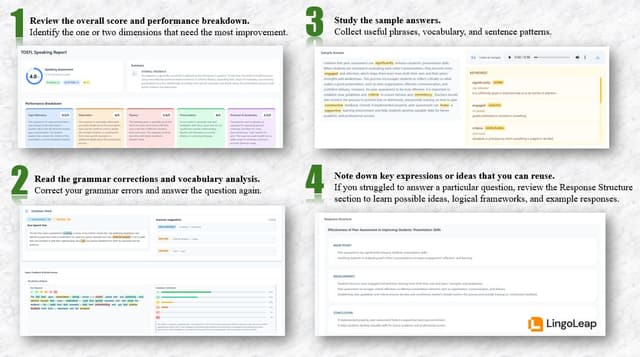
How to review your speaking (interview) task after a mock test
Rather than memorizing model answers, use feedback to develop your own speaking framework and build a library of reusable examples and expressions. This will help you respond more naturally and confidently on test day.
Step 5: Create a Targeted Practice Plan
You can summarize your review with clear, actionable conclusions. For example:
My Reading accuracy drops on inference questions. → I need to practice identifying implied meanings and understanding how conclusions are supported by the passage.
My Listening mistakes mostly came from conversation questions. → I need to focus on conversations during listening practice and pay closer attention to speaker relationships, intentions, and key details.
My Writing lacks supporting examples. → I need to build a library of reusable examples and ideas for common TOEFL topics and practice developing them quickly.
My Speaking delivery needs work. → I need to spend more time practicing pronunciation, pacing, and intonation through repeated speaking drills and shadowing exercises.
Specific observations should lead to specific action items. The goal of review is not simply to identify weaknesses, but to create a clear plan for what to improve before your next practice session.
Then, create a targeted practice plan before taking your next mock test. The goal is not just to practice more, but to practice the right skills based on your review findings.
To help you turn your review insights into an actionable study plan, you can use LingoLeap's TOEFL 2026 Planner Tools:
- TOEFL 2026 Preparation Plan Generator
- DIY Your TOEFL 2026 Preparation Plan
- TOEFL 2026 Daily Preparation Scheduler
- TOEFL 30-Day Pre-Exam Sprint Planner
- TOEFL Section Score Improvement Planner
These tools can help you prioritize weaknesses, allocate study time more effectively, and build a structured preparation plan based on your current level and target score.
Make Every Mock Test Count
Taking a TOEFL mock test is about more than getting a score report. It shows you where you are today, what is holding you back, and what you should focus on next.
The students who improve the fastest are not always the ones who take the most practice tests. They are the ones who learn the most from each one. Review carefully, identify patterns, and let every mock test guide your next stage of preparation.
Ready to put these review strategies into practice? Start your next TOEFL 2026 mock test with LingoLeap and turn every practice session into measurable score improvement.