Complete the Words in TOEFL 2026 Reading: Task Format, Vocabulary, and Scoring
YutingMarch 13, 2026
The 2026 TOEFL Reading section includes several task types that measure different aspects of reading comprehension and language control. Within the reading section, one task that often surprises test takers is Complete the Words.
At first glance, it may look simple. You read a short academic passage, see partially deleted words, and type the missing letters. But in reality, this task is not just a spelling check. It tests how well you can combine vocabulary knowledge, grammar awareness, academic word recognition, and precise spelling under time pressure.
This guide explains what the task looks like, what kinds of words commonly appear, what skills it really measures, and how scoring works.
What is the Complete the Words task?
In Complete the Words, you see a short academic paragraph with several partially hidden words. Your job is to complete the missing letters and restore the full word correctly. This task appears as part of the redesigned 2026 TOEFL Reading section. Each task is typically built around:
- a short academic paragraph
- around 10 blanks
- partially visible words with missing endings or missing later letters
- underscores showing exactly how many letters are missing
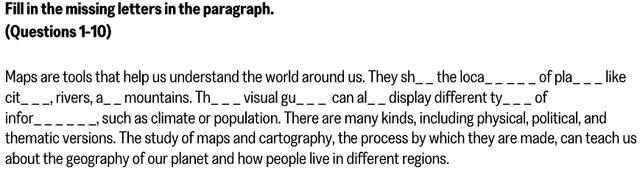
2026 TOEFL Reading Complete the Words Task Example
The task feels different from traditional multiple-choice TOEFL reading questions. You cannot rely on elimination alone. Instead, you need to use the sentence structure, surrounding meaning, visible letters, and exact letter count to reconstruct the word.
Because it is short and fast-paced, many students underestimate it. But small errors can add up quickly.
What is this task really testing?
Many learners describe this as a vocabulary or spelling task, but that is only part of the story. Complete the Words is better understood as a language control task. It checks whether you can process vocabulary in context and produce the exact form required.
1. Academic vocabulary recognition
The passage usually uses academic language rather than casual everyday English. The words are not necessarily obscure, but they are often common in textbooks, lectures, and expository writing. These may include words related to: science, history, environment, society, economics, research processes, etc.That means you need a working knowledge of medium- to high-frequency academic vocabulary.
2. Part of speech awareness
Even if you recognize the word, you can still get the blank wrong if you choose the wrong form. In this task, the challenge is often not the word itself but the version the sentence requires, such as a plural noun, an adverb, or a past-tense verb.
3. Grammatical form control
This is where many mistakes happen. The problem is not always knowing the word itself. It is knowing which version of the word fits the sentence.Common grammar-related checks include:
- singular vs. plural forms
- verb tense
- adjective vs. adverb distinction
- noun formation
- agreement with the subject or surrounding phrase
For that reason, students who rely only on memorized vocabulary lists may still struggle.
4. Accurate spelling
This task requires exact production. If the word is correct in your head but misspelled in your answer, it will still be marked wrong. That is why spelling is not a minor detail here. It is part of the core skill being tested.
What kinds of words commonly appear?
The task does not only test “big academic words.” In fact, it can include a mix of academic vocabulary, grammatical forms, and short function words.
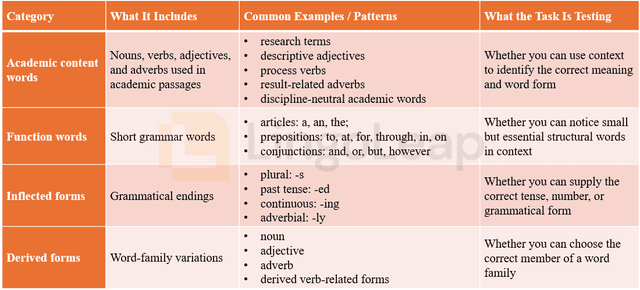
Common Words in the Complete the Words Task TOEFL 2026
Although exact words vary, some patterns appear often enough to be worth noticing.
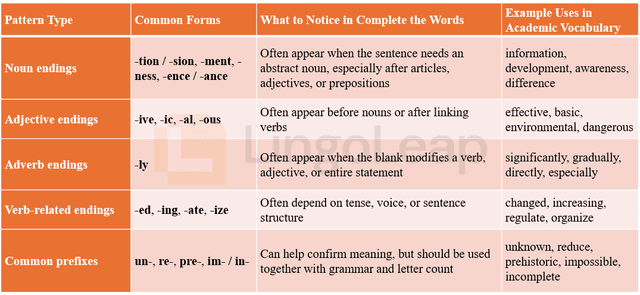
Common Language Patterns in the Complete the Words Task TOEFL 2026
Overall, these examples show that Complete the Words is not simply a vocabulary-recognition task. It also tests word form, grammar fit, and spelling precision, which is why word-family practice matters so much. For a closer look at how to build and practice those patterns, see Prepare for TOEFL Complete the Words: Vocabulary, Spelling, and Word Family Practice.
How is the Complete the Words task scored?
Scoring is straightforward, but strict.
Each blank is scored individually. If your answer is correct, you get the point for that blank. If it is incorrect, you do not.
There is no partial credit. A word that is almost correct but misspelled by one letter does not receive the point. This means:
- spelling must be fully correct
- word form must be correct
- the number of letters must match
- guesses that are semantically close but grammatically wrong will not count
There is also no advantage in leaving a blank empty. If you are unsure, an informed guess is better than no answer.
Why do small mistakes matter so much?
Because the task is broken into many small blanks, one typo may seem trivial. But when several small errors occur in one passage, the score loss can become noticeable.
That is why students preparing for this task should treat it as a precision task, not a rough-meaning task.
You need to train yourself to notice:
- missing plural endings
- missing double letters
- incorrect suffixes
- British vs. American spelling differences
- one-letter omissions
🚩NEXT STEP: Prepare for Complelete the Words Task with LingoLeap
Once you understand what the task is and what it tests, the next step is preparation. That means building the right vocabulary habits, reviewing word families, and practicing spelling in the specific format this task uses.
For a focused breakdown of how to train for it during your daily preparation, you can read Prepare for TOEFL Complete the Words: Vocabulary, Spelling, and Word Family Practice. If you want to move from preparation into test-day execution and strategies, the companion guide 2026 TOEFL Complete the Words: Test Day Tips and Strategies. covers timing and practical strategies.Ready to practice directly?
Try Complete the Words tasks on LingoLeap’s 2026 TOEFL practice platform and build speed with targeted drills in the question bank. Start your free trial today and begin your journey to ace the 2026 TOEFL with LingoLeap.