50+ TOEFL Speaking Prompts and Pro Tips (2025)

Understanding the TOEFL Speaking Section
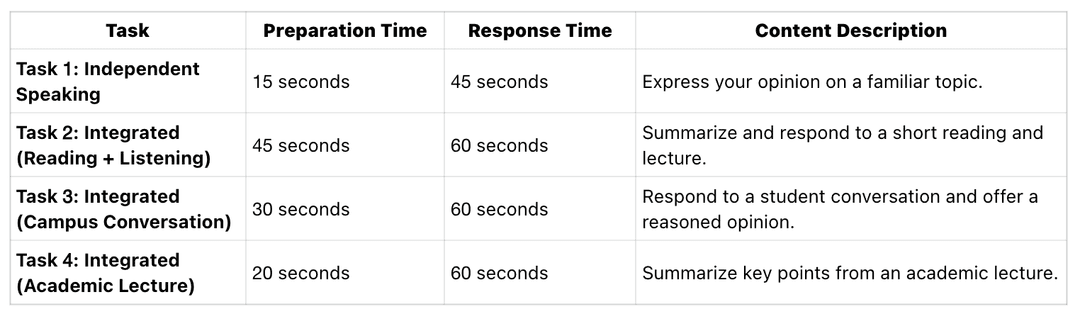
The TOEFL iBT Speaking section assesses your ability to speak English effectively in academic settings. It consists of four tasks: one independent and three integrated.
In this blog, we'll explore over 50 TOEFL speaking prompts, delve into the types of questions you'll encounter, and share expert tips to help you shine on test day.
Here's a breakdown of the TOEFL iBT speaking tasks:
50+ TOEFL Speaking Prompts to Practice
To help you prepare, we've compiled a list of over 50 TOEFL speaking prompts, categorized by task type.
Independent Speaking Prompts:
✏️ Study Preferences
- Do you prefer studying alone or in a group? Why?
- Would you rather attend large lecture-style classes or small discussion-based ones?
- Do you prefer reading paper books or using digital devices like phones and tablets?
👔 School Policies & Student Life
- Should schools eliminate grades and focus on written feedback instead?
- Should college students be required to take classes outside their major?
- Should students be required to wear uniforms? Explain why.
- Should students have a part-time job while attending university?
🏙️ Lifestyle & Environment
- Do you prefer living in a big city or a small town?
- Would you rather work for a large company or start your own business?
🌍 Society & Values
- Do you agree or disagree with the idea that it’s better to be a leader than a follower?
- Do you agree with the idea that "It's more important to be kind than to be honest?" Why or why not?
- Do you agree or disagree with the statement: Success is more about hard work than luck.
- Do you agree or disagree: Friends have a greater influence on teenagers than parents.
🧑🏫 Government & Policy
- Should governments spend more money on healthcare or education?
💬 Technology & Communication
- Do you agree or disagree with the statement: "Technology has made communication better?"
For more practice, check out our TOEFL Independent Speaking Preference Questions 2025.
Integrated Speaking Prompts:
📢 TOEFL Speaking Task 2: Campus Announcement (Conversation + Reading)
You will read a short university announcement, then listen to two students discussing it. Summarize the announcement and how the students feel about it.
Practice 1: Tuition Increase
A university plans to increase tuition fees to improve campus facilities.
Practice 2: Library Hours
The library decides to extend its hours during exam week.
Practice 3: Meal Plan Policy
A new policy requires freshmen to purchase university meal plans.
Practice 4: Daily Homework
The university proposes requiring professors to assign daily homework.
Practice 5: Dorm Renovations
All students in one dormitory will be moved to temporary housing due to renovations.
Practice 6: Online Attendance
A new system will track lecture attendance using online check-ins.
Practice 7: Bus Route Changes
The university is altering its campus shuttle schedule to save costs.
Practice 8: Student ID Upgrades
Students are now required to use upgraded ID cards with tracking chips.
Practice 9: Club Funding Cuts
The administration is reducing funding for student-run clubs.
Practice 10: Guest Lecture Series
A new weekly lecture series featuring guest speakers will be introduced.
Practice 11: Mandatory Chores in Dorms
The dormitory council proposes assigning weekly cleaning duties to residents.
Practice 12: Cell Phone Ban in Classrooms
Instructors are encouraged to ban cell phones during class to improve focus.
Enhance your preparation with our TOEFL Speaking Example Questions for Tasks 2–4.

🏫 TOEFL Speaking Task 3: Academic Lecture (Listening Only)
You will listen to a professor giving a short lecture. Summarize the main ideas and key examples from the lecture.
Practice 1: Photosynthesis
A biology lecture explains the process of photosynthesis in plants.
Practice 2: Price Anchoring
A psychology professor describes the concept of price anchoring in marketing.
Practice 3: French Revolution
A history lecture outlines the economic and political causes of the French Revolution.
Practice 4: Sleep and Memory
A cognitive science professor explains how sleep improves memory consolidation.
Practice 5: Groupthink
A psychology lecture explores the dangers of groupthink in decision-making.
Practice 6: Urban Heat Islands
An environmental science lecture discusses temperature differences in cities vs. rural areas.
Practice 7: Natural Selection
A biology professor elaborates on how natural selection drives evolution.
Practice 8: Opportunity Cost
An economics lecture explains opportunity cost using relatable examples.
Practice 9: Impressionism
An art history professor discusses the techniques used in Impressionist painting.
Practice 10: Classical Conditioning
A lecture explains Pavlov’s classical conditioning and how it applies to modern behavior.
Practice 11: Technology and Creativity
A professor discusses how digital tools have impacted the creative process.
Practice 12: Language Learning Methods
A linguistics lecture compares immersion vs. grammar-based language instruction.
📖 🎧 TOEFL Speaking Task 4: Reading + Lecture
You will read a short academic article, then listen to a professor discussing the same topic. Summarize how the lecture relates to the reading.
Practice 1: Cognitive Dissonance
The article defines the term; the lecture gives modern examples.
Practice 2: Renewable Energy
The reading introduces types of renewable energy; the lecture focuses on solar power challenges.
Practice 3: Evolution and Natural Selection
The reading explains Darwin’s theory; the lecture expands on natural selection.
Practice 4: Mirror Neurons
The reading discusses their discovery; the lecture describes experiments supporting their existence.
Practice 5: Scarcity Principle
The reading introduces scarcity in economics; the lecture uses marketing examples.
Practice 6: Extinction Events
The reading lists historical mass extinctions; the lecture focuses on the asteroid theory.
Practice 7: Social Loafing
The article defines the concept; the lecture gives group project case studies.
Practice 8: The Mozart Effect
The reading claims music boosts intelligence; the lecture critiques the evidence.
Practice 9: Classical Conditioning
The article explains Pavlov’s experiment; the lecture connects it to advertising.
Practice 10: Behavioral Economics
The article defines behavioral economics; the professor applies it to student spending habits.
Practice 11: Artificial Intelligence in Education
The reading outlines the benefits of AI tools; the lecture highlights ethical and practical concerns.
Practice 12: Learning a Second Language
The article describes grammar-focused methods; the lecture advocates for immersion-based approaches.
Expert Tips to Excel in TOEFL Speaking
Practicing with real TOEFL speaking practice questions is just one part of the prep puzzle. Here are five test-proven tips to maximize your speaking score:
- Practice Regularly: Consistent practice helps build confidence and fluency.
- Record Yourself: Listening to your responses can help identify areas for improvement.
- Use a Timer: Simulate test conditions to improve time management.
- Expand Your Vocabulary: A rich vocabulary allows for more precise and varied responses.
- Stay Calm and Focused: Maintain composure to think clearly and articulate your thoughts.
Read this blog to dive into more detailed study tips to boost your TOEFL speaking score!
Conclusion
With a wide variety of TOEFL speaking practice questions, categorized prompts, and expert strategies, you’ll be ready to speak with confidence and clarity on test day. And remember—speaking well isn’t about sounding perfect. It’s about sounding prepared.
Ready to take your preparation to the next level?
Start your free trial at LingoLeap today! Our platform offers interactive practice questions, real-time feedback, and personalized study plans to help you succeed.