Does naming a classmate help your Academic Discussion score?
Every TOEFL Academic Discussion prompt includes two classmates' posts. We checked how often answers name them, and how those answers score.
Helen He, CEO, LingoLeap · Published 26 Sep 2026 · 3,692 scored answers, retrieved 26 Sep 2026
The finding
47.3% of answers name a classmate. They score 0.67 points higher on 0-30.
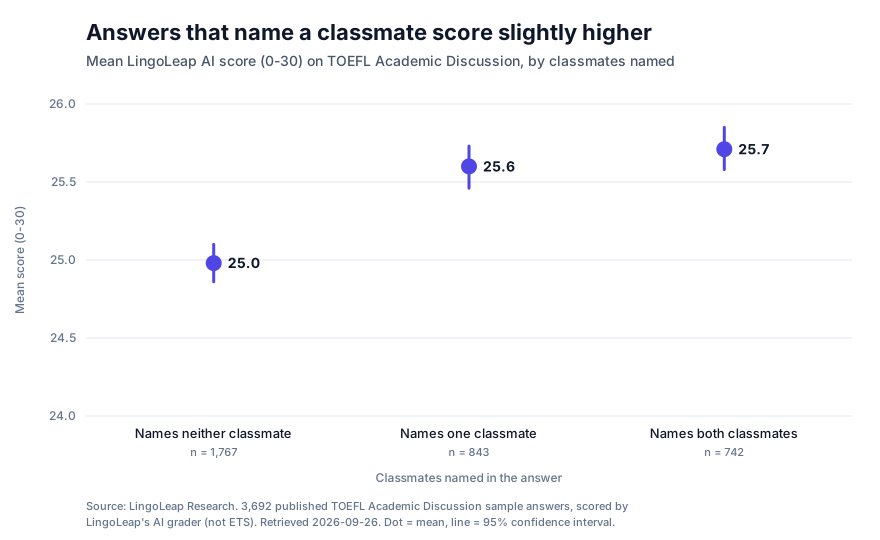
Of 3,352 answers, 1,585 name at least one of the two classmates in the prompt and 742 (22.1%) name both. Answers that name a classmate average 25.65 of 30; answers that name neither average 24.98: a difference of +0.67 (95% CI +0.52 to +0.83).
That is a small difference, under one point on a 30-point scale. It holds after accounting for length (+0.66, standard error 0.08), and comparing answers to the same prompt gives +0.45 (95% CI +0.23 to +0.66).
Read this before quoting it
These are LingoLeap AI scores on published sample answers, not ETS scores and not all test-takers.
Every score here comes from LingoLeap's own rubric-trained AI grader, which reports an estimated 0–30 score and three 0–5 rubric sub-scores. Nothing here was scored by ETS, and nothing here tests how ETS's own scoring works. The answers are the sample answers LingoLeap publishes, which average 25.2 of 30: a stronger-than-typical group, so the spread of scores is narrow. The data is observational: it shows which answers score higher, not what would happen if you changed yours.
Naming a classmate may be a marker of a writer who engages with the discussion, rather than something that raises a score by itself. Adding a name to an answer that does not respond to that classmate's point is not what this data measured.
Score by classmates named
Prep advice routinely tells test-takers to “engage with the other students”. In these answers, fewer than half do it by name. Among answers scoring 28 or more, 50.0% name a classmate (n = 424); among answers scoring 24 or less, 35.1% do (n = 783).
Embed this chart
Paste this HTML into your page. It is a static image with a credit link: no script, no iframe.
<figure style="margin:0;max-width:880px">
  <img src="https://lingoleap.ai/research/charts/academic-discussion-classmates.svg" alt="Score by classmates named" width="880" height="540" style="max-width:100%;height:auto" loading="lazy">
  <figcaption>Source: <a href="https://lingoleap.ai/research/academic-discussion-classmates">LingoLeap, Does Naming a Classmate Help on TOEFL Academic Discussion?</a></figcaption>
</figure>
| Answer | Answers | Share | Mean score (0-30) | 95% CI | Mean words |
|---|---|---|---|---|---|
| Names neither classmate | 1,767 | 52.7% | 24.98 | 24.86-25.10 | 158 |
| Names one classmate | 843 | 25.1% | 25.60 | 25.46-25.73 | 154 |
| Names both classmates | 742 | 22.1% | 25.71 | 25.58-25.85 | 162 |
Which sub-score moves
If naming a classmate mattered only because it shows you are joining the discussion, the gap should sit in Relevance & Contribution to Discussion alone. It does not: Relevance and Clarity move by about the same amount, and Language Use by a little less. That fits the reading that writers who name classmates are somewhat stronger writers overall, not that the name itself is being rewarded.
| Sub-score (0-5) | Names a classmate | Names neither | Difference | 95% CI | Length-adjusted |
|---|---|---|---|---|---|
| Relevance & Contribution | 4.47 | 4.35 | +0.127 | +0.101 to +0.154 | +0.124 |
| Clarity & Elaboration | 3.97 | 3.85 | +0.121 | +0.095 to +0.148 | +0.118 |
| Language Use & Grammar | 3.83 | 3.75 | +0.082 | +0.053 to +0.111 | +0.080 |
Checks
Is it just length?
Answers that name a classmate average 158 words, against 158 for answers that do not. With length held constant in a regression, the difference is +0.66 (standard error 0.08).
Is it just easier prompts?
Comparing only answers to the same prompt, across 233 prompts that have both kinds of answer (2,037 answers), the difference is +0.45 (95% CI +0.23 to +0.66, bootstrapped over prompts).
Does the matcher work?
A classmate counts as named when their first name, exactly as the prompt spells it and capitalised, appears as a whole word in the answer (a possessive such as “Claire's” counts). The matcher was checked against a known positive (“I agree with Claire's point”, matched) and two known negatives (a lower-case “claire” and “Paulina” for Paul, neither matched).
Methodology
- Sample
- Every non-legacy TOEFL Academic Discussion task in LingoLeap's sample library, and the first 20 published sample answers for each: 3,729 sample pages. After exclusions, 3,692 answers across 1,467 tasks (mean score 25.17, SD 2.42; median length 154 words). These are real learner answers that LingoLeap publishes as samples, not every answer ever submitted.
- Period
- Retrieved 26 Sep 2026. The endpoint does not expose when an answer was written, so submission dates are not recorded.
- Source
- LingoLeap's public sample endpoint (the same data the sample pages show), read at no more than two requests a second: 3,723 of 3,729 pages returned a record.
- How scores were produced
- LingoLeap's AI estimate on the 0-30 scale and three rubric sub-scores on 0-5 (Relevance and Contribution to Discussion; Clarity and Elaboration of Viewpoint; Language Use and Grammar), parsed from the grader's report. Not ETS scores, and not on the 1-6 band scale ETS reports for tests from 21 January 2026.
- Exclusions
- 13 records with no answer text and 8 grader failures (overall 0 with every sub-score 0). Any group smaller than 30 answers is not reported.
- Limitations
- Observational: naming a classmate may mark a writer who engages with the discussion rather than raise a score by itself. Published samples average 25.2 of 30, a stronger-than-typical group. LingoLeap AI scores, not ETS.
- Privacy
- Only aggregates are published. No answer text, names, or individual scores appear on this page or in the download.
- Who counts as a classmate
- The two student posts in each prompt, read from the prompt itself. 340 answers whose prompt did not carry two named students are left out of this study, leaving 3,352.
Reproduce it
Every figure on this page is produced by scripts/academic-discussion-findings.py in LingoLeap's website repository, which re-reads the public sample pages and reprints each number. The aggregate table is in the Data section below (CC BY 4.0).
What this does not show
- 1
Not ETS
The scores come from LingoLeap's AI grader. Nothing here tests how ETS's raters treat references to classmates.
- 2
Not causal
Nobody was assigned to name a classmate. Writers who name classmates may differ in other ways the length and same-prompt checks do not capture.
- 3
Naming is not engaging
The study detects a name, not whether the answer responds to that student's argument. A name dropped into an unrelated answer is not what was measured.
- 4
Not every learner
The answers are LingoLeap's published samples, which average 25.2 of 30. The share naming a classmate may differ among all test-takers.
Data
The aggregate tables behind this study, as CSV files.
- Score by classmates namedacademic-discussion-classmates.csv
- Teacher handout (PDF)One page, A4 and Letter: three findings, a classroom drill and the method caveat.
Licence: Aggregate numbers only, under CC BY 4.0: reuse them with credit to LingoLeap and a link to this page. No learner answers, recordings or individual scores are published.
How to cite
APA 7
He, H. (2026, September 26). Does naming a classmate help on TOEFL Academic Discussion? (Version 1.0). LingoLeap. https://lingoleap.ai/research/academic-discussion-classmates
MLA 9
He, Helen. “Does Naming a Classmate Help on TOEFL Academic Discussion?” LingoLeap, 26 Sept. 2026, lingoleap.ai/research/academic-discussion-classmates.
Version 1.0 · Published 26 Sep 2026 · DOI: not yet assigned · Licence: CC BY 4.0
FAQ
Should I mention the other students by name in TOEFL Academic Discussion?
Does naming both classmates help more than naming one?
Is this how ETS scores the test?
Can I reuse the data?
Practise responding to the discussion
Write an Academic Discussion answer and see how the Relevance & Contribution sub-score treats it.
Practise Academic Discussion