2026 New TOEFL Speaking Rubrics Explained: How ETS Scores Listen and Repeat & Interview Task
YutingJanuary 25, 2026

Compared to the old TOEFL, the 2026 new TOEFL has been changed to place greater emphasis on how English is used in real-time academic and everyday communication, rather than how well test-takers perform rehearsed test formats. It also shifts from the traditional 0–30 section scores to a new 1–6 band scores that align with the CEFR system.
Specifically, the Speaking Section in TOEFL 2026 does not reward polished speeches or memorized responses. Instead, ETS evaluates whether a response is intelligible, relevant, and effective for the speaking task at hand.
This article explains ETS’s official Speaking rubrics for the Listen and Repeat and Take an Interview tasks, and highlights several rubric-driven insights that directly affect scoring.
Official TOEFL Speaking Rubrics (2026 Updated)
1. Rubric for "Listen and Repeat"
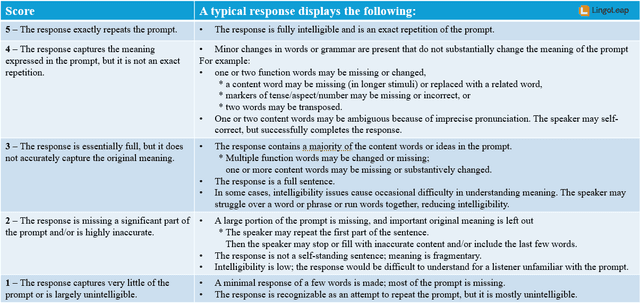
The Listen and Repeat task measures a test-taker’s ability to accurately reproduce spoken language after a single exposure, focusing on short-term recall and intelligibility rather than spontaneous speech.
1.1 Key rubric dimensions include
- Accuracy of Repetition: How faithfully the response reflects the original wording and meaning.
- Intelligibility: Whether the repeated sentence can be understood by a listener unfamiliar with the prompt.
- Pronunciation and Delivery: Clarity of speech, including stress and pacing, without requiring a native-like accent.
At the top score level, responses repeat the prompt exactly and clearly, with all essential content preserved speaking-rubrics
1.2 How this shows up in scored performances
High-band responses maintain meaning even when minor pronunciation variation is present. Scores drop when content words are missing, altered, or reordered in ways that make the sentence harder to understand.The rubric explicitly distinguishes between:
- Small surface-level deviations that do not affect meaning
- Errors that reduce intelligibility or fragment the sentence
In other words, accuracy is judged by listener comprehension, not by accent or expressiveness.
1.3 How to Get a High Score in the "Listen and Repeat" Task
- Aim for faithful reproduction, not rephrasing. The task rewards precision, not interpretation or stylistic variation.
- Strengthen one-time auditory recall. Practicing short audio segments under single-listen conditions improves performance. Try "Shadowing" practice to improve your short-term memory and repeating ability.
- Practice real TOEFL-style questions Listen & Repeat questions on LingoLeap and get feedback focused on intelligibility and accuracy.
2. Rubric for "Take an Interview"
The Take an Interview task evaluates how effectively a test-taker can respond spontaneously and meaningfully to spoken questions in an interview-style interaction.
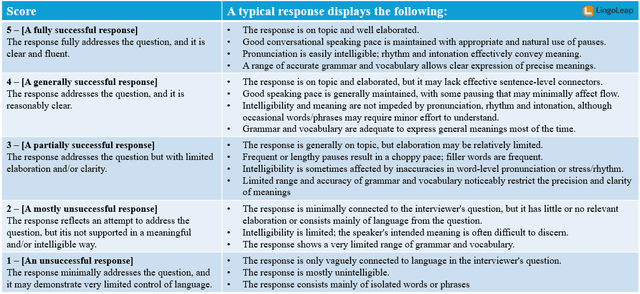
2.1 Key rubric dimensions include
- Task Fulfillment: Whether the response directly addresses the interviewer’s question.
- Elaboration and Support: How clearly ideas are explained and developed.
- Fluency and Pace: Smoothness of delivery, including appropriate pausing.
- Language Control: Range and accuracy of grammar and vocabulary used to convey meaning.
2.2 How raters interpret interview responses
ETS does not score based on how much you say, but on how effectively you communicate. Strong responses:
- Stay focused on the question
- Develop one or two ideas clearly
- Maintain intelligibility throughout the response
Frequent fillers, excessive pauses, or vague phrasing increase the listener’s effort and reduce score potential, even when the topic is addressed.
2.3 How to Get a High Score in the "Take an Interview" Task
- Make your message easy for the listener to follow. Controlled delivery and clear connections score higher than ambitious but unstable language.
- Develop one idea fully instead of listing many. The rubrics reward coherence and clear support, not the number of ideas you mention. Preparing a few reusable topics or personal stories in advance can be helpful, and examples or light templates for 2026 TOEFL interview tasks still have value when they are used flexibly and adapted to the question.
- Practice with interview-style prompts and get rubric-based feedback with LingoLeap. LingoLeap's new speaking practice and assessment helps align fluency, pacing, and relevance with official scoring expectations.
How ETS Actually Scores TOEFL Speaking
1. AI Scoring with Human Oversight
TOEFL Speaking responses are evaluated using ETS’s automated scoring system, supported by advanced speech analysis and NLP technologies. Human raters continuously monitor and calibrate the system to ensure reliability and fairness.
For Speaking, scoring centers on listener-oriented criteria: how understandable the response is, how smoothly it is delivered, and how effectively it addresses the task. Accent, personality, or stylistic flair are not scoring targets.
Practice platforms such as Lingoleap.ai adopt a similar evaluation logic, offering feedback that reflects official Speaking rubrics rather than generic pronunciation checks.
2. Score Consistency Across Test Versions
ETS applies standardized linking procedures so that Speaking scores reflect the same proficiency level across different test dates and prompt versions. While tasks may change, rubric standards remain stable, making familiarity with scoring criteria essential for predictable improvement.
Next Step: Practice with the Rubric in Mind
Once you understand how TOEFL iBT 2026 Speaking is evaluated, preparation becomes more focused and efficient.Instead of practicing blindly, align your training with the rubric:
- Practice Listen & Repeat to improve accuracy and intelligibility
- Try TOEFL Interview practice to refine fluency and development
- Explore the TOEFL Speaking Questions bankto simulate real task conditions
For more personalized feedback, LingoLeap provides task-specific Speaking practice with AI-powered evaluations aligned to official TOEFL rubrics—helping you identify exactly which scoring dimensions need improvement and why.