TOEFL 2026 · Mock Test Hub
TOEFL 2026 Online Mock Test
A TOEFL 2026 mock test is a timed practice test that simulates the real TOEFL 2026 iBT format, question types, and test-day pacing. Lingoleap's TOEFL 2026 mock test platform helps self-study students sit a full-length practice run under exam-like conditions, then review an AI-powered score report that breaks down each section's band score with task-type interpretation — and, for Speaking and Writing, model rewrites plus concrete improvement suggestions. Practice feedback only — only ETS issues official TOEFL scores.
By Erin, LingoLeap Content & SEO Specialist · Reviewed by the LingoLeap TOEFL Content Team · Last reviewed:
What Is a TOEFL Mock Test?
“Mock test” is the umbrella, but Lingoleap actually offers three different practice formats — each suited to a different stage of prep. Pick the one that matches where you are this week.
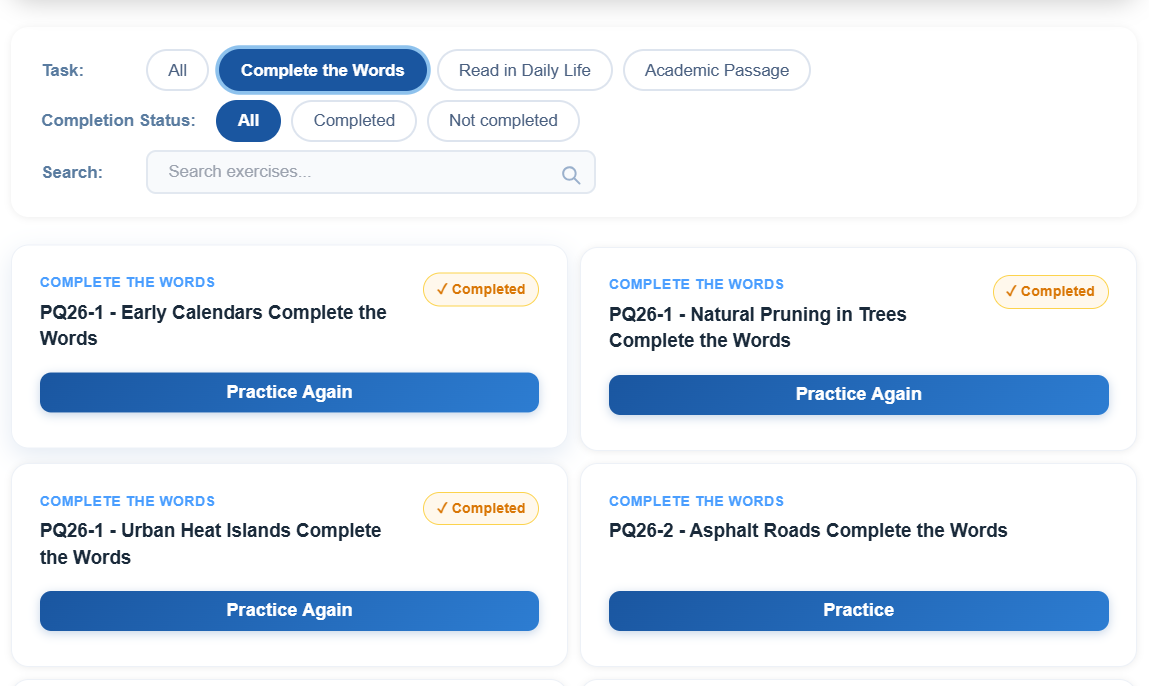
Targeted question-type practice
Drill one specific task type at a time — Complete the Words, Build a Sentence, Listen and Repeat, Take an Interview. Designed to patch a single weak spot rather than measure the whole exam.
Best for: Best when you know which task type costs you the most points and want a focused 20-minute fix.
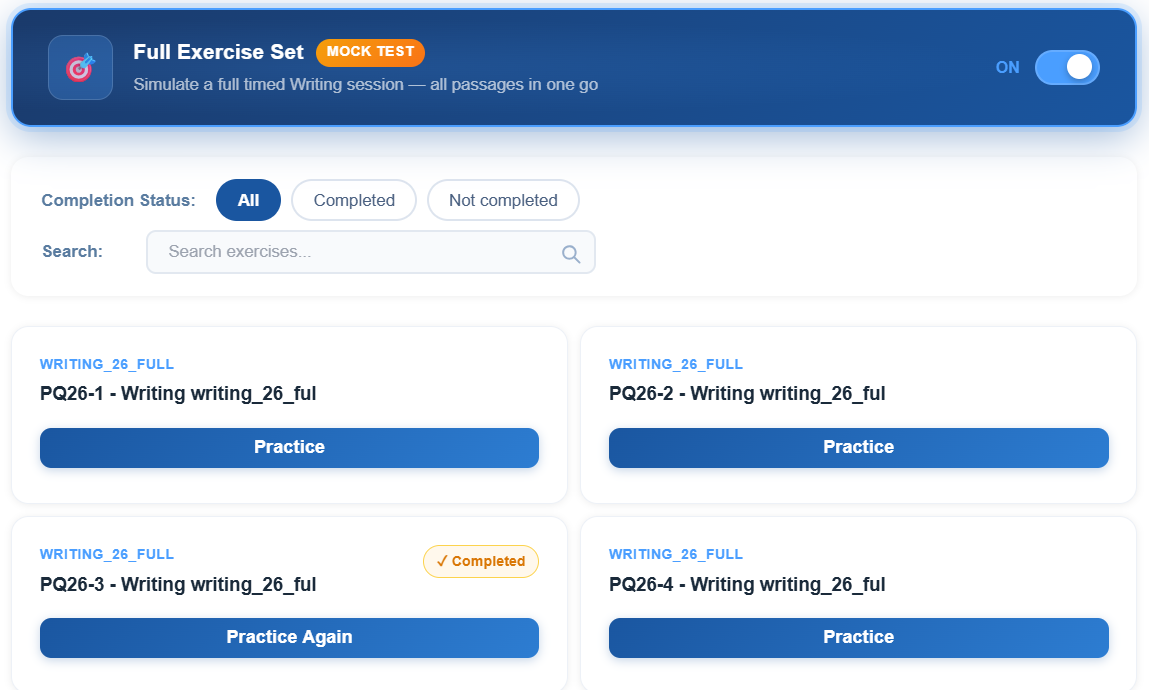
TOEFL section-based practice test
Sit one full section end-to-end under the real 2026 timing — all Reading items, all Listening items, all Writing tasks, or all Speaking tasks in one timed run, scored on the 1–6 band.
Best for: Best when you want to test one section thoroughly without committing to the full two-hour exam window.
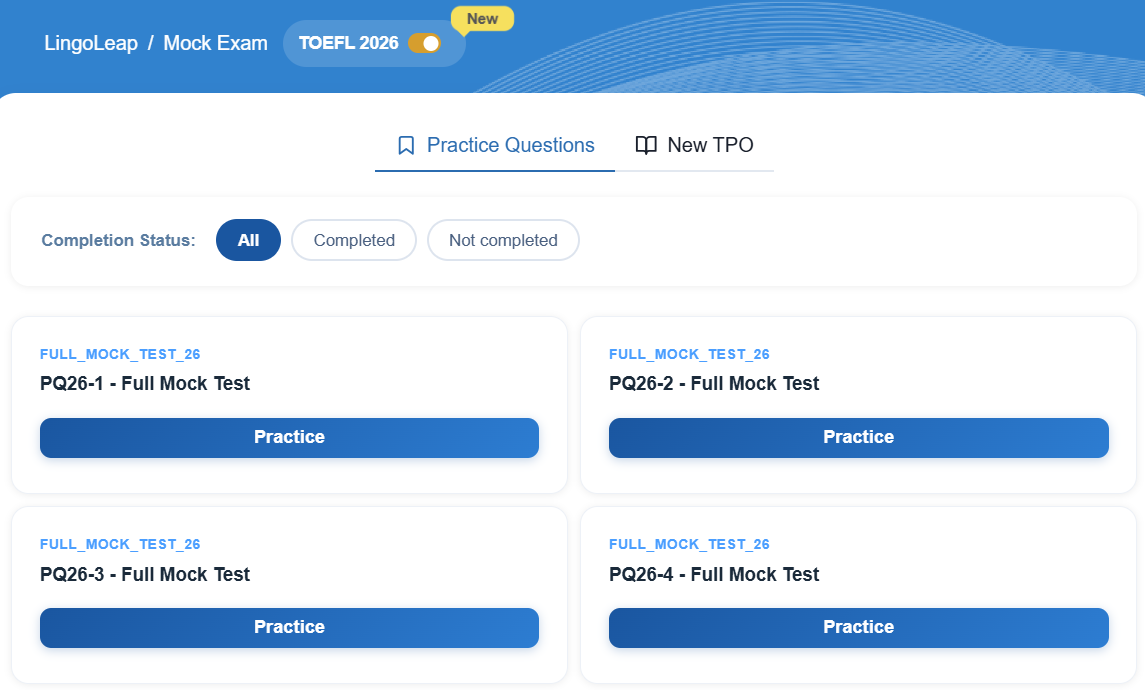
Full TOEFL mock test
The complete 2026 iBT in one sitting: Reading → Listening → Writing → Speaking, no formal break, 2-stage adaptive routing in Reading and Listening, all six task types in Writing and Speaking. Produces a full section-by-section practice score report.
Best for: Best when you want a realistic readiness check — pacing, stamina, and AI-scored Speaking/Writing feedback in one go.
Curious which dimensions make a mock test feel close to the real exam? See what makes a TOEFL mock test realistic — the realism checklist breaks it down into five concrete dimensions of the 2026 iBT.
Why Take a TOEFL Mock Test?
Different learners use mock tests for different reasons. The format that works for a sprint-phase test taker is rarely the right fit for a busy learner with weeks of runway. Three common profiles:
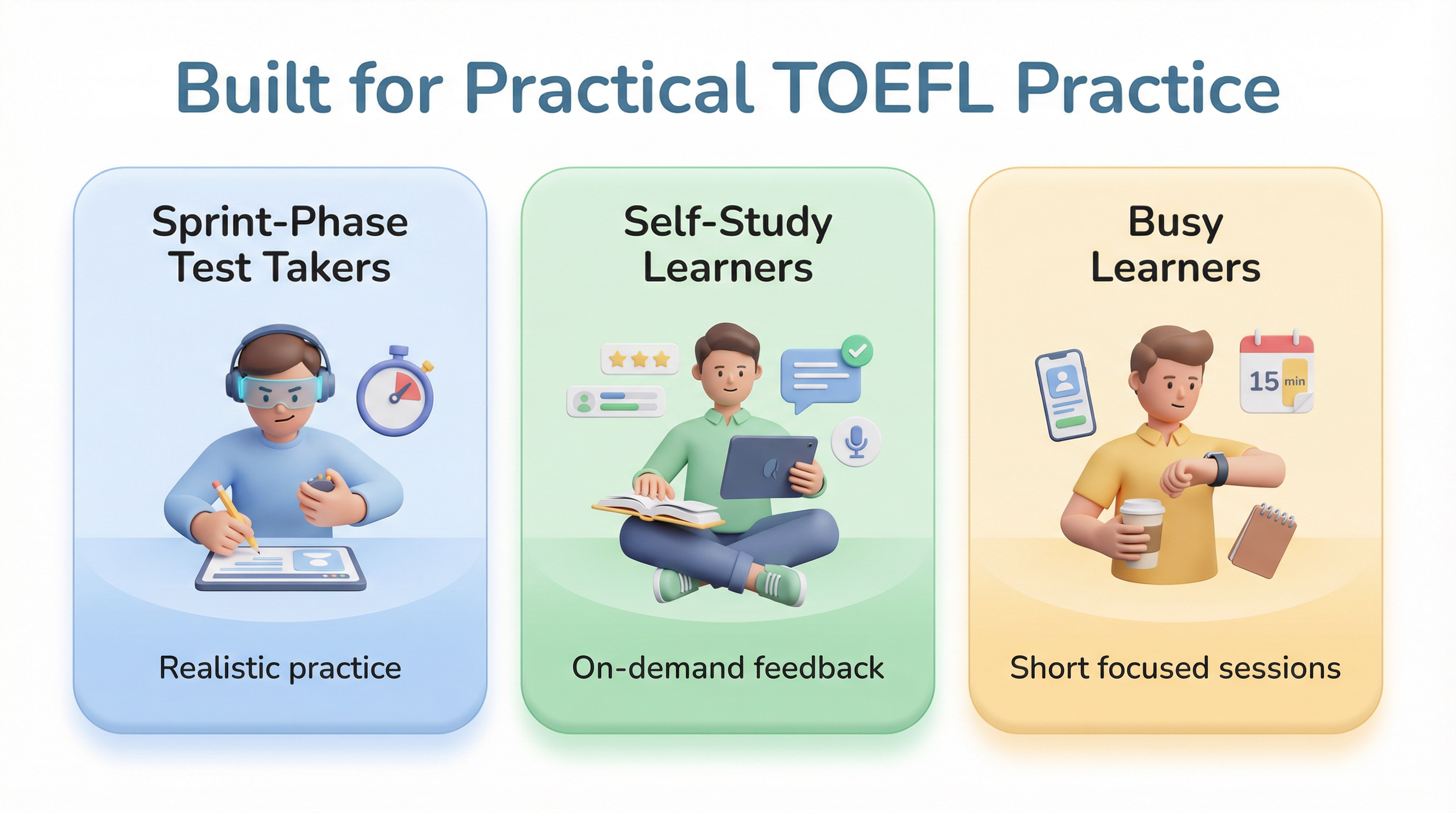
Sprint-Phase Test Takers
You have a test date inside 30 days and need a defensible readiness check. A full TOEFL mock test gives you pacing under the real 2026 windows, a section-level 1–6 band, and a punch list of weak task types for the final sprint.
How to use it: Use a full mock 5–7 days before test day as your dress rehearsal.
Self-Study Learners
No tutor to grade Speaking and Writing. AI-scored Take an Interview, Write an Email, and Write for an Academic Discussion give you structured feedback on fluency, organisation, grammar, and communication — the same qualities ETS lists for these AI-scored tasks.
How to use it: Take one mock every 2–3 weeks; in between, drill the AI-scored tasks the feedback flags.
Busy Learners
Two hours in one block is hard. Use targeted question-type and section-based practice on weekdays, then a full mock on the weekend. The mock surfaces whether the short sessions are actually building exam-day stamina.
How to use it: Mix targeted practice on weekdays with one section-based or full mock on the weekend.
Full-Length TOEFL 2026 Mock Test Experience
A full-length Lingoleap mock test mirrors the 2026 TOEFL iBT order, timing windows, item counts, and 2-stage adaptive routing. The section order is Reading → Listening → Writing → Speaking, run as a single continuous session with no formal mid-test break. Below is the section-by-section flow you sit through.
| Section | Duration | What you do |
|---|---|---|
| Reading | ~27–30 min | 50 items across 3 task types — Complete the Words, Read in Daily Life, Read an Academic Passage. 2-stage adaptive: a router module routes you into a lower or upper Stage 2 module. |
| Listening | ~25–29 min | 47 items across 4 task types — Listen and Choose a Response, Listen to a Conversation, Listen to an Announcement, Listen to an Academic Talk. 2-stage adaptive, same router/module design as Reading. |
| Writing | 23 min | 12 items across 3 task types — Build a Sentence (10 items, scored against an answer key), Write an Email (AI-scored), Write for an Academic Discussion (AI-scored). Linear. |
| Speaking | 8 min | 11 items across 2 task types — Listen and Repeat (7 items, AI-scored against the target sentence) and Take an Interview (4 items, AI-scored). Linear. |
Timing, item counts, and task types follow the April 2026 ETS TOEFL iBT Test Blueprint. Working test time is roughly 1 hr 23 min – 1 hr 29 min; total appointment time is about two hours once instructions and transitions are included.
AI Feedback After the Test
Lingoleap pairs the mock-test report with section-level AI feedback. The goal is not to replace a human tutor — it is to give you a structured, immediate read on Speaking and Writing the day you finish the test, so the review loop closes within hours instead of weeks.
Reading
Every Reading item is auto-graded against the reference answer, scored, and explained — with the original passage shown alongside the feedback so you can re-read it in context.
- →Auto-graded against the reference answer, with per-item correctness and per-task-type accuracy.
- →The original passage is re-displayed in the feedback view, so you can re-read the source text while reviewing each question.
- →A short explanation for every question — why the correct option is correct and why each distractor fails.
Listening
Listening items are auto-graded against the reference answer, scored, and explained — and you can replay the original audio clip directly inside the feedback view.
- →Auto-graded by task type — Listen and Choose a Response, Conversation, Announcement, Academic Talk.
- →Replay the original Listening audio directly in the feedback view, so you can re-listen to the whole clip while reviewing your answers.
- →A short explanation for every question, including the key phrase or detail that decided the answer.
Writing
Writing responses are scored against the 2026 rubric, then analysed for sentence variety, vocabulary range, grammar, and structure — with edits and an article-framework mindmap.
- →Scored against the 2026 Writing rubric — task response, organisation, language use.
- →Sentence-by-sentence analysis: sentence-pattern variety, vocabulary range, grammar corrections, and rewritten model sentences.
- →An article-framework mindmap that summarises a clean structure for your response — the version a higher-band answer would have used.
Speaking
Speaking responses are scored against the 2026 rubric, then analysed for delivery, language use, and structure — with a sample answer and an end-to-end response framework.
- →Scored against the 2026 Speaking rubric — delivery, language use, topic development.
- →Analysis of your sentence patterns and vocabulary range, with grammar corrections on the transcript.
- →A sample answer plus a response framework that maps how to organise the full answer to the question type.
Want the deep dive for each section? Reading, Listening, Writing, and Speaking each have a dedicated guide covering task types, rubric, and practice paths.
AI feedback is a learning reference. The official ETS rubric is the only basis for an admissions-grade score.
Sample TOEFL 2026 Mock Test Score Report
Below is a sample of the feedback and score report you receive after a full Lingoleap TOEFL mock test set — the same Overview, Reading, Listening, Writing, and Speaking tabs you will see in-product, populated with numbers from a recent PQ26-8 attempt to show what the report looks like end-to-end.
Estimated Scores
? How scoring worksOverall Score
5.0
Band Score
95 / 120
Reading
5.0
Band Score
23 / 30
Listening
4.5
Band Score
21 / 30
Writing
5.5
Band Score
27 / 30
Speaking
5.0
Band Score
24 / 30
Score Ranges
| Task type | Items | Correct | Accuracy |
|---|---|---|---|
| Complete the Words | 20 | 15 | 75% |
| Read in Daily Life | 5 | 5 | 100% |
| Read an Academic Passage | 10 | 5 | 50% |
| Task type | Items | Correct | Accuracy |
|---|---|---|---|
| Listen and Choose a Response | 15 | 11 | 73% |
| Listen to a Conversation | 10 | 7 | 70% |
| Listen to an Announcement | 8 | 5 | 63% |
| Listen to an Academic Talk | 12 | 7 | 58% |
| Task type | Items | Score | AI notes |
|---|---|---|---|
| Build a Sentence | 10 | 9 / 10 | — |
| Write an Email | 1 | 4.5 / 5 | The student's email is highly effec… |
| Write for an Academic Discussion | 1 | 4.5 / 5 | The student's response is well-stru… |
| Task type | Items | Score | AI notes |
|---|---|---|---|
| Listen and Repeat | 7 | 29 / 35 | The response is very close to the o… |
| Take an Interview | 4 | 14.5 / 20 | The response is generally successf… |
How to read the overall band
Overall 5.0 = strong B2/C1 (Effective Operational). The 95/120 number is a traditional-scale equivalent shown for reference — universities that still publish 0–120 minimums will compare against that figure until they update to the 1–6 scale. For the full mapping, use the TOEFL Score Converter.
Where to focus next
Listening Academic Talk (58%) and Reading Academic Passage (50%) are the two lowest accuracy cells — both academic-language tasks. Two weeks of timed academic-passage and lecture drills will move those bands faster than another full mock.
Writing & Speaking notes
Build a Sentence is scored right or wrong against the accepted answers, with no model involved. Listen and Repeat is transcribed, measured for pronunciation and fluency, then scored 0–5 by a model against the target sentence. Write an Email, Write for an Academic Discussion, and Take an Interview are AI-scored — click each AI-notes row to expand the full evaluation, including a model rewrite and a concrete suggestion for the next attempt. The full pipeline is on how it works.
Practice scoring boundary
All numbers here are a Lingoleap practice band, calibrated for learning reference. Official TOEFL scores come from ETS only — Lingoleap is independent and not affiliated with ETS.
Illustrative recreation of the Lingoleap mock-test report. Your actual report uses your own response data.
What To Do After a TOEFL Mock Test?
A mock-test score that you do not review is worth less than a single targeted drill. Follow these four steps the day you finish the test.
1. Read the section summary, not the total
The total band tells you where you are. The section-level breakdown tells you what to fix. Start with the section that lost the most points relative to your target.
2. Tag two weak task types
Inside the weakest section, pick the two task types where you missed the most points — e.g. Read an Academic Passage on Reading, or Take an Interview on Speaking. Those become the focus for the next two weeks.
3. Re-record one Take an Interview and rewrite one Academic Discussion response
Take the lowest-scoring Take an Interview response and re-record it after reading the AI feedback. Do the same with one Write for an Academic Discussion response. This single rep on the two AI-scored tasks teaches you more than another full mock test.
4. Schedule the next mock 2–3 weeks out
Lock the next mock test date now. Between mocks, the time is for targeted drills tied to the two task types you tagged, not for another full simulation.
To see what the report looks like before you sit one, read the sample mock test score report, and for the mechanics of a sitting — timing, adaptive modules, what is scored when — see how the TOEFL mock test works.
Need a step-by-step template for the post-mock review itself? See the TOEFL Review Guide — it walks through the exact error log, re-answer, and weak-pattern tagging workflow. To automate the mock + drill cadence, use the TOEFL Preparation Plan Generator to lay out the weeks between mocks.
Take Your Next TOEFL 2026 Mock Test
Time the full 2026 sequence — Reading → Listening → Writing → Speaking, no formal break — then review your practice score report and AI-powered Speaking and Writing feedback the same day.
Start a TOEFL Mock TestTOEFL 2026 Mock Test FAQ
What is a TOEFL mock test?
How long does a full-length TOEFL mock test take?
Does Lingoleap give an official TOEFL score?
What feedback do you get after a Lingoleap TOEFL mock test?
How often should you take TOEFL mock tests?
Can I take a TOEFL mock test at home?
What is the difference between a TOEFL mock test with scores and one with feedback?
Related Mock Test Resources
Realistic Online TOEFL 2026 Mock Test
What separates a realistic mock test from random TOEFL practice — checklist and review.
TOEFL Preparation Plan Generator
Schedule mock tests and the targeted drills that go between them.
TOEFL Score Calculator
Estimate your overall 2026 band score from section scores.
TOEFL 2026 Format Guide
The full task-by-task breakdown of the post-2026 TOEFL iBT.