The Complete Guide to 2026 TOEFL Changes: New Question Types, Adaptive System, Unscored Tryout Questions, and CEFR Alignment
Starting January 21, 2026, the TOEFL iBT will undergo its most significant update in more than a decade. The exam will introduce new task types, a redesigned test structure, an adaptive mechanism for Reading and Listening, and a fully CEFR-aligned scoring system. These changes reflect ETS’s goal of making the TOEFL more practical, efficient, and representative of real academic and everyday communication.
This article breaks down the reform in four clear sections to help you understand exactly what is changing and how it impacts your preparation.
Changes to Question Types in TOEFL 2026
The 2026 TOEFL introduces updated tasks across all four sections. Overall, the exam becomes more concise, more interactive, and more aligned with real-life communication.
Reading
The Reading section now includes three distinct task types, each focusing on different aspects.

Key Changes:
- Introduction of "Complete the Words" tasks: requires completing missing word segments in an academic paragraph; heavily tests vocabulary depth, word formation, and grammatical accuracy.
- Introduction of "Daily Life" passages: based on real-world sources such as notices, emails, instructions, and course descriptions.
- Reduced academic reading load: academic passages are shorter but still evaluate core comprehension skills.
Preparation Strategies:
- Strengthenknowledge of vocabulary morphology (roots, affixes, word families) to perform well "Complete the Words" tasks.
- Practice scanning short, practical texts to improve speed and accuracy for "Daily Life" passages.
- Build wide reading exposure rather than relying only on old TOEFL TPO sets, as the new exam emphasizes real-life comprehension.
Listening
The Listening section contains four task types:
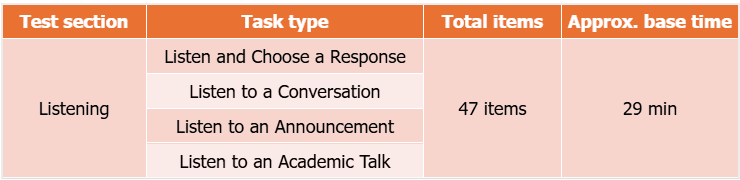
Key Changes:
- More diverse listening sources: including short conversations, announcements, academic lectures, and a main comprehension task.
- Greater emphasis on everyday and campus-based listening scenarios rather than long academic lectures alone.
- Increase in short audio segments, requiring quick information capture rather than long-span note-taking.
Preparation Strategies:
- Practice real-world listening materials such as campus announcements, short dialogues, and informational audio.
- Train short-segment listening skills: focus on extracting names, details, conditions, and specific actions quickly.
- Do not rely solely on lecture-heavy listening practice, as the new TOEFL rewards proficiency with everyday communication.
- Develop quick, concise, structured note-taking techniques for announcements and conversations.
Writing
The new Writing section emphasizes concise, purpose-driven writing.

Key Changes:
- Old Integrated and Independent essays have been removed, replaced by two short, purpose-driven tasks:
- Email Writing (recommended ~60 words)
- Academic Writing (recommended ~100 words)
- A new "Build a Sentence" task (10 items) evaluates grammar accuracy and precise expression.
- Heavy emphasis on clarity, precision, and task completion rather than long-form essay structure.
Preparation Strategies:
- Practice writing concise, accurate sentences and short paragraphs, minimizing complex structures that can introduce errors. Use simple, clean structures to ensure maximum clarity.
- Build a bank of academic function phrases (e.g., “to summarize,” “to provide reasons,” “to request clarification”).
- Learn appropriate email tone and format, with attention to politeness and clarity.
Speaking
The Speaking section now includes only two tasks that are designed to mimic natural communication:

Key Changes:
- More authentic, conversational focus, closer to real academic and social communication.
- Scoring emphasizes naturalness, clarity, and communicative effectiveness rather than rigid structure.
Preparation Strategies:
- Develop accurate and clear repeat skills: Use shadowing exercises to improve your accuracy and sentence precision
- Train interview-style speaking with natural tone, clear reasoning, and personal examples.
- Use simple, well-organized sentences connected by basic linking words (first, then, because, so).
- Personalized responses—avoid overly templated patterns.
The New Adaptive System for TOEFL 2026
The 2026 TOEFL introduces a two-stage adaptive system during the Reading and Listening section. Your Stage 1 performance determines the difficulty level and content of Stage 2. This structure helps ETS more accurately measure ability in less time.
How the System Works
The following observation of adaptive routing such as the amount of items are derived from structural analysis of ETS’s currently available practice tests. ETS has not publicly disclosed a complete or fixed routing algorithm, nor confirmed specific cut-off thresholds. Therefore, the routing framework discussed here should be understood as a preparation-oriented reference model, designed to help test-takers prioritize accuracy and consistency, rather than as an official or definitive scoring rule.
Take the Reading section as an example:
Stage 1 Reading always includes 20 Fixed Questions:
- 10 "Complete the Words" items
- 5 "Read in Daily Life" questions
- 5 "Read an Academic Passage" questions
Your accuracy in Stage 1 determines which Level you enter next:
- ≥ 60% correct (12+ items): You enter Upper level
- < 60% correct (12- items): You enter Lower level
Stage 2 Reading includes 15 questions that are based on the level you entered:

The amount of items are based on the 6 mock tests released by ETS but may change and vary since ETS has been adjusting the item numbers for both reading and listening sections.
Why the Adaptive System Matters
- Reduces total testing time while maintaining accuracy
- Reduces the risk of “high score, low ability” or “low score, high ability” mismatches that occurred in the past
- Individualizes difficulty for each test-taker
- Emphasizes consistent performance throughout the section
Key Insights & Preparation Tips
- Your Stage 1 accuracy determines the difficulty and composition of your Stage 2 questions. Performing well in the router module (Stage 1) routes you to the Upper Level.
- Stage 2 questions strongly influence your final proficiency level and score. Since Stage 2 represents your “true” proficiency range, stronger performance here is essential for achieving the exact outcomes.
- Stage 1 consistency matters more than speed. Since Stage 1 determines your route, maintaining stable accuracy, especially on "Complete the Words". It is more important than rushing through items.
Are Unscored Tryout Questions Back in TOEFL 2026?
ETS has NOT officially confirmed whether unscored tryout questions will be part of the TOEFL iBT after the 2026 update. However, based on the 6 official mock tests released so far, tryout questions do appear to exist, and they show some patterns:
- Only one section—either Reading or Listening—will include unscored tryout questions.
- Unscored tryout questions seem to appear only in Stage 1 of the adaptive system.
- 4 Patterns observed so far:
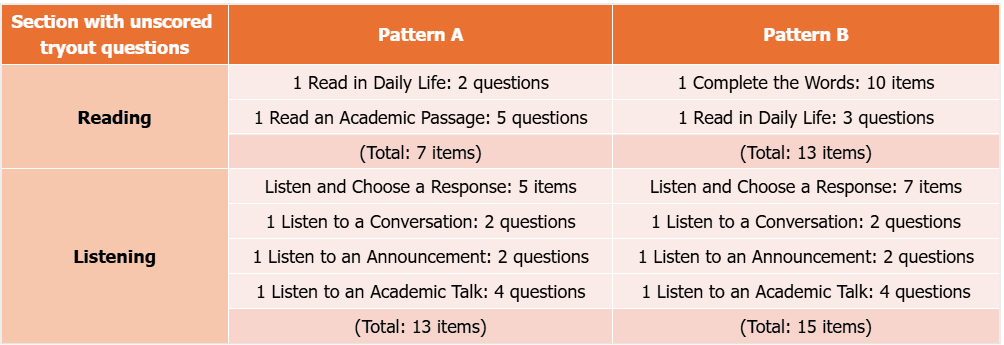
That said, ETS is still adjusting question counts and task formats, so it’s not yet possible to say for sure whether tryout questions will remain in the final version of the 2026 TOEFL.
The observations in this section are based on what we can currently see in the official practice tests, and are meant to help you understand how the test may work — not to guarantee how it will work.
Suggestions and Tips for Handling Tryout Questions:
- Maintain consistent focus—don’t try to guess which items are unscored. Tryout questions look identical to regular questions, so attempting to identify them wastes time and increases anxiety. Treat every item with equal seriousness.
- Keep your pacing steady, especially in Stage 1. Because tryout items seem to appear only in Stage 1, they may artificially lengthen the first module. To avoid fatigue or rushing later, practice maintaining even pacing through longer Stage 1 sessions.
- Train with longer practice sets to simulate the tryout load. The official adaptive mock tests already include tryout questions, so practice with mixed-difficulty passages, extended sets, and variable item counts to build the stamina needed for the test’s unpredictable structure.
- Stay calm and trust the adaptive system. Tryout items do not affect your final score or level. They exist solely for data collection. The adaptive algorithm evaluates your actual performance on scored items only. Keeping a confident and relaxed mindset is one of the strongest strategies.
Full CEFR Alignment: The New Scoring System
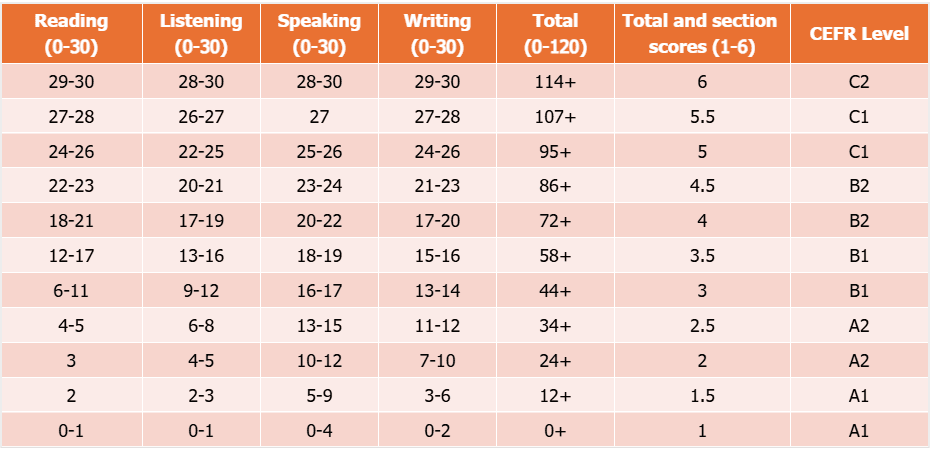
Beginning January 21, 2026, TOEFL iBT score reports will feature a new 1-6 scale, in half point increments, with a more intuitive alignment to the Common European Framework of Reference for Language (CEFR).
New TOEFL Score Scale (per skill and overall score):
Conclusion: What It Means for 2026 TOEFL Test-Takers and How to Prepare Effectively
The 2026 TOEFL changes shift the test toward real-world communication, concise expression, and consistent performance under an adaptive system. To succeed, test-takers need more than memorized templates—they need practical vocabulary, clear reasoning, and the ability to respond accurately across varied task types.
Start preparing by building strong fundamentals: practice short, purpose-driven writing; expose yourself to real academic and everyday English; and train steady accuracy for Stage 1 of Reading and Listening. Effective preparation now depends on quality input, targeted feedback, and repeated performance under realistic conditions.
Platforms like LingoLeap can help streamline this process by providing AI-powered speaking and writing evaluations aligned with scoring descriptors, personalized feedback, and adaptive practice that mirrors the new test structure. Used alongside official materials, it offers a fast, efficient way to track your progress and strengthen the exact skills the new TOEFL prioritizes.
With the right strategy and tools, you’ll be fully prepared to perform confidently on the updated TOEFL—and turn these changes into an advantage.