Boost Your IELTS Writing Task 2 in Four Steps: Step 4 — Enriching and Refining Your Language
Get higher IELTS Writing Task 2 scores by improving vocabulary, sentence variety, and grammar accuracy to write clear, coherent, and top-band essays.

In the first three articles of this series, we explored how to analyze questions precisely, build a solid argument structure, and accumulate convincing evidence. By now, you should already have the foundation needed to write a competent IELTS Writing Task 2 essay.
But if you want your writing to truly stand out and move into higher bands, you need to polish your language. In the official IELTS Writing Task 2 band descriptors, Lexical Resource and Grammatical Range and Accuracy carry substantial weight. Even with a clear structure and sound logic, an essay filled with repetitive vocabulary, unnatural phrasing, or grammar mistakes will inevitably feel less impressive.
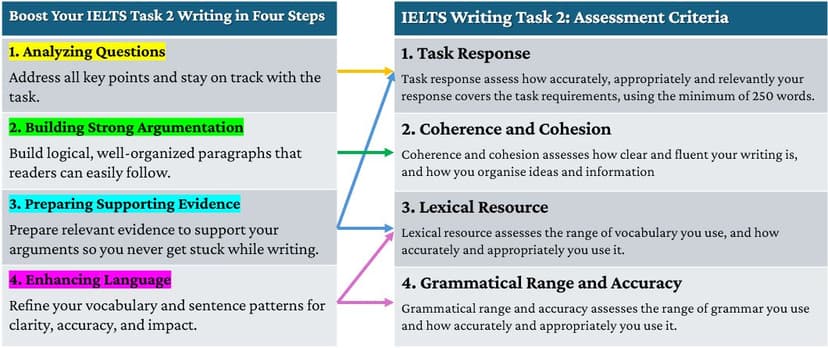
That’s why, in this final article of our “Boost Your IELTS Writing Task 2 in Four Steps” series, we’ll focus on how to enrich your vocabulary, vary your sentence structures, and sharpen your grammar—helping your writing rise from “good enough” to “genuinely impressive.”
Vocabulary Richness: Beyond Basic Word Choice
When it comes to vocabulary, many students immediately think of memorizing fancy words. But in IELTS Writing, your essay reviewers aren’t looking for obscure or overly academic terms—they want to see that you can use words naturally, accurately, and with certain variety.
1. Avoid the “rare word” trap
Don’t force uncommon words into your essay just to look advanced. For example, "plethora of individuals" sounds much less natural than "a considerable number of people".
2. Harness the power of collocations
Phrases can make your writing smoother and more convincing than single words. They help you express ideas in natural English, rather than relying on structures or words from your native language.
3. Use synonyms to avoid repetition
Just like your essay shouldn’t follow a rigid template, your word choice shouldn’t be repetitive. Key words will naturally show up, but repeating the same word—such as “important”—can make your writing dull. Using context-appropriate synonyms like “crucial”, “significant”, or “of paramount importance” not only broadens your vocabulary but also makes your essay more interesting to read.
4. Build topic-based vocabulary banks
Organize your vocabulary around common IELTS topics and practice using synonyms in different contexts. Take the basic verb "improve" as an example—there are several synonyms that work well in different situations:
- Investing in teacher training can enhance students’ critical thinking skills. (focus on raising quality)
- Schools should foster creativity through project-based learning. (emphasizes cultivation and growth)
- Government funding can strengthen the quality of higher education. (focus on reinforcing existing systems)
Combine this with the evidence bank approach we covered in Article 3 (Boost Your IELTS Writing Task 2 in Four Steps: Step 3 — Preparing and Using Your Evidence Bank) of this series, and you’ll end up with a ready-to-use bank of words + examples—material you can directly apply in your essays.
Sentence Variety: Make Your Writing More Dynamic
An essay made up entirely of simple sentences might be logical, but it will feel flat. Essay reviewers expect to see a range of sentence structures, used naturally.
1. Progression from simple to complex
- Simple: Education improves students’ critical thinking.
- Compound: Education improves students’ critical thinking, and it enhances their problem-solving skills.
- Complex: Education improves students’ critical thinking because it encourages them to analyze and evaluate information independently.
2. Essential advanced structures
- Conditionals
- Basic: If students study hard, they will do well in exams.
- Advanced: Students will perform better if they make consistent efforts and adopt effective study strategies.
- Concessive clauses
- Basic: Although education is important, not everyone has access to it.
- Advanced: While education is essential for personal development, many still face significant barriers to accessing quality schooling.
- Inversion
- Basic: Education can improve society.
- Advanced: Not only can education improve society, but it also fosters social cohesion and innovation.
- Participial structures
- Basic: Education helps students develop critical thinking skills.
- Advanced: Encouraging critical thinking, education prepares students to tackle complex problems independently.
- Noun clauses
- Basic: It is important that students learn to think critically.
- Advanced: What is crucial is that students develop the ability to think critically and evaluate information effectively.
3. Balance is key
Don’t overdo it. Variety doesn’t mean cramming advanced structures everywhere. Accuracy always outweighs complexity. Better to use a clean, correct simple sentence than a clumsy “advanced” one full of errors.
Grammar Accuracy: The Foundation of Clarity
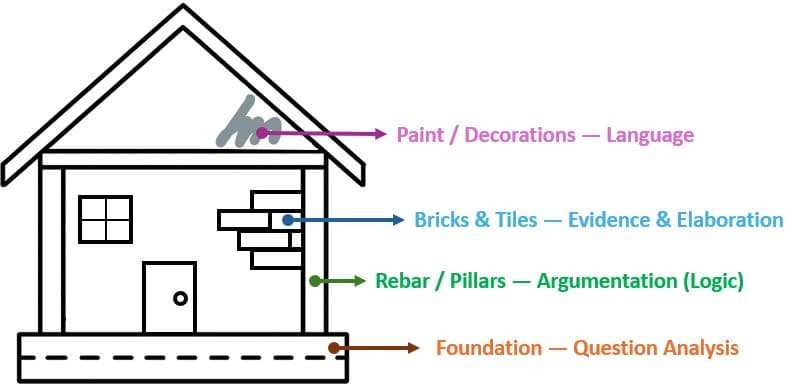
If vocabulary and sentence variety are the “decoration,” grammar accuracy is the foundation that keeps everything in place. A grammatically flawed essay, no matter how ambitious the vocabulary, will lose credibility.
Here’s a handy grammar checklist to keep in mind:
- Tense consistency Make sure that your use of tense is appropriate for the context and remains consistent throughout your essay.
- Subject-verb agreement & countable nouns:Make sure subjects and verbs match in number, and pay attention to the correct use of countable and uncountable nouns.
- Sentence integrity: Avoid run-on sentences or fragmented sentences. Every sentence should express a complete thought clearly.
- Prepositions: Use prepositions that naturally collocate with verbs, adjectives, and nouns to convey accurate relationships between ideas.
- Articles: Use articles correctly, distinguishing between indefinite (a/an) and definite (the) forms, and avoid unnecessary omissions.
- Think in English, not in your native language → Avoid translating ideas word-for-word from your first language. Instead, focus on expressing ideas in fluent, idiomatic English.
Practice Strategies: Building Lasting Improvement
Language improvement is never an overnight task. It takes consistent practice, correction, and refinement, going back and forth. While there’s no magical shortcut, the following methods can help you see meaningful progress and form a good learnin habit within limited prep time:
1. Paraphrasing
Rewrite the same sentence in multiple ways. This skill is especially valuable in IELTS writings, where introductions and conclusions often need paraphrasing of the question.
- e.g. Many people think education is important.
- Change into → A considerable number of individuals believe education plays a crucial role.
2. Feedback and reflection
Never just “write and move on.” Use feedback from teachers, peers, or AI tools to identify recurring issues, and then deliberately target those weaknesses in your next essay. Writing more without reflection leads to little real improvement.
- If you find yourself repeating the same words, make a conscious effort to use alternatives.
- If your grammar errors are mostly in a specific area, focus on practicing sentences in that category.
- If your logic isn’t clear, revisit the question and review your essay structure.
- Keep these points in mind when writing your next essay so you can steadily improve, rather than writing many essays without seeing real progress.
3. Targeted accumulation
Rather than memorizing random word lists, focus on building topic-based vocabulary banks and sentence libraries. Connect each word or phrase to example sentences and relevant evidence for that topic. This way, you’ll have ready-to-use material that you can draw on easily during the exam.
4. Timed practices
Many students write well in practice, but struggle under exam conditions. The key is to train with strict time limits. Regularly simulate the test by completing a Task 2 essay within 40 minutes. This helps you practice managing your time effectively and maintain both grammatical accuracy and vocabulary variety under pressure in real tests.
✨ LingoLeap: Assist Your Practice and Refine Your Writing
LingoLeap is a powerful tool to support your IELTS writing practice and help you polish your essays. Here’s what it can do to help you refine your essays:
1. Essay grading across four dimensions
LingoLeap evaluates your essay in terms of task response, coherence & cohesion, vocabulary, and grammar. This comprehensive feedback helps you pinpoint exactly where you need improvement.
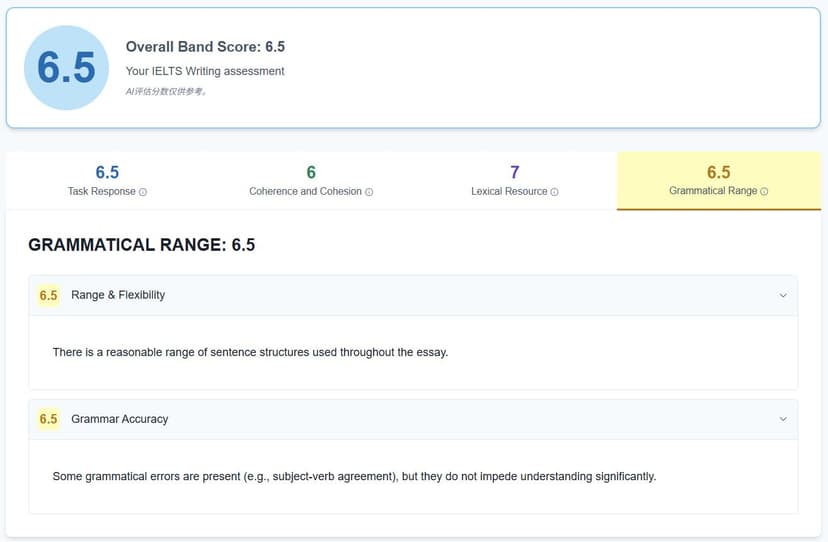
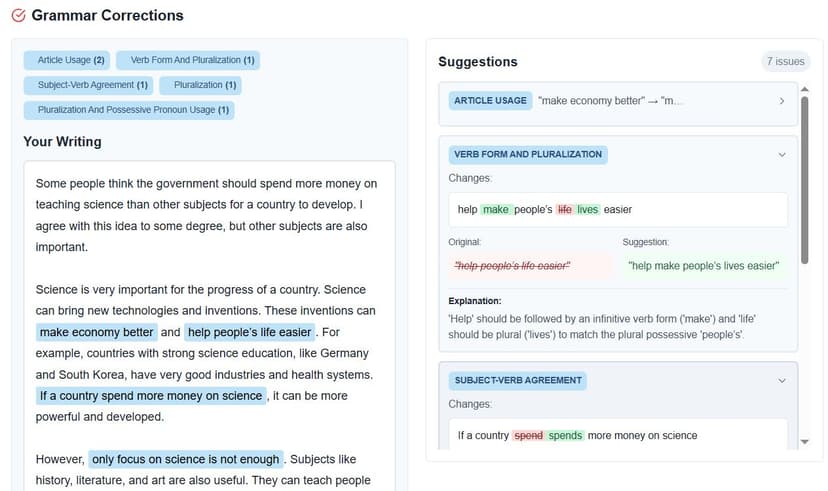
2. Grammar and word choice suggestions
It identifies grammar mistakes and offers alternatives for word choice, guiding you to make your sentences accurate, natural, and more sophisticated.
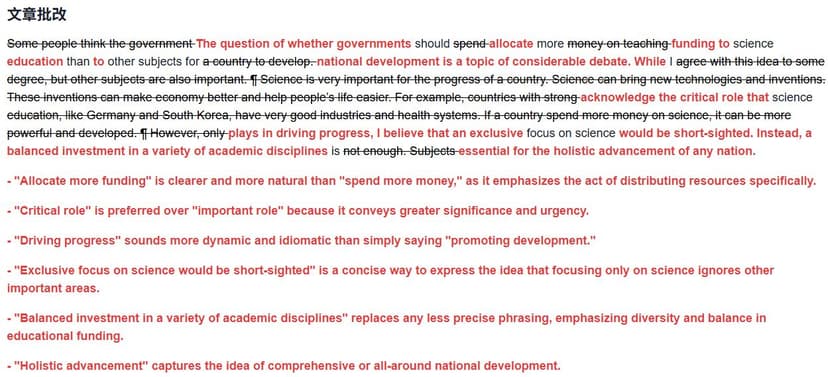
3. Essay revision support
You can revise your entire essay within the platform, experimenting with sentence structures, vocabulary, and paragraph organization to see immediate improvements.
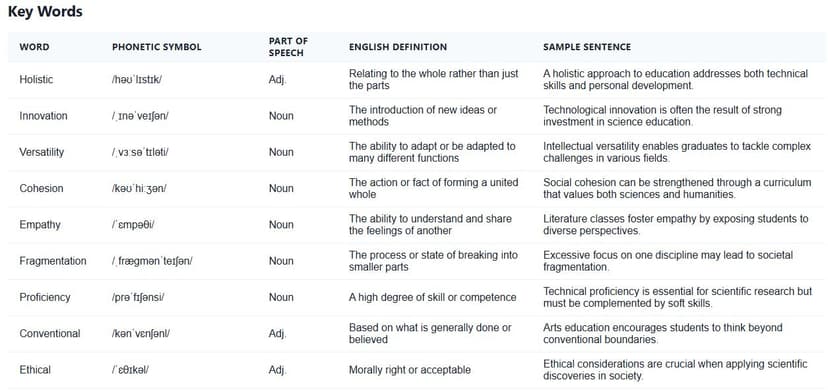
4. Keyword lists and sample sentences
LingoLeap provides curated keyword lists and sample sentences by topic, giving you ready-to-use material that can be directly applied to your essays, saving preparation time and improving efficiency.
Conclusion
Improving your language is one of the most impactful ways to boost your IELTS Writing score—but remember, language must serve content and argumentation. Chasing “flashy” words or convoluted grammar without clarity will only weaken your essay. Always aim for:
- Accuracy before complexity
- Naturalness before sophistication
With this, we’ve wrapped up the full “Four Steps to Higher Band Scores in IELTS Task 2” strategy:
1️⃣ Analyze the question carefully: clarify stance, lay the foundation
2️⃣ Build strong arguments: organize ideas, support logical flow
3️⃣ Use evidence effectively: enrich content with concrete examples
4️⃣ Elevate your language: decorate your essay with polished expressions
These four dimensions support one another. Solid question analysis grounds your essay, rigorous reasoning provides structure, well-chosen evidence brings it to life, and refined language makes it truly compelling.
While this series marks a natural close, for you as a learner and test-taker, it’s just the beginning. The real challenge is to internalize these four steps through consistent practice and thoughtful feedback—so that when you’re in the exam hall, you can write with confidence, clarity, and impact.